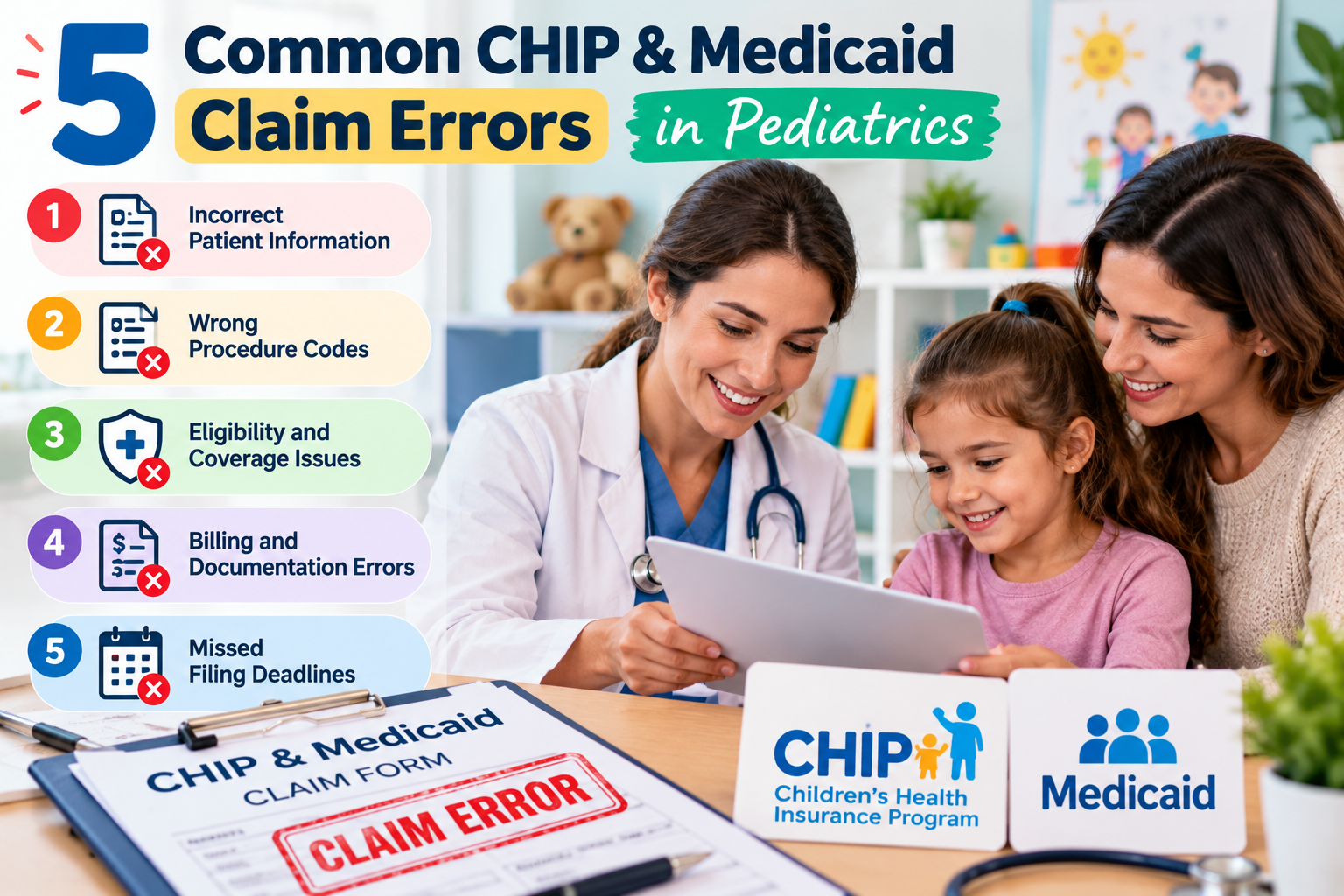
Pediatric practices operate under unique financial and clinical demands. Unlike adult specialty clinics, a significant portion of a pediatric practice’s patient volume relies on Medicaid and the Children’s Health Insurance Program (CHIP). While these state and federal safety-net programs ensure millions of children receive vital healthcare, navigating their reimbursement rules can be an administrative minefield.
A single missed modifier, an unverified eligibility status, or an improper vaccine administration code can trigger immediate claim rejections or denials. Because Medicaid and CHIP programs strictly enforce state-specific guidelines, these billing errors cost practices thousands of dollars in delayed revenue and administrative rework. Identifying where claims break down is the first step toward safeguarding your practice’s financial health.
1. Overlooking Medicaid Eligibility Churn and Coverage Changes
Quick Answer: Failure to verify active coverage on the day of service leads to immediate denials because pediatric Medicaid and CHIP eligibility frequently shifts due to household income changes or paperwork renewal deadlines.
Pediatric patients experience some of the highest rates of insurance “churn” in the medical industry. A child covered by CHIP last month may transition to traditional Medicaid this month, or temporarily lose coverage entirely due to missed annual renewal paperwork.
Relying on insurance information collected during a visit six months ago is one of the most common causes of unpaid claims. When a claim goes to an inactive payer, it undergoes adjudication, gets rejected, and requires manual re-billing to the correct primary or secondary payer. Implementing daily pediatric Medicaid eligibility verification at check-in—rather than relying on monthly batch checks—ensures your front desk catches policy changes before the physician enters the exam room.
2. Incorrect Handling of Same-Day Well-Child and Sick Visits
Quick Answer: Billing a preventive well-child exam alongside a problem-focused E/M visit without appending Modifier 25 and documenting separate medical necessity results in the problem visit being denied as bundled.
It is common for a parent to bring a child in for a routine annual physical (CPT 99381–99395) and mention an active problem, such as an acute ear infection, asthma flare-up, or skin rash. While pediatricians can bill for both services during the same encounter, payers heavily scrutinize these dual-service claims.
Common pitfalls include:
Mismanaging these combined claims leads to frequent Modifier 25 pediatric claim denials, forcing billers to pull clinical notes and file lengthy appeals.
3. Vaccine Product and Administration Coding Discrepancies
Quick Answer: Mismatching vaccine CPT codes with the correct National Drug Code (NDC), administration code (90460/90461 vs. 90471–90474), or Vaccines for Children (VFC) status causes instant immunization denials.
Immunization schedules form the backbone of pediatric preventive care, yet vaccine billing carries some of the highest denial rates in Medicaid and CHIP programs. Because low-income children receive publicly funded vaccines through the Vaccines for Children (VFC) program, practices must follow strict billing rules to avoid billing Medicaid for free vaccine stock.
When billing VFC vaccines, practices must bill the administration code alongside the specific vaccine CPT code appended with a $0 charge (or state-required modifier, such as SL). Errors occur when billers mismatch the administration code—such as using counseling administration codes (90460) for a non-counseled service—or leave off the 11-digit NDC number.
4. Age-Bracket CPT Code Mismatches on Preventive Exams
Quick Answer: Submitting a preventive well-child CPT code that does not match the patient’s exact age on the date of service results in an immediate claim rejection by clearinghouses or state Medicaid portals.
Pediatric preventive medicine CPT codes (99381–99385 for new patients and 99391–99395 for established patients) are strictly categorized by narrow age brackets:
If a child turns 5 years old on the day of their visit, billing code 99392 instead of 99393 triggers an automated age-mismatch rejection. Manual data entry errors on birth dates or outdated CPT templates inside your electronic health record (EHR) are typical causes of these preventable errors.
5. Incomplete EPSDT Documentation and Missing Screening Tools
Quick Answer: Failing to attach standardized screening CPT codes (such as developmental, autism, or maternal depression screens) or lacking required Early and Periodic Screening, Diagnostic, and Treatment (EPSDT) documentation leads to audit clawbacks.
Medicaid’s EPSDT benefit mandates comprehensive preventive health care for children under 21. EPSDT guidelines require specific standardized screening tools at distinct age milestones, including developmental screenings (CPT 96110), autism-specific screens, and vision or hearing screenings.
Common errors include submitting the primary preventive exam code while forgetting to bill the standardized screening codes separately, or failing to document the specific screening tool score in the clinical chart. Maintaining tight EPSDT pediatric coding compliance prevents payers from denying screening add-ons or demanding post-payment audits.
6. Modernizing Revenue Workflows to Stop Pediatric Claim Denials
Quick Answer: Implementing automated claim scrubbing, real-time eligibility checks, and pediatric-specific billing technology eliminates manual entry errors before claims leave your office.
Resolving Medicaid and CHIP billing issues requires transitioning from reactive denial follow-up to proactive claim scrubbing. Because state Medicaid rules and managed care organization (MCO) policies change frequently, relying on manual billing processes leaves your practice vulnerable to recurring revenue loss.
Pediatric practices must leverage digital tools equipped with custom rules engines. Modern platforms automatically verify patient eligibility at check-in, flag age-bracket mismatches, cross-reference vaccine NDCs, and prompt clinicians for required EPSDT documentation. Practices utilizing specialized medical billing software in Utah or nationwide can catch technical errors prior to submission, boosting first-pass clean claim rates above 98%.
7. Myth vs. Fact: Pediatric Medicaid and CHIP Claims
Understanding the realities of public payer rules prevents costly misunderstandings:
|
Misconception |
Medicaid & CHIP Billing Reality |
|
“If a child presents with a fever during a well-child check, we can automatically bill a Level 4 E/M code.” |
A problem E/M code requires distinct documentation showing additional history, examination, or medical decision-making beyond the routine exam. |
|
“Medicaid pays for VFC vaccine product costs.” |
VFC vaccines are supplied free by the government; practices can only bill state Medicaid for the administration fee, not the vaccine product cost. |
|
“Having a physical Medicaid ID card on file guarantees coverage for the visit.” |
Medicaid and CHIP eligibility changes frequently month-to-month; real-time digital verification on the date of service is mandatory. |
8. Checklist for Clean Pediatric Medicaid Claim Submission
Use this pre-submission audit checklist to reduce rejections across your practice:
Navigating pediatric Medicaid and CHIP billing requires balancing complex clinical encounters with rigid administrative requirements. From eligibility churn and Modifier 25 disputes to age-code mismatches and VFC vaccine nuances, small mistakes can quickly choke a practice’s cash flow. By establishing proactive front-desk verification workflows, enforcing strict EPSDT documentation standards, and adopting intelligent billing technology, pediatric practices can protect their revenue, minimize administrative stress, and keep their primary focus where it belongs—caring for children.