
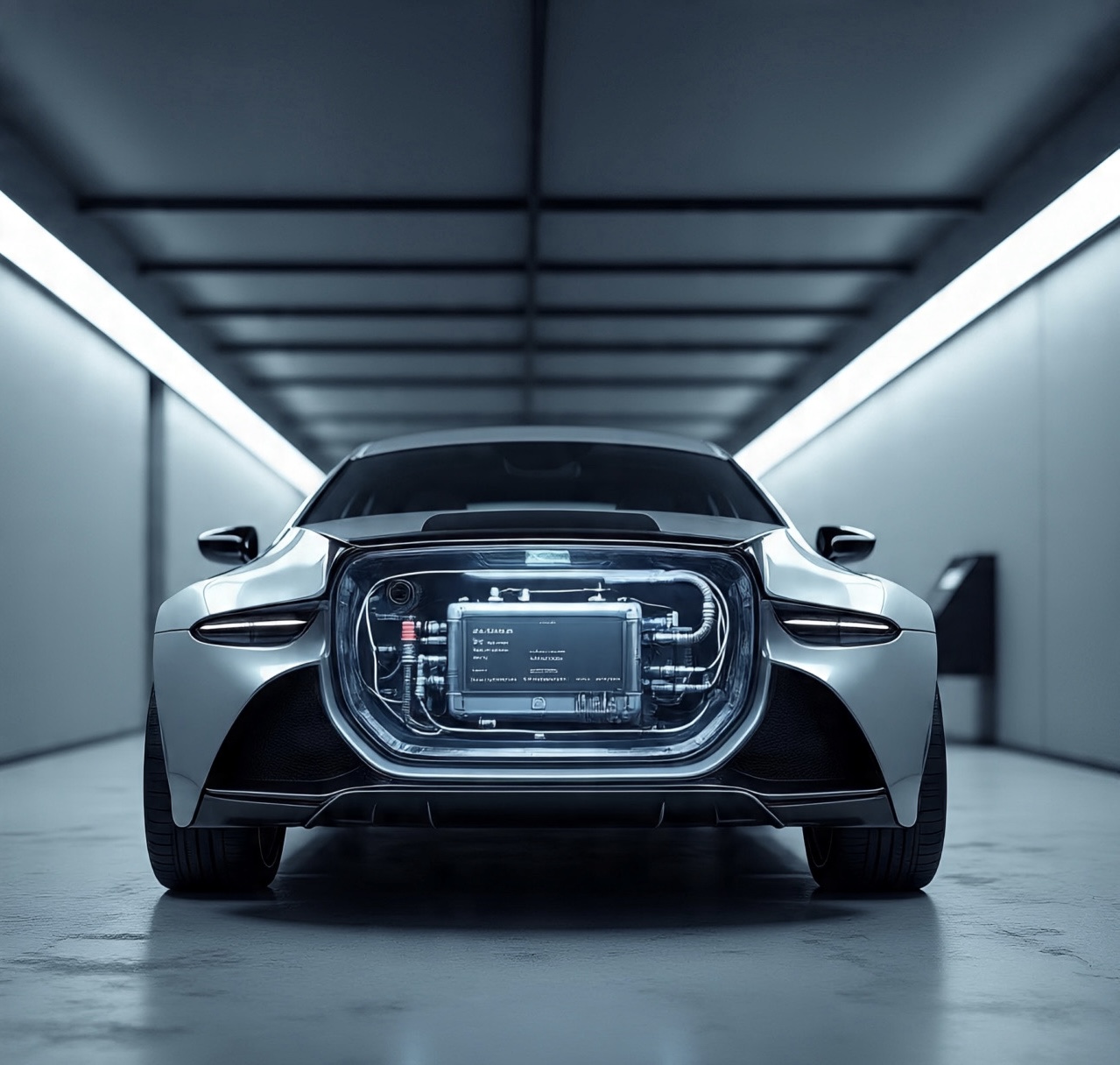
The electric vehicle (EV) revolution has a weight problem. If you strip down a modern electric sedan, you will find a paradox: to make the car go further, engineers add more batteries. But batteries are heavy. The heavier the car gets, the more energy it needs to move, which requires even more batteries.
This “mass decompounding spiral” means that a long-range electric truck can weigh 9,000 pounds—nearly double the weight of its gas-powered ancestor. We are essentially driving massive batteries with wheels attached to them.
But what if the battery didn’t have to be a separate, heavy brick sitting on the floor? What if the hood, the doors, and the roof were the battery?
This concept is known as “massless energy storage,” and it promises to be the biggest leap in automotive design since the Model T. It relies on a property of carbon fiber that goes beyond its famous strength: its ability to conduct electricity.
The Science of “Massless” Energy
In a traditional EV, the chassis does one job (holds the car together) and the battery does another (stores energy). The battery is “parasitic weight”—it adds load without contributing structural support.
Researchers at institutions like Chalmers University of Technology are rewriting this rulebook by developing Structural Batteries. In this design, the carbon fibers serve two simultaneous functions:
- The Skeleton: They act as the load-bearing material, providing the stiffness and crash safety required for the vehicle frame.
- The Electrode: They act as the negative electrode (anode) of a lithium-ion battery.
Here is how it works: The carbon fibers are coated in a polymer electrolyte and sandwiched against a positive electrode (often a lithium-iron-phosphate coated aluminum foil). When the car charges, lithium ions move into the carbon fiber structure. When you drive, they move out.
The term “massless” is used not because the battery has no weight, but because the weight of the battery “disappears” into the structure. You no longer need a separate case, separate cooling fluids, and separate heavy steel brackets. The energy storage is the car.
Breaking the Weight Spiral
The potential gains from this technology are staggering. If a car’s body panels could store energy, the weight of the vehicle could be reduced by up to 50%.
A lighter car is a more efficient car. It accelerates faster, stops shorter, and puts less wear on tires and roads. But most importantly, it breaks the range anxiety cycle. A car that weighs half as much doesn’t need a 1,000-pound battery to drive 300 miles. It might only need the energy stored in its roof and doors to achieve the same distance.
This shift would allow for a new class of “hyper-efficient” vehicles that require significantly fewer raw materials (less lithium, less cobalt) to build, lowering the environmental cost of the transition to green energy.
The Safety and Repair Challenge
However, turning a car into a battery introduces complex new problems. The biggest question is safety.
In a traditional EV, the battery is buried deep in the floor, protected by thick steel rails to keep it safe during a crash. If the door is the battery, what happens when you get T-boned?
Engineers are developing new resin systems that are not only fire-resistant but also self-monitoring. These “smart” materials can detect a crack or a short circuit and electrically isolate the damaged section instantly, preventing a thermal runaway.
Then there is the issue of repairability. Today, if you dent your fender, you replace the fender. In a structural battery car, that fender is a complex electrochemical device wired into the main powertrain. A minor parking lot accident could theoretically result in a significant loss of range or a repair bill that rivals the cost of the vehicle.
The Future of the Fleet
Despite these hurdles, the industry is moving forward. Major automakers are already filing patents for “multifunctional body panels,” and prototypes are running in labs today.
We are moving toward a future where the distinction between “fuel tank” and “frame” vanishes. The next generation of vehicles won’t just be lighter; they will be smarter, more integrated organisms where every single fiber works double duty.
This evolution will demand a new kind of manufacturing expertise. It will require a supply chain that understands not just stamped steel, but the delicate, electrochemical precision of automotive composites, transforming the car factory from a welding shop into a massive, rolling electronics laboratory.
The days of driving “heavy metal boxes” are numbered. The car of the future will be a battery you can sit inside, and it will be lighter than anything we have ever driven.