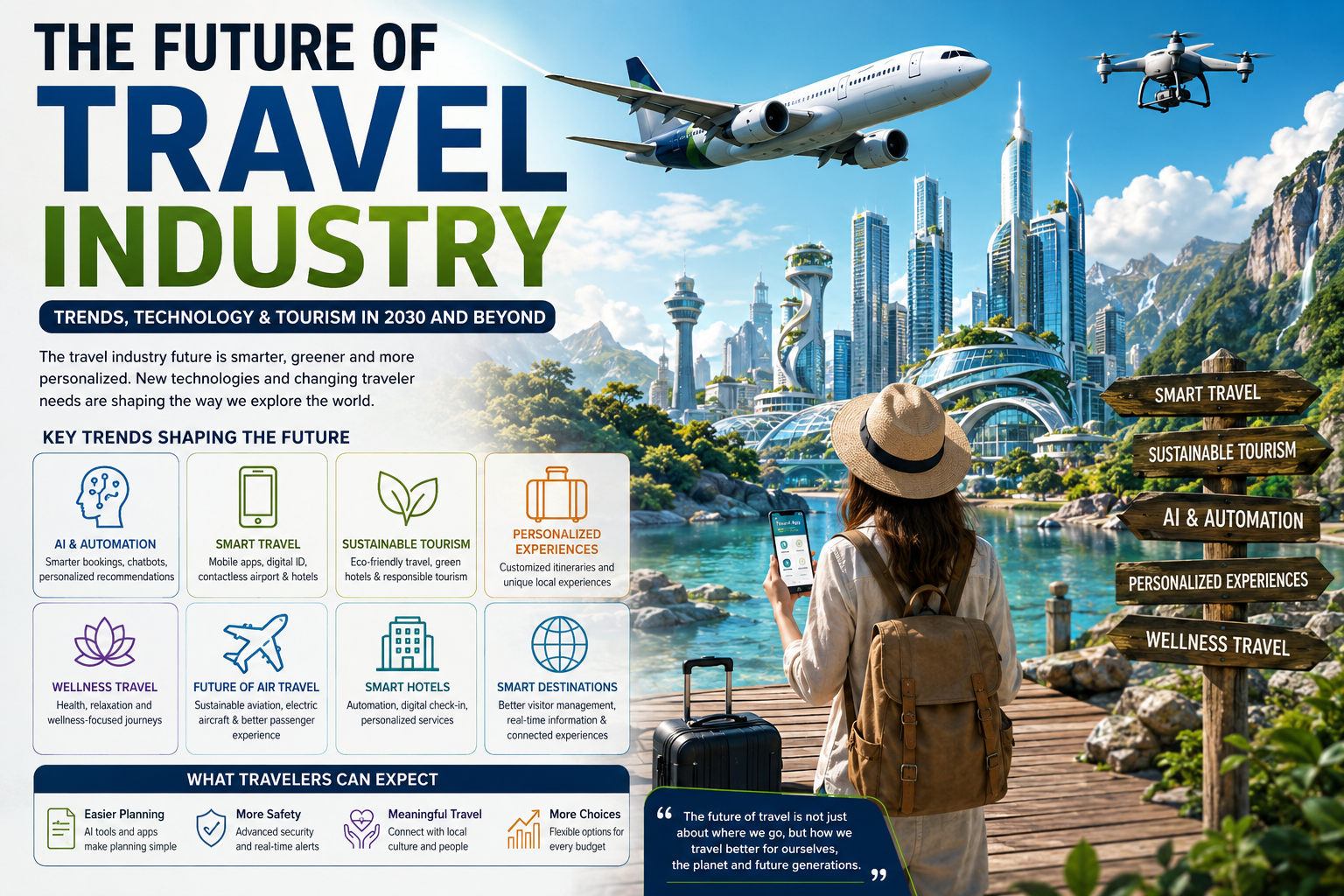
The travel industry future is changing quickly. Travel is no longer only about booking a flight, staying in a hotel, and visiting famous places. Technology, artificial intelligence, sustainability, changing customer needs, remote work, new transportation systems, and digital services are creating a different travel experience. People today want travel to be easier, faster, safer, more personal, and more flexible. They want to search for destinations on their phones, compare prices, receive personalized recommendations, check into hotels digitally, and get real-time updates during their journey. At the same time, many travelers are becoming more interested in responsible tourism and want to understand how their trips affect the environment and local communities Overseas
What Is the Future of the Travel Industry?
The future of the travel industry refers to the way tourism, transportation, accommodation, travel services, and traveler behavior are expected to develop in the coming years.
The travel industry future will likely be more digital and connected than the traditional travel system.
A traveler may increasingly be able to manage almost an entire trip from one device. They could search for a destination, receive recommendations, book flights and hotels, store travel documents, complete digital check-in, navigate an airport, and receive updates through a mobile application.
At the same time, technology will not remove the importance of human experiences. Many people travel because they want to experience different cultures, food, nature, history, entertainment, and local communities.
The future will combine technology with human experiences.
Some of the major changes expected in the travel industry future include:
- Greater use of artificial intelligence
- More personalized travel planning
- Smart airports
- Digital hotel services
- Sustainable transportation
- Eco-friendly accommodation
- Growth of wellness tourism
- More flexible business travel
- Increased demand for unique experiences
- Growth of remote work travel
- Greater use of digital payments
- More focus on travel safety and data protection
These changes will create both opportunities and challenges for the industry.
Major Trends Shaping the Travel Industry Future
Several important trends are already influencing the direction of travel.
| Trend | Possible Impact on Travel |
|---|---|
| Artificial intelligence | Faster and more personalized travel planning |
| Sustainability | More environmentally responsible travel |
| Smart technology | Easier airport and hotel experiences |
| Remote work | Longer and more flexible trips |
| Personalization | Travel experiences based on individual interests |
| Wellness tourism | More health and relaxation-focused trips |
| Digital payments | Easier international transactions |
| Experience tourism | Greater demand for local and unique activities |
| Automation | Faster customer service and operations |
| Smart destinations | Better management of tourism and visitors |
These trends are connected. For example, AI can help travelers find sustainable hotels, while smart destinations can use technology to manage crowds and protect important tourist areas.
Artificial Intelligence and the Travel Industry Future
Artificial intelligence may become one of the strongest forces in the travel industry future.
AI can process large amounts of information and provide recommendations based on a person’s interests, budget, travel dates, and previous choices.
Instead of spending hours searching different websites, travelers may increasingly use AI tools to create a complete travel plan.
For example, a traveler could provide:
- Destination
- Travel dates
- Budget
- Number of travelers
- Preferred activities
- Hotel preferences
- Food interests
- Transportation preferences
An AI system could then organize possible travel options.
AI can also help travel companies improve customer service. Chatbots can answer common questions, provide booking information, explain cancellation policies, and help customers find services.
The future use of AI may include:
- AI travel assistants
- Automated itinerary creation
- Personalized destination suggestions
- Hotel recommendations
- Flight recommendations
- Translation services
- Automated customer support
- Travel price analysis
- Smart fraud detection
- Personalized marketing
- Real-time travel information
AI will not only help travelers. It can also help businesses understand customer demand and improve their operations.
However, AI also creates challenges. Travel companies must protect customer information and make sure automated systems provide accurate information. Travelers may also prefer human support when dealing with complicated problems.
The strongest model may be a combination of AI and human service.
Smart Travel and Digital Technology
Technology is already changing how people move through airports, hotels, and destinations.
In the travel industry future, travelers may rely less on printed documents and physical processes.
Digital technology can make travel faster by reducing the need for repeated manual checks.
Examples include:
- Mobile boarding passes
- Digital hotel check-in
- Digital travel documents
- Contactless payments
- Facial recognition systems
- Smart luggage
- Airport navigation apps
- Real-time flight notifications
- Digital room keys
- Mobile travel guides
Smart technology can also help travelers during unexpected situations.
If a flight is delayed, an application can provide an alert. If a gate changes, travelers can receive updated information. If a hotel reservation changes, the traveler can receive a notification.
This creates a more connected travel experience.
The Future of Air Travel
Air travel will remain a major part of the travel industry future, but the passenger experience may change significantly.
Airlines and aircraft manufacturers are working toward more efficient operations and lower environmental impact. Future developments may include improved aircraft designs, more efficient engines, alternative fuels, and new technologies for airport operations.
Airports are also expected to become more digital.
A future airport could offer:
- Faster check-in
- Automated baggage systems
- Digital identity verification
- Improved security systems
- Smart airport navigation
- Automated boarding
- Real-time passenger information
- Better connection between airport services
The goal will be to reduce waiting times while improving security.
Airlines may also use technology to create more personalized services. Passengers could receive recommendations based on their travel history, preferences, or loyalty status.
The cost of air travel will remain an important issue. Travelers will continue to compare prices, baggage fees, schedules, comfort, and additional services.
Sustainable Travel and the Travel Industry Future
Sustainability is one of the most important parts of the travel industry future.
Tourism can create jobs and support local economies, but large numbers of visitors can also create pressure on natural resources, transportation systems, historical locations, and local communities.
Sustainable travel aims to reduce negative effects while maintaining the benefits of tourism.
Future travel businesses may focus more on:
- Reducing waste
- Saving water
- Improving energy efficiency
- Reducing unnecessary plastic
- Supporting local businesses
- Protecting natural areas
- Encouraging responsible visitor behavior
- Using cleaner transportation
- Building environmentally responsible hotels
Travelers may also have more information about the environmental impact of different choices.
For example, a booking platform could show sustainability information about hotels or transportation options.
Sustainability does not mean that people will stop traveling. Instead, the industry may look for better ways to travel while reducing environmental damage.
The Future of Hotels and Accommodation
Hotels are another important part of the travel industry future.
Traditional hotel services are likely to continue, but digital technology will become more common.
Smart hotels may offer:
- Mobile check-in
- Digital room keys
- Automated customer service
- Smart room controls
- Personalized room settings
- Contactless payment
- Digital concierge services
- Smart energy management
A traveler may be able to complete check-in before arriving at a hotel. The room key could then be available through a mobile device.
Smart rooms may also remember preferences such as temperature or lighting when customers choose to use such services.
Sustainability will also influence hotels. Properties may use energy-efficient lighting, water-saving systems, renewable energy, waste reduction programs, and locally sourced products.
However, technology will not replace hospitality completely. Many guests still want friendly staff and human assistance, especially when they have special needs or problems.
Personalized Travel Experiences
Personalization will be a major feature of the travel industry future.
Travelers are not all looking for the same experience. One person may want adventure, another may want relaxation, while another may want history, food, shopping, or cultural activities.
Future travel services may create recommendations around individual preferences.
A personalized trip could consider:
- Age group
- Budget
- Travel style
- Favorite activities
- Food preferences
- Hotel preferences
- Previous destinations
- Preferred transportation
- Trip length
Instead of offering the same package to everyone, travel companies may create more customized options.
This can make travel more enjoyable because travelers spend more time doing activities they actually like.
Experience-Based Tourism
Many travelers now want more than photographs of famous landmarks. They want experiences that feel personal and meaningful.
Experience tourism may include:
- Local cooking classes
- Traditional food tours
- Cultural festivals
- Outdoor adventures
- Local craft workshops
- Wildlife experiences
- Community-based tourism
- Historical tours
- Nature activities
- Local family experiences
The travel industry future may place greater value on these experiences because they can create stronger memories and help travelers connect with local communities.
Smaller tourism businesses may benefit from this trend because local guides, restaurants, artists, farmers, and activity providers can offer experiences that large companies cannot easily copy.
The Future of Business Travel
Business travel is also changing.
Remote meetings and online communication have reduced the need for some business trips. However, face-to-face meetings, conferences, exhibitions, and business events remain important.
The future may bring more flexible business travel.
One example is “bleisure” travel, where a person combines business travel with leisure time.
A business traveler might attend meetings for several days and then stay longer to explore the destination.
Future business travelers may expect:
- Flexible booking
- Fast internet
- Comfortable workspaces
- Mobile business services
- Flexible hotel stays
- Easy airport transfers
- Digital meeting facilities
Hotels may continue developing rooms and common areas designed for people who need to work while traveling.
Remote Work and Long-Term Travel
Remote work is changing how some people think about travel.
In the past, many travelers needed to return home quickly because their workplace required them to be physically present. Remote work can allow some workers to stay in another location for longer periods.
This can increase demand for:
- Monthly accommodation
- Long-stay hotels
- Serviced apartments
- Co-working spaces
- Reliable internet
- Flexible transportation
- Digital nomad services
The travel industry future may therefore include more travelers who combine work and tourism.
Destinations may compete to attract these visitors by offering good internet, affordable accommodation, comfortable working spaces, safety, and attractive lifestyles.
Wellness and Health Tourism
travel industry future Wellness tourism is another area that may grow in the future.
People increasingly travel for relaxation, fitness, healthy lifestyles, and personal well-being.
Wellness travel can include:
- Spa holidays
- Fitness retreats
- Yoga trips
- Nature retreats
- Meditation programs
- Healthy food experiences
- Relaxation resorts
- Medical tourism
The future of wellness tourism may combine travel with personalized programs.
Hotels and resorts could offer different packages based on customer interests, such as relaxation, fitness, healthy food, or outdoor activities.
Medical tourism can also remain an important part of international travel, although travelers should carefully research medical providers, costs, legal requirements, insurance, and follow-up care before making decisions.
The Future of Family and Leisure Travel
travel industry future Families will remain an important part of the global tourism market.
The travel industry future may bring more family-friendly digital services and accommodation options.
Families may look for:
- Child-friendly hotels
- Family rooms
- Safe transportation
- Flexible meal options
- Family activities
- Easy travel planning
- Entertainment for children
- Convenient booking systems
Technology can make family travel easier by helping parents manage reservations, transportation, tickets, and activities from one place.
Multi-generation travel may also become more important as grandparents, parents, and children travel together.
The Future of Smart Destinations
travel industry future A smart destination uses technology and information to improve tourism management and visitor experiences.
Cities and tourism destinations can use digital systems to understand visitor movement, manage transportation, provide information, and protect important sites.
Smart destinations may offer:
- Digital tourism maps
- Real-time transportation information
- Online attraction tickets
- Crowd information
- Digital visitor services
- Smart parking
- Public Wi-Fi
- Multilingual travel information
Technology can also help destinations manage over-tourism.
If one attraction becomes too crowded, digital systems could encourage visitors to explore other locations.
This can improve the visitor experience while reducing pressure on popular areas.
Space Tourism and New Forms of Travel
travel industry future Space tourism remains a developing area, but it shows how the meaning of travel could expand in the future.
As technology develops, commercial space experiences may become more available to a larger number of people, although cost and safety will remain major factors.
Other unusual forms of tourism may also develop.
Future travel could include:
- Space tourism
- Underwater tourism
- Extreme adventure travel
- Advanced virtual tourism
- New forms of luxury travel
These experiences may initially be expensive and available to a limited number of travelers.
Over time, technology could make some new travel experiences more accessible.
Challenges Facing the Travel Industry Future
The travel industry future will not be completely easy. Businesses will face several serious challenges.
Climate change is one major concern. Extreme weather can affect flights, hotels, beaches, nature destinations, and transportation networks.
Over-tourism is another issue. Popular destinations can become crowded, making life more difficult for local residents and reducing the quality of the visitor experience.
Privacy and cybersecurity will also become more important. As travel becomes more digital, companies will collect and process more customer information.
Other challenges include:
- Rising operating costs
- Labor shortages
- Economic uncertainty
- Political instability
- Changing immigration rules
- Cybersecurity threats
- Climate-related disruptions
- Over-tourism
- Infrastructure pressure
- Changing customer expectations
Travel companies will need strong planning and flexible business models to deal with these issues.
Opportunities for Travel Businesses travel industry future
Despite the challenges, the travel industry future offers many opportunities.
Businesses can use technology to improve their services and reach customers more effectively.
Potential opportunities include:
- AI travel planning
- Personalized travel packages
- Sustainable tourism
- Local experiences
- Smart hotel services
- Digital travel platforms
- Wellness tourism
- Remote-work accommodation
- Family travel services
- Adventure tourism
Small businesses can also benefit from the future of travel.
A local guide, restaurant, hotel, transport provider, or activity company can use digital platforms to reach international customers.
This can help local communities earn more from tourism.
How Travelers Will Change travel industry future
travel industry future The traveler of the future may have different expectations from today’s traveler.
Future travelers are likely to expect fast information, easy booking, flexible options, and personalized services.
They may also want greater transparency about costs and sustainability.
Important changes in traveler behavior may include:
- More mobile travel planning
- Greater use of AI
- More personalized bookings
- More flexible travel dates
- Increased interest in local experiences
- Greater interest in sustainable choices
- More long-term travel
- More work-and-travel combinations
- Higher expectations for digital customer service
However, some basic travel needs will remain the same.
People will still want safety, comfort, good service, attractive destinations, and memorable experiences.
Skills Needed in the Future Travel Industry
travel industry future Workers in the travel industry will need to develop new skills as technology changes.
Traditional customer service will remain important, but digital knowledge will become more valuable.
Useful future skills include:
- Digital technology
- Artificial intelligence
- Data analysis
- Customer service
- Communication
- Problem-solving
- Sustainability
- Cultural awareness
- Language skills
- Online booking systems
Travel professionals who understand both technology and human customer needs may have an advantage.
Travel Industry Future by 2030 and Beyond
The exact future cannot be predicted, but current trends provide some useful possibilities.
| Area | Possible Future Direction travel industry future |
|---|---|
| Travel Planning | More AI-powered and personalized |
| Airports | More automated and digital |
| Hotels | More smart and connected |
| Transportation | More efficient and sustainable |
| Tourism | More experience-focused |
| Customer Service | Combination of AI and human support |
| Payments | More digital and contactless |
| Sustainability | Greater importance |
| Business Travel | More flexible |
| Accommodation | More long-stay and work-friendly options |
travel industry future By 2030 and beyond, travelers may experience fewer manual processes.
Booking, check-in, payments, navigation, and customer support could become more connected.
At the same time, travelers may place greater value on experiences that technology cannot fully replace, such as meeting local people, tasting local food, exploring nature, and learning about different cultures.
How Technology and Human Service Will Work Together
travel industry future There is a common idea that technology will replace people in travel. The reality may be more balanced.
Technology can handle many routine tasks, but human workers are still important for complex situations.
For example, an automated system may answer a basic question about check-in time. But if a traveler has a complicated booking problem, they may prefer to speak with a person.
The strongest travel companies may therefore combine automation with human support.
This approach can provide:
- Faster basic service
- Lower waiting times
- Personalized recommendations
- Better customer support
- Human assistance for difficult situations
The travel industry future will likely be about using technology to improve human experiences rather than removing the human element completely.
The Importance of Responsible Tourism travel industry future
The future of tourism will depend partly on how destinations and travelers behave.
Responsible tourism means considering the effects of travel on local people, culture, animals, and the environment.
Travelers can support responsible tourism by:
- Supporting local businesses
- Respecting local culture
- Avoiding unnecessary waste
- Protecting natural areas
- Following local rules
- Choosing responsible tourism providers
- Avoiding activities that harm animals
- Respecting local communities
Tourism businesses can also help by hiring local workers, buying local products, reducing waste, and protecting natural resources.
FAQs
What is the future of the travel industry?
The future of the travel industry is expected to be more digital, personalized, sustainable, and flexible. Artificial intelligence, smart technology, sustainable transportation, digital services, and changing traveler behavior will influence future travel.
How will AI change the travel industry?
AI can help travelers plan trips, find destinations, compare options, create itineraries, receive customer support, translate languages, and receive personalized recommendations.
Will sustainable tourism become more important?
Yes. Sustainability is expected to become an increasingly important part of travel as businesses and travelers focus more on environmental protection, resource use, local communities, and responsible tourism.
What will future hotels look like?
Future hotels may use mobile check-in, digital room keys, smart rooms, automated services, personalized settings, and energy-saving technology. Human hospitality will still remain important.
How will airports change?
Airports are likely to become more digital and automated. Future services may include faster identity checks, automated baggage systems, digital navigation, contactless services, and improved passenger information.
Will business travel disappear?
Business travel is unlikely to disappear completely. However, remote work and online meetings may reduce some trips while increasing demand for flexible business travel, conferences, exhibitions, and combined business-and-leisure trips.
What is experience-based tourism?
Experience-based tourism focuses on activities that allow travelers to connect with local culture, food, nature, history, and communities instead of only visiting famous attractions.
Will space tourism become common?
Space tourism may become more accessible as technology develops, but cost, safety, regulations, and infrastructure will remain important factors.
What are the biggest challenges for the future travel industry?
Major challenges include climate change, over-tourism, rising costs, cybersecurity, privacy, labor shortages, political uncertainty, and changing traveler expectations.
Conclusion
The travel industry future will be shaped by technology, sustainability, personalization, and changing traveler behavior. Artificial intelligence will make planning and customer service more convenient. Smart airports and hotels will reduce manual processes. Digital payments and mobile services will make journeys more connected. Sustainable travel will become increasingly important as destinations and companies look for ways to reduce environmental impact. At the same time, travelers will continue to value human experiences. People will still want to discover new cultures, taste local food, explore nature, meet other people, and create memories. The most successful travel businesses will likely be those that understand both sides of the future.