Have you ever reached your destination and realized you packed three extra outfits but forgot your charger, medication, travel documents, or comfortable shoes? The best travel essentials are not the items that fill your suitcase; they are the practical things that protect your comfort, safety, mobility, and peace of mind throughout the journey. A smart travel packing list should cover documents, money, clothing, toiletries, technology, health and safety items, destination-specific gear, and a few carefully chosen backup essentials without creating unnecessary baggage City Guides
What Are Travel Essentials?
Travel essentials are the items, documents, equipment, clothing, personal products, technology, and safety supplies that help a traveler complete a journey comfortably and safely.
Some essentials are universal.
For example, identification, payment methods, communication capability, and appropriate clothing are relevant to almost every trip.
Others depend heavily on circumstances.
A hiking trip may require trekking shoes, navigation equipment, a hydration system, and weather protection. A business trip may require formal clothing, presentation equipment, and reliable charging accessories. A beach vacation may require swimwear, sun protection, and water-resistant storage.
The important distinction is between essential items and optional conveniences.
Essential Versus Nice-to-Have Items
An essential item is something whose absence could create a serious inconvenience, financial problem, safety issue, or inability to continue your trip.
A nice-to-have item improves comfort but is not necessary.
For example, your passport may be essential for an international journey, while a travel pillow is usually optional.
Your phone may be important for communication and digital documents, while a tablet may simply make the trip more enjoyable.
This distinction is useful because travelers frequently overpack by confusing convenience with necessity.
The Four-Layer Travel Essentials System
A useful way to organize packing is to divide your travel essentials into four layers:
- Survival essentials — identification, money, medication, emergency contacts, and basic health supplies.
- Journey essentials — tickets, chargers, entertainment, snacks, water bottle, and comfort items.
- Destination essentials — clothing, toiletries, activity equipment, and weather protection.
- Convenience essentials — accessories that make the trip easier but are not critical.
If luggage is lost, delayed, or damaged, the first two layers become especially important.
Why a Travel Essentials Checklist Matters
Packing without a system often produces one of two problems.
You either forget something important or carry far more than necessary.
Both can make travel harder.
A forgotten charging cable can become an expensive airport purchase. Missing medication can create a much more serious problem. Overpacking, meanwhile, can lead to baggage fees, difficult transfers, unnecessary physical strain, and wasted time.
A checklist reduces dependence on memory.
Reduce Travel Stress
Travel already involves uncertainty.
Flights can change.
Connections can be tight.
Weather can shift.
Hotels may not provide the exact amenities you expected.
Having essential items organized reduces the number of small problems you must solve during the trip.
Protect Against Unexpected Situations
A good packing list should include limited backup planning.
For example, carrying a digital copy of important documents can help if a paper document is lost.
Keeping essential medication in accessible carry-on luggage can reduce risk if checked baggage is delayed.
Having more than one payment method can help if a card is blocked or lost.
The goal is not to prepare for every disaster.
The goal is to prepare for realistic disruptions.
Important Travel Documents
Travel documents are among the most important travel essentials because many other items can be replaced, while missing documentation can prevent you from traveling.
Passport and Identification
For international travel, check your passport well before departure.
Do not wait until the week of travel.
Many destinations require passports to have a certain amount of remaining validity beyond the intended stay, while some countries also require blank pages or other documentation.
Check the specific requirements for your destination before departure.
For domestic travel, carry the identification required by your airline, transportation provider, or local authorities.
Visa and Entry Documents
Depending on your nationality and destination, you may need:
- Visa
- Electronic travel authorization
- Entry permit
- Residence documentation
- Transit visa
- Return or onward ticket
- Accommodation information
- Proof of sufficient funds
- Vaccination or health documentation where applicable
Requirements can change, so destination-specific official sources should be checked before international travel.
Travel Insurance Information
If you purchase travel insurance, keep your policy information accessible.
Important details may include:
- Policy number
- Emergency assistance phone number
- Medical assistance information
- Coverage details
- Claim instructions
A screenshot or offline copy can be useful when internet access is limited.
Copies of Important Documents
Keep copies of important documents separately from the originals.
Useful copies may include:
- Passport identification page
- Visa
- Insurance policy
- Flight confirmation
- Hotel reservation
- Emergency contacts
- Prescription information
Digital copies can be encrypted or stored securely, while a limited paper backup can be useful when devices are unavailable.
Money and Payment Essentials
Modern travelers increasingly depend on cards and mobile payments, but relying on one payment method creates unnecessary risk.
Carry Multiple Payment Methods
Consider carrying:
- Primary debit or credit card
- Backup card
- Small amount of local currency
- Emergency funds
Keep backup payment methods separate from your everyday wallet.
If your primary wallet is lost, the backup method can become extremely valuable.
Don’t Carry All Your Money Together
One of the simplest travel safety principles is to avoid putting every financial resource in one location.
If everything is stored in one wallet and the wallet disappears, you could lose access to all your money.
Instead, divide your resources sensibly.
Local Currency
Having a small amount of local currency can be useful when arriving at a destination.
You may need cash for:
- Transportation
- Small shops
- Tips
- Public markets
- Rural areas
- Emergency situations
However, the amount you carry should match your actual needs.
Travel Essentials for Flights
Air travel creates a unique set of requirements because airport security, baggage limits, cabin restrictions, and long periods of sitting affect what you should pack.
Carry-On Essentials
Important carry-on items commonly include:
- Passport or required identification
- Boarding information
- Wallet
- Phone
- Charging cable
- Power bank where permitted
- Medication
- Essential documents
- Valuables
- Glasses
- Basic toiletries
- Headphones
- Empty reusable water bottle
- Light layer
- Essential personal items
The most important rule is simple:
Do not put irreplaceable or medically important items in checked baggage if you can safely keep them with you.
Long-Haul Flight Essentials
Long flights can make comfort significantly more important.
Useful items may include:
- Neck pillow
- Eye mask
- Earplugs
- Headphones
- Moisturizer
- Lip balm
- Toothbrush
- Toothpaste
- Compression socks when appropriate
- Light sweater
- Entertainment
- Reusable water bottle
Not everyone needs all of these.
Choose according to your personal comfort.
Clothing Travel Essentials
Clothing often creates the biggest packing problem.
Many travelers pack based on possibilities rather than probability.
They imagine every event that could happen and pack an outfit for each one.
A better approach is to create a mix-and-match wardrobe.
Choose Versatile Clothing
Neutral colors and interchangeable pieces can reduce the number of items required.
For example, a small selection of shirts and trousers can create many combinations without filling an entire suitcase.
Pack for the Weather
Check expected conditions before departure.
Consider:
- Temperature
- Rain
- Humidity
- Wind
- Snow
- Sun exposure
- Evening temperatures
Do not rely only on the average climate of a destination.
Seasonal conditions can vary significantly.
The Layering Strategy
Layering is often more effective than carrying one extremely heavy garment.
A basic layering system can include:
- Base layer
- Mid-layer
- Outer layer
This allows you to adapt to changing temperatures.
Underwear and Socks
These are easy to underestimate.
Pack enough for the trip while considering whether laundry will be available.
For longer journeys, washing a few items can be more efficient than packing an enormous wardrobe.
Comfortable Shoes
Shoes deserve special attention.
A pair of uncomfortable shoes can turn a pleasant vacation into a painful experience.
For many travelers, one reliable walking shoe plus one activity-appropriate or formal option is enough.
Toiletries and Personal Care Essentials
Toiletries should be practical rather than excessive.
Basic Toiletry Checklist
Common travel toiletries include:
- Toothbrush
- Toothpaste
- Deodorant
- Shampoo
- Conditioner
- Soap or body wash
- Razor
- Comb
- Hair products
- Moisturizer
- Sunscreen
- Lip balm
- Feminine hygiene products
- Contact lenses and supplies if required
Many accommodations provide basic toiletries, but travelers should not assume every property provides everything they need.
Travel-Size Products
Travel-size containers reduce weight and save space.
For air travel, remember that liquids and gels in carry-on baggage may be subject to security restrictions that vary by airport and jurisdiction.
Always check the applicable airline and airport rules before packing.
Personal Hygiene
Small hygiene items can be surprisingly useful during long journeys.
Consider carrying:
- Hand sanitizer
- Tissues
- Wet wipes
- Small towel
- Disposable bags
These items take little space but can solve several minor problems.
Health and Wellness Travel Essentials
Health preparation is one of the most important parts of travel planning.
Prescription Medication
If you take prescription medication, plan carefully.
Keep medication in appropriately labeled packaging and carry enough for the trip plus a reasonable contingency when appropriate.
For international travel, check whether your medication is permitted in the destination country and whether additional documentation is required.
Basic First-Aid Kit
A compact first-aid kit may include:
- Adhesive bandages
- Antiseptic wipes
- Gauze
- Medical tape
- Blister protection
- Digital thermometer
- Basic pain relief medication
- Personal medications
The exact contents should reflect the destination and your needs.
Travel Health Preparation
Before traveling internationally, research relevant health recommendations for the destination.
Depending on where you are going, travelers may need advice regarding:
- Vaccinations
- Food and water precautions
- Insect protection
- Altitude
- Heat exposure
- Local diseases
- Medical facilities
Sleep and Recovery
Travel can disrupt normal sleep.
Jet lag is especially common when crossing multiple time zones.
Hydration, exposure to natural light at appropriate times, regular movement, and sensible sleep scheduling can help travelers adjust.
Technology Travel Essentials
Technology has become one of the most important categories in modern travel.
But technology can also become a source of clutter.
Smartphone
A smartphone can replace several traditional travel tools.
It can provide:
- Maps
- Translation
- Boarding passes
- Hotel information
- Communication
- Camera
- Banking access
- Emergency contacts
- Travel reservations
Make sure essential information is available offline when possible.
Charging Equipment
A simple charging kit can include:
- Phone charging cable
- Wall charger
- Multi-port charger
- Power bank
- Device-specific cables
Avoid carrying multiple chargers when one high-quality multi-port charger can safely handle several devices.
Universal Travel Adapter
International travelers should understand plug types and electrical standards at their destination.
A universal travel adapter can be useful when visiting multiple countries.
However, an adapter changes the physical plug connection; it does not automatically convert voltage.
This distinction matters for electrical safety.
Power Bank
A power bank can be useful during long journeys, airport delays, road trips, hiking, and sightseeing days.
Airline rules often place restrictions on spare lithium batteries and power banks, particularly regarding checked baggage.
Always verify current airline and aviation rules before flying.
Travel Safety Essentials
Safety equipment should be selected according to actual risk rather than fear.
Emergency Contact Information
Store important emergency information somewhere accessible.
This can include:
- Local emergency number
- Accommodation details
- Travel insurance contact
- Family contact
- Embassy or consular information where relevant
Portable Door Security
For some accommodation situations, travelers may consider a compact door security device.
However, such products should never be treated as a replacement for choosing safe accommodation, following hotel security procedures, or responding to emergency instructions.
Personal Alarm
A small personal alarm can provide an additional layer of awareness in certain environments.
It should be viewed as a simple attention-getting device rather than a guarantee of protection.
Backup Communication
When traveling to remote areas, communication requirements change.
A standard mobile connection may not work.
For hiking, remote road trips, or isolated destinations, travelers may need to research local communication options before departure.
Travel Essentials for Families
Traveling with children requires a different packing strategy.
The goal is not to bring the entire household.
Instead, focus on items that address the child’s age, routine, health, feeding, sleep, and entertainment needs.
Baby Travel Essentials
Depending on age and destination, parents may need:
- Diapers
- Wipes
- Feeding supplies
- Change of clothes
- Baby food
- Bottles
- Comfort item
- Child medication
- Stroller
- Car seat where required
Traveling With School-Age Children
Older children may need:
- Comfortable clothing
- Headphones
- Entertainment
- Snacks
- Water bottle
- Small backpack
- Activity books
- Necessary medication
Giving children responsibility for a small portion of their travel gear can also teach organization.
Travel Essentials for Seniors
Older travelers may benefit from a stronger focus on comfort, accessibility, medication organization, and contingency planning.
Comfort First
Important considerations can include:
- Comfortable footwear
- Lightweight luggage
- Medication organization
- Reading glasses
- Mobility aids
- Travel documents
- Emergency contacts
Plan Around Mobility
Long airport corridors, train stations, stairs, and irregular terrain can create challenges.
Research accessibility at airports, hotels, attractions, and transportation systems before departure.
Travel Essentials for Solo Travelers
Solo travelers have greater responsibility for their own planning.
Keep Someone Informed
A trusted contact should know:
- Your itinerary
- Accommodation details
- Major transportation plans
- Approximate travel dates
You do not need to report every movement.
The objective is simply to ensure that someone knows your general plan.
Keep Critical Items Separate
Solo travelers should be particularly careful about concentrating all resources in one bag.
Separate important documents, backup payment methods, and essential medication where practical.
Travel Essentials for Business Travelers
Business travel requires efficiency.
A good business packing system can include:
- Formal or business-casual clothing
- Laptop
- Charger
- Phone
- Presentation materials
- Business cards if still relevant
- Notebook
- Pen
- Travel documents
- Appropriate footwear
Reduce Clothing Complexity
Business travelers often benefit from a capsule wardrobe.
Select pieces that work together across multiple meetings.
This reduces luggage while maintaining a professional appearance.
Travel Essentials for Backpackers
Backpacking requires a completely different philosophy.
Weight becomes a major consideration.
Every item must justify its space and weight.
Lightweight Packing
Backpackers should prioritize:
- Quick-drying clothing
- Multipurpose gear
- Compact toiletries
- Reliable footwear
- Lightweight sleeping equipment when needed
- Water management
- Navigation
- Weather protection
The One-Item, Multiple-Uses Rule
An excellent backpacking principle is to favor items with multiple functions.
A lightweight layer that works for travel, hiking, and evenings is more useful than three separate garments.
Travel Essentials for Road Trips
Road trips create different requirements because travelers may be far from airports, stores, or immediate services.
Useful items can include:
- Phone mount
- Charging cable
- Car charger
- Water
- Snacks
- Navigation backup
- First-aid kit
- Emergency supplies
- Sunglasses
- Blankets or warm layers
- Basic vehicle emergency equipment
Vehicle Preparation
Before a long road trip, check:
- Tire condition
- Spare tire or repair system
- Oil and fluids
- Brakes
- Lights
- Battery
- Insurance
- Registration
A travel checklist should therefore include both personal and vehicle preparation.
Travel Essentials for Beach Vacations
Beach trips usually require fewer clothes but more protection from sun, water, and sand.
Consider:
- Swimwear
- Sunscreen
- Sunglasses
- Hat
- Beach towel
- Water-resistant bag
- Quick-drying clothing
- Sandals
- Reusable water bottle
- Waterproof phone protection where useful
Protect Your Electronics
Saltwater, sand, and moisture can damage electronics.
Keep phones, cameras, chargers, and other sensitive equipment protected when near water.
Travel Essentials for Hiking and Outdoor Adventures
Outdoor travel requires greater attention to weather and emergency preparedness.
Depending on the activity, you may need:
- Hiking footwear
- Navigation tools
- Headlamp
- Water
- Food
- Weatherproof layer
- First-aid kit
- Emergency communication
- Sun protection
- Insect protection
- Backpack
Check the Route Before Leaving
Never rely exclusively on a phone signal in remote terrain.
Understand:
- Route difficulty
- Distance
- Elevation
- Weather
- Water availability
- Emergency access
- Expected travel time
Tell someone where you are going when appropriate.
Travel Essentials for Cold Destinations
Cold-weather travel requires strategic layering.
Useful items may include:
- Thermal base layers
- Insulating mid-layer
- Waterproof outer layer
- Warm socks
- Gloves
- Hat
- Scarf
- Appropriate boots
Protect Extremities
Hands, feet, ears, and the face can become uncomfortable quickly in cold conditions.
Do not focus only on the main coat.
Small accessories can have a significant effect on comfort.
Travel Essentials for Tropical Destinations
Tropical travel often involves heat, humidity, rain, insects, and intense sunlight.
Important items may include:
- Lightweight clothing
- Breathable fabrics
- Sunscreen
- Hat
- Sunglasses
- Insect protection
- Rain layer
- Comfortable sandals
- Reusable water bottle
Hydration Matters
Heat increases fluid requirements for many travelers.
Carry water where appropriate and understand local drinking-water recommendations.
Travel Essentials for International Travel
International travel adds complexity because different countries have different regulations, currencies, languages, infrastructure, climates, and health considerations.
Research Before Departure
Research:
- Entry requirements
- Local laws
- Currency
- Transportation
- Weather
- Cultural expectations
- Emergency numbers
- Health guidance
- Electrical standards
- Internet availability
Learn Basic Local Phrases
Even when translation technology is available, learning a few basic expressions can improve communication.
Simple words such as greetings, thanks, directions, and requests for assistance can be valuable.
The Best Way to Pack a Suitcase
Packing is not only about what you take.
It is also about how you organize it.
Create Categories
Separate items into categories such as:
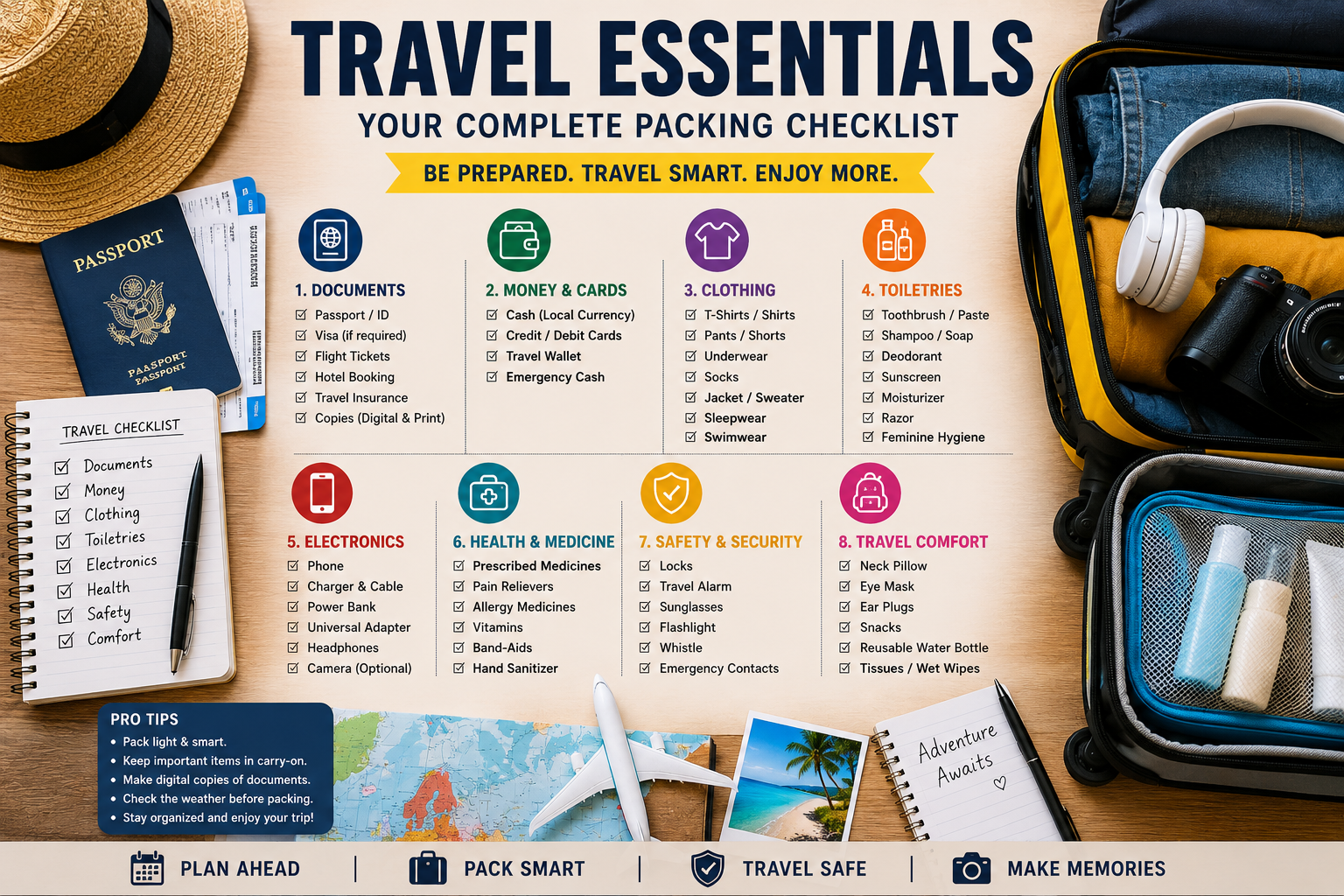
- Documents
- Clothing
- Toiletries
- Electronics
- Health
- Safety
- Activity equipment
This makes it easier to identify missing items.
Use Packing Cubes
Packing cubes can help divide clothing into categories and make it easier to find items without unpacking everything.
They are not mandatory, but they can improve organization.
Roll or Fold?
Both methods work.
Rolling can be useful for casual clothing and smaller items.
Folding can work better for structured garments.
The most important factor is organization rather than a strict rolling-versus-folding rule.
How to Build a Minimalist Travel Essentials List
Minimalist packing does not mean traveling without necessary items.
It means removing unnecessary duplication.
Start with the essentials.
Then ask:
Can this item serve more than one purpose?
Can I buy or access it easily at my destination if needed?
Will I realistically use it?
Is it worth the space and weight?
These questions eliminate many unnecessary items.
The Three-Question Packing Test
Before adding something to your suitcase, ask:
- Will I definitely use this?
- Is there another item I am already bringing that can perform the same function?
- Would replacing it at the destination be easy and affordable?
If the answer is no, no, and no, the item may deserve a place in your luggage.
Common Travel Packing Mistakes
Packing Too Many Clothes
Most travelers do not need an entirely different outfit for every day.
Build combinations rather than individual outfits.
Forgetting Comfortable Shoes
Fashionable footwear does not compensate for painful walking.
Checking Essential Medication
Keep essential medication accessible whenever possible and follow applicable transportation rules.
Relying on One Payment Card
A backup payment method can prevent a small problem from becoming a major emergency.
Forgetting Chargers
A simple charging checklist prevents one of the most common travel inconveniences.
Ignoring Weather
Average climate information is not enough.
Check the actual forecast close to departure.
Overpacking Toiletries
Many products can be purchased at the destination.
Packing Without Considering Activities
A beach vacation, city break, hiking trip, and business conference require different equipment.
Pros and Cons of Packing Light
Advantages of Packing Light
Packing light can provide:
- Easier airport movement
- Lower baggage costs
- Faster hotel check-in
- Easier public transportation
- Less physical strain
- Less risk of lost luggage
- More flexibility
Disadvantages of Packing Too Light
Extreme minimalism can create problems.
You may lack:
- Weather-appropriate clothing
- Necessary medication
- Appropriate footwear
- Emergency supplies
- Work clothing
- Activity-specific equipment
The goal is therefore not the smallest possible suitcase.
The goal is the smallest practical suitcase that meets your needs.
Ten Popular Travel Gear Brands Compared
Brand selection depends on budget, travel style, durability requirements, and the type of equipment needed. The following comparison provides a broad starting point rather than declaring one company universally superior.
| Brand | Best Known For | Suitable Traveler | Key Advantage | Consideration |
|---|---|---|---|---|
| Samsonite | Luggage | General travelers | Wide range of luggage styles | Product quality varies by model |
| American Tourister | Affordable luggage | Budget travelers | Accessible pricing and broad selection | Often more basic construction |
| Tumi | Premium luggage | Business travelers | Premium design and organization | Higher cost |
| Osprey | Backpacks | Backpackers and hikers | Travel and outdoor-focused designs | Some models are more technical than necessary for city trips |
| The North Face | Outdoor gear | Adventure travelers | Strong outdoor heritage | Some travel products prioritize outdoor performance |
| Patagonia | Outdoor clothing | Outdoor and eco-conscious travelers | Technical clothing and durability focus | Often premium-priced |
| Eagle Creek | Travel organization | Frequent travelers | Packing and travel organization | Availability can vary by market |
| Travelpro | Rolling luggage | Frequent flyers | Aviation-focused luggage designs | Less focused on ultralight backpacking |
| Deuter | Outdoor backpacks | Hikers and active travelers | Comfortable backpack systems | Better suited to outdoor use than formal business travel |
| Peak Design | Travel accessories | Tech-focused travelers | Strong organization and camera/tech integration | Premium pricing |
The best brand is not necessarily the most expensive one. A traveler taking two vacations per year may have completely different requirements from someone who flies internationally every month.
Travel Essentials by Traveler Type
Different travelers need different packing strategies.
Travel Essentials for Students
Students often benefit from:
- Affordable luggage
- Laptop protection
- Chargers
- Comfortable clothing
- Identification
- Travel documents
- Basic toiletries
- Reusable water bottle
- Small first-aid kit
Travel Essentials for Couples
Couples can reduce duplication by sharing selected items.
For example, one compact first-aid kit or shared charging equipment may be enough.
Travel Essentials for Families
Families need greater attention to:
- Children’s clothing
- Snacks
- Medication
- Entertainment
- Feeding supplies
- Emergency information
Travel Essentials for Business Professionals
Professionals should prioritize:
- Reliable technology
- Formal clothing
- Document organization
- Charging equipment
- Internet connectivity
- Comfortable luggage
Travel Essentials for Budget Travelers
Budget travelers should prioritize:
- Multipurpose clothing
- Lightweight luggage
- Reusable bottles
- Basic toiletries
- Affordable accommodation-compatible equipment
- Minimal electronics
Travel Essentials for Luxury Travelers
Luxury travel may reduce the need to carry certain comfort items because premium hotels often provide many amenities.
However, travelers should still carry personal essentials, documents, medication, technology, and destination-specific equipment.
Smart Travel Essentials for Sustainable Travel
Sustainable travel is increasingly influencing packing habits.
The most sustainable item is often the item you already own and use repeatedly.
Instead of buying a separate product for every trip, consider durable multipurpose equipment.
Reusable Items
Useful reusable travel items include:
- Water bottle
- Coffee cup
- Shopping bag
- Toiletry containers
- Durable luggage
Avoid Disposable Overpacking
Travelers often purchase small disposable products that create unnecessary waste.
Reusable alternatives can reduce waste over multiple journeys.
Buy Less, Use Longer
A durable product that works for years may be more practical than repeatedly buying inexpensive replacements.
Digital Travel Essentials
Digital organization has become almost as important as physical packing.
Offline Maps
Download important maps before leaving reliable internet access.
Offline Documents
Save essential travel confirmations and documentation securely for offline access.
Translation Tools
A translation application can be useful, particularly when traveling to places where you do not speak the local language.
Password Security
Avoid storing sensitive information carelessly.
Use strong passwords and device security.
Public Wi-Fi should be approached thoughtfully, particularly when accessing sensitive accounts.
The Forgotten Essentials Most Travelers Miss
Some of the most useful travel essentials are surprisingly boring.
Small Laundry Supplies
A few compact laundry items can be useful on longer trips.
Zip Bags
Reusable or sealable bags can help organize:
- Wet clothing
- Snacks
- Small electronics
- Toiletries
Pen
A pen can still be surprisingly useful for forms, notes, and paperwork.
Backup Glasses
For travelers who rely on glasses, a backup pair can be valuable.
Copies of Important Information
Digital and physical backups can reduce stress during emergencies.
Small Day Bag
A suitcase is useful for transportation, but a small daypack can make sightseeing easier.
How to Create a Travel Essentials Checklist in 15 Minutes
You do not need hours to create a useful packing list.
Start by writing your trip details.
Step 1: Identify the Trip
Write down:
- Destination
- Dates
- Duration
- Transportation
- Accommodation
- Main activities
Step 2: Check the Weather
Look at expected conditions and seasonal patterns.
Step 3: List Non-Negotiables
Write down:
- Passport
- Visa
- Medication
- Wallet
- Phone
- Tickets
- Essential documents
Step 4: Build Your Clothing Capsule
Select versatile pieces that work together.
Step 5: Add Technology
Only bring devices you realistically need.
Step 6: Add Destination Gear
Think about beaches, mountains, business meetings, religious sites, hiking, skiing, or other activities.
Step 7: Remove Duplicates
Look for unnecessary items.
Step 8: Separate Carry-On Essentials
Anything essential during the journey should be easily accessible.
Step 9: Review Regulations
Check airline, airport, border, and destination-specific rules.
Step 10: Final Weight Check
Make sure your luggage remains manageable and within applicable baggage limits.
What Should Always Go in Your Carry-On?
For air travel, your carry-on should contain the items you cannot afford to lose access to during the journey.
A practical list includes:
- Passport
- Identification
- Wallet
- Phone
- Medication
- Essential documents
- Valuables
- Charging equipment
- Necessary glasses
- Basic hygiene supplies
- Important personal items
- A change of clothes for longer international journeys when practical
Avoid putting all important resources into one location, but also avoid creating so many separate bags that you cannot manage them.
What Should You Leave at Home?
The smartest packing list includes a do-not-pack list.
Consider leaving behind:
- Excessive clothing
- Duplicate electronics
- Large bottles
- Unused gadgets
- Excessive shoes
- Unnecessary books
- Items prohibited at your destination
- Expensive valuables you do not need
The less you carry, the less you have to protect.
The Future of Travel Essentials
Travel gear is changing rapidly as travelers demand lighter, smarter, more durable, and more versatile products.
Smart Luggage
Modern luggage increasingly incorporates features such as tracking compatibility, improved organization, USB charging capabilities, and advanced materials.
However, travelers should evaluate whether a technology feature genuinely solves a problem.
Technology for its own sake adds complexity.
Lightweight Materials
Manufacturers continue developing lighter materials that can improve luggage and outdoor equipment without sacrificing durability.
Multifunctional Gear
Future travel products are likely to become more modular.
One item may perform several functions rather than requiring travelers to carry separate accessories.
Sustainable Materials Travel essentials
Recycled materials, repair programs, longer-lasting products, and reduced packaging are likely to remain important areas of travel product development.
AI-Assisted Travel Planning Travel essentials
Artificial intelligence is increasingly being used to help travelers organize itineraries, translate information, compare transportation options, and personalize trip planning.
The future traveler’s packing list may eventually be generated dynamically based on:
- Destination
- Weather
- Trip duration
- Activities
- Traveler profile
- Baggage restrictions
- Accommodation amenities
The technology will be useful, but travelers will still need judgment.
A Universal Travel Essentials Checklist
Here is a practical master checklist that can be adapted for almost any journey.
Documents Travel essentials
- Passport
- Identification
- Visa
- Travel authorization
- Tickets
- Accommodation confirmation
- Travel insurance
- Emergency contacts
- Copies of important documents
Money Travel essentials
- Wallet
- Primary payment card
- Backup payment card
- Local currency
- Emergency funds
Clothing Travel essentials
- Underwear
- Socks
- Shirts
- Trousers
- Comfortable walking clothes
- Sleepwear
- Jacket or layer
- Activity-specific clothing
- Appropriate footwear
Toiletries Travel essentials
- Toothbrush
- Toothpaste
- Deodorant
- Shampoo
- Soap
- Razor
- Moisturizer
- Sunscreen
- Personal hygiene products
Health Travel essentials
- Prescription medication
- Basic first-aid supplies
- Personal health products
- Glasses
- Contact lenses
- Health documentation where required
Technology Travel essentials
- Smartphone
- Charger
- Charging cables
- Power bank
- Travel adapter
- Headphones
- Laptop if needed
Safety Travel essentials
- Emergency contacts
- Insurance information
- Backup documents
- Personal alarm where appropriate
- Destination-specific safety equipment
Comfort Travel essentials
- Neck pillow
- Eye mask
- Earplugs
- Reusable bottle
- Snacks
- Light layer
Destination-Specific Travel essentials
- Hiking equipment
- Beach gear
- Winter clothing
- Business attire
- Religious-site appropriate clothing
- Outdoor equipment
- Child-related supplies
FAQs
What are the most important travel essentials?
The most important travel essentials generally include identification, travel documents, money, medication, communication equipment, appropriate clothing, toiletries, and destination-specific safety or activity gear.
What should I pack first for a trip?
Start with non-negotiable items such as your passport, identification, visa, medication, money, and essential documents. Then add clothing, toiletries, technology, and destination-specific equipment.
What should I keep in my carry-on?
Keep important documents, medication, valuables, phone, charging equipment, payment methods, and other items you would need if checked luggage were delayed or lost.
How can I avoid overpacking?
Build a small mix-and-match wardrobe, limit shoes, choose multipurpose products, avoid duplicate items, and check whether your accommodation already provides certain amenities.
How many clothes should I pack for a trip?
There is no universal number. Consider trip length, weather, activities, access to laundry, and personal preferences. For longer trips, washing clothing can be more efficient than packing an enormous wardrobe.
What technology should I take when traveling?
For many travelers, a smartphone, charger, charging cable, power bank, and appropriate travel adapter are enough. Add a laptop, camera, tablet, or other devices only when you have a genuine reason to use them.
Should I bring a first-aid kit when traveling?
A small first-aid kit can be useful, particularly for outdoor travel, road trips, remote destinations, or family travel. Its contents should reflect your destination and personal needs.
Are travel pillows essential?
Travel pillows are comfort accessories rather than universal necessities. They can be useful on long flights or journeys but are unnecessary for travelers who do not find them comfortable.
Is a universal travel adapter necessary?
It can be extremely useful for international travelers visiting countries with different electrical plug configurations. However, an adapter does not necessarily convert voltage, so electrical compatibility should also be checked.
Should I pack a power bank?
A power bank can be useful during long journeys and sightseeing days. For air travel, follow the current airline and aviation rules governing lithium batteries and power banks.
What are the best travel essentials for international trips?
International travelers should prioritize passports, visas or entry authorizations, payment methods, medication, travel insurance information, appropriate clothing, communication tools, chargers, adapters, and destination-specific health and safety items.
What should I pack for a weekend trip?
A weekend trip usually requires a compact wardrobe, basic toiletries, identification, payment methods, phone and charger, medication, comfortable shoes, and weather-appropriate clothing.
What should I pack for a long trip?
For a long trip, focus on versatile clothing, laundry capability, medication, technology, important documents, and items that are difficult to replace. You generally do not need enough clothing for the entire trip if laundry is available.
How can I pack light without forgetting essentials?
Create separate categories for documents, money, health, clothing, toiletries, technology, and destination equipment. Pack the non-negotiables first, then remove unnecessary duplicates.
What travel essentials are useful for families?
Families may need additional clothing, snacks, medication, child entertainment, feeding supplies, hygiene products, and comfort items depending on the ages of the children.
What travel essentials are useful for solo travelers?
Solo travelers should prioritize communication, document backups, multiple payment options, emergency contacts, appropriate insurance, medication, and secure organization of important belongings.
What are the best travel essentials for hiking?
Hiking essentials depend on terrain and duration but commonly include suitable footwear, navigation, water, food, weather protection, first aid, lighting, communication, and destination-specific emergency equipment.
How should I protect important travel documents?
Keep originals secure and accessible, while maintaining secure copies separately. Digital copies can provide useful backups, but sensitive information should be protected appropriately.
What should I not pack when traveling?
Avoid unnecessary duplicates, excessive clothing, oversized toiletries, unused electronics, expensive valuables, and anything prohibited by your airline or destination.
Are expensive travel brands always better?
No. Price does not automatically determine suitability. The best travel gear depends on durability, weight, design, warranty, comfort, and how frequently you travel.
What is the most important travel packing rule?
The most useful rule is to pack according to your actual destination, activities, weather, and transportation rather than imagined possibilities.
Conclusion
Travel essentials are not about owning the biggest suitcase or buying the most expensive travel gear. They are about preparation, practicality, organization, and choosing the right items for the journey ahead. A successful packing strategy starts with the things that would be difficult or impossible to replace, such as identification, travel documents, medication, money, and essential communication tools. From there, travelers can build a practical selection of clothing, toiletries, technology, comfort products, and destination-specific equipment.