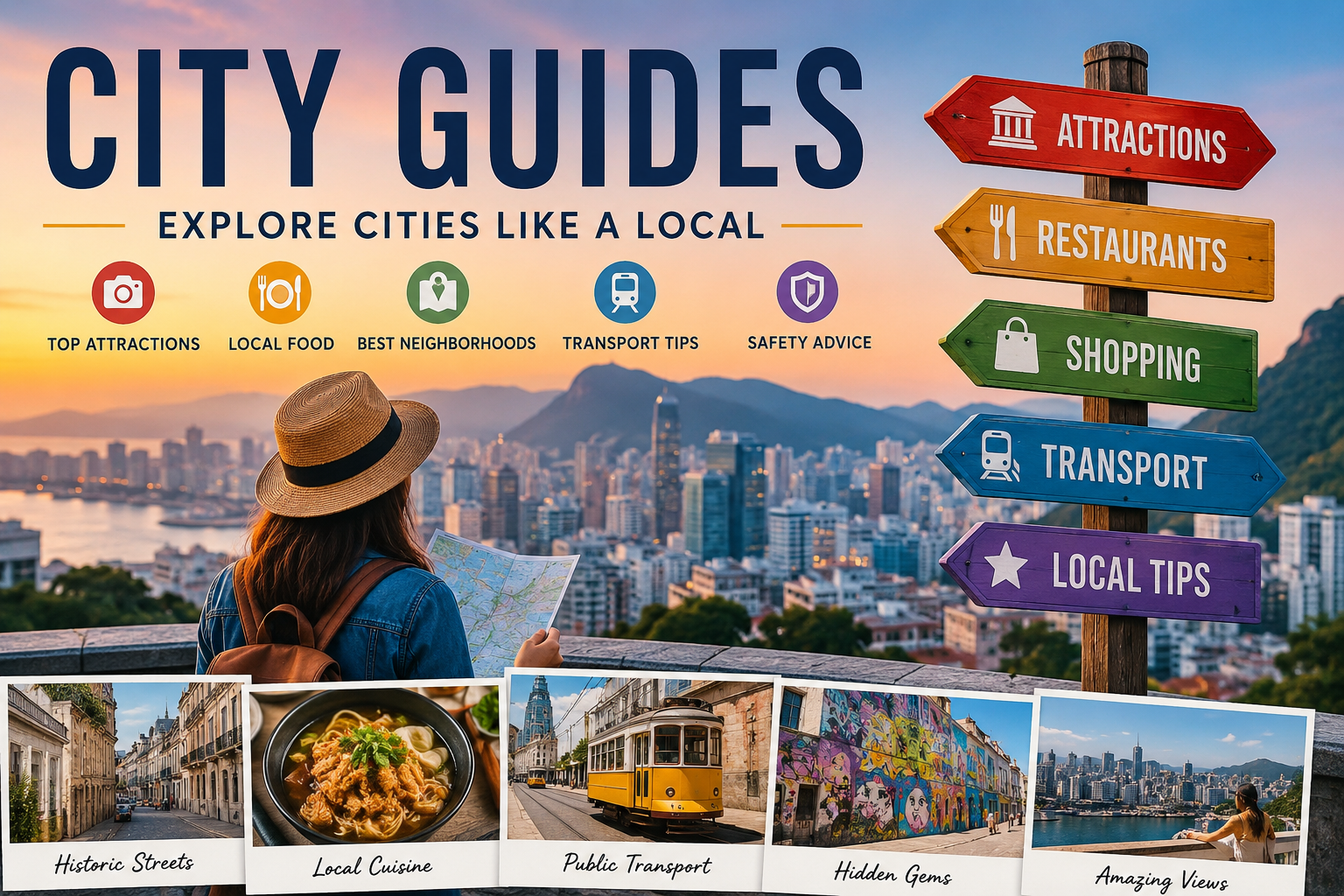
A good city guide turns an unfamiliar destination into a practical, understandable experience by combining neighborhoods, attractions, food, transportation, costs, safety, culture, and local experiences. The best city guides do more than list tourist attractions—they help travelers decide where to stay, what to prioritize, how to move around, and how to experience a destination responsibly Cultural Travel
What Is a City Guide?
A city guide is a practical resource that helps travelers understand and navigate a particular city.
It can cover everything from:
- Where to stay
- Best neighborhoods
- Major attractions
- Hidden gems
- Restaurants
- Cafés
- Local markets
- Public transportation
- Airport transfers
- Walking routes
- Shopping
- Nightlife
- Family activities
- Free attractions
- Budget travel
- Luxury experiences
- Safety
- Local customs
- Weather
- Seasonal events
- Day trips
- Accessibility
- Travel mistakes to avoid
A basic city guide may simply answer, “What should I see?”
A comprehensive city guide answers much bigger questions:
Where should I stay?
How much money should I budget?
How should I get around?
Which attractions deserve my limited time?
What should I eat?
Which areas should I explore after the major tourist attractions?
What changes depending on the season?
How can I avoid wasting time?
How can I experience the city respectfully?
These questions make a city guide useful rather than merely informative.
Why City Guides Matter More Than Ever
Travel information has never been easier to find.
At the same time, finding trustworthy information has never been more complicated.
Search engines produce thousands of results. Social media creates endless destination recommendations. Video platforms show attractive locations without always explaining practical details. AI can generate itineraries in seconds, but generated information can become outdated or overly generic.
A traveler therefore needs more than information.
They need context.
For example, saying that a museum is “one of the best attractions” is not particularly helpful.
A useful guide might explain:
- The museum is best visited in the morning.
- It may take three hours to explore properly.
- Certain days can be more crowded.
- It is close to other attractions.
- Visitors interested in art may want to spend longer there.
- Families with young children may prefer a shorter visit.
- Travelers on a tight budget should check whether free or discounted entry periods exist.
That difference is what separates a list from a genuine city guide.
The Anatomy of an Excellent City Guide
A strong city guide usually contains several layers of information.
Destination Overview
Start with the basic personality of the city.
Explain:
- Where it is
- What it is known for
- Who it suits
- How long visitors should consider staying
- What makes it different
- The best time to visit
- What type of traveler may enjoy it most
The goal is to help readers quickly decide whether the city belongs on their itinerary.
Neighborhood Guide
Neighborhoods are often more useful than attraction lists.
A city may have completely different experiences within a few kilometers.
One neighborhood might be best for:
- Families
- Museums
- Nightlife
- Luxury hotels
- Budget travelers
- Food lovers
- Shopping
- Historic architecture
- Business travel
- Beaches
- Local experiences
A good guide should explain those differences.
Attractions
Major landmarks still matter.
First-time visitors often want to see famous places because these attractions help them understand the city’s history and identity.
The problem occurs when a guide lists twenty attractions without helping the traveler prioritize them.
Instead, classify attractions as:
Must-see: Essential for first-time visitors.
Worth considering: Excellent if time allows.
Special interest: Best for travelers with specific interests.
Alternative: Useful for travelers who want fewer crowds.
This simple structure makes planning easier.
How to Choose the Best City to Visit
Choosing a city should begin with the traveler rather than the destination.
For First-Time International Travelers
Look for cities with:
- Reliable transportation
- Clear tourist infrastructure
- Plenty of accommodation
- Diverse attractions
- Convenient airport connections
- Strong visitor information
- Multiple food options
- Easy-to-understand neighborhoods
The easiest city is not necessarily the most exciting city, but an accessible destination can make a first international trip less stressful.
For Budget Travelers
Focus on cities where you can combine:
- Affordable accommodation
- Public transportation
- Free attractions
- Local food
- Walkable neighborhoods
- Low-cost cultural experiences
A city with cheap flights can still be expensive once accommodation, transportation, food, and attractions are included.
The correct question is not:
“How cheap is the flight?”
It is:
“What will the entire trip cost?”
For Families
Family-friendly city guides should consider:
- Walking distances
- Restrooms
- Child-friendly restaurants
- Parks
- Public transportation
- Attractions suitable for children
- Hotel room configurations
- Medical facilities
- Weather
- Nap and meal schedules
A destination can be excellent for adults but difficult for families.
For Solo Travelers
Solo travelers may prioritize:
- Safe and convenient neighborhoods
- Public transportation
- Social activities
- Walking tours
- Cafés
- Hostels or social accommodation
- Flexible activities
- Evening accessibility
Solo travel is also becoming increasingly mainstream. Recent reporting on 2026 travel trends points to growing interest in solo trips and greater demand for flexibility and spontaneity.
For Couples
Couples may prioritize:
- Scenic neighborhoods
- Restaurants
- Rooftop experiences
- Walkable areas
- Cultural activities
- Romantic hotels
- Sunset viewpoints
- Evening entertainment
For Older Travelers
Consider:
- Accessibility
- Comfortable transportation
- Elevators
- Seating
- Short walking routes
- Convenient accommodation
- Medical access
- Relaxed itineraries
A great city guide should never assume that every traveler has the same mobility, budget, energy level, or interests.
How to Research a City Before Traveling
Research should happen in stages.
Step 1: Understand the City
Learn the basics:
- Geography
- Population
- Main districts
- Climate
- Currency
- Language
- Transportation
- Cultural expectations
You do not need to memorize a city’s history.
You need enough context to understand how it works.
Step 2: Study the Neighborhoods
Open a map and identify:
- Historic center
- Main tourist district
- Business district
- Restaurant areas
- Shopping streets
- Nightlife zones
- Residential neighborhoods
- Parks
- Major transportation hubs
This helps prevent inefficient planning.
Step 3: Create an Attraction Shortlist
Start with ten to fifteen attractions.
Then reduce them.
Ask:
- Which ones are truly important to me?
- Which are close together?
- Which require advance booking?
- Which are seasonal?
- Which can be visited quickly?
- Which are worth the entrance fee?
Step 4: Build Around Geography
Do not create an itinerary by randomly selecting attractions.
Group nearby locations together.
For example:
Morning: Historic district
Lunch: Local food market
Afternoon: Nearby museum
Evening: Riverside neighborhood
This reduces unnecessary transportation.
Step 5: Add Unplanned Time
One of the biggest itinerary mistakes is filling every hour.
Leave room for:
- Unexpected cafés
- Local markets
- Street performances
- Weather changes
- Long lunches
- Shopping
- Rest
- Spontaneous discoveries
Travel should not feel like completing a spreadsheet.
City Guides by Neighborhood
Neighborhood-based city guides are often more useful than generic destination guides.
Historic Districts
Historic areas are usually ideal for:
- Architecture
- Museums
- Walking tours
- Cultural landmarks
- Traditional restaurants
- Local markets
However, historic centers can also be crowded and expensive.
Modern Downtown Areas
Downtown districts often provide:
- Business hotels
- Shopping
- Public transportation
- Restaurants
- Skyscrapers
- Museums
- Entertainment
They can be convenient but may feel less residential.
Creative Neighborhoods
Creative districts often attract:
- Artists
- Designers
- Independent cafés
- Galleries
- Vintage shops
- Music venues
- Street-food businesses
These areas can provide a stronger sense of contemporary city culture.
Residential Neighborhoods
Residential areas can reveal everyday life.
Travelers may discover:
- Neighborhood bakeries
- Local parks
- Small restaurants
- Community markets
- Independent stores
- Less crowded streets
The challenge is respecting local life.
Visitors should behave as guests rather than treating residential communities like open-air attractions.
City Guides for Food Lovers
Food is one of the strongest ways to understand a city.
Modern travelers increasingly connect travel with local flavors and hands-on experiences. American Express Travel’s 2026 report identifies trends such as “sight-doing” and “snackpacking,” reflecting greater interest in activities and food experiences connected to local culture.
What to Research
A food-focused city guide should cover:
- Traditional dishes
- Street food
- Local markets
- Bakeries
- Coffee culture
- Fine dining
- Vegetarian options
- Halal food
- Vegan food
- Family restaurants
- Budget meals
- Food neighborhoods
- Seasonal specialties
Don’t Only Search for “Best Restaurants”
Search for:
- Local breakfast
- Traditional lunch
- Neighborhood food markets
- Regional dishes
- Popular local snacks
- Independent bakeries
- Traditional cafés
- Seasonal food
A city’s food identity is rarely limited to expensive restaurants.
How to Find Authentic Local Food
There is no single formula for finding “authentic” food.
Instead, look for signals.
Local Customer Base
A restaurant filled with local residents can be a useful signal, although it is not absolute proof of quality.
Regional Specialties
Look for dishes associated with the city or region.
Seasonal Menus
Seasonal food can reveal local traditions and agricultural patterns.
Markets
Markets can offer a broader understanding of what residents actually buy and eat.
Ask Locals
Hotel staff, shop owners, guides, and residents can often provide useful recommendations.
City Guides for Public Transportation
Transportation can determine whether a trip feels easy or exhausting.
A comprehensive city guide should explain:
- Metro
- Subway
- Bus
- Tram
- Train
- Ferries
- Taxis
- Ride-hailing
- Bike-sharing
- Walking
- Airport transportation
Learn the Main Transport Zones
Some cities use zones.
Others use flat fares.
Some use contactless payment.
Others require cards or tickets.
A guide should explain the system in plain language.
Airport Transfers
Airport transportation deserves its own section.
Explain:
- Train options
- Bus options
- Taxi options
- Typical journey time
- Where to buy tickets
- Whether reservations are necessary
- What happens late at night
This is particularly important for first-time visitors.
Walking Is Transportation Too
Walking can be one of the best ways to understand a city.
But walking recommendations should consider:
- Distance
- Heat
- Hills
- Weather
- Sidewalk quality
- Accessibility
- Traffic
- Nighttime conditions
“Just walk” is not useful advice if the route is several kilometers uphill in extreme heat.
How to Build a City Itinerary
A good itinerary balances priorities, geography, energy, and flexibility.
One-Day City Itinerary
A one-day visit should focus on a small area.
Choose:
- One major landmark
- One neighborhood
- One food experience
- One cultural activity
- One evening experience
Trying to “see everything” usually creates stress.
Three-Day City Itinerary
Three days allow more flexibility.
Day 1: Major landmarks
Day 2: Neighborhoods and local experiences
Day 3: Museums, shopping, food, parks, or a day trip
Five-Day City Itinerary
Five days allow deeper exploration.
Consider:
- Two major sightseeing days
- Two local-experience days
- One flexible day
The flexible day can absorb unexpected weather or become a spontaneous adventure.
Seven-Day City Itinerary
A week allows travelers to explore beyond the standard tourist center.
Include:
- Major attractions
- Local neighborhoods
- Food
- Museums
- Parks
- Shopping
- Cultural events
- Day trips
- Rest
City Guides for Different Budgets
Budgeting should be realistic rather than based only on hotel prices.
Budget Travelers
Prioritize:
- Hostels
- Guesthouses
- Public transportation
- Free museums
- Parks
- Walking tours
- Markets
- Local restaurants
Mid-Range Travelers
Consider:
- Three- or four-star hotels
- Occasional taxis
- Paid attractions
- Better restaurants
- Guided experiences
- Convenient neighborhoods
Luxury Travelers
Focus on:
- Premium hotels
- Private transfers
- Fine dining
- Private guides
- Exclusive experiences
- Spa and wellness
- Premium transportation
The Hidden Cost of a Cheap Location
A cheap hotel far from the city center may not actually be cheap.
Consider:
Hotel savings + additional transportation + extra travel time + convenience cost
Sometimes paying more for a central location creates better overall value.
City Guides for Free and Low-Cost Experiences
Travel does not need to be expensive.
Many cities offer:
- Public parks
- Free walking routes
- Historic neighborhoods
- Public markets
- Beaches
- Libraries
- Free galleries
- Street art
- Public viewpoints
- Community events
- Cultural festivals
A Useful Budget Strategy
Choose one paid experience per day and combine it with several free experiences.
For example:
Morning: Free neighborhood walk
Afternoon: Paid museum
Evening: Public park or waterfront
This can create a balanced day without excessive spending.
City Guides for Families
Traveling with children changes itinerary design.
Shorter Activity Blocks
Children may not enjoy a three-hour museum visit.
Break the day into smaller experiences.
Add Parks
A playground or park can be as valuable as another attraction.
Plan Food Carefully
Keep snacks available and identify family-friendly restaurants before hunger becomes a problem.
Avoid Excessive Transportation
A geographically efficient itinerary reduces stress.
Keep One Flexible Period
Children can change plans quickly.
A flexible afternoon can save an otherwise difficult travel day.
City Guides for Solo Travelers
Solo travel provides freedom but requires more personal planning.
Choose a Convenient Base
A central or well-connected neighborhood can simplify the trip.
Share Your Plans Responsibly
Let a trusted person know your general itinerary when appropriate.
Avoid Overplanning
Solo travel is an excellent opportunity to change plans.
Join Small Experiences
Walking tours, food classes, workshops, and cultural events can make solo travel more social.
Respect Local Rules
A solo traveler is still responsible for understanding local laws and customs.
City Guides for Sustainable Travel
Sustainable city travel is not simply about using reusable bottles.
It is about understanding how your visit affects the destination.
Use Public Transportation
When practical, trains, buses, trams, walking, and cycling can reduce dependence on private vehicles.
Support Local Businesses
Consider spending money with:
- Independent restaurants
- Local guides
- Small hotels
- Family businesses
- Local artisans
- Community experiences
Avoid Overcrowding
If a landmark is overwhelmed, explore alternative attractions or visit at less busy times.
The growth of interest in second cities is significant. TUI Musement specifically highlighted rising demand for urban destinations that provide authenticity and fewer crowds.
Respect Residential Areas
Do not block entrances, photograph people without permission, create excessive noise, or treat ordinary homes as attractions.
City Guides and Responsible Tourism
Responsible tourism means recognizing that a city is not simply a product.
People live there.
They work there.
They raise families there.
They use the same public transportation as visitors.
They shop in the same markets.
Good Traveler Behavior
- Learn basic local etiquette.
- Follow local laws.
- Keep noise under control.
- Dispose of waste properly.
- Respect religious sites.
- Ask before photographing people.
- Avoid damaging historic places.
- Support local businesses.
- Follow restrictions at natural sites.
- Avoid contributing to harmful wildlife tourism.
A good city guide should explain not only what visitors can do but also what they should avoid.
City Guides and Safety
Safety information should be practical rather than sensational.
Avoid describing an entire city as “dangerous” based on isolated incidents.
Instead, explain:
- Common travel scams
- Areas where visitors should exercise extra caution
- Transportation considerations
- Emergency numbers
- Common theft risks
- Nighttime considerations
- Local laws
- Weather-related risks
- Health considerations
Common Tourist Scams
Depending on the destination, scams may involve:
- Fake tickets
- Overpriced taxis
- Distraction theft
- Fake guides
- Unofficial currency exchanges
- Restaurant billing issues
- ATM manipulation
- Street games involving money
Travelers should research destination-specific risks before leaving.
How to Avoid Outdated City Guide Information
This is one of the most overlooked problems in travel content.
Restaurants close.
Hotels change ownership.
Transportation systems change.
Ticket prices increase.
Museums change opening hours.
Visa rules can change.
Events move dates.
A city guide should therefore separate:
Evergreen information
from
Time-sensitive information.
Evergreen Information
Examples:
- Neighborhood character
- Historical background
- Major landmarks
- General transportation structure
- Cultural traditions
Time-Sensitive Information
Examples:
- Prices
- Opening hours
- Events
- Temporary exhibitions
- Transport disruptions
- Entry requirements
- Hotel policies
Always verify time-sensitive information before acting on it.
The Role of AI in Modern City Guides
AI is changing travel planning rapidly.
A traveler can now ask an AI system:
“Build me a three-day itinerary for Rome for a family with two children.”
That is useful.
But AI-generated travel information has limitations.
AI Is Excellent At
- Organizing information
- Generating itinerary ideas
- Comparing options
- Creating packing lists
- Suggesting themes
- Personalizing plans
- Reorganizing schedules
- Brainstorming alternatives
AI Can Struggle With
- Real-time closures
- Current prices
- Sudden transportation changes
- Visa requirements
- Local safety developments
- Restaurant closures
- Exact availability
- Highly local cultural nuances
The best approach is therefore AI-assisted research plus current verification.
This matters because travel mistakes can be expensive.
TUI Musement’s 2026 research shows how quickly AI adoption is becoming part of trip planning, but the broader lesson is that personalization and trustworthy destination data need to work together.
How to Use AI Without Losing the Human Side of Travel
Instead of asking:
“Give me the best things to do in London.”
Ask:
“Create a two-day London itinerary for a first-time visitor who likes history, affordable local food, walking, and quiet neighborhoods. Keep travel between activities short.”
The second prompt produces more useful results because it provides constraints.
Then verify:
- Opening hours
- Prices
- Transportation
- Availability
- Current rules
- Local conditions
Use AI as a planning assistant, not an unquestioned authority.
Ten Popular Travel Brands and City Guide Platforms Compared
Different travel platforms serve different purposes. No single brand is best for every traveler.
| Brand / Platform | Main Strength | Best For | Key Advantage | Potential Limitation |
|---|---|---|---|---|
| Lonely Planet | Destination guides | Independent travelers | Deep destination coverage | Some information can become outdated |
| Tripadvisor | Reviews and attractions | Comparison shoppers | Large volume of user reviews | Review quality varies |
| Google Maps | Navigation and local discovery | Everyday travel | Maps, directions, places, reviews | Not a complete editorial guide |
| Expedia | Travel booking and destination planning | Mainstream travelers | Booking ecosystem | Less focused on deep local storytelling |
| Booking.com | Accommodation and travel planning | Hotel-focused travelers | Huge accommodation selection | Reviews and listings require judgment |
| Airbnb | Stays and local experiences | Longer stays and local-style travel | Wide variety of properties | Quality varies by listing and location |
| GetYourGuide | Tours and activities | Experience-focused travelers | Easy activity discovery | Primarily activity-focused |
| Viator | Tours and attractions | Sightseeing travelers | Large activity marketplace | Marketplace quality can vary |
| Fodor’s Travel | Editorial travel guides | Traditional planners | Structured destination advice | Less focused on real-time user reviews |
| Rough Guides | Independent travel | Curious explorers | Practical destination information | Coverage varies by destination |
Which Platform Should You Use?
Use Google Maps when you need navigation and nearby places.
Use Tripadvisor when comparing traveler feedback.
Use Lonely Planet or Rough Guides when you want destination context.
Use Booking.com or Expedia when researching accommodation and booking options.
Use GetYourGuide or Viator when searching for activities.
Use Airbnb when accommodation style and local experiences are important.
The smartest travelers often use several resources rather than relying on one.
City Guides for Hidden Gems
The phrase “hidden gem” is heavily overused.
If millions of people know about a place through social media, it may no longer be hidden.
A better term is:
lesser-known alternative.
What Makes a Good Alternative?
A useful alternative should have a reason to visit.
For example:
- A quieter viewpoint
- A smaller museum
- A neighborhood market
- An independent bookstore
- A local park
- A less crowded historical site
- A neighborhood café
- A community cultural event
The goal is not simply to find somewhere obscure.
The goal is to find somewhere meaningful.
City Guides Based on Problems Travelers Need to Solve
One of the strongest approaches to city guide content is to organize information around traveler problems.
“Where Should I Stay?”
Create neighborhood comparisons.
“How Do I Get Around?”
Create transportation guides.
“What Can I Do for Free?”
Create free attraction guides.
“What Should I Eat?”
Create food guides.
“What Should I Do in Bad Weather?”
Create indoor activity guides.
“What Can Families Do?”
Create family itineraries.
“What Can I Do in One Day?”
Create short-trip itineraries.
“Where Can I Go Without a Car?”
Create car-free city guides.
“Where Can I Find Halal Food?”
Create destination-specific halal food guides.
“Where Can I Find Vegan Food?”
Create vegan city guides.
“What Should Solo Travelers Do?”
Create solo travel guides.
This problem-solving structure makes city content more useful and easier to navigate.
Demographic Modifiers for City Guide Content
City guides can become much more useful when they reflect different types of travelers.
Consider creating dedicated guides for:
- City guides for families
- City guides for solo travelers
- City guides for couples
- City guides for students
- City guides for seniors
- City guides for digital nomads
- City guides for first-time travelers
- City guides for budget travelers
- City guides for luxury travelers
- City guides for food lovers
- City guides for photographers
- City guides for history lovers
- City guides for art lovers
- City guides for outdoor enthusiasts
- City guides for business travelers
These modifiers help turn a generic destination into a highly specific resource.
Problem-Solving Modifiers for City Guides
Another powerful approach is to target practical travel problems.
Examples include:
- Best city guides for short trips
- Best city guides for weekend travel
- City guides without a car
- City guides for rainy weather
- City guides for hot weather
- City guides for free activities
- City guides for first-time visitors
- City guides for affordable travel
- City guides near airports
- City guides for public transportation
- City guides for accessible travel
- City guides for food lovers
- City guides for nightlife
- City guides for cultural travel
- City guides for shopping
- City guides for local experiences
This structure allows one broad topic to become a large, organized content ecosystem.
City Guide SEO Strategy
If you are building a travel website, “city guides” can become a major topical cluster.
Instead of publishing random travel articles, create a structured destination system.
Destination Pillar
Example:
Paris City Guide
Then create supporting articles:
- Best neighborhoods in Paris
- Best hotels in Paris
- Best restaurants in Paris
- Best free things to do in Paris
- Paris public transportation guide
- Paris itinerary for first-time visitors
- Paris itinerary for three days
- Paris with kids
- Paris on a budget
- Best cafés in Paris
- Paris hidden gems
- Paris day trips
- Best time to visit Paris
- Paris travel mistakes to avoid
This creates strong topical relationships.
Suggested Internal Linking Structure
For a city guide website, internal links should follow a logical hierarchy.
Main City Guide
Paris City Guide
Link to:
- Where to stay in Paris
- Paris neighborhoods
- Things to do in Paris
- Paris food guide
- Paris transportation
- Paris itinerary
- Paris budget guide
- Paris safety guide
- Paris day trips
Then each supporting page should link back to the main city guide.
This creates a hub-and-spoke content structure.
Example Internal Link Anchors
Use descriptive anchors such as:
- complete Paris city guide
- best neighborhoods in Paris
- Paris public transportation guide
- things to do in Paris
- Paris itinerary for three days
- best restaurants in Paris
Avoid using the same generic anchor such as “click here” repeatedly.
City Guide Content Cluster Example
A large travel website could organize its content like this:
Europe City Guides
France
- Paris
- Lyon
- Nice
- Marseille
- Bordeaux
Italy
- Rome
- Milan
- Florence
- Venice
- Naples
Spain
- Madrid
- Barcelona
- Seville
- Valencia
- Málaga
Asia City Guides
Japan
- Tokyo
- Kyoto
- Osaka
- Hiroshima
- Sapporo
South Korea
- Seoul
- Busan
- Jeju
- Incheon
Southeast Asia
- Bangkok
- Singapore
- Kuala Lumpur
- Hanoi
- Ho Chi Minh City
- Bali
North America City Guides
- New York City
- Los Angeles
- Chicago
- Toronto
- Vancouver
- Mexico City
Middle East City Guides
- Dubai
- Abu Dhabi
- Doha
- Muscat
- Riyadh
- Amman
Africa City Guides
- Cape Town
- Johannesburg
- Nairobi
- Marrakech
- Cairo
Oceania City Guides
- Sydney
- Melbourne
- Brisbane
- Auckland
- Wellington
This structure can grow naturally without creating a chaotic website.
How to Make City Guide Content More Useful for Search
Search engines increasingly need content that satisfies the underlying intent behind a query.
For example, someone searching:
“Tokyo city guide”
may actually want answers to:
- Where should I stay?
- How much does Tokyo cost?
- How do I use trains?
- What should I eat?
- What attractions are essential?
- How many days do I need?
- Is Tokyo family friendly?
- Is Tokyo expensive?
- What neighborhood is best?
A comprehensive guide should answer these related questions naturally.
This creates a more useful resource than repeating the phrase “Tokyo city guide” dozens of times.
How to Write City Guides That Feel Human
Generic travel writing often sounds like this:
“Paris is a beautiful city known for its rich history, delicious cuisine, and stunning architecture.”
It is not wrong.
It is simply forgettable.
A stronger approach is to describe decisions and experiences.
For example:
“If you only have two days in Paris, don’t spread your itinerary across every corner of the city. Choose one central cluster each day, leave room for a long lunch, and save the evening for walking rather than another scheduled attraction.”
This is practical.
It helps someone make a decision.
Use Specific Details
Instead of:
“Public transportation is convenient.”
Explain:
“Choose accommodation near a major metro or rail connection if you plan to visit several districts.”
Instead of:
“There are many restaurants.”
Explain:
“Research the neighborhood before choosing a restaurant because dining options can change dramatically from the historic center to residential districts.”
Specificity creates authority.
Common City Guide Mistakes
Mistake 1: Listing Too Many Attractions
A list of 50 attractions may look comprehensive but can overwhelm readers.
Solution: Categorize and prioritize.
Mistake 2: Ignoring Geography
Sending travelers back and forth across a city wastes time.
Solution: Group activities by neighborhood.
Mistake 3: Providing Outdated Prices
Travel costs change frequently.
Solution: Date-sensitive information should be verified regularly.
Mistake 4: Treating Every Traveler the Same
A backpacker and a luxury traveler need different recommendations.
Solution: Add demographic and budget modifiers.
Mistake 5: Ignoring Local Culture
A guide that focuses only on attractions misses the identity of the destination.
Solution: Include food, traditions, etiquette, neighborhoods, and everyday life.
Mistake 6: Overusing “Hidden Gems”
The phrase has become meaningless when applied to every location.
Solution: Explain why an alternative attraction is worth visiting.
Mistake 7: Creating Unrealistic Itineraries
Ten attractions in one day may be technically possible but practically miserable.
Solution: Build itineraries around realistic travel time.
Mistake 8: Ignoring Weather
Rain, extreme heat, snow, or seasonal conditions can completely change an itinerary.
Solution: Include weather alternatives.
Mistake 9: Treating AI Output as Verified Information
AI can produce confident but incorrect details.
Solution: Verify current information through authoritative and local sources.
Mistake 10: Forgetting the Local Community
Tourism can affect housing, congestion, resources, and neighborhood life.
Solution: Encourage respectful and responsible travel.
Pros and Cons of Using City Guides
Pros
- Save planning time
- Reduce uncertainty
- Discover neighborhoods
- Understand transportation
- Compare attractions
- Build realistic itineraries
- Find local experiences
- Manage budgets
- Avoid common mistakes
- Improve trip organization
Cons
- Information can become outdated
- Popular recommendations can become overcrowded
- Generic advice may not fit everyone
- Reviews can be subjective
- Social media recommendations can be misleading
- AI-generated information may contain errors
- Commercial recommendations may create bias
The answer is not to stop using city guides.
It is to use them critically.
How to Evaluate Whether a City Guide Is Trustworthy
Before relying on a travel guide, check:
Date
When was it published or updated?
Author
Does the writer demonstrate genuine destination knowledge?
Sources
Are important claims supported?
Specificity
Does the guide provide practical information?
Transparency
Are sponsored recommendations clearly identified?
Balance
Does it mention disadvantages as well as advantages?
Local Context
Does it explain how recommendations affect residents and local businesses?
Current Information
Are prices, opening times, transport details, and regulations presented carefully?
A trustworthy city guide should acknowledge uncertainty instead of pretending everything is permanent.
The Future of City Guides
The future will probably not be about choosing between human-written guides and AI.
It will be about combining both.
AI-Personalized Itineraries
Travelers will increasingly receive itineraries based on:
- Budget
- Interests
- Age
- Mobility
- Weather
- Time
- Travel companions
- Food preferences
- Accommodation location
Real-Time Adjustments
Future travel systems may dynamically change plans when:
- Rain begins
- A museum closes
- A train is delayed
- A restaurant becomes unavailable
- A neighborhood becomes crowded
- A traveler changes plans
More Local Experiences
Travelers increasingly want to do things rather than simply photograph them.
The 2026 American Express report highlights “sight-doing,” where travelers seek hands-on experiences connected to the places they visit.
Growth of Second Cities
Overcrowding in famous destinations will continue encouraging travelers to explore alternatives.
TUI Musement’s 2026 analysis specifically points toward growing interest in “second cities” that can provide authenticity and fewer crowds.
More Flexible Short Trips
Short urban breaks are likely to remain important because travelers can fit them around work and other responsibilities.
TUI Musement describes city breaks as an established trend, while other 2026 travel research points toward shorter, flexible, experience-focused travel.
Travel Based on Personal Interests
The future city guide may be less about:
“Top 10 things to do.”
And more about:
“Tokyo for architecture lovers.”
“Rome for food lovers.”
“Barcelona for families.”
“Seoul for first-time solo travelers.”
“London for book lovers.”
“Dubai for luxury travelers.”
“Lisbon for digital nomads.”
That is a more useful way to organize travel information.
How City Guides Could Become More Personalized
Imagine entering:
Destination: Tokyo
Trip length: 4 days
Travelers: Couple
Budget: Mid-range
Interests: Food, architecture, neighborhoods
Walking: Moderate
Crowds: Prefer quieter places
A modern city guide could then create a route that matches those preferences.
Instead of showing the same “top attractions” to everyone, it could prioritize:
- Neighborhood restaurants
- Architecture walks
- Smaller museums
- Local markets
- Scenic evening locations
- Efficient transportation routes
This is where structured city-guide content becomes especially valuable.
AI can personalize the information, but reliable underlying destination knowledge still matters.
The Most Important City Guide Principle: Optimize for the Traveler’s Time
Money matters.
But time is often more valuable.
Suppose a traveler has three days in a city.
Every unnecessary 45-minute journey consumes a meaningful part of that trip.
Every poorly timed attraction creates another queue.
Every restaurant located far from the day’s activities adds friction.
The best city guide therefore asks:
How can this traveler experience more value with less unnecessary effort?
That means:
- Group attractions geographically.
- Explain transportation.
- Recommend realistic schedules.
- Include rest.
- Provide alternatives.
- Identify booking requirements.
- Consider opening days.
- Consider weather.
- Consider crowd patterns.
Good travel planning is not about doing more.
It is about wasting less.
A Practical City Guide Planning Framework
Use this framework for almost any destination.
Phase 1: Discover
Research:
- City identity
- Main attractions
- Neighborhoods
- Food
- Culture
Phase 2: Filter
Remove:
- Attractions that do not match your interests
- Excessive travel
- Repetitive activities
- Low-value experiences
Phase 3: Organize
Group activities by:
- Location
- Opening hours
- Energy level
- Transportation
- Meal times
Phase 4: Verify
Check:
- Current opening hours
- Tickets
- Transportation
- Weather
- Local rules
- Safety information
Phase 5: Leave Space
Keep time for:
- Rest
- Discovery
- Food
- Delays
- Spontaneous experiences
Phase 6: Review
Before departure, ask:
Can I explain my trip simply?
If the answer is no, the itinerary may be too complicated.
A 24-Hour City Guide Formula
For travelers with only one day, use the following structure:
Morning
Explore the most important landmark or historic district.
Late Morning
Walk through a nearby neighborhood.
Lunch
Try a local specialty.
Afternoon
Choose one major museum, market, shopping district, or cultural attraction.
Evening
Visit a scenic area and have dinner nearby.
Night
Choose a relaxed local experience rather than adding another distant attraction.
The formula works because it balances sightseeing, food, walking, and flexibility.
A 48-Hour City Guide Formula
Day One
Focus on the city’s identity.
- Historic center
- Major landmark
- Local lunch
- Museum
- Evening neighborhood
Day Two
Focus on local character.
- Local market
- Alternative neighborhood
- Food experience
- Park or waterfront
- Evening entertainment
This prevents both days from feeling identical.
A Seven-Day City Guide Formula
For a week-long visit:
Day 1: Orientation
Understand the city.
Day 2: Major Attractions
Visit the essential landmarks.
Day 3: Neighborhoods
Explore areas outside the tourist center.
Day 4: Food and Culture
Focus on markets, cooking, museums, or local experiences.
Day 5: Alternative Experiences
Explore less-visited areas.
Day 6: Day Trip
If appropriate, leave the city.
Day 7: Flexible Day
Return to a favorite area, shop, relax, or follow a spontaneous recommendation.
This approach is less exhausting than seven consecutive sightseeing days.
City Guides for Travelers on a Tight Schedule
If time is limited, use the three-priority rule.
Choose:
- One attraction you absolutely want to see.
- One food experience you absolutely want to try.
- One neighborhood you absolutely want to explore.
Everything else is optional.
This prevents a short trip from becoming a race.
City Guides for Travelers Who Want Local Experiences
To experience a city beyond landmarks, look for:
- Local markets
- Cooking classes
- Community events
- Independent bookstores
- Small galleries
- Neighborhood cafés
- Traditional workshops
- Walking tours
- Local sports
- Music venues
- Cultural centers
The goal is not to pretend to be a local.
You are still a visitor.
The goal is to experience more than the standard tourist route.
Why “Like a Local” Can Be Misleading
Travel websites frequently promise that visitors can “live like a local.”
That phrase needs context.
A visitor cannot truly understand a city after three days.
Instead, a responsible city guide should say:
“Experience the city beyond the main tourist attractions.”
This is more honest.
Local life is complex.
A city is not a theme park designed for visitors.
Good travel content respects that distinction.
How to Build a Better Global City Guide Website
For publishers and bloggers, city guides can create a strong long-term content strategy.
Start with one region.
Then build authority city by city.
Stage One
Create:
- 10 comprehensive city guides
Stage Two
Add:
- Neighborhood guides
- Food guides
- Hotel guides
- Itineraries
- Transportation guides
Stage Three
Add demographic content:
- Families
- Solo travelers
- Couples
- Budget travelers
- Luxury travelers
Stage Four
Add seasonal content:
- Spring
- Summer
- Autumn
- Winter
- Christmas
- Festivals
Stage Five
Add problem-solving content:
- Free things to do
- Rainy-day activities
- Car-free travel
- One-day itineraries
- Airport transfers
- Local food
This creates a deep topical network rather than a collection of unrelated articles.
City Guide Content Ideas
A city guide website can expand into many useful topics.
Destination Content
- Complete city guides
- Best cities to visit
- Emerging cities
- Second cities
- Weekend cities
Practical Content
- Airport transfers
- Public transportation
- Currency
- Internet access
- Local etiquette
- Safety
Experience Content
- Food
- Museums
- Shopping
- Nightlife
- Markets
- Parks
- Architecture
Audience Content
- Families
- Couples
- Solo travelers
- Seniors
- Students
- Budget travelers
Seasonal Content
- Summer city breaks
- Winter city breaks
- Christmas markets
- Spring travel
- Autumn travel
Intent-Based Content
- One-day city guides
- Three-day city guides
- Free things to do
- Things to do at night
- Rainy-day activities
- Car-free city travel
FAQs
What is a city guide?
A city guide is a travel resource that explains how to experience a particular city, including attractions, neighborhoods, food, transportation, accommodation, budgets, safety, culture, and practical travel advice.
What should a city guide include?
A comprehensive city guide should include an overview, best neighborhoods, major attractions, food, transportation, accommodation areas, costs, safety, local customs, itineraries, seasonal advice, and practical tips.
How many days are enough for a city?
It depends on the destination. A short city break may require one to three days, while larger cities can justify five to seven days or more. The ideal length depends on your interests and travel pace.
Are city guides useful for first-time travelers?
Yes. A good city guide can reduce uncertainty about transportation, neighborhoods, attractions, costs, cultural etiquette, and itinerary planning.
Are city guides useful for solo travelers?
Yes. Solo-focused city guides can emphasize convenient neighborhoods, transportation, safe planning practices, social activities, walking routes, and flexible experiences.
How can I travel around a city cheaply?
Public transportation, walking, free attractions, local markets, parks, and affordable neighborhood restaurants can significantly reduce travel costs.
Should I follow a city guide exactly?
No. Use it as a framework. Leave room for weather changes, unexpected discoveries, rest, and personal preferences.
Are AI city guides reliable?
AI can be useful for brainstorming and itinerary organization, but travelers should verify time-sensitive information such as prices, opening hours, transportation changes, entry rules, and availability.
What is a second city?
A second city is generally a destination outside the most famous or dominant tourist city in a country or region. These destinations can offer different cultural experiences and sometimes fewer crowds.
How do I find authentic experiences in a city?
Look beyond major attractions. Explore local markets, independent businesses, cultural events, neighborhood restaurants, workshops, museums, and community-oriented experiences while respecting local residents.
How do I create a city guide for a specific audience?
Start with the audience’s needs. A family guide should consider children, transport, food, and accessibility, while a budget guide should focus on low-cost accommodation, free attractions, public transportation, and affordable food.
Should city guides include prices?
Yes, when useful, but prices should be treated as time-sensitive information. Whenever possible, indicate that prices can change and encourage readers to verify current rates.
What makes a city guide different from a travel blog post?
A city guide is usually broader and more structured. It attempts to answer multiple practical questions about visiting a destination instead of focusing on one attraction or experience.
How often should a city guide be updated?
There is no universal schedule. Update it whenever important information changes, especially transportation, entry requirements, prices, opening hours, safety information, and major attractions.
Can city guides help with SEO?
Yes. A well-structured city guide can act as a pillar page supporting related content about neighborhoods, attractions, food, transportation, itineraries, hotels, and activities.
What are the best city guides?
The best city guide is not necessarily the longest. It is the one that provides accurate, relevant, practical information for a specific traveler and helps them make better decisions.
Conclusion
A city guide should do more than tell travelers where famous landmarks are. It should help them understand how a destination works. The most valuable guides combine practical planning with curiosity. They explain where to stay, how to move around, what to eat, which attractions deserve time, how to avoid common mistakes, and how to experience local culture respectfully. The direction of travel in 2026 makes this even more important. City breaks remain strong, travelers are increasingly interested in local and hands-on experiences, second cities are gaining attention, and AI is becoming part of the planning process. But the fundamental principle has not changed: Travel is better when information helps people make confident decisions without removing the opportunity for discovery.