
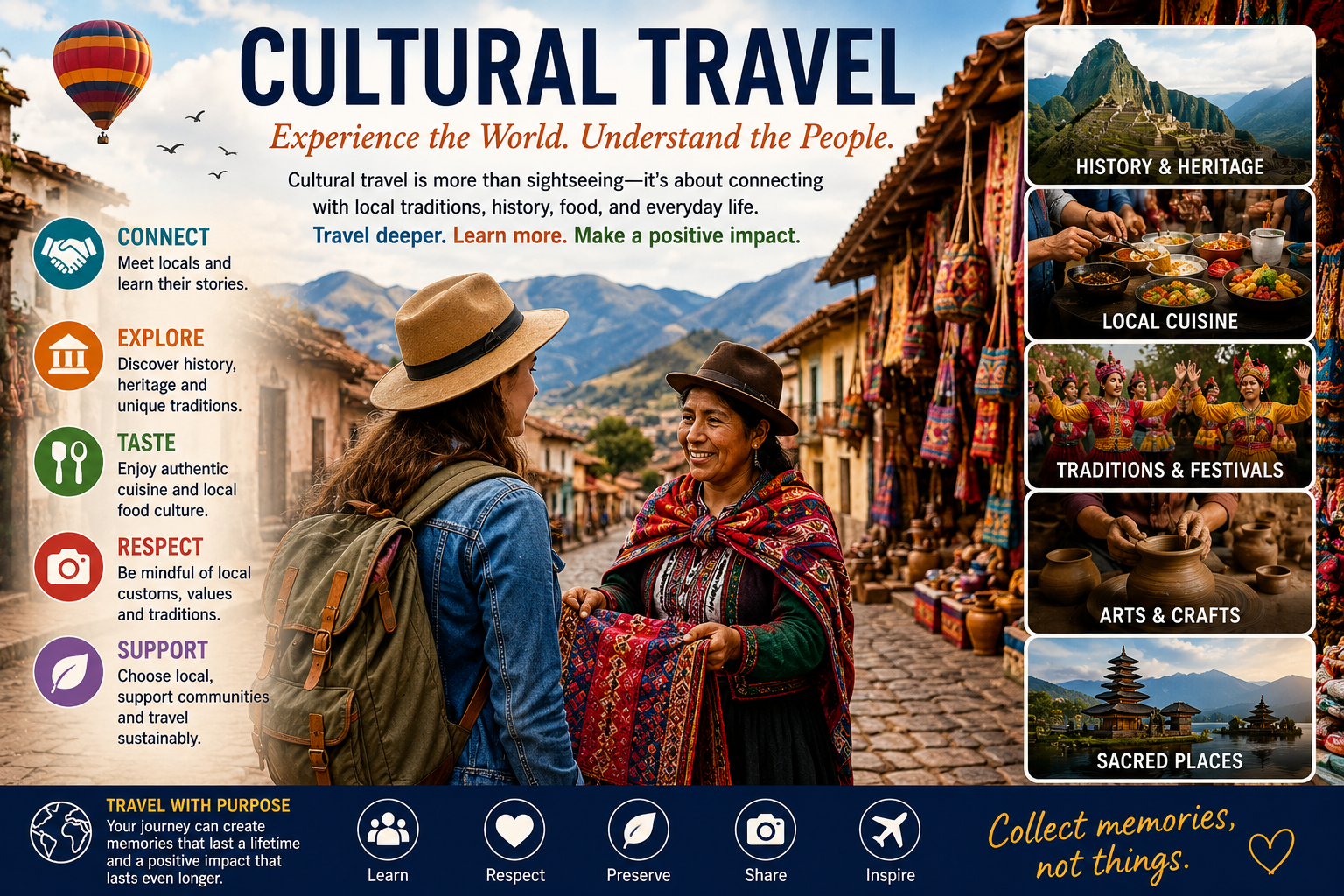
Cultural travel is a form of travel focused on understanding the history, traditions, food, arts, language, heritage, lifestyles, and everyday experiences of the communities you visit. Instead of simply seeing a destination, cultural travel encourages visitors to understand it, interact respectfully with local people, support local communities, and leave with a deeper appreciation of how different societies live and remember their past 3S International Travel
What Is Cultural Travel?
Cultural travel is travel motivated partly or primarily by the desire to experience, understand, and appreciate the culture of a destination.
Culture can include much more than monuments.
It can involve:
- History
- Language
- Food
- Music
- Dance
- Art
- Architecture
- Religion
- Festivals
- Traditional clothing
- Crafts
- Literature
- Family customs
- Local markets
- Traditional occupations
- Social traditions
- Indigenous knowledge
- Everyday lifestyles
This makes cultural travel a broad category.
A person visiting an ancient archaeological site is participating in cultural tourism.
So is someone taking a traditional cooking class.
Someone attending a local music performance is experiencing culture.
So is someone visiting a neighborhood market and learning how local people shop for food.
Cultural Travel Versus Traditional Sightseeing
Traditional sightseeing often focuses on what can be seen.
Cultural travel focuses more heavily on what can be understood.
For example, a sightseeing visitor might photograph a historic building and move on.
A cultural traveler might ask:
- Who built it?
- Why was it built?
- What architectural traditions influenced it?
- Who used it?
- How has its purpose changed?
- What does it mean to local residents today?
The difference is not necessarily the destination.
It is the approach.
Cultural Travel Is About Participation
The strongest cultural experiences often involve participation.
Instead of only watching, travelers might:
- Cook
- Learn
- Listen
- Ask questions
- Practice traditional crafts
- Attend community events
- Explore local food
- Learn basic local phrases
- Meet local residents
- Visit small cultural institutions
Participation can create stronger memories because travelers become involved rather than remaining observers.
Why Cultural Travel Matters
Cultural travel can benefit both travelers and destinations when managed responsibly.
It Builds Cultural Understanding
Travel creates opportunities to challenge assumptions.
People may discover that a culture they previously understood through films, social media, or news is much more complex in reality.
Direct interaction can replace stereotypes with human experiences.
It Preserves Local Traditions
Tourism can create economic incentives for traditional crafts, performances, food businesses, museums, and heritage sites.
If travelers actively support authentic local enterprises, their spending can help maintain cultural practices.
It Supports Local Economies
Cultural travel can distribute tourism spending across:
- Local guides
- Restaurants
- Artisans
- Museums
- Small hotels
- Family businesses
- Transportation providers
- Cultural organizations
This can be particularly valuable when visitors move beyond major tourist attractions.
It Creates Educational Experiences
Cultural travel can turn history into something tangible.
Reading about an ancient civilization provides information.
Standing inside an archaeological site can create a stronger sense of scale, craftsmanship, and historical context.
It Encourages Respect
Understanding why a tradition matters can change how visitors behave.
A traveler who knows that a location is sacred is more likely to treat it appropriately.
A visitor who understands the history of a community may think differently about photography, clothing, or participation in local events.
The Main Elements of Cultural Travel
Cultural travel can be understood through several interconnected elements.
History
History provides the foundation for understanding a destination.
Travelers can explore:
- Historic buildings
- Museums
- Battlefields
- Archaeological sites
- Historic neighborhoods
- Memorials
- Archives
- Former industrial areas
History also helps explain why a place looks and behaves the way it does today.
Food
Food may be one of the easiest ways to experience culture.
Cuisine reflects:
- Geography
- Climate
- Agriculture
- Religion
- Migration
- Trade
- Family traditions
- Historical influences
A traditional dish can tell a story about a region’s past.
Language
Even learning a few basic phrases can change a travel experience.
Simple expressions such as greetings, thank-you phrases, or polite requests can demonstrate respect.
Language also helps travelers understand local humor, place names, signs, and cultural references.
Architecture
Buildings can reveal a surprising amount about a society.
Architecture reflects:
- Available materials
- Climate
- Religion
- Social organization
- Security concerns
- Technology
- Economic conditions
- Aesthetic preferences
Music and Performing Arts
Music and dance can communicate stories and emotions that may be difficult to explain through written history.
Traditional performances can preserve memories, celebrations, religious practices, and community identity.
Traditional Crafts
Crafts provide a direct connection between cultural knowledge and physical skill.
Examples include:
- Pottery
- Weaving
- Embroidery
- Wood carving
- Metalwork
- Jewelry
- Basketry
- Calligraphy
- Textile production
A responsible traveler can help sustain these traditions by purchasing directly from genuine artisans.
Cultural Travel and Cultural Heritage
Cultural travel and cultural heritage are closely connected but are not identical.
Cultural heritage refers to the traditions, places, objects, knowledge, and practices communities inherit and value.
Cultural travel is the experience of visiting and engaging with these cultural resources.
A historic city may be cultural heritage.
Walking through that city with an informed local guide is cultural travel.
A traditional cooking method can be cultural heritage.
Learning that method from a local cook is cultural travel.
Tangible Heritage
Tangible heritage includes physical resources such as:
- Monuments
- Historic buildings
- Museums
- Archaeological sites
- Manuscripts
- Artifacts
- Traditional homes
Intangible Heritage
Intangible heritage includes:
- Languages
- Oral traditions
- Music
- Dance
- Rituals
- Festivals
- Craft knowledge
- Traditional food practices
Cultural travelers should appreciate both.
How to Plan a Cultural Travel Experience
A culturally meaningful trip does not require an unlimited budget.
It requires preparation.
Research the Destination
Before traveling, learn about:
- Local history
- Major cultural traditions
- Religious customs
- Appropriate clothing
- Social etiquette
- Food traditions
- Important festivals
- Photography rules
- Local transportation
- Heritage conservation rules
Research should go beyond a simple list of attractions.
Try to understand the story behind the destination.
Learn Basic Local Etiquette
Etiquette differs between cultures.
In some places, removing shoes before entering a building is expected.
In others, particular forms of greeting are important.
Some communities have strict rules about photography.
Research these issues before arrival.
Learn a Few Local Words
You do not need to become fluent.
Even a few phrases can make interactions more comfortable.
Learning how to say:
- Hello
- Thank you
- Please
- Excuse me
- Goodbye
can demonstrate effort and respect.
Choose Local Experiences
Look for opportunities involving:
- Local guides
- Family-owned restaurants
- Community tourism
- Artisan workshops
- Local markets
- Cultural centers
- Small museums
- Traditional performances
The goal is not to avoid all major attractions.
It is to balance famous sites with local experiences.
How to Experience Culture Without Becoming a Tourist Spectator
There is an important difference between observing culture and engaging with it.
Ask Questions
If you are visiting a craft workshop, ask about the process.
If you are eating a traditional dish, ask about its history.
If you visit a historic neighborhood, ask how it has changed.
Good questions create meaningful conversations.
Listen More Than You Speak
Cultural travel works best when travelers approach communities with curiosity.
Instead of immediately comparing everything to home, listen to how local people describe their own experiences.
Avoid Assuming One Person Represents an Entire Culture
No individual can speak for millions of people.
Countries and communities contain enormous internal diversity.
A local guide can provide valuable insight, but their perspective is still one perspective.
Cultural Travel for Families
Cultural travel can be particularly valuable for families.
Children often learn more effectively when they can connect information with real experiences.
Make History Interactive
Instead of simply visiting a museum, ask children to identify:
- Objects
- Symbols
- Clothing
- Tools
- Building styles
Then discuss what these objects reveal about the past.
Try Local Food Together
Food can create an easy cultural learning activity.
Ask children:
- What ingredients are different?
- How is the food prepared?
- Why is this dish important?
- Does the dish have a special occasion?
Visit Workshops
Watching an artisan work can show children that products do not simply appear in stores.
They are the result of knowledge, time, materials, and skill.
Cultural Travel for Young Adults
Young travelers often have opportunities to explore culture through affordable and flexible experiences.
Useful options can include:
- Walking tours
- Local markets
- Cultural festivals
- Hostels with local events
- Cooking classes
- Language exchanges
- Museums
- Public transportation
- Community experiences
Social media can help discover experiences, but travelers should verify whether activities genuinely benefit local communities.
Cultural Travel for Older Travelers
Older travelers may prefer slower and more comfortable cultural experiences.
Options can include:
- Guided heritage tours
- Museums
- Historic hotels
- Culinary experiences
- Scenic rail journeys
- Small-group tours
- Cultural performances
- Architecture tours
Slow travel can be especially valuable because it allows visitors to spend more time understanding a destination.
Cultural Travel for Solo Travelers
Solo travel can create opportunities for deeper interaction.
A solo traveler may find it easier to join:
- Small tours
- Cooking classes
- Walking groups
- Language exchanges
- Cultural workshops
However, travelers should still prioritize personal safety and research local conditions.
Cultural Travel for Budget Travelers
Cultural experiences do not have to be expensive.
Affordable options include:
- Free museums
- Public markets
- Historic neighborhoods
- Local parks
- Community festivals
- Public cultural events
- Walking tours
- Self-guided architecture walks
Some of the most memorable cultural experiences may cost very little.
Responsible Cultural Travel
Responsible travel means recognizing that tourism affects real communities.
A good cultural traveler considers:
Where does my money go?
Does this experience respect local people?
Am I contributing to preservation or exploitation?
Am I behaving appropriately?
Support Local Businesses
Whenever practical, spend money with locally owned businesses.
This can include:
- Restaurants
- Guesthouses
- Guides
- Artisan workshops
- Cultural centers
- Independent stores
Respect Photography Boundaries
Not everything should be photographed.
Ask permission before photographing people, especially during personal, religious, or ceremonial moments.
Do Not Touch Protected Objects
Historic artifacts and structures can be fragile.
Follow conservation rules even when nobody appears to be watching.
Respect Sacred Places
A religious site may be a tourist attraction to you but a deeply important place of worship to local residents.
Behavior should reflect that difference.
Cultural Travel and Local Food
Food tourism has become an important part of cultural travel.
Eat Where Locals Eat
Busy local restaurants can provide insight into everyday food culture.
This does not mean every tourist-oriented restaurant is bad.
Some are excellent.
The point is to explore beyond international chains when possible.
Learn the Story Behind the Dish
Ask:
- Is it associated with a particular region?
- Is it eaten during festivals?
- Does it have religious significance?
- How has the recipe changed?
- Which ingredients are locally produced?
Respect Dietary Traditions
Different cultures have different approaches to food.
Travelers should respect religious and cultural dietary rules.
Cultural Travel and Festivals
Festivals can offer powerful cultural experiences.
They can celebrate:
- Religion
- Seasons
- Harvests
- Historical events
- Music
- Community identity
- Traditional arts
But festivals can also become overcrowded.
Travelers should follow local instructions and avoid treating cultural ceremonies purely as entertainment.
Participate Respectfully
If visitors are allowed to participate, they should follow the guidance of local organizers.
Do not assume that every public event means every ritual is open to tourists.
Cultural Travel and Religious Sites
Religious tourism and cultural tourism often overlap.
Visitors may encounter:
- Mosques
- Churches
- Temples
- Synagogues
- Shrines
- Monasteries
- Sacred landscapes
Before visiting, travelers should research:
- Dress requirements
- Photography rules
- Visiting hours
- Prayer schedules
- Entrance restrictions
- Appropriate behavior
Respect should always come before the perfect photograph.
Cultural Travel and Museums
Museums remain valuable cultural travel destinations.
A good museum can explain:
- Historical timelines
- Artistic movements
- Local communities
- Political change
- Technology
- Migration
- Everyday life
Look Beyond Famous Objects
Visitors sometimes focus only on the most famous artifact.
Try reading smaller displays.
Objects that seem ordinary can reveal how people actually lived.
Tools, household objects, clothing, letters, toys, and food-related items can provide fascinating information.
Cultural Travel and Historic Neighborhoods
Historic neighborhoods can provide a more realistic cultural experience than isolated monuments.
Look for:
- Traditional markets
- Old houses
- Local cafés
- Religious buildings
- Craft workshops
- Historic streets
- Community spaces
Walk slowly.
Notice details.
Architecture, street layouts, shop signs, sounds, and food can reveal how a neighborhood developed.
The Benefits of Cultural Travel
Greater Cultural Awareness
Travelers become more aware of different ways of living.
Stronger Memories
Participatory experiences often feel more memorable than passive sightseeing.
Educational Value
Travel can transform abstract history into real-world understanding.
Local Economic Support
Community-focused tourism can direct spending toward local businesses.
Heritage Preservation
Tourism revenue can help support conservation when properly managed.
Personal Growth
Traveling outside familiar cultural environments can challenge assumptions and develop adaptability.
The Challenges of Cultural Travel
Cultural travel is not automatically positive.
Commercialization
Traditions may be modified primarily to satisfy tourists.
Overtourism
Large visitor numbers can damage cultural sites and disrupt local life.
Cultural Appropriation
Travelers and businesses can sometimes use cultural symbols without understanding or respecting their meaning.
Stereotyping
Travel content can reduce complex cultures to a few recognizable images.
Unequal Economic Benefits
Tourism revenue does not automatically reach local communities.
Loss of Privacy
Residents may feel uncomfortable when tourists photograph or record everyday life.
Cultural Appropriation and Cultural Appreciation
This is an important issue for modern travelers.
Cultural appreciation involves learning about and respecting another culture.
Cultural appropriation can involve taking cultural elements out of their context, particularly when there is a significant power imbalance or commercial exploitation.
Travelers should consider:
- Where did this cultural symbol originate?
- What does it mean?
- Is it sacred?
- Is it appropriate for outsiders to use?
- Who benefits financially?
- Is the community comfortable with its use?
Curiosity should be combined with context.
Common Cultural Travel Mistakes
Mistake 1: Only Visiting Famous Attractions
Famous landmarks can be worthwhile, but they do not represent an entire culture.
Solution: Add neighborhoods, local food, museums, community experiences, and smaller cultural sites.
Mistake 2: Expecting Culture to Match Social Media
Online content often highlights the most photogenic parts of a destination.
Solution: Research multiple perspectives and talk to local people.
Mistake 3: Ignoring Local Rules
Different destinations have different cultural expectations.
Solution: Research etiquette before arrival.
Mistake 4: Treating People as Photography Subjects
Residents are not tourist attractions.
Solution: Ask permission and respect refusals.
Mistake 5: Buying Unverified Cultural Artifacts
Some objects may be protected or illegally exported.
Solution: Purchase from reputable, legitimate sellers and ask about provenance when appropriate.
Mistake 6: Trying to See Everything
Rushing through ten attractions can create less understanding than spending a full day in one neighborhood.
Solution: Slow down.
Cultural Travel and Sustainable Tourism
Sustainable cultural travel seeks to reduce negative impacts while increasing benefits for communities and conservation.
Stay Longer
Longer stays can encourage travelers to explore beyond the most crowded attractions.
Travel During Shoulder Seasons
Visiting outside peak periods can reduce pressure on popular sites.
Use Local Transportation
Public transportation can provide insight into everyday life while reducing dependence on private vehicles.
Stay Locally
Where appropriate, locally owned accommodation can help keep tourism income within the community.
Reduce Waste
Carry reusable items where practical and follow local waste rules.
Cultural Travel and Technology
Technology has transformed how travelers discover culture.
Travelers can now use:
- Digital maps
- Translation applications
- Museum apps
- Audio guides
- Virtual tours
- Online archives
- Digital ticketing
- AI travel assistants
Technology can improve access, but it should support rather than replace human interaction.
The Risk of Algorithmic Tourism
Recommendation systems often push travelers toward the same highly reviewed attractions.
This can create concentrated tourism.
Travelers can counter this by intentionally searching for:
- Local neighborhoods
- Community organizations
- Independent cultural venues
- Small museums
- Local artisans
Artificial Intelligence and Cultural Travel
AI can help travelers understand history and cultural context.
For example, AI tools can help explain:
- Historical backgrounds
- Architecture
- Language phrases
- Cultural etiquette
- Museum collections
But travelers should verify sensitive historical or cultural claims.
AI-generated explanations can sometimes oversimplify complex histories.
Virtual Cultural Travel
Virtual experiences allow people to explore cultural sites without physically traveling.
This can help:
- Students
- People with mobility limitations
- Remote learners
- Researchers
- Travelers planning future trips
However, virtual travel cannot completely reproduce the sensory and social experience of being physically present.
Cultural Travel and Photography
Photography can preserve memories and promote cultural awareness.
But responsible photography requires judgment.
Ask Before Photographing People
Especially in intimate or ceremonial situations.
Avoid Intrusive Behavior
Do not block paths, interrupt rituals, or enter restricted areas for a photograph.
Understand Sacred Imagery
Some religious objects, ceremonies, or locations may have photography restrictions.
Think Before Posting
A photograph can travel far beyond the original location.
Ask yourself whether publishing it respects the people shown.
Cultural Travel and Social Media
Social media can introduce travelers to lesser-known cultural experiences.
It can also create problems.
Viral locations can suddenly receive huge numbers of visitors.
A small cultural site may not have the infrastructure to handle thousands of people.
Travelers should consider whether sharing a sensitive location publicly could contribute to overcrowding.
Ten Travel Brands and Platforms for Cultural Travel
No single company specializes in every form of cultural travel. Different platforms serve different purposes, so travelers should choose based on their trip style, destination, budget, and desired level of local interaction.
| Brand / Platform | Main Strength | Cultural Travel Use | Best For |
|---|---|---|---|
| Intrepid Travel | Small-group travel | Local experiences and culturally focused itineraries | Travelers seeking guided experiences |
| G Adventures | Small-group adventure travel | Community and local experiences | Social and active travelers |
| TourRadar | Tour marketplace | Comparing multi-day cultural tours | Travelers comparing itineraries |
| Viator | Experiences marketplace | Food tours, museums, walking tours and activities | Independent travelers |
| GetYourGuide | Tours and activities | Cultural attractions and local experiences | Flexible travelers |
| Airbnb | Accommodation and experiences | Local stays and selected experiences | Independent travelers |
| Booking.com | Accommodation | Access to destinations and locally located stays | Broad accommodation needs |
| Tripadvisor | Reviews and discovery | Researching museums, tours and cultural attractions | Trip planning |
| Culture Trip | Cultural travel content | Destination inspiration and cultural ideas | Travelers seeking inspiration |
| National Geographic Expeditions | Expedition-style travel | History, culture and expert-led journeys | Premium educational travel |
These brands should not be judged simply by popularity.
A traveler interested in deep cultural immersion should consider factors such as group size, local ownership, guide quality, community participation, itinerary design, sustainability practices, and the amount of free time available for independent exploration.
How to Choose a Cultural Travel Tour
When comparing cultural tours, look beyond the number of attractions included.
Check the Group Size
Smaller groups can make meaningful interaction easier.
Research the Guides
A knowledgeable local guide can dramatically improve a cultural experience.
Examine the Itinerary
Does the tour include only major attractions?
Or does it provide opportunities to meet local people and understand everyday culture?
Check Community Benefits
Look for transparent information about local partnerships and spending.
Avoid Exploitative Experiences
Be cautious about activities that treat vulnerable communities as entertainment.
Cultural Travel for Problem-Solving Travelers
Cultural travel can also address specific travel goals.
For Travelers Who Want Authentic Experiences
Spend more time in local neighborhoods and less time following standardized tourist routes.
For Travelers Who Hate Crowds
Explore cultural attractions during quieter periods and investigate smaller nearby communities.
For Travelers on a Budget
Prioritize markets, public museums, walking routes, public cultural events, and local food.
For Travelers Interested in History
Choose destinations with museums, archives, historic districts, archaeological sites, and expert-led tours.
For Food Lovers
Research regional cuisine and cooking traditions before traveling.
For Photography Lovers
Study local photography etiquette and explore architecture, landscapes, markets, and crafts respectfully.
For Families
Choose interactive museums, workshops, food experiences, and child-friendly heritage sites.
For Older Travelers
Prioritize accessible museums, guided tours, cultural performances, and slower itineraries.
How to Create a Seven-Day Cultural Travel Plan
A week can be enough to experience a destination meaningfully if the itinerary is not overloaded.
Day One: Orientation
Explore the central area and learn about local history.
Day Two: History
Visit major museums, monuments, or archaeological attractions.
Day Three: Everyday Culture
Explore a local neighborhood and market.
Day Four: Food
Take a cooking class or food-focused tour.
Day Five: Arts and Crafts
Visit galleries, workshops, or cultural centers.
Day Six: Community Experience
Attend a cultural event or take part in a locally led activity.
Day Seven: Slow Exploration
Return to a neighborhood you enjoyed, speak with locals, revisit a favorite place, and reflect on what you learned.
The exact activities will depend on the destination.
The principle is more important than the schedule:
Leave room for discovery.
The Future of Cultural Travel
Cultural travel is likely to become more experience-driven.
Travelers increasingly have access to photographs and information about famous attractions before they arrive.
What cannot be easily replaced is genuine human interaction.
More Local Experiences
Travelers are likely to seek more opportunities to interact directly with communities.
More Slow Travel
Instead of rushing through multiple cities, some travelers will prefer deeper experiences in fewer places.
Digital Heritage Will Grow
Museums and heritage sites will continue developing digital archives and interactive experiences.
Sustainable Tourism Will Matter More
Environmental and community impacts will become increasingly important in travel decisions.
Technology Will Personalize Cultural Travel
AI and recommendation systems may help travelers find experiences based on interests such as:
- Architecture
- Food
- History
- Art
- Music
- Religion
- Traditional crafts
Travelers Will Demand More Transparency
People may increasingly ask:
- Who owns this tour?
- Who receives my money?
- Does this activity benefit residents?
- Is this site being protected?
- Is this cultural experience ethical?
This could encourage better tourism practices.
A Better Cultural Travel Framework
A useful way to approach cultural travel is the 5R model.
Research
Learn about the destination before visiting.
Respect
Follow local customs and cultural boundaries.
Relate
Interact with people rather than treating culture as a display.
Reinvest
Support local businesses, artisans, guides, and cultural organizations.
Reflect
Think about what you learned and how the experience changed your understanding.
This framework turns cultural travel from simple consumption into a more responsible form of cultural exchange.
FAQs
What is cultural travel?
Cultural travel is travel focused on learning about and experiencing the culture of a destination, including its history, food, language, traditions, arts, architecture, heritage, and everyday community life.
What is the difference between cultural travel and tourism?
Cultural travel is a form of tourism, but it places greater emphasis on cultural understanding and meaningful engagement. Traditional tourism may focus primarily on attractions, relaxation, or entertainment, while cultural travel often focuses on learning and interaction.
Why is cultural travel important?
Cultural travel can increase cultural understanding, support local businesses, encourage heritage preservation, create educational opportunities, and help travelers develop a deeper connection with destinations.
What are examples of cultural travel?
Examples include visiting historic sites, exploring museums, taking local cooking classes, attending cultural festivals, learning traditional crafts, visiting local markets, joining community-led tours, and experiencing traditional music or performances.
Is cultural travel expensive?
It does not have to be. Free museums, public cultural events, local markets, historic neighborhoods, walking tours, and affordable local restaurants can provide meaningful cultural experiences.
How can I travel more responsibly?
Research local customs, respect cultural and religious practices, ask before photographing people, support locally owned businesses, avoid damaging heritage sites, and choose experiences that provide clear benefits to local communities.
How can cultural travel help local communities?
When tourism is managed responsibly, visitor spending can support local guides, restaurants, artisans, accommodation providers, museums, cultural organizations, and heritage conservation.
Can cultural travel harm local culture?
Yes. Poorly managed tourism can contribute to overtourism, commercialization, cultural exploitation, loss of privacy, rising local costs, and damage to historic sites.
Is local food part of cultural travel?
Yes. Food is an important cultural expression because recipes and cooking traditions can reflect geography, history, religion, agriculture, migration, and family traditions.
Is visiting museums considered cultural travel?
Yes. Museums can provide important historical, artistic, scientific, and cultural context and can help travelers understand a destination beyond its tourist attractions.
What should I avoid during cultural travel?
Avoid disrespectful behavior at sacred places, unauthorized photography, touching protected artifacts, entering restricted areas, stereotyping local communities, and treating residents or ceremonies as entertainment.
How can technology improve cultural travel?
Technology can provide digital maps, translation assistance, virtual tours, museum information, audio guides, digital archives, personalized recommendations, and historical context.
Is cultural travel suitable for children?
Yes. Cultural travel can be highly educational for children when activities are interactive, age-appropriate, and connected to real experiences such as food, crafts, history, architecture, and local traditions.
What is sustainable cultural travel?
Sustainable cultural travel aims to protect cultural and environmental resources while ensuring that tourism provides meaningful benefits to local communities.
What is the most important rule of cultural travel?
Treat the destination as someone’s home, not simply as a tourist product. Curiosity, respect, patience, and genuine interest can make cultural travel more rewarding for both visitors and host communities.
Conclusion
Cultural travel offers a different way to understand the world because it asks travelers to look beyond attractions and discover the people, stories, traditions, food, language, architecture, history, and everyday experiences that give destinations their identity. The most meaningful journey is not necessarily the one with the largest number of attractions, but the one that creates genuine understanding and respect. By researching before traveling, learning local customs, supporting community-owned businesses, choosing responsible experiences, protecting cultural heritage, and allowing enough time for real interaction, travelers can create deeper and more memorable journeys.