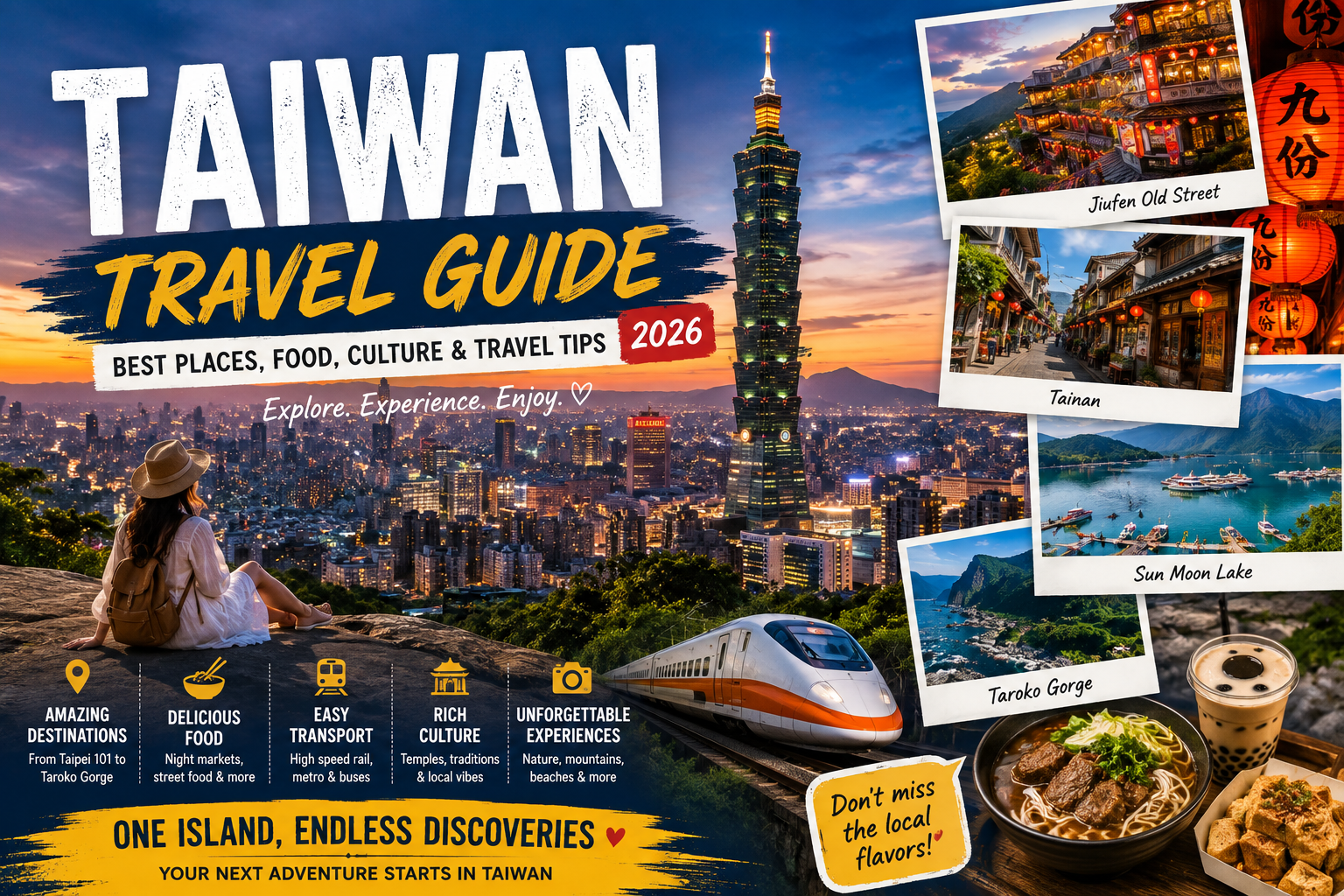
Taiwan travel offers an unusually complete experience in a compact destination, combining modern cities, mountain landscapes, traditional temples, night markets, hot springs, dramatic coastlines, and some of Asia’s most distinctive food culture. For first-time visitors, the secret is not trying to see everything, but building an itinerary that balances Taipei with smaller cities, nature, food, and authentic local experiences Italy Travel
Why Taiwan Travel Is Worth Experiencing
Taiwan appeals to a broad range of travelers because it combines several travel styles in one destination.
A traveler interested in food can spend days exploring restaurants and markets.
A nature lover can hike through mountain landscapes.
A history enthusiast can explore temples, historic streets, museums, and old settlements.
A family can use convenient transportation to create a relatively comfortable itinerary.
A solo traveler can build an independent trip around food, neighborhoods, rail journeys, hiking, and cultural experiences.
A couple can combine boutique hotels, hot springs, scenic towns, tea houses, and coastal escapes.
The unusual part is how close these experiences can be to one another.
Taiwan Travel Combines City and Nature
Many destinations force travelers to choose between urban tourism and nature.
Taiwan does not.
Taipei provides skyscrapers, museums, shopping districts, restaurants, cafés, temples, and night markets, while mountainous areas are accessible from the capital and other cities.
This means a traveler can create an itinerary that changes character every few days.
Taiwan Is More Than Taipei
Taipei is an excellent starting point, but stopping there means missing much of what makes Taiwan distinctive.
Taiwan’s smaller cities and rural areas reveal different aspects of its food, history, architecture, landscapes, and local life.
Cities such as Tainan, Kaohsiung, Taichung, Hualien, and Chiayi can each support different types of travel.
Food Is a Major Reason to Visit
Taiwanese food culture is one of the strongest reasons to visit.
Night markets, breakfast shops, noodle restaurants, tea houses, bakeries, seafood restaurants, dessert shops, dumpling restaurants, and family-run establishments create enormous variety.
The most interesting food experiences are not always found in expensive restaurants.
Often, the best discoveries happen in ordinary neighborhoods.
Understanding Taiwan Before Your First Trip
Taiwan is an island in East Asia located off the southeastern coast of mainland China.
Its geography is important to understand because the island’s eastern and central areas are much more mountainous than the heavily urbanized western corridor.
This affects travel planning.
The Western Corridor
The western side contains many of Taiwan’s major population centers and transportation links.
Taipei, Taoyuan, Hsinchu, Taichung, Chiayi, Tainan, and Kaohsiung are connected by major rail infrastructure.
The Taiwan High Speed Rail operates along this corridor and can significantly reduce travel time between major cities.
The Eastern Side
The east offers a different atmosphere.
Travelers will find dramatic mountains, Pacific coastline, smaller communities, rural landscapes, and opportunities for nature-focused travel.
However, travel in eastern Taiwan can require more planning because terrain and transportation options differ from the western urban corridor.
The Central Mountains
Taiwan’s interior is dominated by mountainous terrain.
This creates opportunities for hiking, scenic drives, forests, waterfalls, tea-growing areas, and mountain villages.
It also means that weather, road conditions, and transportation schedules can affect plans.
Best Time for Taiwan Travel
There is no single perfect season for Taiwan because different regions and activities have different advantages.
Taiwan has a subtropical to tropical climate, and conditions vary considerably by elevation and location.
Spring Travel
Spring can be an appealing period for travelers interested in comfortable sightseeing, nature, flowers, and outdoor activities.
It is also a good time to combine cities with mountain destinations.
Summer Travel
Summer can be hot and humid, particularly in lowland cities.
Travelers should plan around heat, humidity, rainfall, and possible tropical weather systems.
For outdoor activities, early mornings can be more comfortable.
Autumn Travel
Autumn is often attractive for city exploration, food-focused travel, hiking, and scenic trips.
Mountain areas can feel substantially different from urban Taiwan as elevation changes.
Winter Travel
Winter conditions vary.
Northern Taiwan can feel cool and damp, while southern areas are generally warmer.
This makes winter a potentially useful period for travelers who want to combine Taipei with warmer southern destinations.
Typhoon and Severe Weather Considerations
Weather can change quickly, particularly during periods of tropical storms or heavy rainfall.
Travelers should check official weather information close to departure and avoid treating an itinerary as fixed when severe weather threatens.
For mountain trips, weather deserves even more attention because rainfall can affect roads, trails, and transportation.
How Many Days Do You Need in Taiwan?
The ideal trip length depends on your priorities.
Taiwan Travel in 4 Days
Four days works for a concentrated Taipei experience.
You can explore major neighborhoods, food markets, cultural attractions, and perhaps make one day trip.
Trying to cover the entire island in four days would create unnecessary travel pressure.
Taiwan Travel in 7 Days
Seven days is a useful introduction.
A traveler could divide the trip between Taipei and one or two additional destinations.
For example, Taipei could be combined with Jiufen, a mountain destination, or a southern city.
Taiwan Travel in 10 Days
Ten days allows greater variety.
You can combine Taipei, central Taiwan, Tainan or Kaohsiung, and selected nature experiences.
Taiwan Travel in 14 Days
Two weeks allows a much deeper journey.
You can combine major cities, mountain regions, food destinations, cultural towns, and eastern Taiwan without constantly moving.
The important principle is simple:
More days should create more depth, not simply more destinations.
Taipei: The Essential Starting Point
Taipei is the natural entry point for many international visitors.
The city combines modern infrastructure with traditional neighborhoods, temples, markets, museums, restaurants, shopping areas, and mountain scenery.
Taipei 101
Taipei 101 is one of the city’s defining landmarks.
The surrounding district is modern, commercial, and well suited to travelers interested in architecture, shopping, dining, and city views.
National Palace Museum
The National Palace Museum is important for travelers interested in Chinese art, historical objects, ceramics, paintings, calligraphy, and cultural heritage.
Allow enough time rather than treating it as a quick stop.
Longshan Temple
Longshan Temple provides an opportunity to observe religious architecture and traditional spiritual practices within an urban environment.
Visitors should behave respectfully because this is a functioning religious site rather than simply a tourist attraction.
Ximending
Ximending is known for shopping, street culture, entertainment, restaurants, and youthful energy.
It works particularly well for travelers who want an active evening.
Dadaocheng
Dadaocheng offers a different perspective on Taipei.
Historic architecture, traditional businesses, tea culture, markets, and riverside areas make it useful for travelers who prefer neighborhoods over major landmarks.
Taipei Night Markets
Night markets are an important part of Taiwan travel.
Rather than visiting only one famous market, consider exploring a market near where you are staying.
This can provide a more relaxed experience.
Jiufen and the Northern Mountains
Jiufen is one of the most recognizable day-trip destinations from Taipei.
Its narrow lanes, hillside setting, tea houses, food stalls, and historic atmosphere make it visually appealing.
However, popularity also means that timing matters.
Visit Early or Late
Arriving outside the busiest periods can make the experience more enjoyable.
The town’s narrow streets can become crowded.
Combine Jiufen With Nearby Attractions
Instead of treating Jiufen as an isolated stop, travelers can build a northern Taiwan day around several nearby attractions.
This reduces repeated transportation and creates a more coherent itinerary.
Beitou and Taiwan’s Hot Spring Culture
Beitou is a convenient option for travelers who want a hot spring experience without leaving the Taipei area.
Why Hot Springs Matter
Hot springs are part of Taiwan’s broader wellness and bathing culture.
For travelers, they provide an opportunity to slow down after several days of sightseeing.
Build a Rest Day
A common mistake is treating a hot spring visit as another activity to rush through.
A better approach is to make it part of a slower day.
Tamsui and the Riverside
Tamsui offers a different pace from central Taipei.
The riverside, historic areas, food stalls, and sunset atmosphere make it suitable for a relaxed half-day or evening.
It can be especially appealing to travelers who want to escape the intensity of central Taipei without committing to a full-day excursion.
Taichung: Art, Food, and Modern City Life
Taichung is an important city in central Taiwan.
It provides a different urban atmosphere from Taipei and can serve as a base for exploring central Taiwan.
Why Visit Taichung?
Taichung appeals to travelers interested in:
- Contemporary culture
- Cafés
- Food
- Markets
- Architecture
- Art
- Day trips
- Central Taiwan
Taichung as a Base
Because of its location, Taichung can work as a strategic base rather than simply another city on a checklist.
Travelers should decide whether they want to explore the city itself or use it to access surrounding destinations.
Sun Moon Lake
Sun Moon Lake is one of Taiwan’s best-known scenic destinations.
The lake is surrounded by mountains and offers opportunities for cycling, boat trips, walking, cultural exploration, and relaxation.
Why Sun Moon Lake Works for Slow Travel
The area is particularly suitable for travelers who want to reduce the pace.
Instead of trying to see everything in one afternoon, spend a night and allow time for the landscape to become part of the experience.
Cycling Around the Lake
Cycling is a popular way to experience the area.
However, travelers should consider fitness, weather, equipment, and route conditions before committing to a long ride.
Alishan and Mountain Travel
Alishan is associated with mountain scenery, forests, tea-growing areas, rail travel, and sunrise experiences.
It offers a very different atmosphere from Taiwan’s major cities.
Why Alishan Is Special
The appeal comes from the combination of elevation, forest landscapes, cultural history, railways, and mountain communities.
Plan for Weather
Mountain conditions can change quickly.
Pack layers even when the lowland forecast looks warm.
Chiayi: The Gateway to Alishan
Chiayi is often used as a practical gateway for mountain travel.
This creates an interesting itinerary opportunity.
Instead of treating Chiayi merely as a transportation stop, travelers can explore its food and cultural character before continuing into the mountains.
Tainan: Taiwan’s Historic Soul
Tainan is one of the most important destinations for travelers interested in history and food.
The city has deep historical roots and a distinctive culinary identity.
Why Tainan Is Different
Tainan rewards travelers who explore slowly.
Historic lanes, temples, traditional food shops, older architecture, markets, and neighborhood businesses create a layered travel experience.
Tainan Food Travel
Tainan is particularly attractive for food-focused travelers.
Rather than searching only for famous restaurants, try small local establishments and regional specialties.
Food tourism here works best when treated as exploration rather than a checklist.
Kaohsiung: Taiwan’s Southern Energy
Kaohsiung is a major southern city with a warmer climate, waterfront areas, cultural attractions, food, and urban development.
Why Visit Kaohsiung?
Kaohsiung can appeal to travelers who want:
- Warm weather
- Waterfront scenery
- Contemporary art
- Urban exploration
- Food
- Southern Taiwan culture
Kaohsiung as a Two-Night Stop
For a longer Taiwan itinerary, two nights can provide enough time to explore the city without turning the trip into constant hotel changes.
Hualien and Taiwan’s East Coast
Hualien has long been associated with access to some of Taiwan’s most dramatic natural landscapes.
The surrounding region combines mountains, coastline, forests, and outdoor experiences.
Nature Comes First
Travelers visiting Hualien should plan around nature rather than trying to replicate a city itinerary.
Check Conditions Before Traveling
Because eastern Taiwan includes mountainous terrain, travelers should verify current road, trail, rail, and attraction conditions before departure.
Taroko and Mountain Travel Considerations
The Taroko area is famous for dramatic marble gorges and mountain scenery.
However, travelers should never assume that famous trails or roads are open simply because they appear in older travel guides.
Natural disasters, landslides, earthquakes, construction, and weather can affect access.
Always check current official information before planning a visit.
This is an important general lesson for Taiwan travel:
A destination guide can tell you what exists, but only current local information can tell you what is accessible today.
Kenting and Southern Coastal Taiwan
Kenting is associated with beaches, tropical landscapes, coastal scenery, water activities, and a relaxed holiday atmosphere.
It can work well for travelers who want to add several days of coastal relaxation to a broader Taiwan trip.
Beach Travel in Taiwan
Taiwan is not primarily marketed as a beach destination in the same way as some tropical islands, but its coastline offers plenty of opportunities for travelers interested in the sea.
Taiwan’s Islands Beyond the Main Island
Taiwan’s travel landscape extends beyond the main island.
Penghu
Penghu is known for island scenery, coastal landscapes, marine activities, and local culture.
It can be an interesting choice for travelers who have already explored the main island.
Kinmen
Kinmen offers a distinctive cultural and historical environment.
Its location and history give it a different character from Taipei, Tainan, or the east coast.
Travelers should check transportation and entry arrangements when planning island trips.
Taiwan Food Travel
Food deserves its own section because it can easily become the organizing principle of an entire Taiwan trip.
Beef Noodle Soup
Beef noodle soup is one of Taiwan’s best-known comfort foods.
Different restaurants interpret the dish differently, so trying it in several places can be more interesting than searching for one supposedly definitive version.
Xiao Long Bao
Soup dumplings are strongly associated with Taiwan’s food scene and are widely available.
Beef Rolls
Beef rolls combine thin pancakes, beef, scallions, and sauce.
They are popular street-food choices and easy to include in a food-focused itinerary.
Scallion Pancakes
Scallion pancakes are another popular street food.
They demonstrate an important feature of Taiwanese food culture: simple ingredients can become remarkably satisfying when technique is excellent.
Gua Bao
Gua bao are steamed buns commonly filled with meat, herbs, peanuts, and other ingredients.
They can be found in restaurants and street-food settings.
Stinky Tofu
Stinky tofu is one of Taiwan’s most recognizable foods.
The smell can be intense, but the flavor and texture can be surprisingly different from what first-time visitors expect.
Bubble Tea
Taiwan is strongly associated with bubble tea, and trying different versions can become a fun part of a trip.
Night Market Desserts
Taiwan’s night markets offer a wide range of sweet foods, shaved ice, pastries, fruit-based desserts, and drinks.
Taiwan Tea Culture
Tea is an important part of Taiwan’s cultural and agricultural identity.
Travelers can experience tea through:
- Tea houses
- Mountain tea regions
- Tea tastings
- Tea shops
- Traditional brewing
- Tea-based desserts
Tea Tourism
A tea-focused day can provide a slower alternative to conventional sightseeing.
Instead of rushing from attraction to attraction, travelers can visit a tea-growing region, learn about production, taste different varieties, and enjoy the surrounding landscape.
Taiwan Night Markets
Night markets are not simply shopping areas.
They function as social, culinary, and entertainment spaces.
How to Explore a Night Market
Do not arrive expecting to eat one complete meal.
Instead, share small portions and try several foods.
This creates a more varied experience.
Go With an Open Mind
Some foods may look unfamiliar.
That is part of the adventure.
Taiwan Travel Transportation Guide
Transportation is one of Taiwan’s strongest advantages for independent travelers.
Taiwan High Speed Rail
The High Speed Rail connects 12 stations along the western corridor and can reach speeds of up to 300 km/h.
This makes it particularly useful for multi-city itineraries.
The official Taiwan High Speed Rail system provides current schedules, ticketing information, stations, and booking services.
Taiwan Railway
Taiwan Railway provides another important rail network and can be useful for routes and destinations not directly served by high-speed rail.
Taipei Metro
The Taipei Metro is particularly useful for visitors staying in Taipei.
It connects major neighborhoods and reduces the need for taxis during ordinary sightseeing.
Buses
Buses become increasingly important outside major cities.
For rural destinations, check the latest timetable rather than assuming services operate frequently.
Taxis and Ride Services
Taxis can be useful when carrying luggage, traveling with family, or reaching locations that are poorly connected by public transport.
Rental Cars
A rental car can be useful in rural areas but is not always necessary in major cities.
Consider traffic, parking, driving regulations, language, insurance, and road conditions before renting.
Taiwan PASS and Multi-Modal Travel
Taiwan’s Tourism Administration announced an upgraded Taiwan PASS in 2026, with High Speed Rail and Taiwan Railway versions and integration with metropolitan MRT systems and scenic-area shuttle services.
This is particularly relevant to travelers planning multi-city journeys.
However, do not automatically buy a pass simply because it exists.
Compare the pass cost against your actual itinerary.
A simple point-to-point ticket may be better for some trips.
Taiwan Travel Costs
Taiwan can work for different budgets.
The final cost depends heavily on accommodation, transportation, dining style, activities, and season.
Budget Taiwan Travel
Budget travelers can reduce costs by choosing guesthouses, simple hotels, local restaurants, public transportation, and free attractions.
Mid-Range Taiwan Travel
Mid-range travelers can combine comfortable hotels with local dining, paid attractions, rail travel, and occasional private transportation.
Luxury Taiwan Travel
Luxury travelers can choose premium hotels, private guides, high-end dining, spa experiences, private transfers, and customized excursions.
The important point is that Taiwan’s food and public transportation allow travelers to spend selectively.
How to Save Money in Taiwan
Eat Local
Local restaurants can provide excellent meals without premium pricing.
Use Public Transportation
Public transport can reduce the cost of taxis and private transfers.
Stay Near Transportation
A slightly more expensive hotel near a major station can sometimes save money and time.
Avoid Constant Hotel Changes
Moving every night creates hidden costs through transportation, luggage handling, and lost sightseeing time.
Taiwan Travel for Solo Travelers
Taiwan can be a rewarding destination for solo travelers who enjoy independent exploration.
Why Solo Travel Works
Food markets, public transportation, cafés, museums, neighborhoods, and hiking can all be enjoyed without a group.
Plan a Flexible Schedule
Solo travelers should avoid creating an itinerary so rigid that there is no room for spontaneous discoveries.
Taiwan Travel for Couples
Couples can build a Taiwan itinerary around food, tea, hot springs, scenic towns, mountain stays, boutique hotels, and coastal experiences.
Romantic Taiwan Experiences
Consider:
- Hot spring stays
- Scenic mountain accommodation
- Tea-house visits
- Sunset walks
- Private dining
- Coastal excursions
- Slow city exploration
The strongest romantic experiences often involve slowing down rather than adding more activities.
Taiwan Travel for Families
Taiwan can work well for families because transportation, food, urban infrastructure, and attraction variety allow parents to mix activities.
Keep Travel Days Short
Children often tolerate sightseeing better when transportation and activity periods are broken into manageable sections.
Choose Convenient Hotels
Being near transportation and restaurants can be more valuable than having the most famous hotel.
Mix Educational and Fun Experiences
Museums, temples, markets, nature areas, rail travel, and food experiences can create variety.
Taiwan Travel for Seniors
Older travelers may benefit from a slower itinerary.
Limit Hotel Changes
Choose fewer bases and take day trips where practical.
Consider Accessibility
Check stairs, elevators, walking distances, trail conditions, and transportation requirements in advance.
Prioritize Comfort
A comfortable hotel in a convenient location may provide more value than a cheaper property requiring long daily transfers.
Taiwan Travel for Food Lovers
Food travelers should avoid creating an itinerary based only on famous restaurants.
Follow Neighborhoods
Explore where locals eat.
Try Different Price Levels
Combine night-market snacks with traditional restaurants and contemporary dining.
Explore Regional Food
Tainan, Taipei, Taichung, Kaohsiung, and other regions have different culinary identities.
Taiwan Travel for Nature Lovers
Nature travelers should look beyond famous attractions.
Mountains
Taiwan’s mountainous geography creates extensive opportunities for hiking and scenic travel.
Coastlines
The island offers Pacific and other coastal landscapes with different characteristics.
Forests
Mountain forests provide cooler environments and distinctive ecosystems.
Hot Springs
Hot spring destinations can combine nature with relaxation.
Taiwan Travel for Luxury Travelers
Luxury travel in Taiwan does not need to imitate Dubai or Singapore.
Its strength is experiential.
Luxury Hotels
Taipei offers international luxury hotels, while other destinations provide resorts, boutique properties, and scenic accommodations.
Private Guides
A private guide can provide deeper access to history, food, architecture, and local culture.
Private Transportation
This can be useful for rural destinations where public transportation is less frequent.
Luxury Food Experiences
Taiwan’s culinary scene can support both fine dining and highly personalized food experiences.
Taiwan Travel for Digital Nomads and Remote Workers
Travelers combining tourism with remote work should consider internet reliability, accommodation workspace, noise levels, and visa conditions.
A tourist trip should not automatically be treated as authorization to work.
Immigration and employment rules should be checked according to nationality and activity.
Taiwan Visa and Entry Requirements
Visa rules depend on nationality, passport type, purpose, and current policy.
Some nationalities qualify for visa-exempt entry, while others require a visitor visa.
Taiwan’s Bureau of Consular Affairs currently lists eligible visa-exempt nationalities and conditions, including passport validity requirements.
Travelers should never rely on an old blog post for entry requirements.
Travelers From Pakistan
Pakistani passport holders should pay particular attention to Taiwan’s current visa procedures.
Pakistan is included among the designated nationalities subject to specific visitor-visa procedures.
Taiwan’s official tourism visitor-visa information lists requirements including an application form, photographs, passport validity, proof of financial resources, travel itinerary, and return-ticket evidence, while additional documents may be requested.
Because immigration rules can change, Pakistani travelers should verify the latest requirements with Taiwan’s official Bureau of Consular Affairs or the appropriate overseas mission before booking non-refundable arrangements.
Online Arrival Information
Taiwan’s National Immigration Agency provides an Online Arrival Card service for foreign visitors.
Travelers should check the official instructions before departure rather than assuming that procedures remain unchanged from an earlier trip.
Taiwan Travel Safety
Taiwan is generally regarded by travelers as a highly organized destination, but no destination is risk-free.
Earthquakes
Taiwan is located in a seismically active region.
Travelers should understand basic earthquake safety and follow local instructions during an event.
Typhoons
Tropical weather can disrupt flights, ferries, trains, roads, and attractions.
Never continue with a mountain or coastal itinerary simply because you already paid for it.
Safety comes first.
Mountain Safety
Hiking requires preparation.
Carry water, suitable footwear, weather-appropriate clothing, communication equipment, and sufficient time.
Food Safety
Use normal food-safety precautions, especially with unfamiliar foods or improperly stored products.
Taiwan Travel Etiquette
Temple Etiquette
Dress and behave respectfully.
Avoid loud conversations and disruptive photography.
Queueing
Follow local queues and transportation procedures.
Public Transportation
Keep noise low and follow posted rules.
Dining
Some restaurants have specific ordering systems.
Observe what other diners do if instructions are unclear.
Tipping
Tipping customs differ from country to country.
Do not assume that American-style tipping expectations apply everywhere.
Check the restaurant or service provider’s actual policy.
Common Taiwan Travel Mistakes
Trying to See the Entire Island Too Quickly
Taiwan may look small on a map, but mountains and transportation connections affect travel time.
Solution: Choose a few regions and explore them properly.
Spending the Entire Trip in Taipei
Taipei is excellent, but Taiwan is much larger culturally than its capital.
Solution: Add at least one regional destination if your trip length allows.
Ignoring Weather
Outdoor plans can be disrupted by heavy rain, storms, or mountain conditions.
Solution: Keep alternative activities available.
Booking Every Day in Advance
A completely fixed itinerary can make travel stressful.
Solution: Pre-book important accommodation and time-sensitive experiences, but leave some flexibility.
Following Social Media Trends Blindly
An attraction can become famous online without being the best experience for you.
Solution: Ask whether it matches your interests.
Assuming Old Travel Information Is Still Accurate
Transport routes, attraction access, visa requirements, and operating conditions can change.
Solution: Verify current information before departure.
Pros and Cons of Taiwan Travel
Advantages of Taiwan Travel
Taiwan offers excellent food variety, strong transportation infrastructure, diverse landscapes, rich cultural experiences, modern cities, traditional neighborhoods, mountain travel, hot springs, and opportunities for both independent and guided exploration.
The country’s compact geography can make it possible to combine urban and nature experiences within one trip.
Challenges of Taiwan Travel
The weather can be unpredictable.
Mountain destinations require more planning.
English availability can vary outside major tourist areas.
Popular attractions can become crowded.
Travelers with limited time may struggle to decide which regions to prioritize.
These are manageable challenges when the itinerary is designed realistically.
Ten Travel Brands and Services to Know for Taiwan Travel
The following comparison focuses on transportation, aviation, and accommodation brands that can be relevant when planning a Taiwan trip. They are not ranked from best to worst because they serve different purposes.
| Brand | Category | Best For | Main Strength | Consideration |
|---|---|---|---|---|
| EVA Air | Airline | International visitors | Extensive Taiwan connectivity and premium cabins | Compare routes and fares |
| China Airlines | Airline | International and regional flights | Major Taiwan-based carrier | Route availability varies |
| STARLUX Airlines | Airline | Premium-focused travelers | Modern premium positioning | Network is more limited than older carriers |
| Taiwan High Speed Rail | Rail | Western Taiwan city travel | Fast intercity transportation | Does not cover every region |
| Taiwan Railways | Rail | Regional travel | Broad conventional rail network | Journey times vary |
| Taipei Metro | Urban transit | Taipei sightseeing | Efficient city transportation | Mainly useful within metro area |
| Mandarin Oriental Taipei | Hotel | Luxury travelers | High-end city hospitality | Premium pricing |
| Grand Hyatt Taipei | Hotel | Business and leisure | Central luxury accommodation | Large hotel environment |
| Regent Taipei | Hotel | Luxury city stays | Upscale service and location | Compare room categories carefully |
| Taiwan PASS | Travel pass | Multi-city visitors | Integrated transport options | Value depends on itinerary |
The best choice depends on your route rather than brand reputation alone.
How to Build a Taiwan Travel Itinerary
A strong itinerary should follow geography.
Step One: Choose Your Arrival City
Most international travelers begin in the Taipei area, but route availability varies by origin.
Step Two: Decide Your Travel Personality
Choose whether the trip is mainly:
- Food-focused
- Cultural
- Nature-focused
- Family-oriented
- Romantic
- Luxury
- Budget
- Adventure-based
Step Three: Choose Two or Three Regional Anchors
For example:
Taipei + Tainan + Kaohsiung
or
Taipei + Sun Moon Lake + Alishan
or
Taipei + Hualien + southern Taiwan
Step Four: Add Day Trips Carefully
Day trips are useful, but too many can turn the trip into a transportation marathon.
Step Five: Protect Free Time
Keep at least a few periods open.
A Sample 7-Day Taiwan Itinerary
Day One: Arrive in Taipei
Check into your accommodation, recover from the flight, explore your neighborhood, and have an easy dinner.
Day Two: Taipei Culture
Explore a temple, museum, historic neighborhood, and local food district.
Day Three: Taipei Food and Night Markets
Use the day for neighborhoods, cafés, shopping, and a night market.
Day Four: Northern Taiwan
Take a day trip toward Jiufen and nearby northern attractions, adjusting the plan according to weather and crowd levels.
Day Five: Travel South
Use high-speed rail to reach a southern or central destination.
The Taiwan Tourism Administration confirms the western high-speed rail corridor connects major stations from Nangang through Taipei, Taoyuan, Hsinchu, Miaoli, Taichung, Changhua, Yunlin, Chiayi, Tainan, and Zuoying.
Day Six: Explore Regional Taiwan
Focus on food, culture, historical areas, or nature.
Day Seven: Return and Depart
Allow sufficient transportation time for your international departure.
A Sample 10-Day Taiwan Itinerary
Days One to Three: Taipei
Spend three nights exploring Taipei rather than rushing through every landmark.
Day Four: Northern Taiwan
Explore Jiufen or another northern destination.
Days Five and Six: Central Taiwan
Move south and explore Taichung, Sun Moon Lake, or another central destination.
Days Seven and Eight: Tainan
Focus on historic neighborhoods and food.
Day Nine: Kaohsiung
Explore southern Taiwan’s urban and waterfront environment.
Day Ten: Return to Taipei
Travel back according to your flight schedule and allow a buffer.
A Sample 14-Day Taiwan Itinerary
Days One to Four: Taipei
Explore the capital deeply.
Days Five and Six: Northern Mountains
Use a slower itinerary around northern mountain and hot spring areas.
Days Seven and Eight: Central Taiwan
Visit Sun Moon Lake or another central destination.
Days Nine and Ten: Alishan or Chiayi
Explore mountain landscapes and tea culture.
Days Eleven and Twelve: Tainan
Focus on food and history.
Day Thirteen: Kaohsiung
Explore the south.
Day Fourteen: Departure
Return to the airport with a generous buffer.
This structure is deliberately slower than itineraries that attempt to cover every major attraction.
How to Make Taiwan Travel More Authentic
Authentic travel does not mean avoiding all tourist attractions.
It means allowing room for ordinary life.
Stay in Neighborhoods Taiwan Travel
Instead of choosing accommodation solely because it is near a famous landmark, consider staying in a neighborhood with restaurants, markets, cafés, and public transport.
Eat Where Locals Eat Taiwan Travel
A small neighborhood restaurant can be as memorable as a famous dining destination.
Learn Basic Mandarin Phrases Taiwan Travel
Even a few phrases can improve communication.
Simple greetings and polite expressions demonstrate effort.
Visit During Local Events Taiwan Travel
Taiwan’s Tourism Administration maintains a biennial tourism calendar featuring major events and activities across the country. The 2026–2027 calendar includes 109 selected events, with criteria including local culture, off-peak opportunities, sustainability, and regional tourism development.
Taiwan Travel and Sustainable Tourism
Sustainability is becoming more relevant to destination planning.
Use Public Transportation Taiwan Travel
Rail and public transit can reduce dependence on private vehicles.
Stay Longer Taiwan Travel
Longer stays can create deeper experiences while reducing the number of repeated journeys.
Support Local Businesses Taiwan Travel
Eat at local establishments, purchase locally produced goods, and use local guides where appropriate.
Respect Natural Areas Taiwan Travel
Do not remove rocks, plants, wildlife, or cultural objects.
Follow trail and environmental regulations.
The Future of Taiwan Travel
Taiwan’s tourism strategy is increasingly emphasizing regional travel, sustainable tourism, cultural experiences, and improved transportation integration.
The updated Taiwan PASS is one example of efforts to make cross-regional travel easier by integrating rail and urban transportation.
The 2026–2027 tourism calendar also emphasizes sustainability, regional awareness, cultural connection, and off-peak tourism.
These developments suggest that Taiwan’s tourism future will not depend only on Taipei.
More Regional Travel Taiwan Travel
Visitors are likely to discover more smaller cities, rural areas, islands, mountain communities, and coastal destinations.
More Experiential Tourism Taiwan Travel
Food, tea, crafts, culture, nature, and local workshops can become more important than traditional sightseeing.
More Sustainable Transportation Taiwan Travel
Integrated rail and public transportation can make multi-region travel easier.
More Personalized Travel
Travelers increasingly expect itineraries based on their interests rather than generic packages.
Why Slow Travel May Be the Best Way to See Taiwan
Taiwan rewards travelers who slow down.
A traveler who spends two hours exploring a market, three hours eating and talking with locals, and an afternoon walking through a neighborhood may experience more of Taiwan than someone who visits six landmarks in a single day.
This is the central philosophy behind a strong Taiwan itinerary:
Do less, but experience it better.
The Taiwan Travel Decision Framework
Before booking anything, answer five questions.
What Do I Want to Feel?
Relaxed?
Excited?
Inspired?
Connected?
Adventurous?
What Do I Want to Eat?
If food is your priority, dedicate more time to Tainan, Taipei, markets, and regional cuisine.
What Do I Want to See?
Cities?
Mountains?
Coastlines?
Temples?
Tea farms?
How Much Travel Time Can I Handle?
A trip that looks efficient on a map may feel exhausting in reality.
What Should I Leave Unplanned?
This is often the most important question.
Leave space for discovery.
Taiwan Travel Packing Guide
Clothing Taiwan Travel
Pack according to season and region.
Layering is useful because temperatures can differ between cities and mountains.
Rain Protection Taiwan Travel
A compact umbrella or rain jacket can be useful.
Comfortable Shoes Taiwan Travel
Taiwan travel often involves walking through stations, markets, historic neighborhoods, and urban streets.
Power Adapter Taiwan Travel
International travelers should check Taiwan’s electrical standards and bring the appropriate adapter for their devices.
Reusable Water Bottle Taiwan Travel
A reusable bottle can be convenient, especially during outdoor activities.
Small Day Bag Taiwan Travel
A compact backpack or crossbody bag is useful for daily sightseeing.
Taiwan Travel Technology Tips Taiwan Travel
Offline Maps Taiwan Travel
Download important maps before leaving your hotel.
Translation Tools Taiwan Travel
A translation app can help when communication becomes difficult.
Digital Reservations Taiwan Travel
Keep important bookings accessible offline.
Mobile Connectivity Taiwan Travel
Consider a suitable SIM or eSIM option if your phone supports it.
Battery Power Taiwan Travel
Long travel days can drain a phone quickly.
A power bank can be useful.
How to Handle Language Barriers Taiwan Travel
English is more common in major tourist areas, hotels, transport hubs, and international businesses, but travelers should not assume everyone speaks English.
Use Simple Communication Taiwan Travel
Short sentences and visual references often work better than complicated explanations.
Keep Addresses in Chinese Taiwan Travel
Having your destination’s Chinese address available can be useful when taking a taxi.
Learn Basic Courtesy Taiwan Travel
Simple Mandarin greetings and thank-you expressions can make interactions easier.
What Not to Do in Taiwan
Do not assume every attraction is open simply because it appears in an old guide.
Do not ignore weather warnings.
Do not disrespect temples or religious ceremonies.
Do not litter in natural areas.
Do not build an itinerary with impossible transfer times.
Do not treat social-media popularity as a guarantee of quality.
Do not forget to check your specific visa requirements.
FAQs
Is Taiwan good for tourists?
Yes. Taiwan offers a strong combination of cities, food, culture, mountains, coastline, transportation, hot springs, and independent travel opportunities. Its compact geography also makes it possible to experience several travel styles within one trip.
How many days are enough for Taiwan?
Seven to ten days can provide a good first introduction, while two weeks allows travelers to explore more regions at a slower pace. Four days is more suitable for a concentrated Taipei trip.
What is the best month to visit Taiwan?
There is no single best month for everyone. Spring and autumn can be attractive for comfortable sightseeing and outdoor activities, while winter and summer have their own advantages and weather considerations. Travelers should consider the specific regions they plan to visit.
Is Taiwan expensive to visit?
Taiwan can accommodate budget, mid-range, and luxury travelers. Local food and public transportation can help keep costs manageable, while premium hotels, private guides, and luxury experiences can substantially increase the budget.
Is Taipei worth visiting?
Absolutely. Taipei provides a combination of food, culture, shopping, museums, temples, modern architecture, neighborhoods, and public transportation that makes it an excellent introduction to Taiwan.
What are the best places to visit in Taiwan?
Popular choices include Taipei, Jiufen, Tainan, Kaohsiung, Sun Moon Lake, Alishan, Taichung, Hualien, and Kenting. The best selection depends on whether your priority is food, culture, nature, beaches, hiking, or city travel.
Is Taiwan good for solo travel?
Yes. Public transportation, food culture, museums, neighborhoods, markets, and independent sightseeing make Taiwan suitable for solo travelers who enjoy flexible itineraries.
Is Taiwan good for families?
Taiwan can be a good family destination because of its transportation options, food variety, urban infrastructure, and mix of educational and recreational attractions. Families should avoid overly ambitious itineraries.
Is Taiwan good for couples?
Yes. Couples can combine food, hot springs, boutique hotels, mountain scenery, tea experiences, coastal destinations, and relaxed city exploration.
Is Taiwan safe for travelers?
Travelers should use normal precautions and stay informed about weather, earthquakes, transportation, hiking conditions, and local regulations. Mountain and coastal trips require additional attention to current conditions.
Do I need a visa to visit Taiwan?
It depends on your nationality, passport, purpose, and current Taiwanese immigration policy. Some nationalities qualify for visa-exempt entry, while others require a visitor visa. The official Bureau of Consular Affairs should be checked before travel.
Do Pakistani citizens need a Taiwan visa?
Pakistani citizens should expect to follow Taiwan’s applicable visitor-visa procedures unless they qualify under a specific current exemption or special arrangement. Pakistan is listed among nationalities subject to designated-country visitor-visa procedures.
What documents may Pakistani travelers need?
Taiwan’s official visitor-visa information lists documents such as a completed application, photographs, a passport with appropriate validity, proof of financial resources, travel itinerary, and return-ticket evidence. Additional documentation may be requested.
Is Taiwan High Speed Rail useful for tourists?
Yes. Taiwan High Speed Rail is particularly useful for traveling between major destinations along the western corridor. The Tourism Administration lists 12 stations from Nangang to Zuoying and notes maximum operating speeds of up to 300 km/h.
Can I travel around Taiwan without renting a car?
Yes. Major cities and the western corridor can be explored effectively using rail and public transportation. A car may become more useful for certain rural or remote areas, depending on the itinerary.
What food should I try in Taiwan?
Consider beef noodle soup, soup dumplings, scallion pancakes, beef rolls, gua bao, stinky tofu, bubble tea, Taiwanese breakfast foods, seafood, shaved ice, and night-market snacks.
Are Taiwan night markets worth visiting?
Yes. Night markets provide an easy way to experience local food, shopping, street culture, and evening entertainment. Visit with an appetite for small portions so you can try several dishes.
Should I visit Taipei or Tainan?
Both are valuable but offer different experiences. Taipei is larger, more modern, and packed with museums, shopping, nightlife, and diverse neighborhoods. Tainan is especially attractive for history, traditional culture, and food.
Is Jiufen worth visiting?
Jiufen can be worthwhile for its hillside setting, historic atmosphere, tea houses, food, and scenery. However, crowds can affect the experience, so timing matters.
Is Sun Moon Lake worth visiting?
Yes, particularly for travelers interested in scenic landscapes, cycling, lake views, cultural experiences, and slower travel.
Is Alishan worth visiting?
Alishan is particularly attractive to travelers interested in mountain landscapes, forests, tea culture, scenic rail experiences, and sunrise views. Weather and transportation should be checked before travel.
Can I visit Taiwan on a budget?
Yes. Travelers can reduce costs through local accommodation, public transportation, neighborhood restaurants, markets, free attractions, and careful itinerary planning.
What should I pack for Taiwan?
Comfortable walking shoes, season-appropriate clothing, rain protection, travel documents, electronics, an appropriate power adapter, and a small day bag are useful starting points. Mountain trips require additional layers and outdoor equipment.
Is Taiwan good for luxury travel?
Yes. Taiwan offers luxury hotels, premium dining, private guides, scenic resorts, wellness experiences, hot springs, cultural activities, and customized transportation. Luxury travel is particularly strong when centered on food, culture, nature, and personalized service.
What is the biggest Taiwan travel mistake?
The biggest mistake is often trying to cover too much territory too quickly. Taiwan rewards travelers who spend enough time in each destination to experience its food, neighborhoods, landscapes, and culture.
Conclusion
Taiwan is the kind of destination that becomes more interesting the longer you stay .At first, you may notice Taipei’s skyline, night markets, temples, shopping streets, and restaurants.Then you discover the mountains. Then the tea regions. Then the hot springs. Then the historic streets of Tainan. Then the food becomes a reason to travel from one neighborhood to another. Then you realize that Taiwan’s greatest strength is not any single attraction