
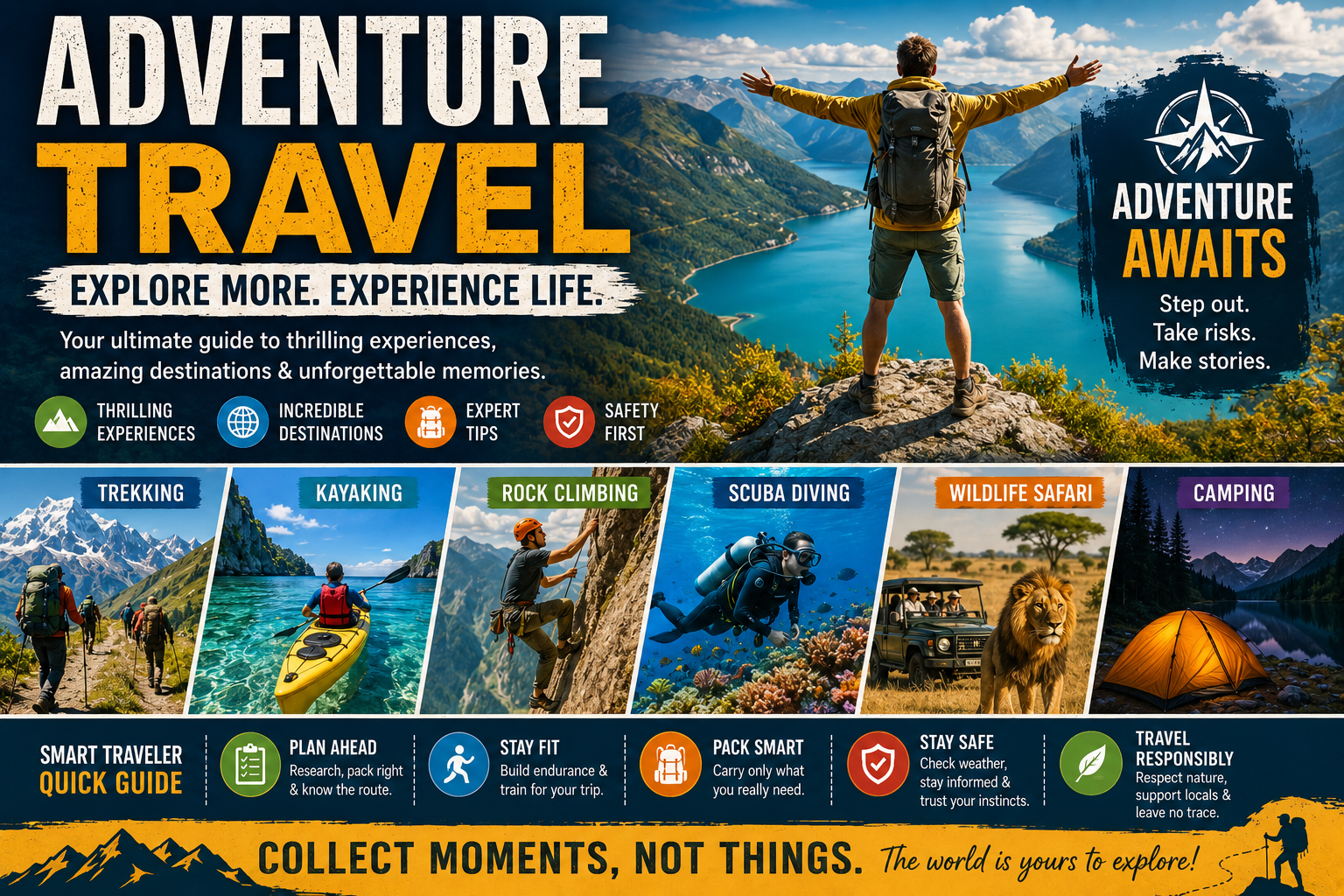
Adventure travel combines exploration, physical activity, cultural discovery, and meaningful experiences beyond conventional vacations. Whether you want to trek through mountains, dive into clear oceans, cycle across remote landscapes, explore deserts, or experience wildlife in its natural habitat, the right preparation can turn an exciting journey into a safe and unforgettable adventure Europe Travel
What Is Adventure Travel?
Adventure travel is a form of tourism centered around active exploration, unusual environments, physical activities, cultural experiences, or encounters with nature.
A traditional vacation might involve arriving at a destination, visiting major attractions, eating at restaurants, and relaxing at a hotel.
Adventure travel changes the emphasis.
The journey itself becomes part of the destination.
You might travel through a mountain region on foot instead of by car. You might explore a coastline by kayak instead of taking a sightseeing bus. You might cycle between villages rather than traveling directly between cities.
Adventure does not have to mean climbing Mount Everest.
It can mean:
- Hiking
- Trekking
- Camping
- Cycling
- Kayaking
- Rafting
- Scuba diving
- Snorkeling
- Surfing
- Skiing
- Snowboarding
- Wildlife safaris
- Desert expeditions
- Mountain journeys
- Sailing
- Caving
- Rock climbing
- Cultural expeditions
- Food-focused exploration
- Remote road trips
- Multi-day wilderness journeys
The defining feature is usually active participation and exploration.
Why Is Adventure Travel Becoming So Popular?
Modern travelers increasingly want experiences rather than possessions.
A conventional holiday can be enjoyable, but travelers often remember a difficult hike, a conversation with a local family, a sunrise over a mountain range, or a wildlife encounter more vividly than another afternoon beside a hotel pool.
Several factors are supporting the popularity of adventure travel.
Experiences Have Become More Valuable
People increasingly want travel to produce memories, personal growth, photographs, stories, and meaningful experiences.
Adventure travel naturally provides these elements.
Travelers Want Authentic Experiences
Major tourist attractions can become crowded.
Adventure travelers often look for quieter alternatives.
Instead of visiting only a famous city, they may explore surrounding villages, national parks, hiking routes, coastlines, or rural regions.
Outdoor Recreation Is More Accessible
Technology has made outdoor recreation easier to plan.
Travelers can use:
- Digital maps
- GPS devices
- Weather applications
- Satellite communication
- Online trail information
- Travel communities
- Fitness trackers
- Offline navigation
- Translation applications
However, technology should support preparation rather than replace basic outdoor skills.
Social Media Influences Destination Choices
Photographs and videos can inspire people to visit remote mountains, deserts, waterfalls, beaches, caves, and national parks.
The positive side is inspiration.
The negative side is that social media can make difficult environments appear deceptively easy.
A beautiful photograph rarely shows:
- Bad weather
- Exhaustion
- Navigation problems
- Altitude
- Cold temperatures
- Long approaches
- Emergency procedures
Responsible travelers learn to separate visual inspiration from practical reality.
Different Types of Adventure Travel
Adventure travel is not one activity.
It is a broad category containing experiences for different fitness levels, interests, budgets, and comfort zones.
Hiking and Trekking
Hiking is among the most accessible forms of adventure travel.
You can find trails ranging from easy walks lasting an hour to multi-week expeditions.
Trekking generally involves longer journeys, often through mountainous or remote environments.
Popular trekking regions include:
- Himalayas
- Alps
- Andes
- Rockies
- Patagonia
- Caucasus
- Atlas Mountains
- New Zealand
- Japanese mountain regions
Beginner Hiking Adventures
Beginners should start with:
- Short distances
- Well-marked trails
- Moderate elevation
- Reliable weather
- Accessible emergency services
A five-hour hike with manageable elevation may be a better first adventure than immediately attempting a multi-day high-altitude trek.
Multi-Day Trekking
Multi-day trekking introduces additional challenges.
You must consider:
- Accommodation
- Food
- Water
- Navigation
- Weather
- Pack weight
- Hygiene
- Recovery
- Emergency planning
The difficulty of a trek depends on more than distance.
A 15-kilometer mountain route can be considerably harder than a 25-kilometer flat route.
Mountain Adventure Travel
Mountain environments provide some of the world’s most dramatic adventure experiences.
They also demand respect.
Altitude, rapidly changing weather, cold temperatures, steep terrain, rockfall, snow, and limited emergency access can increase risk.
Popular mountain destinations include:
- Nepal
- Pakistan
- Switzerland
- Austria
- France
- Italy
- Canada
- United States
- Peru
- Chile
- New Zealand
- Georgia
High-Altitude Travel
Altitude deserves special attention.
The human body needs time to adapt to lower oxygen availability at higher elevations.
Travelers heading into high mountains should research:
- Elevation gain
- Sleeping altitude
- Acclimatization schedule
- Weather
- Emergency evacuation
- Medical support
Fitness alone does not guarantee successful altitude adaptation.
This is one reason experienced operators build acclimatization days into high-altitude itineraries.
Water-Based Adventure Travel
Water creates another enormous category of adventure travel.
Kayaking
Kayaking can range from calm lake paddling to technical sea and whitewater environments.
Beginners should start in controlled conditions with appropriate instruction.
Rafting
Whitewater rafting combines teamwork, water movement, physical activity, and wilderness scenery.
Difficulty is commonly described using river classifications, but local conditions can change the practical difficulty of a route.
Scuba Diving
Scuba diving provides access to an underwater world that most travelers never experience.
Popular diving regions include:
- Red Sea
- Great Barrier Reef
- Indonesia
- Philippines
- Maldives
- Caribbean
- Mexico
- Pacific islands
Divers should consider certification requirements, local conditions, currents, depth, equipment, and operator safety standards.
Surfing
Surfing can be both relaxing and physically demanding.
Beginners should prioritize:
- Professional instruction
- Appropriate boards
- Suitable beaches
- Weather awareness
- Rip-current knowledge
Wildlife Adventure Travel
Wildlife tourism allows travelers to observe animals in natural environments.
Examples include:
- African safaris
- Whale watching
- Gorilla trekking
- Birdwatching
- Marine wildlife expeditions
- Polar journeys
- Orangutan encounters
- Turtle conservation trips
The most responsible wildlife tourism keeps the welfare of animals above visitor entertainment.
Responsible Wildlife Encounters
Avoid operators that:
- Encourage touching wild animals
- Feed wildlife unnecessarily
- Force unnatural interactions
- Crowd animals
- Ignore distance regulations
- Promote exploitative animal experiences
A good wildlife experience should leave the animal’s behavior largely undisturbed.
Desert Adventure Travel
Deserts can produce some of the most memorable adventure experiences.
Popular desert environments include:
- Sahara
- Arabian Desert
- Wadi Rum
- Namib
- Atacama
- Gobi
- Thar
- Australian deserts
Activities can include:
- Camel journeys
- 4×4 expeditions
- Hiking
- Sandboarding
- Stargazing
- Camping
- Photography
- Cultural experiences
Desert Safety
Desert environments create a dangerous misconception.
They may look empty and peaceful, but dehydration, heat exposure, navigation problems, and sudden weather changes can become serious problems.
Carry adequate water and follow local guidance.
Polar and Cold-Weather Adventures
For travelers seeking extreme landscapes, polar and subpolar regions offer unique experiences.
Adventure activities may include:
- Expedition cruising
- Sea kayaking
- Snowshoeing
- Wildlife observation
- Glacier exploration
- Cross-country skiing
Cold environments require careful preparation because exposure can become dangerous quickly.
Layering is more important than simply bringing one extremely thick jacket.
Cycling Adventure Travel
Cycling allows travelers to cover more distance than walking while remaining closely connected to the environment.
Popular cycling destinations include:
- Vietnam
- Japan
- Italy
- France
- Spain
- New Zealand
- Taiwan
- Netherlands
- Portugal
- Morocco
Cycling trips can range from relaxed countryside journeys to demanding mountain expeditions.
Why Cycling Is Special
Cycling provides a useful middle ground.
You move slowly enough to notice local landscapes while traveling far enough to experience geographic changes within a single trip.
Cultural Adventure Travel
Adventure does not always require extreme physical activity.
Cultural immersion can be adventurous because it takes travelers outside familiar routines.
Examples include:
- Staying with local families
- Learning traditional crafts
- Cooking regional food
- Visiting rural communities
- Learning traditional music
- Participating in community projects
- Exploring local markets
- Traveling through less-touristed regions
Cultural Respect
Responsible cultural adventure means observing rather than treating communities as attractions.
Learn basic local etiquette before arriving.
Understand appropriate photography practices.
Ask before photographing people.
Respect religious sites and community traditions.
Best Adventure Travel Destinations Around the World
The world offers an enormous variety of adventure environments.
Nepal
Nepal is one of the world’s best-known destinations for mountain trekking.
The Himalayas offer journeys ranging from accessible foothill hikes to demanding high-altitude expeditions.
Popular regions include:
- Everest
- Annapurna
- Langtang
- Manaslu
Nepal is particularly attractive to travelers interested in combining mountain landscapes with local culture.
Pakistan
Pakistan offers remarkable adventure opportunities across the northern mountain regions.
The country is home to some of the world’s highest peaks and dramatic landscapes.
Adventure travelers can explore:
- Hunza Valley
- Skardu
- Gilgit
- Naltar
- Fairy Meadows
- Deosai
- Chitral
- Karakoram regions
The Karakoram is particularly important for mountaineering and trekking.
Travelers should always check current local conditions, permits, access rules, weather, and professional guiding requirements before undertaking remote journeys.
New Zealand
New Zealand is exceptionally well suited to adventure travel.
Its landscape provides opportunities for:
- Hiking
- Kayaking
- Mountain biking
- Skiing
- Bungee jumping
- Rafting
- Scenic road trips
- Wildlife experiences
Its combination of mountains, coastlines, forests, lakes, and relatively developed tourism infrastructure makes it attractive to both beginners and experienced travelers.
Switzerland
Switzerland combines dramatic alpine scenery with strong transportation infrastructure.
Adventure activities include:
- Hiking
- Skiing
- Mountaineering
- Cycling
- Paragliding
- Snowshoeing
It is particularly suitable for travelers who want outdoor experiences without completely disconnecting from comfortable infrastructure.
Iceland
Iceland offers unusual geological landscapes.
Travelers can experience:
- Volcanoes
- Glaciers
- Waterfalls
- Black-sand beaches
- Lava fields
- Hot springs
- Coastal landscapes
Weather can change quickly, so adventure planning should never rely only on a favorable forecast from the previous day.
Costa Rica
Costa Rica is an excellent destination for combining adventure with biodiversity.
Activities include:
- Ziplining
- Rafting
- Surfing
- Hiking
- Wildlife watching
- Volcano exploration
- Canyoning
It is particularly attractive to travelers seeking an adventure trip without requiring expedition-level experience.
Peru
Peru combines archaeology, mountains, forests, and diverse landscapes.
Adventure opportunities include:
- Andes trekking
- Mountain cycling
- Amazon exploration
- Cultural trekking
- High-altitude hiking
The famous Machu Picchu region can also be incorporated into broader adventure itineraries.
Tanzania
Tanzania is known for wildlife and mountain adventures.
Travelers can combine:
- Safari
- Kilimanjaro trekking
- Cultural experiences
- Wildlife photography
- Beach travel
This combination allows travelers to experience several types of adventure within one country.
Canada
Canada offers enormous wilderness areas and diverse outdoor environments.
Activities include:
- Hiking
- Canoeing
- Skiing
- Wildlife watching
- Mountain climbing
- Camping
- Backcountry exploration
Its scale means travelers should take logistics seriously.
A location that looks close on a map can still involve significant travel time.
Japan
Japan offers a surprisingly diverse adventure environment.
Beyond major cities, travelers can discover:
- Mountain trails
- Cycling routes
- Coastal walks
- Ski resorts
- Forests
- Volcanic landscapes
- Traditional rural communities
Japan is especially interesting for travelers who want to combine outdoor adventure with food, culture, history, and modern infrastructure.
Morocco
Morocco provides several adventure environments within relatively manageable distances.
Travelers can experience:
- Atlas Mountain trekking
- Sahara desert journeys
- Surfing
- Cycling
- Cultural exploration
The combination of mountains, desert, coastline, and historic cities makes Morocco highly versatile.
How to Plan an Adventure Travel Trip
Planning is where an exciting adventure becomes a successful adventure.
Choose the Right Difficulty
Do not choose an itinerary based only on photographs.
Look at:
- Distance
- Elevation
- Duration
- Temperature
- Terrain
- Technical difficulty
- Remoteness
- Emergency access
A route rated “moderate” by one organization might feel difficult to someone with little outdoor experience.
Match the Trip to Your Experience
Ask yourself:
- How often do I exercise?
- Have I hiked before?
- Have I traveled independently?
- Can I navigate?
- Have I camped?
- How comfortable am I with heights?
- How do I handle cold or heat?
- Can I carry a backpack for several hours?
Honest answers are more useful than ambition.
Build Physical Preparation Into Your Schedule
Fitness preparation should reflect the actual activity.
For hiking, train:
- Walking endurance
- Leg strength
- Core stability
- Balance
For cycling, increase:
- Riding distance
- Hill training
- Endurance
- Recovery
For water activities, swimming ability and water confidence can be important.
Train With Your Equipment
One of the most common mistakes is buying new equipment immediately before departure.
New boots can cause blisters.
A new backpack can create pressure points.
Unfamiliar clothing can perform poorly in real conditions.
Test your equipment before the trip.
Create an Adventure Travel Packing List
Packing depends heavily on the environment.
A basic adventure travel checklist may include:
- Appropriate footwear
- Weatherproof layers
- Lightweight clothing
- Water bottle
- Navigation device
- Offline maps
- First-aid supplies
- Headlamp
- Power bank
- Sun protection
- Insect protection
- Emergency contact information
- Identification
- Required medications
- Travel insurance documentation
- Personal hygiene items
- Appropriate technical equipment
Do not pack everything you own.
Every unnecessary kilogram becomes heavier after several hours on a trail.
Understand Weather Before You Travel
Weather is one of the most underestimated factors in adventure travel.
A destination can experience completely different conditions across seasons.
Research:
- Rain patterns
- Temperature
- Snow
- Wind
- Storms
- Heat
- Daylight hours
- Seasonal closures
Mountain weather can change particularly quickly.
Always have a contingency plan.
Research Local Regulations
Adventure destinations can have specific rules concerning:
- National parks
- Camping
- Fires
- Fishing
- Drones
- Photography
- Wildlife
- Permits
- Border areas
- Mountain access
Ignoring regulations can create both safety and legal problems.
Adventure Travel Safety
Safety should never be treated as something that makes adventure less exciting.
Good safety practices make adventure possible.
Tell Someone Your Itinerary
If traveling into remote areas, leave details with a trusted person.
Include:
- Destination
- Route
- Expected return
- Accommodation
- Transportation
- Emergency contacts
For remote adventures, more detailed trip plans may be appropriate.
Carry Communication Backup
Mobile coverage is not guaranteed in wilderness environments.
Depending on the trip, consider appropriate emergency communication equipment.
Do not assume your phone will work everywhere.
Understand Your Limits
Turn around if conditions become unsafe.
This is especially important when:
- Weather deteriorates
- You become injured
- Visibility drops
- Navigation becomes uncertain
- You run low on water
- The terrain becomes beyond your ability
A successful adventure is not defined by reaching the original destination.
Sometimes the smartest achievement is returning safely.
Travel Insurance for Adventure Activities
Standard travel insurance may not automatically cover every adventure activity.
Policies can have exclusions for:
- High-altitude trekking
- Mountaineering
- Scuba diving
- Extreme sports
- Racing
- Remote expeditions
Read the policy carefully before purchasing.
Look specifically at:
- Medical treatment
- Emergency evacuation
- Search and rescue
- Activity exclusions
- Equipment
- Trip cancellation
Responsible Adventure Travel
Adventure tourism can provide economic benefits to local communities, but poorly managed tourism can damage environments.
Responsible travelers should minimize their impact.
Follow Leave No Trace Principles
Where applicable:
- Carry waste out
- Stay on established trails
- Avoid damaging vegetation
- Respect wildlife
- Minimize campfire impact
- Avoid disturbing natural features
Support Local Businesses
Consider using:
- Local guides
- Family-run accommodation
- Local restaurants
- Community-based tourism
- Local transport
- Regional craftspeople
This can help more tourism revenue remain within the destination.
Sustainable Adventure Travel
Sustainability is becoming increasingly important in outdoor tourism.
Adventure travelers often visit fragile environments.
A mountain trail, coral reef, desert ecosystem, or wildlife habitat can be damaged by excessive visitor pressure.
Choose Smaller-Scale Experiences
Small groups can sometimes reduce environmental pressure and improve cultural interaction.
Reduce Single-Use Plastic
Carry reusable bottles and containers where practical.
Respect Water Resources
In dry or remote destinations, water can be scarce.
Use water responsibly and follow local guidance.
Avoid Wildlife Disturbance
A photograph is never worth stressing an animal.
Adventure Travel for Beginners
Beginners should focus on confidence rather than intensity.
Good first adventures include:
- Day hikes
- Guided kayaking
- Beginner rafting
- Cycling tours
- Wildlife safaris
- Introductory camping
- Easy multi-day walks
The goal is to discover what type of adventure you enjoy.
You do not need to become an extreme athlete.
Adventure Travel for Families
Family adventure travel can create powerful memories.
The most important consideration is age-appropriate planning.
Choose activities based on:
- Children’s abilities
- Attention spans
- Weather tolerance
- Safety requirements
- Emergency access
- Accommodation
- Food availability
Family-Friendly Adventure Ideas
Consider:
- Wildlife safaris
- Easy hikes
- Snorkeling
- Cycling
- Nature camps
- Scenic train journeys
- Kayaking in calm water
- Farm stays
- Cultural workshops
A successful family adventure should be challenging enough to be memorable but not so difficult that everyone becomes miserable.
Adventure Travel for Couples
Couples often choose adventure travel because shared challenges can create strong memories.
Popular options include:
- Mountain trekking
- Safari
- Road trips
- Scuba diving
- Ski trips
- Cycling holidays
- Desert camps
- Island exploration
The key is agreeing on the level of adventure before booking.
One person’s “relaxing hike” may be another person’s endurance challenge.
Adventure Travel for Solo Travelers
Solo adventure travel can be incredibly rewarding.
It provides independence and encourages interaction with other travelers and locals.
But solo travelers should be more conservative with risk.
Consider:
- Guided trips
- Group excursions
- Well-established trails
- Regular check-ins
- Reliable accommodation
- Emergency communication
Avoid taking unnecessary risks simply to prove independence.
Adventure Travel for Seniors
Age does not automatically eliminate adventure.
The right trip depends on health, fitness, experience, and medical considerations.
Suitable options can include:
- Scenic hiking
- Wildlife safaris
- Gentle cycling
- Cultural walking tours
- Nature cruises
- Accessible national parks
- Moderate trekking
The principle is simple:
Choose the adventure based on capability, not age alone.
Adventure Travel on a Budget
Adventure travel does not always require luxury equipment or expensive tours.
Budget travelers can reduce costs by:
- Traveling during shoulder seasons
- Using public transportation
- Camping where legally permitted
- Staying in hostels or guesthouses
- Joining group tours
- Cooking when practical
- Choosing local guides
- Selecting less expensive destinations
However, never cut costs on critical safety requirements.
Cheap equipment is not always a bargain if it fails when you need it most.
Common Adventure Travel Mistakes
Mistake 1: Choosing an Adventure Based on Social Media
A photograph does not show difficulty.
Solution: Research the complete route, conditions, duration, and requirements.
Mistake 2: Overpacking
Heavy luggage reduces mobility.
Solution: Build a lightweight packing list based on actual conditions.
Mistake 3: Ignoring Acclimatization
Travelers sometimes assume fitness eliminates altitude problems.
Solution: Follow appropriate acclimatization plans and local medical guidance.
Mistake 4: Ignoring Weather
Beautiful weather at breakfast does not guarantee safe conditions later.
Solution: Check forecasts and understand local weather patterns.
Mistake 5: Underestimating Water Requirements
Heat and physical exertion can increase water needs.
Solution: Understand local water availability and carry sufficient safe drinking water.
Mistake 6: Not Testing Equipment
New gear can cause unexpected problems.
Solution: Test everything before departure.
Mistake 7: Taking Unnecessary Risks
Adventure is not the same as recklessness.
Solution: Know when to stop.
Mistake 8: Forgetting Recovery
Some travelers plan every hour.
Solution: Build rest and recovery into the itinerary.
Adventure Travel Pros and Cons
| Pros | Cons |
|---|---|
| Creates memorable experiences | Can involve physical discomfort |
| Encourages outdoor activity | Weather can disrupt plans |
| Supports exploration | Some activities carry genuine risk |
| Can connect travelers with nature | Equipment can be expensive |
| Encourages cultural interaction | Remote areas may have limited services |
| Provides personal challenges | Requires preparation |
| Can support local economies | Poor tourism management can harm ecosystems |
| Offers unique photography opportunities | Travel logistics can be complicated |
The goal is not to eliminate every challenge.
The goal is to choose challenges that are appropriate, meaningful, and manageable.
Adventure Travel vs Traditional Tourism
Adventure travel and traditional tourism are not necessarily opposites.
A single trip can contain both.
For example, you could spend three days exploring a major city, two days hiking nearby mountains, and another two days relaxing beside the coast.
The best itinerary depends on your goals.
Adventure travel tends to emphasize:
- Activity
- Exploration
- Nature
- Challenge
- Discovery
Traditional tourism often emphasizes:
- Attractions
- Comfort
- Sightseeing
- Food
- Relaxation
A balanced trip can combine both.
Ten Adventure Travel Brands and Companies Compared
The following comparison focuses on well-known adventure travel operators and outdoor travel brands. Availability, itineraries, prices, and destinations can change, so travelers should verify current offerings before booking.
| Brand | Typical Focus | Best For | Adventure Style | Planning Level |
|---|---|---|---|---|
| Intrepid Travel | Small-group adventures | General travelers | Cultural and active | Low to moderate |
| G Adventures | Small-group travel | First-time adventure travelers | Active and cultural | Low to moderate |
| Exodus Adventure Travels | Trekking and active holidays | Experienced and intermediate travelers | Hiking, cycling, wildlife | Moderate |
| Explore Worldwide | Small-group adventure | Active travelers | Trekking, cycling, culture | Moderate |
| World Expeditions | Expeditions and trekking | Experienced adventurers | Mountain and remote travel | High |
| REI Adventures | Outdoor-focused trips | Outdoor enthusiasts | Hiking, cycling, rafting | Moderate |
| National Geographic Expeditions | Expedition-style travel | Travelers seeking premium experiences | Wildlife, culture, exploration | Low |
| Much Better Adventures | Active outdoor trips | Younger and independent-minded travelers | Hiking, cycling, paddling | Moderate |
| AdventureSmith Explorations | Small-ship adventure | Expedition travelers | Polar, marine, wildlife | Moderate |
| Macs Adventure | Self-guided walking and cycling | Independent travelers | Hiking and cycling | Moderate |
How to Choose an Adventure Travel Company
Do not choose solely based on price.
Compare:
- Guide qualifications
- Group size
- Emergency procedures
- Accommodation
- Transportation
- Activity difficulty
- Insurance requirements
- Sustainability practices
- Customer reviews
- Included equipment
- Cancellation policies
A cheaper trip is not necessarily better value.
How Much Does Adventure Travel Cost?
There is no universal adventure travel price.
A weekend hiking trip may cost relatively little, while a remote expedition can cost thousands of dollars.
Your total budget may include:
- Flights
- Visas
- Accommodation
- Guides
- Park permits
- Equipment
- Food
- Transportation
- Travel insurance
- Emergency funds
- Activities
Budget Adventure Travel
Camping, local transportation, hostels, and self-guided routes can reduce costs.
Mid-Range Adventure Travel
Small-group tours and comfortable guesthouses provide a balance between convenience and cost.
Luxury Adventure Travel
Luxury adventure travel can combine challenging activities with high-end lodges, private guides, premium transportation, and specialized experiences.
The Hidden Costs of Adventure Travel
Experienced travelers know that the advertised trip price is rarely the entire budget.
Consider:
- Equipment purchases
- Airport transfers
- Tips
- Permits
- Vaccinations or travel health preparation where relevant
- Additional accommodation
- Weather delays
- Gear replacement
- Emergency transportation
A realistic budget includes a contingency reserve.
Adventure Travel Photography
Adventure destinations are naturally photogenic, but photography should never compromise safety.
Avoid stepping onto unstable cliffs simply for a better photograph.
Avoid approaching wildlife for closer images.
Protect cameras from:
- Water
- Dust
- Sand
- Extreme cold
- Humidity
Capture the Journey
The strongest adventure photographs are not always the most dramatic landscapes.
Photograph:
- People
- Small details
- Local food
- Trail signs
- Weather
- Equipment
- Camps
- Landscapes
- Wildlife from a safe distance
- Everyday life
These images tell a fuller story.
Adventure Travel Technology
Modern technology can improve preparation and safety.
Useful tools can include:
- GPS navigation
- Offline maps
- Weather forecasts
- Satellite communication
- Digital translation
- Fitness trackers
- Emergency location sharing
- Digital travel documents
Don’t Become Dependent on Technology
Batteries fail.
Devices break.
Signals disappear.
Download offline maps and carry backup navigation methods when appropriate.
Knowing basic navigation remains valuable.
The Future of Adventure Travel
Adventure tourism is likely to become more personalized.
Travelers increasingly want trips based on:
- Fitness
- Interests
- Experience
- Sustainability
- Culture
- Wildlife
- Food
- Photography
- Wellness
Technology may make itinerary planning more personalized, while travelers simultaneously become more interested in low-impact experiences.
AI-Powered Trip Planning
Artificial intelligence can help travelers compare routes, organize itineraries, identify potential logistics problems, and adapt plans.
However, AI recommendations should be verified against official local information and experienced operators, especially for remote or high-risk environments.
Growth of Soft Adventure
One of the strongest long-term opportunities is likely to be “soft adventure.”
This includes experiences such as:
- Easy hiking
- Wildlife watching
- Scenic cycling
- Cultural exploration
- Kayaking
- Nature photography
These activities provide adventure without requiring extreme physical ability.
More Sustainable Adventure Tourism
As environmental awareness increases, travelers may increasingly favor:
- Small groups
- Local operators
- Low-impact transport
- Conservation programs
- Community-based tourism
- Longer stays
- Less crowded destinations
Slow Adventure Travel
Instead of visiting five destinations in one week, travelers may spend several days exploring one region deeply.
This approach reduces transportation and can create stronger connections with local communities.
The Most Important Adventure Travel Principle
The best adventure is not necessarily the most dangerous one.
A meaningful adventure should challenge you without exceeding your ability to manage the environment.
Think of adventure as a spectrum.
At one end:
Easy nature walk → moderate hike → multi-day trek → technical expedition
You do not need to reach the extreme end to have an extraordinary experience.
A sunrise hike through a quiet forest can be just as meaningful as an expedition to a remote mountain.
A Practical Adventure Travel Planning Checklist
Before leaving, ask yourself:
Destination
- Where am I going?
- What is the climate?
- What are the local conditions?
- Are permits required?
Physical Preparation
- Am I fit enough?
- Have I trained for the terrain?
- Have I practiced with my equipment?
Safety
- What are the major risks?
- Where is the nearest medical facility?
- What happens if I cannot continue?
- Does someone know my itinerary?
Equipment
- Do I have appropriate footwear?
- Do I have weather protection?
- Do I have navigation tools?
- Do I have sufficient power and communication options?
Money
- What is the complete trip cost?
- Do I have emergency funds?
- Does my insurance cover the activities?
Environment
- How can I reduce waste?
- Am I following local rules?
- How can I support local communities?
If you can answer these questions confidently, you are far more prepared for your adventure.
How to Build the Perfect Adventure Itinerary
A strong itinerary should have a rhythm.
Do not schedule intense activities every day.
For example:
Day 1: Arrival and recovery
Day 2: Easy exploration
Day 3: Main adventure
Day 4: Recovery and cultural experience
Day 5: Second adventure
Day 6: Flexible weather day
Day 7: Departure
The flexible day is especially useful.
If weather cancels an activity, you have room to move it rather than losing the entire experience.
Why Adventure Travel Can Change the Way You See a Destination
A destination viewed through a vehicle window is different from one experienced on foot.
Walking makes you notice:
- Sounds
- Smells
- Weather
- Terrain
- Architecture
- Local interactions
- Wildlife
- Small details
Adventure travel slows down the experience.
Instead of simply asking, “What did I see?”
You begin asking:
What did I experience?
That distinction explains why adventure trips often create particularly strong memories.
Conclusion
Adventure travel is ultimately about curiosity. It is about leaving familiar routines and discovering what exists beyond them. You do not need to climb the world’s highest mountain, cross an enormous desert, or dive to extreme depths. Your adventure might be a three-hour hike. It might be your first camping trip. It might be cycling through a foreign countryside. It might be snorkeling above a coral reef. It might be watching elephants at sunrise.