
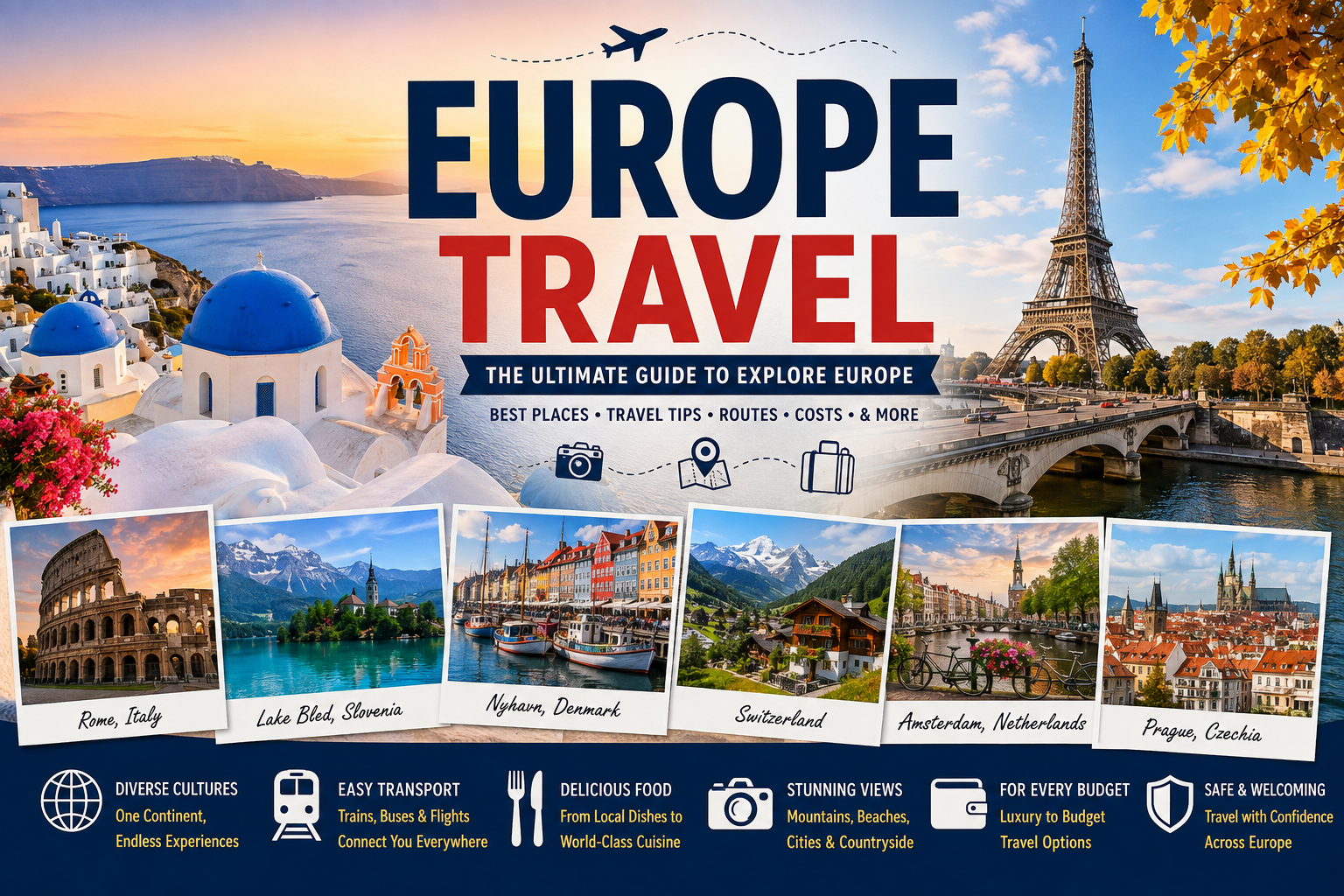
Europe travel offers an unusually diverse combination of history, culture, food, nature, architecture, beaches, mountains, and efficient transportation across a relatively compact region. The smartest way to explore Europe is not to rush through as many countries as possible, but to build a realistic route around your interests, budget, season, transport options, and available time 3S International Travel
What Makes Europe Travel So Appealing?
Europe combines an enormous variety of experiences with relatively short distances between many major destinations.
Depending on your itinerary, you can experience:
- Ancient Roman history
- Medieval towns
- Renaissance art
- Modern architecture
- Mediterranean beaches
- Alpine landscapes
- Northern forests
- Christmas markets
- World-famous museums
- Local food traditions
- Wine regions
- Football culture
- Music festivals
- Royal palaces
- Castles
- National parks
- Scenic railway journeys
- Island escapes
- Vibrant nightlife
This variety makes Europe suitable for almost every type of traveler.
Europe for First-Time Travelers
First-time visitors often choose Western European destinations because they offer internationally recognized landmarks and well-developed tourism infrastructure.
Popular starting points include:
- Paris
- Rome
- London
- Barcelona
- Amsterdam
- Vienna
- Prague
- Lisbon
- Athens
These cities can provide a strong introduction to European history and culture.
Europe for Experienced Travelers
Repeat visitors often benefit from looking beyond the most famous destinations.
Consider:
- Slovenia
- Albania
- Montenegro
- Slovakia
- Estonia
- Latvia
- Lithuania
- Bulgaria
- Romania
- North Macedonia
- Bosnia and Herzegovina
These destinations can offer different landscapes, cultures, food traditions, and travel experiences.
The best choice depends on your interests rather than simply following popularity rankings.
Understanding Europe Before You Plan Your Trip
One of the first mistakes travelers make is treating Europe as a single country or travel system.
Europe is a continent containing many independent countries.
They have different:
- Languages
- Currencies
- Entry requirements
- Laws
- Transport systems
- Cultural customs
- Costs
- Food traditions
- Public holidays
- Weather patterns
There is also an important distinction between the European Union, the Schengen Area, and Europe as a geographical region.
What Is the Schengen Area?
The Schengen Area is a border-free travel zone rather than the same thing as the European Union.
As of 2026, the Schengen Area contains 29 countries: 25 EU member states plus Iceland, Liechtenstein, Norway, and Switzerland. Bulgaria and Romania became full members on January 1, 2025.
Internal border controls are generally abolished between Schengen countries, although temporary controls can be reintroduced under specific circumstances.
This makes multi-country travel considerably easier once you are legally admitted to the Schengen Area.
Is Every European Country in Schengen?
No.
Countries in Europe have different relationships with Schengen.
For example:
- Ireland is not part of the Schengen Area.
- Cyprus participates in Schengen cooperation but does not yet have abolished internal border controls.
- The United Kingdom is outside the Schengen Area.
- Several European countries outside the EU are part of Schengen.
Always check current entry rules for each country on your route.
Europe Travel Visa and Entry Requirements
Visa requirements depend on your nationality, destination, purpose of travel, and length of stay.
Do not assume that a visa for one European country automatically covers every European country.
For short visits, Schengen rules are particularly important.
The European Commission states that the Schengen countries generally apply a common visa policy for short stays of up to 90 days within any 180-day period.
If You Need a Schengen Visa
Your planning should include:
- Checking which country is responsible for your application.
- Preparing the required documentation.
- Providing evidence of accommodation and travel plans where required.
- Demonstrating financial means where required.
- Obtaining appropriate travel insurance if required.
- Submitting biometrics where applicable.
- Allowing sufficient processing time.
- Following the official consulate or visa-center instructions.
Do not buy expensive non-refundable arrangements solely because a visa application is pending unless you understand the relevant rules and risks.
If You Are Visa-Exempt
Visa-exempt travelers should still check entry requirements.
Visa-free travel does not mean unlimited travel.
The 90/180 rule can be particularly important for travelers moving between multiple Schengen countries.
ETIAS and Europe Travel in 2026
One of the biggest changes travelers should understand is ETIAS, the European Travel Information and Authorisation System.
As of August 2026, ETIAS is not yet operational. The European Union says it is scheduled to begin in the last quarter of 2026, with the exact start date to be announced officially.
ETIAS will apply to visa-exempt nationals traveling to the participating European countries.
The official EU information says the planned fee is €20, with exemptions for certain travelers, including some people under 18 and over 70.
An approved ETIAS is not the same as a visa and does not guarantee entry.
Border authorities can still verify whether a traveler meets entry requirements.
What Travelers Should Do
If you are planning Europe travel later in 2026:
- Check the official ETIAS website.
- Confirm whether your nationality requires ETIAS.
- Do not use unofficial websites claiming to process ETIAS before the system launches.
- Check the official start date before traveling.
- Make sure your passport details match your application.
The EU also introduced the Entry/Exit System for non-EU nationals traveling for short stays. The European Commission says EES became fully operational across the Schengen countries on April 10, 2026.
Because entry systems can change, travelers should always verify current requirements shortly before departure.
Best Time to Travel to Europe
There is no single “best” month for Europe.
The best time depends on your destination.
Spring: March to May
Spring can be excellent for:
- City breaks
- Gardens
- Museums
- Walking tours
- Southern Europe
- Cultural trips
Advantages include:
- Generally milder weather
- Spring landscapes
- Fewer crowds in many destinations than peak summer
- Potentially better accommodation value
However, weather can remain unpredictable.
Summer: June to August
Summer is ideal for:
- Mediterranean beaches
- Island vacations
- Northern Europe
- Outdoor festivals
- Long daylight hours
- Hiking in many mountain areas
But summer is also peak season for many European destinations.
Expect:
- Higher accommodation prices
- Crowds
- Busy attractions
- Hot weather in southern Europe
- More pressure on popular destinations
The European Travel Commission’s 2026 research found very strong travel intentions, with 82% of Europeans planning to travel between April and September 2026. It also noted that travelers were becoming more cautious about budgets and trip length.
Autumn: September to November
Autumn is one of the most attractive seasons for many travelers.
It can offer:
- Cooler temperatures
- Autumn scenery
- Wine-region experiences
- Cultural events
- Fewer peak-season crowds
- Better value in some destinations
September is especially useful for travelers who want warm weather without the height of summer.
Winter: December to February
Winter is excellent for:
- Christmas markets
- Skiing
- Northern Lights trips
- Winter festivals
- Museums
- Cozy city breaks
Popular winter destinations include:
- Austria
- Switzerland
- Finland
- Norway
- Sweden
- Germany
- Czechia
But northern Europe can have very short daylight hours.
The Shoulder Season Advantage
One of the most useful Europe travel strategies is traveling during the shoulder season.
Shoulder season generally falls between peak and off-peak periods.
Examples include:
- April to May
- September to October
depending on the destination.
Benefits can include:
- Fewer tourists
- Lower accommodation costs
- Comfortable weather
- Better restaurant availability
- Easier sightseeing
- More relaxed photography
The European Travel Commission specifically reported growing interest in shoulder-season travel in 2026.
Best European Destinations for First-Time Visitors
There is no objective list of the ten “best” European destinations.
But certain cities provide an excellent introduction to the continent.
Paris, France
Best for:
- Art
- Architecture
- Food
- Fashion
- History
- Romantic travel
- Museums
Paris can be expensive, but it offers enormous cultural depth.
Rome, Italy
Best for:
- Ancient history
- Food
- Architecture
- Art
- Religious heritage
Rome rewards travelers who are willing to walk.
Barcelona, Spain
Best for:
- Architecture
- Beaches
- Food
- Nightlife
- Art
Barcelona combines urban sightseeing with Mediterranean relaxation.
London, United Kingdom
Best for:
- Museums
- History
- Theatre
- Shopping
- Food
- Multicultural experiences
London is outside Schengen, so travelers planning multi-country trips should remember that its entry requirements are separate.
Amsterdam, Netherlands
Best for:
- Canals
- Museums
- Cycling
- Architecture
- Art
The city is compact but can become crowded in popular areas.
Vienna, Austria
Best for:
- Classical music
- Imperial architecture
- Museums
- Coffeehouse culture
- Central European history
Prague, Czechia
Best for:
- Historic architecture
- Affordable city breaks
- Beer culture
- Walking
- Medieval atmosphere
Lisbon, Portugal
Best for:
- Food
- Architecture
- Coastal experiences
- Culture
- Mild weather
Athens, Greece
Best for:
- Ancient history
- Greek cuisine
- Museums
- Mediterranean travel
Athens can also work as a gateway to Greek islands.
Best European Destinations for Nature Lovers
Europe is not just about cities.
Switzerland
Ideal for:
- Mountains
- Lakes
- Hiking
- Scenic trains
- Alpine villages
Norway
Best for:
- Fjords
- Northern Lights
- Hiking
- Scenic landscapes
Iceland
Best for:
- Volcanoes
- Waterfalls
- Glaciers
- Geothermal landscapes
Slovenia
Best for:
- Lakes
- Mountains
- Hiking
- Caves
- Small-town travel
Austria
Excellent for:
- Alpine scenery
- Skiing
- Lakes
- Hiking
Croatia
Ideal for:
- Adriatic coastline
- Islands
- Historic towns
- National parks
Best European Destinations for Food Lovers
Food can be one of the strongest reasons to travel.
Italy
Known for regional differences in:
- Pasta
- Pizza
- Cheese
- Seafood
- Gelato
- Coffee
Do not assume Italian food is identical across the country.
France
Excellent for:
- Pastries
- Cheese
- Wine regions
- Regional cuisine
- Fine dining
Spain
Explore:
- Tapas
- Seafood
- Regional dishes
- Markets
- Modern cuisine
Greece
Look beyond the internationally famous dishes.
Explore:
- Regional cheeses
- Seafood
- Grilled foods
- Pastries
- Island specialties
Portugal
Try:
- Seafood
- Pastries
- Regional stews
- Grilled fish
- Local wines
Europe Travel for Budget Travelers
Europe can be expensive.
But “Europe is expensive” is too simplistic.
Costs vary dramatically.
A luxury trip to Switzerland is not comparable with a budget trip through parts of Central Europe.
Budget-Friendly Strategies
Consider:
- Traveling in shoulder season
- Staying outside the most expensive tourist centers
- Using trains and buses strategically
- Booking accommodation with kitchens
- Eating local rather than exclusively in tourist areas
- Using free attractions
- Walking
- Taking advantage of city passes only when the math works
Don’t Choose Destinations Based Only on Flight Prices
A €50 flight does not necessarily create a cheap trip.
The total cost includes:
- Airport transfers
- Accommodation
- Food
- Transportation
- Attractions
- Travel insurance
- Taxes
- Luggage
- Local transport
A slightly more expensive flight to a better-connected destination may save money overall.
How Much Should You Budget for Europe Travel?
There is no universal daily budget.
Instead, divide your costs into categories.
Accommodation
Your biggest expense may be:
- Hotel
- Hostel
- Apartment
- Guesthouse
- Resort
Transportation
Include:
- Flights
- Trains
- Buses
- Metro
- Airport transfers
- Taxis
Food
Separate:
- Breakfast
- Lunch
- Dinner
- Snacks
- Coffee
- Drinks
Attractions
Budget for:
- Museums
- Tours
- Historical sites
- Shows
- Guided experiences
Emergency Buffer
Keep money aside for:
- Delays
- Unexpected transport
- Medical needs
- Lost items
- Last-minute accommodation
The emergency buffer is often overlooked until travelers need it.
Europe Travel by Train
Rail travel is one of Europe’s strongest advantages.
Depending on your route, trains can provide:
- City-center arrivals
- Comfortable seating
- Scenic views
- No airport-style security process for many journeys
- Convenient connections
- Easy access to smaller destinations
When Trains Make Sense
Trains are especially useful for:
- Paris to Brussels
- Amsterdam to Brussels
- Paris to Amsterdam
- Vienna to Budapest
- Vienna to Prague
- Milan to nearby Italian cities
- Zurich to Swiss destinations
Exact routes, prices, and travel times change, so verify them before booking.
When Flying May Make More Sense
Flights may be preferable for:
- Very long distances
- Island destinations
- Northern-to-Southern Europe journeys
- Routes where rail connections are poor
The smartest approach is not “always train” or “always fly.”
Compare the door-to-door journey.
Europe Travel by Bus
Long-distance buses can provide cheaper alternatives to trains.
They can be useful for:
- Budget travelers
- Routes with limited rail connections
- Regional travel
- Last-minute journeys
However, buses may take considerably longer.
If saving €20 means losing six hours, decide whether that trade-off is worthwhile.
How to Plan a Multi-Country Europe Trip
The biggest multi-country mistake is trying to visit too many places.
A traveler may imagine:
London → Paris → Amsterdam → Berlin → Prague → Vienna → Budapest → Rome
in two weeks.
Technically possible.
Practically exhausting.
Use the Slow-Travel Rule
For a two-week trip, consider three to five primary bases rather than seven or eight.
For example:
Paris → Amsterdam → Berlin → Prague
This provides enough time to explore.
The Hub Strategy
Choose one central city as a base and take day trips.
This reduces:
- Hotel changes
- Packing
- Check-in time
- Transportation stress
The Open-Jaw Flight Strategy
Instead of:
Home → Paris → Home
consider:
Home → Paris
and
Rome → Home
when the price and route make sense.
This can prevent unnecessary backtracking.
Popular Europe Travel Routes
Western Europe Route
London → Paris → Amsterdam → Brussels
Best for:
- First-time visitors
- Museums
- History
- Major cities
Central Europe Route
Prague → Vienna → Bratislava → Budapest
Best for:
- Architecture
- History
- Food
- Culture
Mediterranean Route
Barcelona → Nice → Florence → Rome
Best for:
- Food
- Architecture
- Beaches
- History
Alpine Route
Zurich → Lucerne → Interlaken → Milan
Best for:
- Mountains
- Lakes
- Scenic rail
- Outdoor travel
Iberian Route
Lisbon → Porto → Madrid → Barcelona
Best for:
- Food
- Architecture
- Culture
- Urban travel
These are examples rather than fixed itineraries.
Europe Travel for Families
Europe can be fantastic for families if the itinerary is designed around children.
Choose Walkable Bases
A hotel near transportation and attractions can make a huge difference.
Avoid Excessive Museum Days
Mix:
- Museums
- Parks
- Food markets
- Boat rides
- Interactive attractions
- Outdoor spaces
Build in Rest
Children may need downtime even when adults want to keep sightseeing.
Use Apartment-Style Accommodation Carefully
A kitchen and laundry facilities can be useful for longer family trips.
Europe Travel for Couples
Couples may enjoy combining major destinations with slower experiences.
Consider:
- Scenic train journeys
- Wine regions
- Coastal towns
- Romantic restaurants
- Historic hotels
- Sunset viewpoints
- Lake destinations
- Small villages
Avoid building every day around famous attractions.
Sometimes the most memorable part of a European trip is simply walking through a neighborhood together.
Europe Travel for Solo Travelers
Solo travel offers flexibility.
You can:
- Change plans
- Eat when convenient
- Spend longer in museums
- Wake up early
- Take spontaneous day trips
Useful Solo Travel Tips
- Stay in well-connected neighborhoods.
- Keep copies of important documents.
- Be cautious with valuables.
- Learn basic local phrases.
- Share your general itinerary with someone you trust.
- Understand local transport before late-night travel.
- Avoid excessive alcohol consumption when traveling alone.
- Keep emergency contacts accessible.
Europe Travel for Seniors
Older travelers can enjoy Europe enormously with thoughtful planning.
Prioritize:
- Elevators
- Comfortable hotels
- Short transportation connections
- Accessible attractions
- Rest periods
- Direct trains
- Reliable taxis when needed
Avoid changing hotels every night.
A slower itinerary often produces a better experience.
Europe Travel for Students and Young Travelers
Students often prioritize:
- Affordability
- Nightlife
- Public transportation
- Hostels
- Cultural experiences
- Social environments
Central and Eastern European cities can sometimes provide strong value, but prices vary by season and location.
Do not assume any destination is universally cheap.
Europe Travel for Muslim and Halal Travelers
Europe has large Muslim communities and many destinations offer halal food and prayer facilities.
Before traveling, research:
- Halal restaurants
- Mosques
- Prayer spaces
- Food ingredients
- Hotel location
- Friday prayer options
- Nearby grocery stores
Major cities generally provide more choices than small towns.
A Practical Strategy
Save several halal restaurants on your map before arriving.
This does not mean you need to follow a strict food itinerary.
It simply gives you reliable options.
Europe Travel for Vegetarian and Vegan Travelers
Many European cities now have extensive vegetarian and vegan options.
Large urban centers generally provide more choices.
Useful phrases to learn include local translations for:
- Vegetarian
- Vegan
- Dairy
- Eggs
- Nuts
- Gluten
Do not assume that a dish is vegetarian simply because it does not visibly contain meat.
Europe Travel for Photography Lovers
Europe offers enormous photographic diversity.
Best Subjects
- Historic architecture
- Street scenes
- Markets
- Mountains
- Coastal landscapes
- Bridges
- Churches
- Castles
- Public squares
- Local transport
The Best Photography Advice
Wake up early.
Popular landmarks that are packed at noon can be remarkably peaceful early in the morning.
Always respect:
- Photography restrictions
- Religious sites
- Private property
- People who do not want to be photographed
Europe Travel for History Lovers
Europe’s history is layered.
One street can contain:
- Roman remains
- Medieval buildings
- Renaissance architecture
- Baroque churches
- Industrial-era structures
- Modern buildings
Strong Destinations for History
Consider:
- Rome
- Athens
- Istanbul
- Paris
- Vienna
- Prague
- Berlin
- Kraków
- Budapest
- Lisbon
History-focused travelers should avoid rushing.
Museums and historical sites require time to understand rather than simply photograph.
Europe Travel for Beach Lovers
Europe’s beaches extend far beyond the Mediterranean.
Consider:
- Greece
- Croatia
- Spain
- Portugal
- Italy
- France
- Malta
- Montenegro
- Albania
Island Travel
Island trips require additional planning.
Consider:
- Ferry schedules
- Seasonal service
- Luggage
- Car rentals
- Weather
- Airport connections
Never assume that an island ferry operates at the same frequency year-round.
Europe Travel for Mountain Lovers
Europe’s mountain regions include:
- Alps
- Pyrenees
- Carpathians
- Dinaric Alps
- Scandinavian Mountains
Popular mountain destinations can be expensive during peak ski season.
Summer can offer hiking, cycling, lakes, and scenic rail journeys.
Europe Travel and Sustainable Tourism
Europe’s popularity creates both economic opportunities and tourism pressure.
Popular cities can experience:
- Crowding
- Housing pressure
- Traffic
- Waste
- Strain on infrastructure
- Overuse of historic areas
Travelers can help by:
- Visiting outside peak periods
- Staying longer
- Exploring secondary destinations
- Supporting local businesses
- Using public transport
- Avoiding unnecessary short-distance flights
- Respecting residential areas
Why Staying Longer Can Be Better
A traveler who spends five days in one city may contribute more meaningfully to local businesses than someone who spends only 18 hours rushing through.
Slow travel can therefore benefit both traveler and destination.
Europe Travel Safety Tips
Europe is generally popular with international travelers, but no destination is risk-free.
Common problems can include:
- Pickpocketing
- Phone theft
- Tourist scams
- Overpriced taxis
- Fake tickets
- Crowded public transport
- Lost documents
Protect Your Belongings
In crowded areas:
- Use a secure bag.
- Keep your phone away when unnecessary.
- Avoid displaying large amounts of cash.
- Keep passports secure.
- Separate emergency funds.
- Use hotel safes when appropriate.
Be Careful With Tourist Scams
Common tactics vary by city.
Examples can include:
- Distraction techniques
- Fake petitions
- Unofficial guides
- Overpriced transportation
- Fake charity requests
- Rigged street games
Research destination-specific scams before arrival.
Europe Travel and Travel Insurance
Travel insurance is one of those expenses that feels unnecessary until something goes wrong.
Depending on your policy, coverage may include:
- Medical emergencies
- Trip cancellation
- Lost baggage
- Delayed baggage
- Travel disruption
- Emergency evacuation
Always read the policy rather than assuming everything is covered.
Travel insurance is particularly important for expensive multi-country itineraries.
How to Pack for Europe Travel
Packing depends heavily on season and region.
Essential Categories
Pack:
- Comfortable shoes
- Weather-appropriate clothing
- Lightweight layers
- Passport and documents
- Medication you legally need
- Chargers
- Universal adapter where appropriate
- Small day bag
- Reusable water bottle
- Travel insurance information
Don’t Overpack
European train stations and old city centers often involve stairs, cobblestones, and walking.
A lightweight suitcase can be more valuable than an extra pair of shoes.
What to Wear in Europe
There is no single “European dress code.”
Europe is culturally diverse.
However, practical clothing is usually best.
Consider:
- Comfortable walking shoes
- Layers
- Weather protection
- Modest clothing for religious sites
- Lightweight clothing in hot destinations
- Warm layers for northern destinations
Check local expectations when visiting religious buildings.
Europe Travel and Mobile Internet
Travelers can usually choose among:
- Roaming plans
- Local SIM cards
- eSIMs
- Pocket Wi-Fi
Compare:
- Coverage
- Data allowance
- Price
- Tethering
- Country coverage
Do not automatically buy the first SIM card offered at an airport.
How to Use Maps Effectively
Download offline maps before leaving reliable internet access.
Save:
- Hotel
- Airport
- Train station
- Embassy or consulate
- Restaurants
- Major attractions
- Transport hubs
Also save your accommodation address in the local language where practical.
This can help when asking for directions.
Common Europe Travel Mistakes
Mistake 1: Visiting Too Many Countries
Solution: Slow down.
Mistake 2: Traveling Only to Capitals
Solution: Add smaller cities and towns.
Mistake 3: Ignoring Travel Time
Solution: Calculate door-to-door journeys.
Mistake 4: Booking Every Activity
Solution: Leave free time.
Mistake 5: Visiting Only During Peak Summer
Solution: Consider spring or autumn.
Mistake 6: Ignoring Local Customs
Solution: Research etiquette before arrival.
Mistake 7: Confusing the EU With Schengen
Solution: Check the exact countries on your route.
Mistake 8: Ignoring Visa Rules
Solution: Verify entry requirements using official sources.
Mistake 9: Relying Entirely on Social Media
Solution: Use social platforms for inspiration, then verify details.
Mistake 10: Using AI Without Verification
Solution: Treat AI as a planning assistant rather than a final authority.
The Pros and Cons of Europe Travel
Advantages
- Huge cultural diversity
- Many destinations close together
- Excellent rail connections in many regions
- Diverse food
- Rich history
- Large range of budgets
- Beautiful natural landscapes
- Major museums
- Strong public transportation
- Many family-friendly destinations
- Excellent options for solo travelers
Disadvantages
- Popular destinations can be crowded
- Peak-season accommodation can be expensive
- Entry rules vary by nationality
- Some cities face overtourism
- Transportation strikes or disruptions can occur
- Long multi-country itineraries can become exhausting
- Prices vary dramatically
- Weather can be unpredictable
Europe is not automatically easy or cheap.
It is simply highly flexible.
That flexibility is one of its biggest advantages.
Ten Major Travel Brands and Platforms for Europe Travel Compared
Travel platforms serve different purposes. A booking platform, review website, rail operator, and destination guide are not interchangeable.
| Brand / Platform | Primary Strength | Best For | Key Advantage | Limitation |
|---|---|---|---|---|
| Lonely Planet | Destination guides | Independent travelers | Detailed destination context | Some information may require updates |
| Tripadvisor | Reviews and attractions | Comparing experiences | Large review ecosystem | Reviews vary in quality |
| Booking.com | Accommodation | Hotel and apartment research | Broad accommodation inventory | Listings require careful comparison |
| Expedia | Travel booking | Flights and hotels | Integrated travel planning | Less editorial depth than specialist guides |
| Airbnb | Accommodation and experiences | Longer stays and local-style travel | Wide property variety | Quality varies by listing |
| Eurail | European rail travel | Multi-country train trips | Rail-pass planning | Passes are not always cheapest |
| Omio | Transport comparison | Trains, buses, flights | Convenient route comparison | Pricing and availability can change |
| GetYourGuide | Activities | Tours and experiences | Large activity selection | Marketplace quality varies |
| Viator | Tours and attractions | Guided activities | Extensive experience marketplace | Not every operator is equally strong |
| Google Maps | Navigation | Everyday city travel | Maps, directions, places, reviews | Not a complete travel guide |
Which Platform Should You Choose?
Use destination guides for context.
Use maps for navigation.
Use accommodation platforms for lodging research.
Use rail and transport platforms for route planning.
Use activity marketplaces for experience discovery.
The strongest Europe travel plan often combines several tools.
How to Create a Europe Travel Itinerary
A strong itinerary follows four principles:
Geography.
Pacing.
Priorities.
Flexibility.
Step 1: Pick a Region
Do not start with 20 cities.
Start with a region.
Examples:
- Western Europe
- Southern Europe
- Central Europe
- Northern Europe
- Balkans
- Scandinavia
Step 2: Pick Three to Five Bases
Choose locations that connect logically.
Step 3: Identify Your Top Experiences
Write down five to ten things you genuinely care about.
Step 4: Add Buffer Time
Transport delays happen.
Restaurants take time.
Museums can be unexpectedly interesting.
Step 5: Check the Calendar
Before finalizing:
- Museum opening days
- Public holidays
- Festivals
- Transport schedules
- Seasonal closures
Example: Seven-Day Europe Travel Plan
Here is a conceptual itinerary rather than a rigid schedule.
Days 1–2: Paris
Focus on:
- Historic center
- Museums
- Architecture
- Local food
Days 3–4: Amsterdam
Focus on:
- Canals
- Museums
- Neighborhoods
- Cycling or walking
Days 5–6: Brussels
Focus on:
- Historic center
- Food
- Architecture
- Museums
Day 7: Flexible Day
Use the final day to revisit a favorite location or take a short excursion.
This type of itinerary is less exhausting than changing countries every day.
Europe Travel Based on Traveler Demographics
The phrase “Europe travel” is broad.
A better travel strategy pairs the destination with the person.
Europe Travel for Families
Focus on:
- Short transport connections
- Parks
- Interactive museums
- Family accommodation
- Flexible meals
Europe Travel for Couples
Focus on:
- Scenic destinations
- Food
- Romantic experiences
- Boutique accommodation
- Slow travel
Europe Travel for Solo Travelers
Focus on:
- Convenient neighborhoods
- Public transport
- Walking tours
- Social activities
- Personal safety
Europe Travel for Seniors
Focus on:
- Accessibility
- Comfortable hotels
- Direct transportation
- Moderate walking
- Longer stays
Europe Travel for Students
Focus on:
- Affordable accommodation
- Rail and bus options
- Free attractions
- Student discounts
- Flexible itineraries
Europe Travel for Luxury Travelers
Focus on:
- Premium hotels
- Fine dining
- Private transfers
- Exclusive experiences
- Luxury rail journeys
Europe Travel Based on Problems Travelers Need to Solve
A strong Europe travel plan can also be built around a specific problem.
Europe Travel on a Budget
Prioritize affordable destinations, public transport, free attractions, and local food.
Europe Travel Without a Car
Choose cities connected by rail and public transport.
Europe Travel for Short Trips
Choose one or two destinations rather than five.
Europe Travel in Winter
Focus on cities, Christmas markets, skiing, and northern lights destinations depending on the season.
Europe Travel in Summer
Consider Mediterranean destinations, northern Europe, mountain regions, and coastal towns.
Europe Travel for Food Lovers
Build routes around regional cuisine rather than simply restaurant rankings.
Europe Travel for History Lovers
Choose destinations with layered historical sites and strong museums.
Europe Travel for Nature Lovers
Combine cities with mountains, coastlines, lakes, or national parks.
Europe Travel for First-Time Visitors
Choose a manageable route with strong transportation connections.
How Europe Travel Is Changing in 2026
The European travel market is showing strong resilience.
The European Travel Commission reported that international arrivals increased 5.0% year-to-date in 2026, while overnight stays rose 4.8%.
But the numbers tell only part of the story.
Traveler priorities are changing.
Travelers Are Becoming More Value-Conscious
Travelers increasingly want to know:
- What does this trip actually cost?
- Can I avoid peak prices?
- Is this destination worth the money?
- Can I travel for fewer days?
ETC reported that travelers are prioritizing value and becoming more cautious about budgets.
Shorter Trips Are Becoming Important
Not every traveler wants a three-week vacation.
Weekend breaks and shorter city trips can fit modern work schedules more easily.
Shoulder Season Is Gaining Attention
Travelers are increasingly looking beyond July and August.
Nearby Destinations Matter
Regional travel can reduce:
- Flight costs
- Travel time
- Complexity
- Environmental impact
Authentic Experiences Are More Important
Travelers increasingly want activities rather than simply sightseeing.
That means:
- Cooking classes
- Local markets
- Workshops
- Walking tours
- Cultural events
- Regional food
- Neighborhood exploration
The Future of Europe Travel
The next phase of Europe travel is likely to be more personalized.
AI-Powered Itineraries
Travelers will increasingly use AI to combine:
- Interests
- Budget
- Weather
- Travel time
- Mobility
- Food preferences
- Hotel location
Real-Time Travel Planning
Future travel tools may automatically adapt when:
- Flights are delayed
- Trains are cancelled
- Weather changes
- Attractions close
- Crowds become extreme
More Secondary Destinations
Popular destinations will continue to encourage travelers toward less crowded alternatives.
Longer Stays in Fewer Places
Slow travel may become more attractive as travelers prioritize meaningful experiences over destination collecting.
Greater Interest in Sustainable Travel
Travelers may increasingly consider:
- Rail travel
- Local businesses
- Longer stays
- Shoulder-season trips
- Smaller destinations
The future of Europe travel is therefore unlikely to be simply about visiting more places.
It may be about experiencing each place more deeply.
A Better Way to Think About Europe Travel
Think of Europe as a library rather than a checklist.
You do not need to read every book.
Choose the section that interests you.
If you love history, explore Rome, Athens, Prague, Vienna, and Berlin.
If you love beaches, explore Greece, Croatia, Portugal, Spain, and Italy.
If you love mountains, consider Switzerland, Austria, Slovenia, Norway, and the Pyrenees.
If you love food, build your journey around regional cuisines.
If you love architecture, select cities with distinct architectural identities.
Your Europe trip should reflect you.
Final Europe Travel Advice
If you remember only a few things from this guide, remember these.
Do not try to conquer Europe in one trip.
Do not choose destinations solely because they are famous.
Do not confuse cheap flights with cheap vacations.
Do not build an itinerary with zero breathing room.
Do not assume that every European country follows the same entry rules.
Do not rely on outdated travel information.
Do not treat social media as a substitute for research.
And do not underestimate the value of simply slowing down.
A three-day stay in one city can sometimes create more meaningful memories than a seven-city itinerary.
FAQs
What is the best country to visit in Europe?
There is no single best country. Italy, France, Spain, Greece, Switzerland, Portugal, Norway, Austria, Slovenia, Croatia, and many other countries offer very different experiences. The best choice depends on your interests, budget, season, and available time.
How many days are enough for Europe travel?
For a focused European trip, seven to fourteen days can provide a good introduction to one region. Longer trips allow more countries or slower exploration. Avoid adding destinations simply to increase the country count.
What is the best month for Europe travel?
May, June, September, and October can be excellent for many destinations, but the ideal month depends on the country and type of trip. Summer is popular for beaches and northern destinations, while winter is ideal for skiing and Christmas markets.
Is Europe expensive to visit?
Europe has both expensive and relatively affordable destinations. Switzerland, Iceland, Norway, and some major Western European cities can be costly, while some Central and Eastern European destinations can offer better value.
Is Europe travel safe?
Many European destinations are popular with international travelers, but travelers should still protect valuables, understand local scams, follow local laws, and monitor official travel advice.
Can I travel between European countries by train?
Yes. Many European countries have extensive rail networks and international train connections. Rail travel can be especially convenient for destinations that are geographically close.
Is a Eurail Pass worth it?
It depends on your itinerary. Compare the cost of the pass with individual tickets before buying. Travelers taking several long train journeys may find a pass useful, while travelers making only a few trips may save money with individual tickets.
Do I need a Schengen visa to travel to Europe?
That depends on your nationality and destination. The Schengen Area has common short-stay visa rules, but not every European country belongs to Schengen. Always check the official requirements for your passport and itinerary.
What is the 90/180 rule?
For travelers subject to the Schengen short-stay rule, it generally means a maximum stay of 90 days within any rolling 180-day period. The rule applies across the relevant Schengen area rather than giving 90 days per country.
What is ETIAS?
ETIAS is the European Travel Information and Authorisation System for eligible visa-exempt travelers visiting participating European countries. As of August 2026, it is not yet operational and is scheduled for the last quarter of 2026.
How much will ETIAS cost?
The planned ETIAS application fee is €20, although certain travelers are exempt from paying the fee.
Can I visit several Schengen countries with one Schengen visa?
Generally, a Schengen visa allows eligible travelers to visit multiple Schengen countries during the authorized stay, subject to the conditions of the visa and applicable rules.
Should I visit Europe in summer or winter?
Choose summer for Mediterranean beaches, outdoor activities, long daylight hours, and many festivals. Choose winter for skiing, Christmas markets, winter scenery, and northern-lights experiences.
Is Europe good for family travel?
Yes. Europe offers museums, parks, beaches, castles, interactive attractions, rail journeys, and family-friendly cities. The key is choosing manageable distances and avoiding overly ambitious schedules.
Is Europe good for solo travelers?
Yes. Major European cities often have extensive public transport, accommodation choices, walking tours, museums, and social activities that work well for solo visitors.
What is the best way to travel around Europe?
There is no universal answer. Trains are excellent for many short and medium-distance routes, while flights may make sense for longer journeys or islands. Buses can provide budget alternatives.
Should I travel to popular cities or lesser-known destinations?
A combination can work best. Visit major destinations for iconic experiences, then add smaller or less crowded destinations for a different perspective.
How can I save money on Europe travel?
Travel during shoulder season, compare transportation options, stay outside the most expensive tourist centers, use public transportation, eat at local restaurants, and prioritize free or low-cost attractions.
How can I avoid crowds in Europe?
Travel outside peak periods, arrive early at major attractions, stay longer in one destination, explore residential or alternative neighborhoods respectfully, and consider less crowded destinations.
Can I use one currency throughout Europe?
No. The euro is widely used across many European countries, but not every European country uses it. Check the currency of every destination on your itinerary.
Should I book European trains in advance?
For popular routes, high-speed trains, and peak travel periods, advance booking can be useful. However, rules and pricing vary by operator and route.
What should I pack for Europe?
Pack according to season and destination. Comfortable walking shoes, adaptable layers, weather protection, travel documents, chargers, and appropriate clothing for religious or cultural sites are useful basics.
Is Europe good for budget travel?
Yes, but budget planning needs to account for the complete trip rather than only transportation. Accommodation, food, local transport, attractions, and airport transfers can significantly change the final cost.
What is the biggest Europe travel mistake?
Trying to visit too many destinations in too little time. A slower itinerary usually produces a more enjoyable and less stressful trip.
Conclusion
Europe travel is not about checking the largest number of countries off a list. It is about choosing destinations that match your interests, budget, travel style, and available time—and giving yourself enough time to experience them properly. Whether you dream of historic cities, Mediterranean beaches, Alpine landscapes, local food, cultural experiences, or scenic train journeys, Europe offers an incredible range of possibilities. The best approach is to plan a realistic route, understand entry requirements, compare transportation and accommodation costs, travel during the right season, and leave room for unexpected discoveries.