
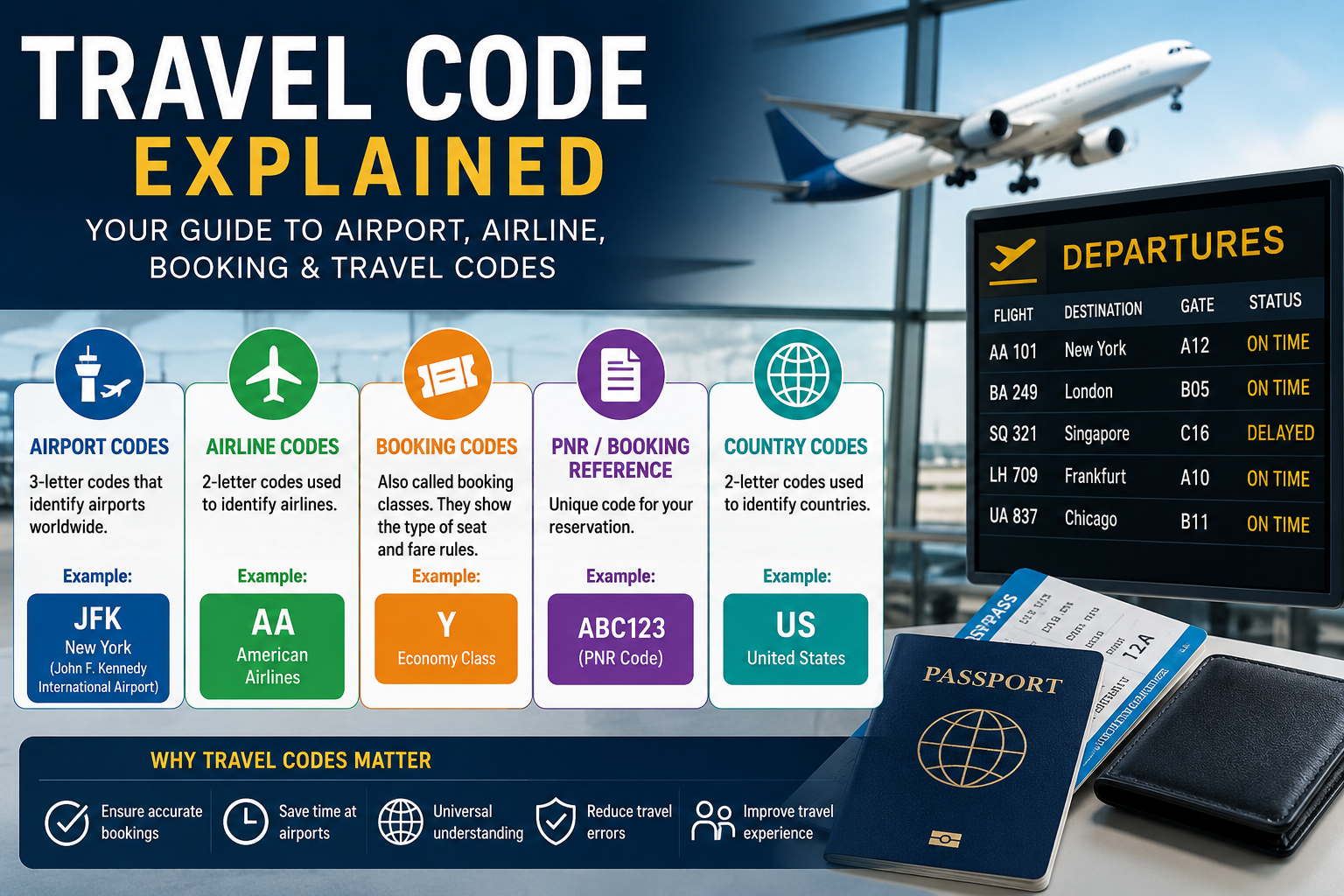
Have you ever looked at a flight ticket and wondered why your destination appears as three letters such as LHR, DXB, JFK, or NRT? Or perhaps you have seen a six-character booking reference, a two-letter airline code, or a country code and wondered what all those combinations actually mean Travel Industry
Travel Code for Travel Agents
Travel agents should understand codes at a deeper level.
A travel professional may need to distinguish between:
- Location code
- Airline code
- Flight number
- Booking reference
- Ticket number
- Fare information
- Reservation status
- Segment information
The difference between these identifiers can affect how a booking is managed.
For example, changing a reservation and changing a ticket are not necessarily the same action.
Travel Code for Business Travelers
Business travelers often deal with more complex itineraries.
A single trip may contain:
- Multiple airlines
- Multiple cities
- Several hotels
- Ground transportation
- Expense records
- Corporate policies
- Different currencies
Codes help organize this information.
Corporate travel platforms increasingly connect booking data with expense management and policy controls. Travel Code, for example, describes its platform as combining booking, expenses, corporate cards, and travel policy functionality in one ecosystem.
Travel Code for Travel Bloggers
Travel bloggers can also benefit from understanding codes.
They can make content easier to use by including both city and airport information.
Instead of writing:
Fly to Tokyo.
write:
Fly to Tokyo Haneda Airport (HND).
This helps readers understand exactly where they are going.
It can also make travel guides more useful for people comparing flight options.
Travel Code for Families
Families should pay particular attention to airport codes when traveling with children.
A difference between two airports can affect:
- Hotel transfers
- Taxi costs
- Train connections
- Travel time
- Luggage handling
- Sleep schedules
A few extra minutes spent checking the airport code can prevent hours of unnecessary stress.
Travel Code for Older Travelers
The same principle applies to older travelers.
A booking may appear attractive because of a low price, but an inconvenient airport can make the journey considerably harder.
When comparing flights, consider:
- Airport accessibility
- Transfer distance
- Terminal changes
- Connection duration
- Ground transportation
- Baggage arrangements
The cheapest itinerary is not always the easiest itinerary.
Travel Code and Accessibility
Travel codes themselves do not determine whether an airport is accessible.
But they help travelers identify the correct facility before researching accessibility services.
If a traveler needs:
- Wheelchair assistance
- Accessible transport
- Reduced-mobility services
- Special boarding assistance
they should verify the services available at the actual airport rather than relying only on the city name.
Travel Code and Airport Transfers
Airport transfer companies often ask for an airport code.
Why?
Because “Paris” alone may not tell the driver which airport you are using.
A transfer request containing:
CDG
is considerably more precise.
Always make sure your transfer booking matches the airport on your flight reservation.
Travel Code and Hotel Bookings
Hotel reservations usually do not use the same universal three-letter airport system.
A hotel may have an internal property identifier within a booking platform or supplier system.
Travelers generally do not need to memorize these codes.
However, the distinction is important:
Airport codes are standardized public-facing identifiers, while many hotel property codes are platform or supplier specific.
Travel Code and Train Travel
Rail travel also uses location identifiers and station codes.
The exact system varies by country and railway.
This is another reason travelers should not assume that every three-letter code has the same meaning.
A code must always be interpreted within its system.
Travel Code and Car Rentals
Car rental companies may use location codes for:
- Airport branches
- City offices
- Pickup locations
- Drop-off locations
Again, the code may be specific to the provider.
When booking a car, verify the actual location address as well as the code.
Common Travel Code Mistakes
Mistake 1: Assuming Every Code Is an Airport Code
Not every short code refers to an airport.
It could be:
- Airline code
- Country code
- Currency code
- Booking reference
- Station code
- Internal supplier identifier
Solution
Always identify the code system first.
Mistake 2: Guessing an Airport Code
Some codes are intuitive.
Others are not.
Solution
Verify important codes using a reliable travel or aviation reference.
Mistake 3: Confusing City and Airport
A city can have multiple airports.
Solution
Always check the three-letter airport identifier.
Mistake 4: Confusing PNR and Ticket Number
They are not interchangeable.
Solution
Keep both numbers in your travel records.
Mistake 5: Ignoring Airport Changes
A connection may involve different airports in the same metropolitan area.
Solution
Compare the departure and arrival airport codes for every segment.
Mistake 6: Assuming the Cheapest Airport Is the Best
A lower airfare may come with higher transportation costs.
Solution
Calculate the entire trip cost.
Mistake 7: Sharing Booking Information Publicly
Travelers sometimes post boarding passes on social media.
This can expose sensitive travel information.
Solution
Avoid publicly displaying booking references, ticket numbers, barcodes, or QR codes.
How to Protect Your Travel Codes
Travel codes are not all equally sensitive.
A public airport code such as DXB is not secret.
A personal booking reference is different.
Protect information such as:
- PNR
- Booking confirmation
- Ticket number
- Passport details
- Frequent flyer information
- Boarding-pass barcode
- Payment information
A useful rule is:
Public location code = generally safe to share.
Personal reservation identifier = treat as private.
Pros of Travel Codes
Travel codes offer many advantages.
Faster Communication
Short codes are easier to display and transmit.
Better Data Organization
Databases can efficiently organize travel locations and services.
International Standardization
Standardized codes reduce ambiguity across borders.
Better Automation
Travel software can process structured identifiers quickly.
Easier Flight Searching
Travelers can search directly for specific airports.
Improved Operational Efficiency
Airlines and airports can exchange information more effectively.
Cons and Limitations of Travel Codes
Travel codes are not perfect.
They Can Be Confusing
Beginners may not know what a code means.
Similar Airports Can Cause Errors
Large cities can have several airports.
Different Systems Create Complexity
IATA and ICAO codes are not the same.
Codes Can Have Historical Origins
Some codes cannot be logically guessed.
Travelers Can Misread Them
A small mistake can result in selecting the wrong airport.
A Balanced View: Are Travel Codes Still Necessary?
It is tempting to think that modern AI and search engines make travel codes outdated.
That conclusion is premature.
AI may make the user interface more natural.
But travel infrastructure still needs structured information.
Consider a simple request:
Find me a flight from Dubai to Tokyo.
The system must determine:
- Which Dubai airport?
- Which Tokyo airport?
- Which airlines?
- Which dates?
- Which flight numbers?
- Which fare classes?
- Which availability?
- Which passenger information?
- Which ticketing system?
Natural language makes the request easier for humans.
Structured identifiers make it easier for systems.
The future will likely use both.
The Future of Travel Codes
Travel codes are likely to become less visible rather than disappear.
This distinction is important.
AI will hide complexity
Travelers may increasingly interact with travel systems conversationally.
Instead of searching airport codes manually, users may simply describe their trip.
Systems will continue using structured identifiers
Behind the interface, software still needs precise locations and entities.
Multimodal travel planning will grow
AI systems may combine:
- Text
- Maps
- Flight data
- Hotel information
- Calendar data
- Transportation
- Weather
- Traveler preferences
Identifiers help connect those systems.
The Rise of Machine-Readable Travel
Modern travel is becoming increasingly machine-readable.
A traveler might receive a digital itinerary that contains:
- Airport identifiers
- Airline identifiers
- Flight numbers
- QR codes
- Booking references
- Digital tickets
- Hotel records
These systems can automatically populate calendars and travel apps.
The traveler sees a simple interface.
The infrastructure underneath can be extremely complex.
AI Travel Assistants and Structured Codes
The next generation of travel assistants may make codes almost invisible.
Imagine saying:
I need to fly from Dubai to London on Friday morning, arrive before noon, and stay near the client office.
An AI assistant could potentially determine:
- Relevant airports
- Available flights
- Travel duration
- Hotel options
- Ground transportation
- Corporate travel policies
The traveler may never manually type “DXB” or “LHR.”
But the systems still need to identify those locations precisely.
Travel Code’s 2026 MCP initiative provides one example of how AI assistants can interact with structured flight and hotel services through natural-language requests.
Travel Codes and Personalization
Future travel systems may also use codes to personalize recommendations.
A travel platform could understand that a user frequently travels between certain locations.
It could then prioritize:
- Preferred airports
- Preferred airlines
- Frequent destinations
- Loyalty programs
- Corporate travel rules
The more structured the travel data, the easier this personalization becomes.
Will Airport Codes Ever Disappear?
Probably not in the foreseeable future.
They are deeply embedded in:
- Airline systems
- Airport systems
- Travel agencies
- Flight databases
- Baggage systems
- Travel applications
- Operational infrastructure
Even if consumers rarely see them, the underlying systems still benefit from standardized identifiers.
How Travel Bloggers Can Use Travel Codes Better
If you publish travel content, use airport codes strategically for readers.
For example:
Instead of:
The best airport for Tokyo is Haneda.
Use:
Tokyo Haneda Airport (HND) is one of the main airports serving Tokyo.
Then explain the practical difference between HND and NRT.
This approach helps both beginners and experienced travelers.
Recommended Travel Code Content Ideas for a Travel Website
If you are building a travel website, travel-code content can become a useful information category.
Possible articles include:
- Airport Codes A–Z
- Airline Codes A–Z
- World Airport Codes
- Europe Airport Codes
- Asia Airport Codes
- Middle East Airport Codes
- USA Airport Codes
- Pakistan Airport Codes
- UAE Airport Codes
- Japan Airport Codes
- UK Airport Codes
- Airport Code vs City Code
- IATA vs ICAO
- What Is a PNR?
- What Is an E-Ticket Number?
- How to Read a Boarding Pass
- How to Read a Flight Number
- Country Codes for Travelers
- Currency Codes for Travelers
- Travel Abbreviations Explained
This creates a practical travel reference library.
Demographic and Problem-Solving Travel Code Modifiers
Travel-code content becomes more useful when it answers a specific travel problem.
Instead of creating only generic pages, consider modifiers such as:
For Beginners
- Travel Codes for Beginners
- Airport Codes Explained Simply
- How to Read Flight Codes
For Frequent Travelers
- Airport Codes Frequent Travelers Should Know
- Most Useful International Airport Codes
For Families
- Airport Codes Families Should Check Before Booking
- How to Avoid the Wrong Airport When Traveling With Kids
For Business Travelers
- Travel Codes for Business Travelers
- PNR vs Ticket Number for Corporate Travel
For Travel Agents
- Complete Travel Code Guide for Travel Agents
- IATA and ICAO Codes Explained for Travel Professionals
For Students
- Airport Codes Every Student Traveler Should Know
- How International Travel Codes Work
For Budget Travelers
- How Airport Codes Can Help Find Cheaper Flights
- Avoid Hidden Airport Transfer Costs
For Seniors
- Airport Codes and Easy International Travel Planning
For International Travelers
- World Airport Codes Explained
- Country and Currency Codes for International Travel
These modifiers create more useful content because they connect the topic to a real problem.
How to Build a Personal Travel Code Cheat Sheet
You can create your own simple travel reference.
Include:
| Information | Example |
|---|---|
| Home airport | Your airport code |
| Frequent destination | Destination code |
| Preferred airline | Airline code |
| Booking reference | Your current PNR |
| Ticket number | Your current ticket |
| Emergency airline contact | Airline contact |
| Hotel address | Full address |
| Currency | Local currency code |
Do not publish your personal reservation codes.
The cheat sheet is for private use.
A Useful Analogy: Travel Codes Are Like Internet Addresses
A helpful way to understand travel codes is to compare them with internet addresses.
You can think of:
Airport code = location identifier
Airline code = airline identifier
Flight number = specific service identifier
PNR = reservation identifier
Ticket number = ticket identifier
Each identifier helps the system find a particular piece of information.
This is why a short code can be extremely powerful.
Why Some Travel Codes Look Strange
A common question is:
Why doesn’t the airport code match the airport name?
There are several possible reasons.
A code may be influenced by:
- Historical airport names
- City names
- Previous airport identities
- Existing code assignments
- Geographic references
- Legacy systems
Therefore, airport codes should not always be treated as simple abbreviations.
Can Two Airports Have Similar Codes?
Yes, codes can sometimes look confusingly similar.
This is another reason not to guess.
When booking an expensive international flight, verify:
Airport name + city + code
rather than relying on the code alone.
Travel Code Checklist Before Booking a Flight
Before paying for an international flight, check:
- airport
- Departure airport code
- Arrival airport
- Arrival airport code
- Airline
- Flight number
- Date
- Departure time
- Arrival time
This simple process can prevent many avoidable mistakes
Travel Code and Separate Tickets
This is an important issue for advanced travelers.
Two flights can appear to form a convenient connection even when they are booked separately.
For example:
Ticket A: Flight 1
Ticket B: Flight 2
The airport codes may look perfectly reasonable.
But if the first flight is delayed, the second airline may not be responsible for your missed connection.
Therefore, travelers should check whether flights are on:
- One ticket
- One booking
- Separate bookings
The codes alone cannot tell you everything.
Travel Code and Codeshare Flights
Codeshare flights can make travel information more complicated.
A flight may be marketed by one airline but operated by another.
This means travelers may see more than one airline code associated with essentially the same physical flight.
Always check:
“Operated by”
when the itinerary provides that information.
This is especially useful when checking:
- Check-in
- Baggage rules
- Terminal
- Seat selection
- Loyalty benefits
Travel Code and Baggage
Baggage systems rely heavily on machine-readable information.
A baggage tag may contain:
- Destination information
- Flight information
- Passenger-related data
- Barcodes
- Routing information
This allows bags to move through complicated airport networks.
A traveler may only see a small label.
Behind the scenes, it can support automated sorting and routing.
Travel Code and Flight Tracking
Flight-tracking platforms commonly allow searches by:
- Flight number
- Airline
- Airport
- Route
Airport and airline codes can make these searches faster.
For example, knowing the airport code can help distinguish one location from another when a city has multiple airports.
Travel Code and Travel Planning
Travel codes are most useful when combined with practical travel planning.
Do not stop at:
“What is the airport code?”
Ask:
“What does knowing the airport code help me decide?”
It can help you determine:
- Which terminal you need
- How far the airport is from the city
- Which train to take
- Which hotel to choose
- How much transfer time you need
- Whether your connecting airport is correct
The code is useful because it identifies the place precisely.
A Practical Framework: CODE
A simple way to remember how to use travel codes is the CODE framework.
C — Confirm
Confirm what type of code you are looking at.
O — Observe
Look at the full name associated with it.
D — Double-check
Verify it before booking or traveling.
E — Evaluate
Consider what the code means for the actual journey.
This approach is particularly helpful for beginners.
The Biggest Insight: Travel Codes Are a Hidden Language
The average traveler sees:
DXB → LHR
The travel industry sees a structured journey.
It knows:
- Departure location
- Arrival location
- Airline
- Flight
- Reservation
- Passenger
- Ticket
- Schedule
- Baggage
- Connection
That is why travel codes matter.
They are not just random letters printed on a boarding pass.
They are part of the infrastructure that allows global travel to operate at enormous scale.
What Travelers Should Remember
You do not need to become an aviation database expert.
Instead, learn the fundamentals.
Airport codes identify locations.
Airline codes identify carriers.
Flight numbers identify scheduled services.
PNRs identify reservations.
Ticket numbers identify issued tickets.
Country codes identify countries.
Currency codes identify currencies.
Once you understand these distinctions, most travel documents become much easier to read.
FAQs
What is a travel code?
Travel code is a broad term for identification codes used in travel and transportation. These can include airport, airline, booking, ticket, country, and currency codes.
What is an airport travel code?
An airport travel code commonly refers to an airport identifier, particularly the three-letter IATA code used in passenger travel.
What is the difference between IATA and ICAO?
IATA airport codes generally use three letters and are widely visible to passengers, while ICAO location indicators generally use four letters and are primarily used in aviation operations.
What is a PNR?
A PNR, or Passenger Name Record, is a reservation record containing information associated with a travel booking.
Is a PNR the same as a ticket number?
No. A PNR identifies a reservation record, while a ticket number identifies an issued electronic ticket.
Why do airports have three-letter codes?
Three-letter identifiers provide a compact way to identify locations in passenger travel and commercial aviation systems.
Why are some airport codes difficult to understand?
Some have historical or legacy origins rather than being simple abbreviations.
Do I need to memorize travel codes?
No. Learning the codes for airports you regularly use can be useful, but most travelers can simply look them up when necessary.
Are airport codes confidential?
Public airport codes are not confidential. However, personal booking references, ticket numbers, and boarding-pass data should be treated carefully.
Will AI replace travel codes?
AI may hide travel codes from users by allowing natural-language searches, but structured identifiers are likely to remain important in the underlying travel infrastructure.
Conclusion
Travel codes may look like meaningless combinations of letters and numbers when you first encounter them. But they are actually a compact language used throughout the global travel ecosystem. From the three-letter airport code printed on your boarding pass to the reservation reference connected to your booking, these identifiers help airlines, airports, travel agencies, technology companies, and travelers communicate accurately.