There is a curious footnote in the history of behavioural economics that anyone choosing promotional merchandise ought to know. The most famous experiment ever run on the psychology of ownership used, of all things, a coffee mug. Not a car, not a house, not a sum of money. A plain mug.
In 1990 the economists Daniel Kahneman, Jack Knetsch and Richard Thaler gave mugs to some university students and not to others, then opened a market between the two groups. The result became a textbook fixture. Students who had been given a mug, and had owned it for only minutes, demanded roughly twice as much to sell it as the other students were willing to pay to buy one. Brief, almost trivial ownership had inflated the object’s value in their minds. They named the effect the endowment effect, and the mug has been attached to it ever since.
There is a second detail that makes this irresistible for anyone in this trade. In the classic version of the experiment, the object weighed against the mug as an equal-value swap was a pen. Mugs and pens, the two staples of the entire promotional industry, are literally the props in the most cited ownership study ever conducted. It is the kind of coincidence that is too good not to mention.
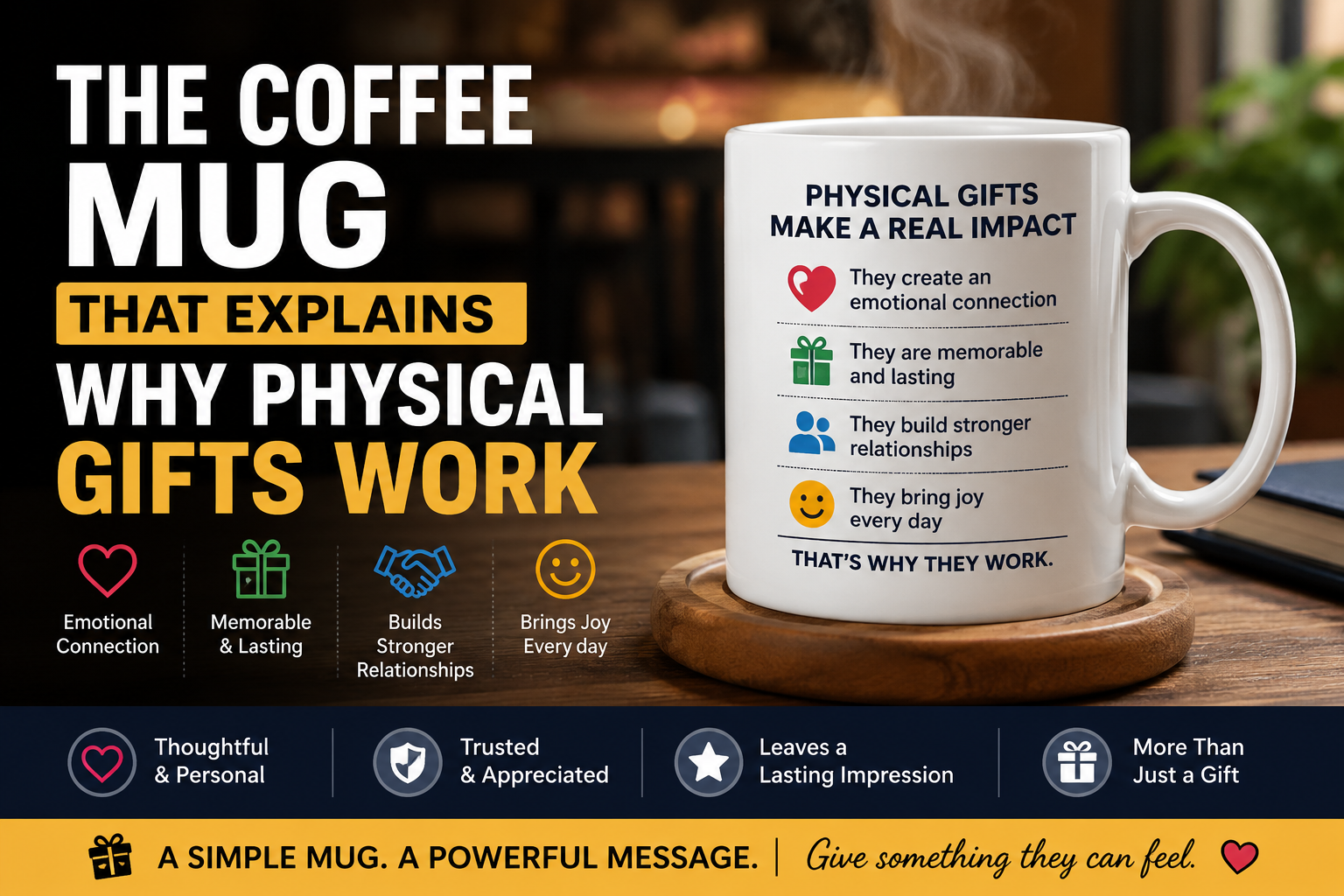
The lesson for merchandise is worth drawing carefully, and it is one reason this UK promotional-mugs supplier leans on physical items rather than digital impressions. A branded mug placed in someone’s hand is not just a surface for a logo. It becomes, in a small way, theirs, and the research suggests we value the things we own above their sticker price. A later study by Reb and Connolly, again using mugs, found that merely touching an object, without owning it at all, was enough to raise how much people valued it. The handling itself does some of the work.
It is important to be honest about what this does and does not prove. The endowment effect is about how much someone values an object they hold, not a guarantee that they will go on to buy from the company whose logo is on it. Serious researchers have also debated its limits, particularly for easily substituted goods. So the right claim is a modest one: a physical, kept, handled object earns a kind of psychological foothold that a banner ad or an email never can. It is not magic, and it is not a purchase guarantee.
Still, that modest claim is more than most promotional advice offers, because it rests on real evidence rather than assertion. A mug sits on a desk, gets picked up a dozen times a day, and quietly becomes part of someone’s routine and, in a small sense, their belongings. Decades of research suggest that matters. When you are deciding whether a physical giveaway is worth it over a digital campaign, it is a point worth putting on the scale. The effect has been replicated many times across different objects and settings, which is why it survives in textbooks rather than as a one-off curiosity.
It is fair to ask why a company should care about a decades-old economics experiment. The answer is that it reframes what a promotional item actually is. A logo on a screen is borrowed attention that ends the moment the page changes. A physical object handed over becomes, however modestly, a possession, and the evidence suggests possessions are valued more highly than the same thing unowned. That shift from borrowed to owned is the quiet advantage a physical giveaway holds.
The everyday version of this is unremarkable and constant. A mug is handled dozens of times a day, held while it is filled, carried, drunk from, rinsed and set back down. Each of those moments is a small act of handling that the touch research suggests deepens the sense that the object is yours. Over weeks and months, a branded mug is not passively seen so much as repeatedly possessed, which is a far stronger relationship than a glance at an advert.
There is a practical corollary for anyone comparing a physical campaign with a digital one. Digital impressions are rented and disappear; a well-chosen physical object is handed over and kept. The research on ownership and touch does not say the mug will make someone buy, but it does help explain why kept, handled items keep earning attention long after a paid impression has scrolled away. That durability of attention is the thing a giveaway is really buying.
The next time someone dismisses a branded mug as a throwaway,you can tell them it is the single most studied object in the psychology of ownership. There is more going on in that cupboard than anyone assumes. Behind the ordinary object sits a genuinely interesting body of evidence, and it happens to favour exactly the kind of item this industry has always sold.