
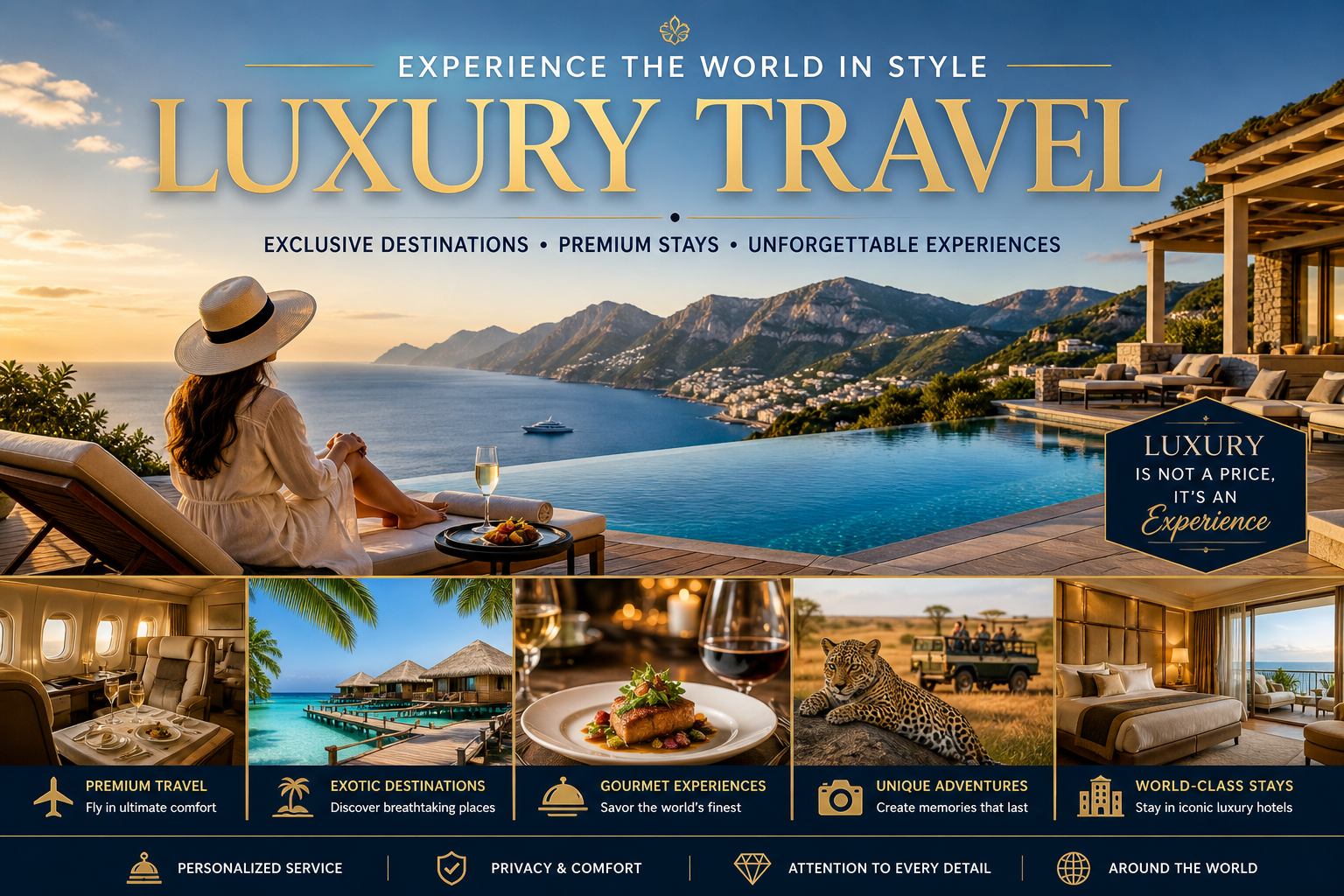
Luxury travel is no longer simply about expensive hotels, first-class flights, or showing off exclusive experiences; it is increasingly about time, privacy, personalization, comfort, and meaningful experiences. The best luxury trips combine exceptional accommodation, seamless transportation, thoughtful service, authentic local experiences, and enough flexibility to let travelers enjoy a destination without constantly worrying about schedules City Guides
What Is Luxury Travel?
Luxury travel is a form of tourism focused on premium comfort, personalized service, privacy, convenience, exclusivity, and high-quality experiences.
It can involve luxury hotels and resorts, private transportation, premium airline cabins, yacht journeys, villas, private guides, exclusive dining, wellness retreats, cultural experiences, adventure travel, and highly customized itineraries.
However, luxury travel has no single universal definition.
For one traveler, luxury may mean a presidential suite overlooking a famous skyline.
For another, it may mean having a private guide in a historic city.
For someone else, luxury could simply mean spending a week in a quiet villa with no crowds and no fixed schedule.
This is why modern luxury travel is better understood through value perception rather than price alone.
How Luxury Travel Has Changed
Luxury tourism has evolved significantly over time.
Traditional luxury was often associated with visible wealth. Large suites, expensive cars, famous restaurants, designer shopping, and exclusive clubs were central to the idea.
Contemporary luxury is becoming more subtle.
Privacy Is Becoming More Valuable
For high-end travelers, privacy can be more valuable than size.
A private villa, secluded resort, yacht, or exclusive lodge can offer something a large luxury hotel cannot: control over the environment.
This is especially attractive to families, couples, celebrities, executives, and travelers who want to avoid crowds.
Time Has Become a Luxury
One of the most important developments in luxury travel is the growing value of time.
A premium traveler may willingly pay more to avoid:
- Long transfers
- Complicated connections
- Waiting in lines
- Poorly coordinated transportation
- Repetitive hotel changes
- Unnecessary itinerary stops
This creates an important concept:
Luxury is often the removal of friction.
Personalization Matters More Than Standardization
Luxury travelers increasingly expect experiences to reflect their preferences.
This can involve:
- Room preferences
- Dining preferences
- Activity levels
- Wellness goals
- Transportation choices
- Cultural interests
- Family requirements
- Special occasions
A personalized itinerary can feel more luxurious than a generic package regardless of price.
The Five Pillars of Luxury Travel
A useful framework for evaluating luxury travel is based on five pillars.
Comfort
Comfort includes accommodation, transportation, sleep quality, food, climate control, space, and physical convenience.
Service
Excellent service anticipates needs without becoming intrusive.
Privacy
Privacy can range from a secluded hotel room to a private villa or completely private itinerary.
Personalization
The experience should reflect the traveler’s interests, preferences, pace, and priorities.
Meaning
The most memorable luxury trips often provide experiences that feel personally significant.
A private meal in a beautiful setting may become more memorable than an expensive shopping trip.
Why People Choose Luxury Travel
Luxury travel attracts people for different reasons.
Celebration
Birthdays, anniversaries, weddings, honeymoons, graduations, and major personal achievements can motivate travelers to choose premium experiences.
Rest and Recovery
Luxury wellness resorts and secluded destinations can provide an environment for slowing down.
Adventure
Luxury does not mean avoiding adventure.
Private safari camps, polar expeditions, yacht journeys, mountain lodges, and remote cultural experiences can combine comfort with exploration.
Cultural Discovery
Luxury travelers may seek deeper access to art, history, architecture, food, music, and local traditions.
Family Time
Families may choose villas or resorts that provide privacy, activities, childcare options, and convenient services.
Business and Networking
Luxury hotels and premium travel services can also serve business purposes, particularly for executives who value efficiency and privacy.
Luxury Travel Destinations Around the World
There is no single list of the world’s best luxury destinations because travel preferences differ.
However, certain destination types consistently appeal to luxury travelers.
Luxury Travel in Europe
Europe offers an unusually broad range of luxury experiences within relatively accessible distances.
France
France combines luxury accommodation, gastronomy, art, fashion, wine regions, coastal destinations, and historic properties.
Paris can appeal to travelers interested in culture and fine dining, while the French Riviera offers a very different coastal experience.
The French Alps provide another dimension through luxury mountain resorts and winter activities.
Italy
Italy is particularly strong for experiential luxury.
Travelers can combine historic cities, countryside estates, coastal villages, vineyards, culinary experiences, fashion, and art.
A well-planned Italian luxury itinerary might combine several contrasting environments rather than focusing only on major cities.
Switzerland
Switzerland is attractive to travelers who value scenery, transportation efficiency, mountain experiences, lakes, wellness, and high-end hospitality.
Luxury travel here can involve alpine resorts, scenic rail journeys, private excursions, and refined city stays.
Greece
Greece combines island scenery, Mediterranean cuisine, historic sites, private villas, sailing, and coastal resorts.
For luxury travelers, island selection matters because each destination has a different atmosphere.
Spain
Spain offers luxury city breaks, Mediterranean resorts, historic architecture, gastronomy, wine regions, and island escapes.
Travelers can create very different experiences depending on whether they prioritize culture, beach time, food, or nightlife.
Luxury Travel in the Middle East
The Middle East has become one of the world’s most visible luxury tourism regions.
United Arab Emirates
The UAE offers luxury hotels, private desert experiences, fine dining, shopping, yachts, premium transportation, and highly developed hospitality infrastructure.
Dubai is particularly well known for combining urban luxury with desert and coastal experiences.
Abu Dhabi offers a different atmosphere with cultural attractions, resorts, beaches, and expansive spaces.
Qatar
Qatar combines modern architecture, luxury hotels, cultural attractions, desert landscapes, and high-end dining.
It can work well for a short premium city break.
Saudi Arabia
Saudi Arabia is developing a broader tourism ecosystem with major projects, heritage destinations, coastal developments, and adventure opportunities.
Because tourism infrastructure continues to evolve, travelers should verify current access, regulations, operating conditions, and entry requirements before planning a trip.
Luxury Travel in Asia
Asia offers exceptional variety.
Japan
Japan can provide luxury through precision, hospitality, craftsmanship, food, architecture, and cultural experiences.
A luxury journey might combine Tokyo, Kyoto, mountain areas, traditional accommodations, fine dining, and private cultural experiences.
Maldives
The Maldives is strongly associated with private villas, marine experiences, beaches, wellness, and secluded resorts.
Its geography makes transportation planning particularly important.
Thailand
Thailand offers luxury resorts, wellness retreats, private islands, culinary experiences, cultural attractions, and tropical landscapes.
Travelers can choose between energetic cities, quieter islands, and nature-focused destinations.
Singapore
Singapore is well suited to travelers who want premium hotels, excellent dining, shopping, architecture, and efficient transportation within a compact destination.
Indonesia
Indonesia can provide luxury through private villas, island resorts, wellness retreats, cultural experiences, and nature.
Bali is particularly established, while other Indonesian destinations offer more remote experiences.
Luxury Travel in Africa
Luxury travel in Africa often focuses on experiences rather than traditional urban luxury.
Safari
A high-end safari can combine wildlife viewing with comfortable accommodation, expert guides, personalized itineraries, and remote locations.
The quality of the guide can be as important as the property itself.
South Africa
South Africa offers luxury lodges, wine regions, coastal scenery, urban experiences, and wildlife.
This makes it possible to combine multiple travel styles in one journey.
Tanzania and Kenya
East African destinations can provide wildlife-focused luxury experiences, particularly for travelers interested in safari.
Timing matters because wildlife conditions, weather, migration patterns, and lodge operations vary.
Morocco
Morocco offers riads, desert experiences, historic cities, gastronomy, architecture, mountains, and premium hospitality.
A well-designed itinerary can combine cultural exploration with periods of relaxation.
Luxury Travel in the Americas
North and South America offer enormous variety.
United States
The United States offers luxury city breaks, national park experiences, beach resorts, mountain destinations, private aviation services, wellness properties, and culinary travel.
Luxury can look completely different in New York, California, Hawaii, Colorado, Florida, or Alaska.
Canada
Canada provides premium wilderness experiences, mountain resorts, luxury rail journeys, lakeside retreats, and sophisticated city hotels.
Mexico
Mexico combines luxury resorts, private villas, gastronomy, cultural destinations, wellness, and coastal experiences.
Caribbean
Caribbean destinations are especially attractive for private villas, beachfront resorts, yacht experiences, and relaxed tropical travel.
South America
South America can deliver luxury through wine travel, cultural journeys, wildlife, dramatic landscapes, gastronomy, and premium lodges.
Argentina, Brazil, Chile, Peru, and other destinations offer very different forms of high-end travel.
What Makes a Luxury Hotel Different?
Luxury accommodation is not defined solely by room size or star rating.
Location
A great location can reduce transportation time and improve the overall experience.
Service
Service is one of the strongest differentiators.
The best properties create a sense that staff understand what guests need without requiring repeated explanations.
Design
Luxury travelers often value architecture, interiors, landscaping, materials, and attention to detail.
Privacy
Private entrances, villas, secluded pools, terraces, and low-density properties can provide an important advantage.
Food and Beverage
Restaurants, breakfast quality, room service, lounges, bars, and private dining can significantly influence the experience.
Wellness
Modern luxury properties increasingly integrate spas, fitness, recovery, sleep, nutrition, and wellness services.
Luxury Travel Experiences Worth Paying For
Not every expensive experience provides good value.
The key is identifying experiences that are difficult to replicate independently.
Private Guides
A knowledgeable private guide can transform a standard sightseeing experience into a deeper exploration of history and culture.
Private Transfers
Private transportation can save time and reduce stress, particularly when arriving in unfamiliar destinations.
Yacht Experiences
Private or semi-private yacht experiences can provide access to coastlines and islands that are difficult to experience otherwise.
Private Dining
A carefully planned private dining experience can be memorable when the food, location, service, and cultural context work together.
Exclusive Cultural Experiences
Examples may include private museum access where legitimately offered, specialist-led art experiences, workshops, or visits arranged around local expertise.
Availability varies by destination.
Wilderness Experiences
Luxury does not have to mean cities.
Remote lodges, private camps, and wilderness experiences can offer an unusual combination of isolation and comfort.
Luxury Travel and Food
Food is increasingly central to premium travel.
Luxury travelers often want more than expensive restaurants.
They want context.
Culinary Travel
A culinary itinerary might include:
- Local markets
- Cooking experiences
- Farm visits
- Winery visits
- Regional specialties
- Chef-led dining
- Food tours
- Traditional restaurants
Authenticity Versus Prestige
An expensive restaurant is not automatically more meaningful than a small local establishment.
Luxury travel can become more interesting when travelers combine exceptional fine dining with authentic local food.
Luxury Wellness Travel
Wellness is one of the strongest areas of modern premium tourism.
Spa Retreats
Traditional spa services remain popular, but modern wellness travel can extend far beyond massages and facials.
Sleep-Focused Travel
Some luxury properties increasingly emphasize sleep environments, quiet spaces, comfortable bedding, relaxation programs, and reduced digital distractions.
Fitness and Recovery
Travelers may combine holidays with:
- Personal training
- Yoga
- Pilates
- Hiking
- Swimming
- Recovery sessions
- Nutrition programs
Mental Space
One of the most valuable wellness experiences may simply be having enough uninterrupted time.
A peaceful environment without a packed schedule can be more restorative than an itinerary filled with treatments.
Luxury Adventure Travel
Adventure and luxury are not opposites.
Luxury Safari
Safari lodges can combine wildlife experiences with comfortable rooms, high-quality food, expert guides, and personalized service.
Luxury Yacht Travel
Yacht travel provides privacy, flexible movement, and access to coastal destinations.
However, costs can vary substantially based on vessel size, crew, itinerary, fuel, marina fees, and season.
Mountain Travel
Luxury mountain travel can involve premium lodges, private guides, scenic transportation, skiing, hiking, wellness, and fine dining.
Expedition Travel
Some travelers seek remote experiences in polar, desert, rainforest, or other challenging environments.
The defining feature is not simply comfort.
It is the ability to experience difficult-to-access environments with professional logistical support.
How to Plan a Luxury Travel Itinerary
Luxury travel benefits from careful planning.
Define Your Priority
Before choosing hotels, decide what matters most.
Is it:
- Privacy?
- Food?
- Culture?
- Wellness?
- Nature?
- Adventure?
- Shopping?
- Beach time?
- Family convenience?
Choose the Right Pace
Luxury travel should rarely feel like a race.
If you have one week, it may be better to experience two destinations deeply than five destinations superficially.
Design Around the Best Experiences
Choose your most important experiences first.
Then build accommodation and transportation around them.
This is often more effective than booking hotels first and trying to fit experiences afterward.
The Luxury Travel Value Equation
A useful way to assess premium travel is:
Value = Experience + Time Saved + Comfort + Personalization + Access − Friction.
Price is not included directly in the equation because an expensive experience can still offer poor value.
For example, paying more for a direct transfer may be worthwhile if it saves several hours and reduces stress.
Conversely, paying a large premium for a room with a slightly better view may provide limited additional value if you spend most of your time outside.
How to Budget for Luxury Travel
Luxury travel requires a broader budget than simply calculating room rates.
Accommodation
Consider:
- Nightly rate
- Taxes
- Resort fees where applicable
- Breakfast
- Transfers
- Additional services
Transportation
Include:
- Flights
- Premium cabin upgrades
- Private transfers
- Car rental
- Drivers
- Trains
- Boats
- Domestic flights
Experiences
Private guides, excursions, dining, wellness, and activities can become significant expenses.
Contingency
A luxury trip should still have an emergency budget.
Unexpected weather, transportation changes, medical needs, or itinerary changes can create additional costs.
How to Save Money Without Destroying the Luxury Experience
Luxury travel does not have to mean paying maximum prices for everything.
Spend on What You Notice
If you care deeply about sleep, prioritize the hotel.
If transportation frustrates you, prioritize premium transfers.
If food is your passion, invest in dining.
Avoid Paying for Unused Features
A massive suite may have little value if you spend all day exploring.
Travel During Shoulder Periods
Traveling outside peak periods can sometimes provide better availability and pricing.
However, seasonal weather and property operations should be checked before booking.
Stay Fewer Nights but Better
For some travelers, three exceptional nights can be more satisfying than seven mediocre nights.
Luxury Travel for Couples
Couples often prioritize privacy, romance, dining, and memorable experiences.
Romantic Luxury Escapes
Suitable experiences can include:
- Private villas
- Scenic resorts
- Sunset cruises
- Fine dining
- Spa treatments
- Cultural experiences
- Private tours
The most important factor is alignment with the couple’s interests.
A quiet countryside retreat may be more romantic for one couple than a famous party destination.
Luxury Travel for Families
Family luxury is fundamentally about convenience.
Family Villas
Private villas can provide space, flexibility, kitchens, pools, and shared living areas.
Resorts
Resorts may offer children’s activities, family restaurants, pools, childcare options, and structured entertainment.
Private Transportation
A private transfer can make family arrivals significantly easier, particularly when traveling with young children and luggage.
Luxury Travel for Solo Travelers
Solo luxury travel offers an unusual benefit: complete control.
You can design the trip around your own interests.
Private Experiences
Private guides and tailored excursions can be particularly valuable because the itinerary does not have to accommodate a group.
Safety and Convenience
Solo travelers may also place greater value on reliable transportation, central accommodation, concierge assistance, and clear communication.
Luxury Travel for Seniors
Older travelers may prioritize comfort, accessibility, convenience, and medical or dietary considerations.
Reduce Transportation Complexity
Fewer hotel changes and private transfers can make a major difference.
Consider Accessibility
Before booking, confirm the practical accessibility of accommodation and activities rather than relying only on general labels.
Build Recovery Time
A slower itinerary often produces a better experience.
Luxury Travel for Business Professionals
Business travelers frequently value time.
Premium Transportation
The ability to work, rest, or arrive refreshed can make premium transportation worthwhile.
Executive Hotels
Important features may include:
- Reliable connectivity
- Quiet rooms
- Business facilities
- Convenient location
- Meeting spaces
- Efficient service
Combining Business and Leisure
Adding personal time to a business journey can create a short luxury extension without requiring a completely separate trip.
Luxury Travel Packing
Luxury travel does not mean packing everything.
Build a Capsule Wardrobe
Choose clothing that works across multiple settings.
Pack for the Destination
Consider:
- Climate
- Cultural expectations
- Activities
- Dress codes
- Formal events
- Footwear requirements
Protect Valuable Items
Use appropriate cases and secure storage for electronics, documents, jewelry, or other valuables.
Luxury Travel Technology
Technology can improve convenience when it remains invisible.
Digital Documents
Keep essential reservations and travel information accessible offline where possible.
Travel Connectivity
International travelers should consider how they will maintain mobile connectivity.
Device Charging
Carry appropriate chargers, cables, and adapters.
Digital Security
Use strong passwords and appropriate account security, especially when connecting to unfamiliar networks.
Common Luxury Travel Mistakes
Mistake: Assuming Expensive Means Better
Price does not guarantee quality.
Solution: Research service quality, location, guest experience, and what is actually included.
Mistake: Overloading the Itinerary
Luxury becomes meaningless when every hour is scheduled.
Solution: Protect free time.
Mistake: Choosing Hotels Before Experiences
A beautiful hotel in the wrong location can create daily transportation problems.
Solution: Choose experiences and geography first.
Mistake: Chasing Status
Some travelers select destinations because they look impressive rather than because they genuinely want to visit them.
Solution: Define your own version of luxury.
Mistake: Ignoring Seasonality
A destination can look perfect online but feel very different during unfavorable weather.
Solution: Research seasonal conditions before booking.
Mistake: Forgetting Transfer Times
A remote luxury resort may require several additional transportation stages.
Solution: Calculate the complete door-to-door journey.
Challenges of Luxury Travel
Luxury travel has advantages, but it also has limitations.
High Cost
Premium service requires significant resources.
Expectations
The more you pay, the more noticeable small service failures become.
Lack of Authenticity
Some highly commercial luxury experiences can feel disconnected from local culture.
Environmental Concerns
Private aviation, large yachts, extensive transportation, and resource-intensive properties can have substantial environmental impacts.
Over-Planning
A highly customized trip can become excessively structured.
Luxury should create freedom, not another schedule to follow.
Pros of Luxury Travel
Luxury travel can provide exceptional comfort, personalized service, privacy, convenience, access, and memorable experiences.
For travelers with limited time, paying for efficiency can also increase the amount of useful time available at the destination.
Private transportation can reduce logistical stress, while high-quality accommodation can make the hotel itself part of the experience.
Cons of Luxury Travel
The biggest disadvantage is cost.
Luxury experiences can also create unrealistic expectations, and travelers may become focused on premium services rather than the destination itself.
There can also be environmental and ethical questions around resource consumption, exclusivity, and access.
A thoughtful luxury traveler should consider these issues rather than treating luxury as unlimited consumption.
Sustainable Luxury Travel
Sustainability is becoming increasingly important within luxury tourism.
Longer Stays
Traveling less frequently but staying longer can sometimes provide a better balance between transportation and time at the destination.
Local Experiences
Working with local guides, restaurants, craftspeople, and businesses can make the trip more connected to the local economy.
Responsible Properties
Travelers can investigate how hotels approach energy, water, waste, food sourcing, conservation, and local employment.
Claims about sustainability should be evaluated carefully rather than accepted solely because a property uses environmental language in marketing.
Conservation-Based Travel
Some luxury tourism experiences directly support conservation initiatives.
Safari lodges and wilderness properties can sometimes connect tourism revenue with conservation and local communities, although the actual impact varies by operator and destination.
Ten Luxury Travel Brands and Companies to Know
Luxury travel includes hotels, resorts, cruise operators, travel advisors, and hospitality groups. The brands below operate in different segments, so this is a category comparison rather than a direct ranking.
| Brand | Primary Area | Best Known For | Ideal Traveler | Luxury Strength |
|---|---|---|---|---|
| Four Seasons | Hotels & Resorts | Personalized hospitality | Couples, families, executives | Service and consistency |
| Aman | Hotels & Resorts | Privacy and understated luxury | Couples, privacy-focused travelers | Seclusion and design |
| Ritz-Carlton | Hotels & Resorts | Traditional luxury hospitality | Business and leisure travelers | Service and premium properties |
| Mandarin Oriental | Hotels & Resorts | Urban and resort luxury | Couples and business travelers | Hospitality and wellness |
| Rosewood | Hotels & Resorts | Residential-style luxury | Experience-focused travelers | Sense of place |
| Belmond | Luxury travel experiences | Trains, hotels, cruises and experiences | Experiential travelers | Distinctive journeys |
| Six Senses | Resorts & Wellness | Wellness and sustainability-focused luxury | Wellness travelers | Integrated wellness |
| One&Only | Resorts | High-end destination resorts | Couples and families | Exclusive resort experiences |
| Aman Resorts | Ultra-luxury hospitality | Private, design-led properties | Privacy-focused travelers | Intimacy and exclusivity |
| Explora Journeys | Luxury cruising | Modern premium cruising | Cruise travelers | Contemporary cruise experience |
Brand names alone should never determine a booking decision. A specific property, location, management team, season, room category, and itinerary can have a much greater effect on the actual experience.
How to Compare Luxury Hotels
Compare Location
A slightly less famous property in a better location may create a superior overall trip.
Compare Included Services
Check what is actually included.
Breakfast, transfers, activities, wellness services, and other benefits can materially change the total value.
Compare Room Categories
Do not compare only the hotel’s headline suite.
Study the specific room you are considering.
Compare Service Reputation
Look for consistent feedback about service, housekeeping, responsiveness, and problem resolution.
Compare Experience
Ask whether the property itself contributes meaningfully to your trip.
Luxury Travel and Personalization
Personalization is one of the biggest differences between premium travel and mass tourism.
Personalized Itineraries
Instead of selecting a prebuilt itinerary, travelers can organize trips around their own interests.
Personalized Dining
Hotels and travel planners may accommodate preferences and special occasions when notified in advance.
Personalized Activities
A traveler interested in photography may require a very different guide and schedule from someone interested in architecture or food.
Personalized Pace
Perhaps the most important personalization is pace.
Some travelers want early mornings and full days.
Others want late breakfasts and long afternoons.
A luxury itinerary should reflect that difference.
How Artificial Intelligence May Change Luxury Travel
Artificial intelligence is likely to influence luxury tourism, but its greatest value may not be replacing human travel advisors.
Faster Research
AI systems can help travelers compare destinations, transportation options, activities, and itinerary structures.
Preference Learning
Future travel systems may become better at understanding preferences across trips.
Real-Time Adaptation
AI-assisted travel planning may eventually adjust itineraries based on weather, delays, crowds, closures, and changing traveler preferences.
Human Expertise Will Still Matter
Luxury travel often involves judgment.
A human advisor, concierge, guide, or local expert can understand subtle details that automated systems may miss.
The strongest future model may therefore combine technology with human expertise.
Future Trends in Luxury Travel
Luxury tourism is likely to continue evolving toward experiences that are more personal, private, wellness-oriented, and meaningful.
Quiet Luxury
Visible extravagance may continue giving way to subtle design, excellent materials, exceptional service, and privacy.
Private Travel
Private villas, jets, yachts, guides, transfers, and small-group experiences are likely to remain attractive to travelers who value control.
Wellness Travel
Wellness is likely to become more integrated into mainstream luxury hospitality.
Regenerative and Responsible Tourism
Luxury properties may increasingly compete around conservation, community relationships, biodiversity, local sourcing, and environmental performance.
Remote Destinations
As travelers become more experienced, some may seek destinations that are less crowded and more difficult to access.
Slow Luxury
Instead of moving constantly, travelers may spend longer periods in fewer places.
This creates a form of luxury centered on time and immersion.
The Rise of Meaningful Luxury
One of the most important future trends is the movement from material luxury toward experiential luxury.
A traveler may remember:
- A conversation with a local artist
- A private sunrise experience
- A family dinner overlooking the sea
- A guided wildlife encounter
- A traditional cooking lesson
- A quiet morning in the mountains
These moments may have greater emotional value than another expensive object.
The future of luxury travel may therefore be less about asking, “How much did this cost?”
It may be about asking:
“How much will I remember this?”
How to Create a Luxury Trip Without an Unlimited Budget
You do not need unlimited money to incorporate luxury into travel.
Choose One Luxury Anchor
Select one part of the trip to upgrade.
For example:
- One exceptional hotel
- One private tour
- One special dinner
- One premium transfer
- One spa experience
Then keep other elements more moderate.
Prioritize Experience Over Display
An expensive room that you barely use may provide less value than a memorable private experience.
Reduce Quantity
Spend more on fewer experiences.
This is often the easiest way to improve perceived luxury without dramatically increasing the total trip budget.
Luxury Travel for First-Time Premium Travelers
First-time luxury travelers sometimes feel pressure to understand complicated hotel categories, airline cabins, loyalty programs, and premium services.
They do not need to.
Start With Comfort
Choose accommodation with strong reviews, convenient location, and reliable service.
Upgrade Strategically
You do not need premium everything.
Choose the part of the journey where comfort matters most to you.
Ask Questions
Luxury hotels and travel advisors exist to help guests customize experiences.
Communicate preferences early.
Luxury Travel for Experienced Travelers
Experienced travelers often become more selective.
They may care less about famous names and more about:
- Privacy
- Design
- Authenticity
- Service
- Location
- Food
- Space
- Personalization
This is one reason sophisticated travelers may choose smaller properties over globally famous hotels.
The Luxury Travel Decision Matrix
Before booking, score each major component from one to five on:
Comfort
Will this improve how physically comfortable I feel?
Convenience
Will it save time or reduce friction?
Experience
Will it create a memorable moment?
Personalization
Does it fit my preferences?
Authenticity
Does it feel connected to the destination?
Value
Is the additional cost justified?
A product or service that scores highly across these areas is more likely to deserve its premium.
Luxury Travel Packing Checklist
A premium trip still requires practical preparation.
Travel Documents
Carry:
- Passport
- Visa documents where required
- Travel insurance information
- Hotel confirmations
- Transportation details
- Emergency contacts
Electronics
Consider:
- Smartphone
- Chargers
- Appropriate travel adapter
- Power bank
- Headphones
- Camera if required
Clothing
Pack according to:
- Weather
- Hotel dress codes
- Activities
- Cultural expectations
- Formal occasions
Personal Items
Include the toiletries, medications, glasses, accessories, and other essentials you actually use.
Luxury travel is not improved by bringing a suitcase full of unnecessary items.
A Seven-Day Luxury Travel Planning Example
A seven-day luxury itinerary demonstrates how pacing can work.
Day One
Arrival, private transfer, hotel check-in, relaxed dinner, and rest.
Day Two
Slow breakfast followed by a private cultural or sightseeing experience.
Day Three
Wellness morning followed by a flexible afternoon.
Day Four
A major destination experience such as a scenic excursion, private boat trip, or guided nature activity.
Day Five
Free day with optional dining, shopping, spa, or local exploration.
Day Six
A signature experience designed around the traveler’s main interest.
Day Seven
Relaxed morning, final meal, and comfortable departure.
The important feature is not the exact schedule.
It is the space between activities.
Luxury Travel and the Importance of Flexibility
A luxury trip should have plans, but it should not feel imprisoned by them.
Weather may change.
A restaurant may disappoint.
A traveler may discover an unexpected neighborhood.
A guide may recommend something better.
Flexibility allows the journey to respond.
This is particularly important because some of the most memorable travel experiences cannot be scheduled in advance.
How to Choose a Luxury Travel Advisor
For complex journeys, a skilled travel advisor can save considerable time.
Look for Destination Knowledge
Someone who has direct knowledge of the destination can provide more useful advice than someone simply reading hotel descriptions.
Evaluate Personalization
Ask whether the advisor builds trips around your interests or primarily sells fixed packages.
Understand Fees
Make sure you understand advisory fees, booking conditions, cancellation policies, and commissions where relevant.
Assess Communication
Luxury planning often involves multiple moving parts.
Reliable communication is essential.
Luxury Travel and Travel Insurance
High-value trips can involve significant financial exposure.
Travelers should carefully examine insurance coverage before departure.
Consider whether the policy addresses relevant risks such as:
- Trip cancellation
- Trip interruption
- Medical emergencies
- Lost or delayed luggage
- Travel delays
- Certain adventure activities
Coverage varies by policy and destination.
Travel insurance should be reviewed based on the actual trip rather than purchased solely because it is labeled premium.
Luxury Travel Safety
Luxury does not eliminate travel risks.
Protect Important Documents
Keep passports and essential documents secure.
Avoid Advertising Wealth Unnecessarily
Travelers should remain aware of their surroundings and avoid unnecessary displays of valuables.
Use Reliable Transportation
In unfamiliar destinations, use reputable transportation providers.
Research Local Conditions
Safety conditions can vary dramatically between destinations and even neighborhoods.
Ethical Considerations in Luxury Tourism
Luxury travel creates difficult questions.
Who benefits from tourism revenue?
How much water and energy does a resort consume?
Are workers treated fairly?
Does an experience disturb wildlife?
Does tourism displace local communities?
These questions do not mean travelers must reject luxury.
They mean luxury can be approached more thoughtfully.
The Future Definition of Luxury
The definition of luxury will likely continue shifting.
For some travelers, luxury will remain associated with premium hotels, private jets, yachts, and exclusive resorts.
For others, luxury will increasingly mean:
- Time
- Privacy
- Silence
- Nature
- Health
- Authenticity
- Personal attention
- Flexibility
- Space
- Meaning
This suggests that the future luxury traveler may become more selective rather than simply more extravagant.
FAQs
What is luxury travel?
Luxury travel is premium tourism focused on comfort, personalized service, privacy, convenience, exceptional accommodation, exclusive or specialized experiences, and high-quality hospitality. It does not necessarily require spending the maximum possible amount.
What makes a trip luxurious?
A trip becomes luxurious when it provides a high level of comfort, service, personalization, privacy, convenience, or access that matches the traveler’s priorities. The experience matters more than price alone.
Is luxury travel only for wealthy people?
Traditional luxury travel can be extremely expensive, but travelers with different budgets can selectively include premium experiences. Choosing one luxury element, such as a special hotel or private tour, can create a more premium trip without upgrading everything.
What are the best luxury travel destinations?
The best destination depends on personal interests. Europe offers culture and gastronomy, Asia provides diverse cultural and wellness experiences, the Middle East offers modern luxury infrastructure, Africa provides safari and wilderness experiences, and the Americas offer everything from cities to beaches and remote nature.
What is the difference between luxury travel and regular travel?
The biggest differences are generally the level of service, personalization, comfort, privacy, convenience, and access. Luxury travelers often pay to reduce friction and increase control over their experience.
Are luxury hotels worth the money?
They can be, particularly when the hotel provides exceptional service, location, privacy, design, wellness, dining, or experiences that matter to the traveler. However, a high price does not automatically mean high value.
How can I make a vacation feel luxurious?
Focus on the details that matter most to you. You could choose a beautiful hotel, arrange a private transfer, book a special dinner, add a private guide, schedule a spa experience, or simply design a slower itinerary.
What is quiet luxury travel?
Quiet luxury travel emphasizes understated design, privacy, craftsmanship, personalized service, comfort, and authentic experiences rather than obvious displays of wealth.
What is experiential luxury travel?
Experiential luxury focuses on memorable activities and access rather than material possessions. Examples can include private cultural experiences, exclusive dining, wildlife encounters, sailing, wellness retreats, or specialist-led adventures.
Is luxury travel sustainable?
It can be, but not automatically. Luxury travel can have significant environmental impacts, particularly when it involves resource-intensive accommodation or transportation. Travelers can consider responsible properties, local experiences, conservation programs, longer stays, and efficient transportation.
What is the best luxury travel experience?
There is no universal answer. The best experience is one that matches your interests and creates meaningful memories. For one person that may be a private safari, while another may prefer a quiet villa, culinary journey, or cultural experience.
Is private travel always better?
Not necessarily. Private travel provides control, privacy, and flexibility, but group experiences can sometimes provide stronger social interaction and cultural exchange. The right choice depends on the traveler and purpose.
What should I prioritize when planning a luxury trip?
Start with the purpose of the journey, then choose the destination, major experiences, accommodation, transportation, and schedule. Prioritize the aspects of travel that matter most personally rather than upgrading everything.
How much does luxury travel cost?
There is no universal price. Costs vary according to destination, accommodation, transportation, season, room category, private services, activities, and trip duration. A realistic budget should include all major trip components rather than focusing only on hotel rates.
Is luxury travel good for families?
Yes. Family luxury travel can provide larger accommodation, private transportation, flexible schedules, high-quality dining, children’s facilities, childcare options, and convenient services. The best properties are those designed around actual family needs.
What is luxury wellness travel?
Luxury wellness travel combines premium accommodation with experiences designed around relaxation, fitness, nutrition, spa services, sleep, mindfulness, recovery, and overall well-being.
What is luxury adventure travel?
Luxury adventure travel combines challenging or unusual experiences with premium accommodation, expert guides, high-quality transportation, and personalized service. Safari, yacht travel, mountain trips, and remote expeditions are common examples.
Should luxury travelers use a travel advisor?
A travel advisor can be valuable for complicated itineraries, special occasions, remote destinations, multi-country journeys, and trips requiring multiple private services. For simple trips, independent planning may be sufficient.
How early should I plan luxury travel?
There is no universal timeline. Popular properties, villas, yachts, special experiences, and peak-season destinations can require substantial advance planning. More flexibility generally provides more options.
What is the biggest mistake luxury travelers make?
One of the biggest mistakes is assuming that the most expensive option is automatically the best option. Luxury should be judged by experience, service, comfort, personalization, location, and value.
Conclusion
Luxury travel is changing. It is moving beyond the simple idea that luxury means the most expensive hotel, the biggest suite, the fastest car, or the most exclusive restaurant. The modern definition is more personal. For one traveler, luxury means privacy. For another, it means having a private guide who opens a deeper understanding of a destination. For someone else, it means waking up beside the ocean without an alarm. For a family, luxury may be a villa where everyone has enough space.