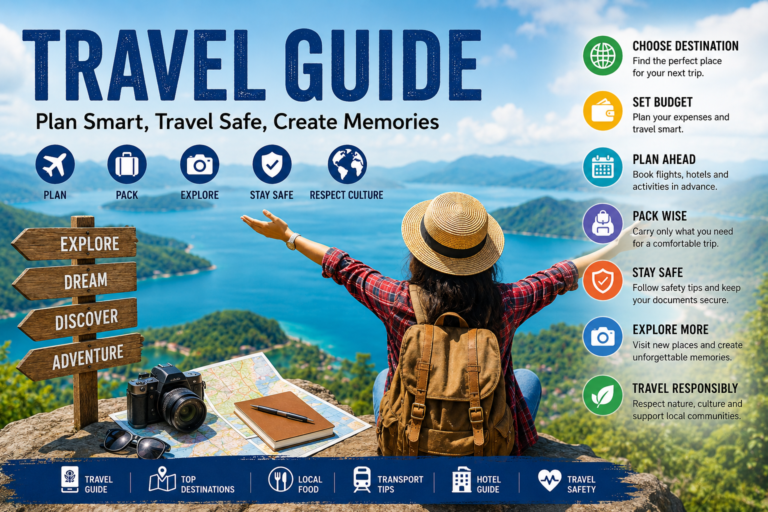
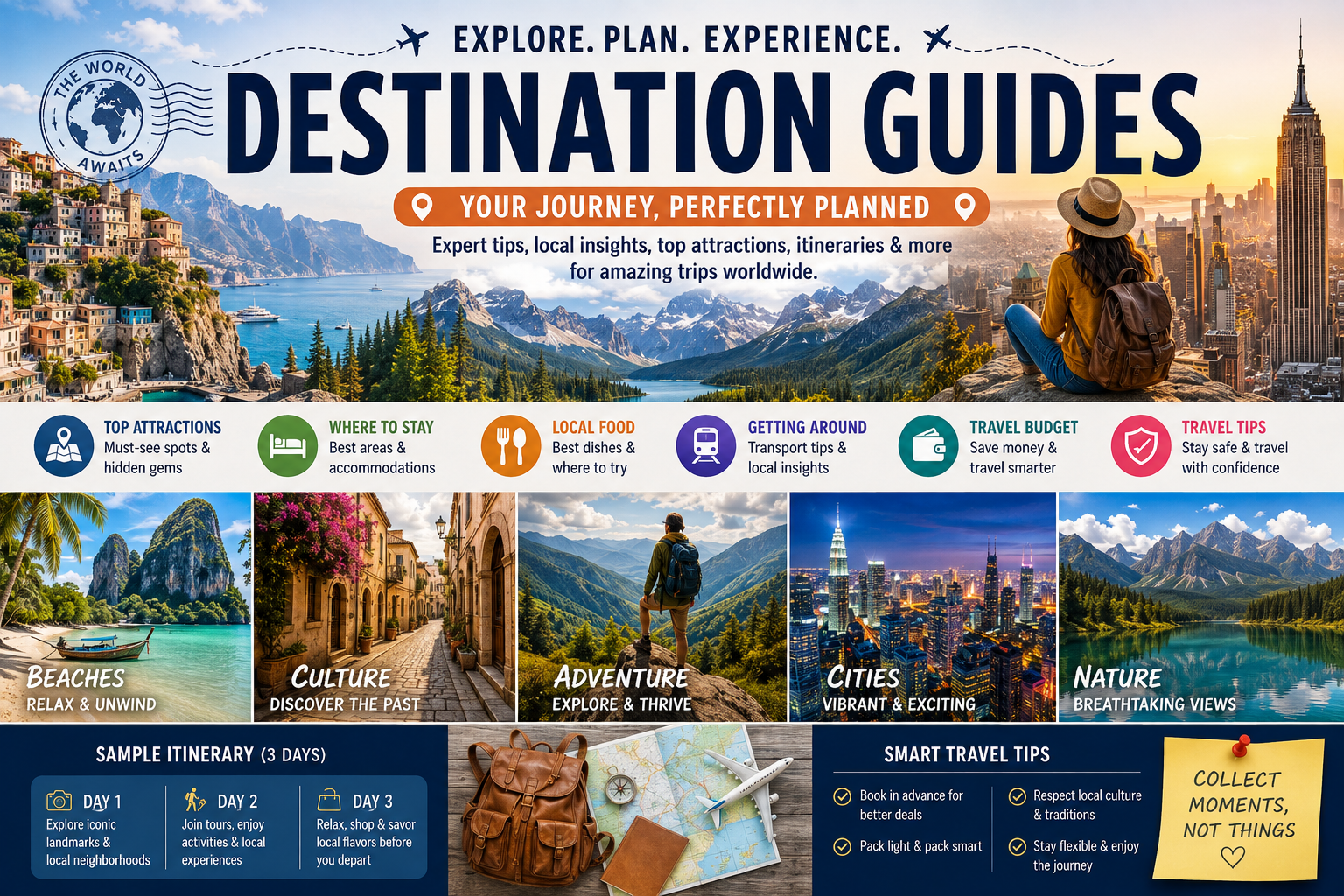
Destination guides help travelers turn a place they have never visited into a practical, realistic travel plan by explaining where to go, what to see, when to visit, how to get around, where to stay, what to eat, what to budget, and how to avoid common mistakes. The best destination guides go beyond lists of attractions: they explain how a destination actually feels, how its neighborhoods differ, what type of traveler it suits, and how to build an itinerary around real priorities Travel Code
What Is a Destination Guide?
A destination guide is a detailed travel resource designed to help someone understand and plan a trip to a specific place.
The destination could be:
- A country
- A city
- An island
- A region
- A national park
- A beach destination
- A mountain area
- A historic town
- A road-trip route
- A group of nearby destinations
A basic travel article might simply list attractions.
A strong destination guide goes much further.
It can cover:
- Best time to visit
- Weather and seasons
- Things to do
- Attractions
- Neighborhoods
- Accommodation areas
- Transportation
- Food
- Culture
- Safety
- Budget planning
- Family travel
- Solo travel
- Couples travel
- Accessibility
- Local customs
- Suggested itineraries
- Common mistakes
- Sustainable travel
- Practical planning
The goal is to reduce uncertainty.
Why Destination Guides Matter for Modern Travelers
Planning a trip has become easier and harder at the same time.
It is easier because travelers can access enormous amounts of information from phones and computers.
It is harder because there is too much information.
Search for a major destination and you may find:
- Hundreds of hotels
- Thousands of restaurants
- Endless attraction lists
- Social media recommendations
- Conflicting advice
- Old information
- Sponsored recommendations
- Generic itineraries
- AI-generated travel content
The traveler is left with another problem:
Which information should I trust?
A useful destination guide acts as a filter.
Instead of asking travelers to research everything themselves, it organizes the information according to practical travel decisions.
What Makes a Great Destination Guide?
A great destination guide should be:
Practical
Readers should be able to use it while planning their trip.
Accurate
Important details should be checked and updated when necessary.
Balanced
A guide should explain both advantages and disadvantages.
Specific
Instead of saying “the city has great food,” explain what type of food travelers can expect and where different experiences fit into an itinerary.
Audience-focused
A backpacker, family, luxury traveler, digital nomad, and first-time visitor may need completely different advice.
Honest
Not every famous attraction deserves unlimited time.
A strong guide should be willing to say when something is overrated, inconvenient, expensive, crowded, seasonal, or unsuitable for certain travelers.
How to Choose a Destination
Before creating an itinerary, decide what kind of trip you actually want.
This sounds obvious, but many travelers start with attractions instead of priorities.
Ask What You Want From the Trip
Do you want:
- Relaxation?
- Adventure?
- Culture?
- Food?
- History?
- Nature?
- Shopping?
- Nightlife?
- Photography?
- Wellness?
- Family entertainment?
- Outdoor activities?
- Luxury?
- Budget travel?
Your answer changes the destination.
A traveler interested in ancient architecture may love a historic city but become bored at a resort.
Someone seeking relaxation may find a packed sightseeing itinerary exhausting.
Someone traveling with children may prioritize short travel times and convenient accommodation over nightlife.
Destination Guides for Different Types of Travelers
Destination Guides for Beginners
First-time travelers usually need more practical information.
A beginner-friendly destination guide should explain:
- How to arrive
- Where to stay
- How transportation works
- Basic cultural expectations
- Typical daily costs
- Major attractions
- Areas to avoid or approach carefully
- How long to stay
- Common tourist mistakes
Avoid assuming that readers already understand local transportation or cultural norms.
Destination Guides for Families
Families often have different priorities.
Consider:
- Child-friendly accommodation
- Short transportation connections
- Rest periods
- Family restaurants
- Weather
- Medical access
- Stroller accessibility
- Attractions suitable for different ages
- Bathroom availability
- Evening schedules
A destination can be excellent for adults but difficult for young children.
Destination Guides for Solo Travelers
Solo travelers may prioritize:
- Walkability
- Public transportation
- Social environments
- Safe accommodation
- Day tours
- Flexible schedules
- Solo dining options
The best solo travel guide should discuss both freedom and practical considerations.
Destination Guides for Couples
Couples may be interested in:
- Scenic areas
- Romantic restaurants
- Boutique hotels
- Sunset locations
- Cultural experiences
- Spa and wellness activities
- Private tours
However, couples should not assume that every romantic destination requires luxury spending.
Destination Guides for Budget Travelers
Budget travelers need more than a list of cheap hotels.
A useful budget guide should explain how to reduce costs without destroying the travel experience.
For example:
- Stay outside the most expensive tourist center
- Use public transportation
- Visit free attractions
- Eat at local markets
- Travel during shoulder seasons
- Choose fewer destinations and stay longer
- Compare transportation options
- Avoid unnecessary tours
Destination Guides for Luxury Travelers
Luxury travel guides should focus on quality rather than simply price.
Important factors include:
- Service
- Location
- Privacy
- Dining
- Wellness
- Unique experiences
- Airport transfers
- Personalized tours
- Exclusive access
The most expensive option is not automatically the best option.
How to Research a Destination Properly
Good destination content starts with research.
Start With Geography
Understand:
- Where the destination is
- Nearby regions
- Main airport or transport hubs
- Distance between major attractions
- Terrain
- Climate
- Major neighborhoods
Geography determines itinerary efficiency.
A traveler who misunderstands a city’s layout may waste hours crossing it repeatedly.
Study the Seasons
Weather affects almost every travel decision.
Research:
- Peak season
- Shoulder season
- Low season
- Rainy periods
- Hot periods
- Cold periods
- Holiday periods
- Major festivals
- School vacations
The “best time” is not universal.
The best time for beach weather may not be the best time for low prices.
The best time for photography may not be the best time for comfortable hiking.
Understanding Peak, Shoulder, and Low Season
Peak Season
Peak season generally brings:
- Higher prices
- More visitors
- Greater demand
- Longer queues
- More booked accommodation
But it can also offer:
- Better weather
- More activities
- Longer opening hours
- More transportation options
Shoulder Season
Shoulder season can provide an attractive balance between:
- Price
- Weather
- Crowds
- Availability
For many travelers, it is an excellent compromise.
Low Season
Low season often means:
- Lower prices
- Fewer visitors
- More availability
But travelers may encounter:
- Unpredictable weather
- Reduced services
- Seasonal closures
- Shorter operating hours
How Many Days Should You Spend at a Destination?
There is no universal answer.
A major city may deserve four or five days.
A smaller town might be ideal for two days.
A large country could require weeks.
A useful method is to divide your trip into three categories:
- Must-see experiences
- Nice-to-have experiences
- Optional experiences
Then estimate realistic travel time between them.
The One-Major-Experience Rule
For busy sightseeing days, consider planning around one major experience and several smaller activities.
This leaves room for:
- Meals
- Transportation delays
- Rest
- Unexpected discoveries
- Photography
- Local exploration
An itinerary that looks perfect on paper can become exhausting in reality.
How to Build a Destination Itinerary
A strong itinerary should have structure without becoming a prison.
Step 1: Choose Your Base
Pick accommodation based on your activities.
Do not automatically choose the cheapest room.
A slightly more expensive hotel in a convenient area may save significant transportation time.
Step 2: Group Nearby Attractions
If three attractions are close together, visit them on the same day.
This reduces unnecessary travel.
Step 3: Consider Opening Hours
Check whether attractions:
- Close on certain days
- Require reservations
- Have timed entry
- Operate seasonally
Step 4: Leave Empty Space
Do not schedule every hour.
A good itinerary should contain breathing room.
Step 5: Create a Backup Plan
Weather, transport problems, fatigue, and unexpected closures happen.
Have at least one alternative activity.
Destination Guides Should Explain Neighborhoods
One of the most overlooked elements of travel planning is where to stay.
A city is not one experience.
Different neighborhoods can feel like completely different destinations.
One area might be:
- Historic
- Residential
- Business-focused
- Artistic
- Luxury-oriented
- Family-friendly
- Nightlife-focused
- Beach-oriented
How to Compare Neighborhoods
| Factor | Questions to Ask |
|---|---|
| Location | Is it close to the places you want to visit? |
| Transport | Are stations or routes nearby? |
| Atmosphere | Is it quiet, busy, historic, modern, or nightlife-focused? |
| Price | Are hotels and restaurants within your budget? |
| Food | Are there convenient dining options? |
| Evening experience | Is the area comfortable after dark? |
| Family suitability | Are facilities suitable for children? |
| Walkability | Can you comfortably explore on foot? |
Transportation in Destination Guides
Transportation can make or break a trip.
A good destination guide should explain the major options.
Walking
Walking is often the best way to experience historic districts and compact city centers.
Advantages include:
- Free
- Flexible
- Good for photography
- Encourages local discovery
Public Transportation
Public transport can be efficient and affordable.
Potential options include:
- Metro
- Bus
- Tram
- Train
- Ferry
Taxis and Ride Services
Useful when:
- Traveling with luggage
- Arriving late
- Visiting places with limited public transport
- Traveling in groups
Rental Cars
Rental cars can be useful for:
- Rural areas
- Road trips
- Mountain destinations
- Remote beaches
- National parks
They can be less useful in dense city centers where parking is expensive.
How to Build a Travel Budget
A destination guide should never treat the hotel price as the entire travel budget.
Consider:
- Flights
- Accommodation
- Local transportation
- Food
- Attractions
- Tours
- Shopping
- Travel insurance
- Visas or entry requirements where applicable
- Emergency expenses
- Internet or connectivity
- Tips and service charges where customary
The Three-Budget Method
Create:
Minimum budget
The cheapest realistic version of the trip.
Comfortable budget
A practical middle option.
Premium budget
Higher-end accommodation, dining, transport, and experiences.
This gives travelers flexibility.
Food and Destination Guides
Food is one of the strongest ways to understand a destination.
A useful food section should explain:
- Local specialties
- Popular meal times
- Street food culture
- Restaurant etiquette
- Dietary options
- Typical prices
- Regional differences
Don’t Only Recommend Famous Restaurants
Some of the most meaningful food experiences happen at:
- Local markets
- Family-run restaurants
- Bakeries
- Street stalls
- Small cafés
- Traditional food districts
The goal is not simply to find the most famous restaurant.
It is to understand the food culture.
Cultural Etiquette in Destination Guides
Travelers should know the basic social expectations of a destination.
Depending on the country, this may involve:
- Dress
- Greetings
- Photography
- Religious sites
- Tipping
- Dining etiquette
- Public behavior
- Personal space
- Hand gestures
- Shoes
- Language
Why Cultural Respect Matters
Tourists are temporary visitors.
Local residents live there every day.
A thoughtful traveler adapts rather than expecting the destination to behave like home.
Responsible and Sustainable Travel
Modern destination guides should discuss environmental and community impact.
Travel can support:
- Local businesses
- Cultural preservation
- Employment
- Conservation
- Community development
But poorly managed tourism can contribute to:
- Overcrowding
- Waste
- Housing pressure
- Environmental damage
- Cultural commodification
- Resource consumption
Practical Sustainable Travel Choices
Travelers can:
- Use public transportation where practical
- Support local businesses
- Avoid damaging natural areas
- Follow photography rules
- Carry reusable items
- Respect wildlife
- Stay longer rather than constantly moving
- Travel outside extreme peak periods
- Avoid purchasing questionable cultural artifacts
The Hidden Value of Slow Travel
Slow travel focuses on spending more meaningful time in fewer places.
Instead of visiting five cities in seven days, a traveler might choose two destinations and explore them deeply.
Benefits can include:
- Less transportation stress
- Lower logistical complexity
- Better cultural immersion
- More opportunities for local interaction
- Lower environmental impact
- More relaxed schedules
The best destination guide should not always encourage travelers to see more.
Sometimes the better advice is:
See less, but experience it better.
Destination Guides and Travel Photography
Photography influences modern destination choices.
Travelers often choose places because they look beautiful online.
But photographs can create unrealistic expectations.
The Social Media Problem
A photograph may:
- Hide crowds
- Use unusual angles
- Be taken during perfect weather
- Exclude surrounding construction
- Represent a tiny part of a large location
Destination guides should therefore provide context.
A beautiful viewpoint can still be worth visiting while requiring an early morning arrival or a significant hike.
How to Avoid Tourist Traps
Tourist traps are not always scams.
Sometimes they are simply expensive experiences designed around visitors rather than local culture.
Warning signs may include:
- Extremely aggressive sales tactics
- Unclear prices
- Menus without prices
- Fake urgency
- Unsolicited guides
- Poorly explained fees
- Highly inflated prices
Practical Solution
Before paying:
- Ask the total price.
- Confirm what is included.
- Check whether additional fees apply.
- Compare alternatives.
- Use official booking channels where appropriate.
Common Destination Planning Mistakes
Mistake 1: Trying to See Everything
More attractions do not automatically mean a better trip.
Solution: Choose priorities.
Mistake 2: Booking Based Only on Price
Cheap accommodation far away can become expensive through transportation costs and lost time.
Solution: Consider total trip cost.
Mistake 3: Ignoring Travel Time
Maps can be misleading.
Solution: Estimate actual transportation time.
Mistake 4: Overplanning
A rigid itinerary leaves no space for reality.
Solution: Keep buffer time.
Mistake 5: Visiting Only Famous Attractions
Famous attractions can be excellent, but they rarely represent an entire destination.
Solution: Add one local neighborhood, market, park, cultural experience, or small museum.
Mistake 6: Ignoring Local Customs
A behavior that is normal at home may be inappropriate elsewhere.
Solution: Research basic etiquette before arrival.
Mistake 7: Using Outdated Information
Travel rules, transportation schedules, prices, opening hours, and entry requirements can change.
Solution: Verify time-sensitive details close to departure.
Destination Guides and Travel Safety
Travel safety advice should be practical rather than alarmist.
Consider:
- Local emergency numbers
- Common tourist scams
- Transportation safety
- Weather risks
- Local laws
- Health precautions
- Valuable-item security
- Travel documents
- Copies of important information
Keep Important Documents Secure
Travelers should consider having secure access to:
- Passport information
- Booking details
- Insurance information
- Emergency contacts
- Important addresses
Destination Guides for Different Travel Problems
For Travelers With Limited Time
Focus on:
- Central location
- Major highlights
- Efficient transportation
- One or two signature experiences
For Travelers on a Tight Budget
Focus on:
- Free attractions
- Affordable neighborhoods
- Public transport
- Local food
- Off-season travel
For Travelers With Mobility Needs
Focus on:
- Accessible hotels
- Step-free transportation
- Elevator availability
- Accessible attractions
- Terrain
- Rest areas
Accessibility should not be treated as an afterthought.
For Travelers With Dietary Restrictions
Research:
- Common ingredients
- Local terminology
- Restaurant communication
- Food labeling
- Suitable cuisines
For Older Travelers
Consider:
- Shorter travel days
- Comfortable transportation
- Medical access
- Convenient accommodation
- Fewer hotel changes
- Rest periods
Pros and Cons of Using Destination Guides
| Pros | Cons |
|---|---|
| Save planning time | May become outdated |
| Organize information | Can oversimplify a destination |
| Help create itineraries | Personal preferences differ |
| Explain local culture | Some recommendations may be subjective |
| Help compare neighborhoods | Popular places can become overcrowded |
| Support budget planning | Prices change |
| Reduce common mistakes | No guide can predict every situation |
| Help first-time visitors | Travelers may follow guides too rigidly |
The best approach is to use destination guides as decision-making tools, not instructions that must be followed word for word.
Ten Travel Brands and Destination Guide Comparison
Travel brands serve different purposes, so travelers should choose based on the type of planning support they need.
| Brand | Main Strength | Best For | Key Advantage | Limitation |
|---|---|---|---|---|
| Lonely Planet | Destination information | Independent travelers | Broad destination coverage | Some travelers may prefer more personalized planning |
| Tripadvisor | Reviews and traveler opinions | Comparing experiences | Large volume of user feedback | Reviews can vary in quality |
| Expedia | Trip planning and bookings | Package-oriented travelers | Multiple travel products | Booking-focused rather than deeply cultural |
| Booking.com | Accommodation discovery | Hotel planning | Extensive accommodation choices | Primarily accommodation-focused |
| Airbnb | Local-style stays | Longer or neighborhood-based trips | Wide variety of properties | Experience varies by property and location |
| Google Maps | Navigation and place discovery | Independent exploration | Mapping and location planning | Not a complete destination guide |
| National Geographic | Travel and exploration content | Culture and nature enthusiasts | Strong storytelling | Less focused on transaction-based planning |
| Rough Guides | Independent travel | Curious travelers | Detailed destination orientation | Style may appeal more to self-directed travelers |
| Fodor’s | Travel planning | Mainstream travelers | Organized destination advice | Coverage varies by destination |
| Frommer’s | Practical travel planning | Travelers seeking structured advice | Practical orientation | Less focused on spontaneous discovery |
No single brand is best for everyone.
A traveler might use a destination guide for research, a mapping service for navigation, a booking platform for accommodation, and traveler reviews for final comparisons.
How Destination Guides Can Be Improved With Technology
Technology has changed travel planning dramatically.
Artificial Intelligence
AI can help travelers organize information and generate preliminary itineraries.
However, AI-generated travel recommendations should still be verified.
AI may:
- Misunderstand local conditions
- Provide outdated information
- Invent details
- Confuse similarly named places
- Miss seasonal closures
The best use of AI is as a planning assistant rather than an unquestioned authority.
Digital Maps
Maps allow travelers to understand:
- Distance
- Neighborhoods
- Transportation
- Walking routes
- Restaurant locations
- Attraction clusters
Translation Technology
Translation tools can reduce language barriers.
But travelers should still learn basic local phrases where practical.
Future Trends in Destination Guides
Destination guides are likely to become increasingly personalized.
AI-Personalized Itineraries
Instead of one generic itinerary, future guides may produce versions for:
- Families
- Solo travelers
- Couples
- Luxury travelers
- Backpackers
- Older travelers
- Food lovers
- Photographers
- History enthusiasts
Real-Time Travel Information
Travel planning may increasingly integrate:
- Weather
- Transportation
- Crowding
- Event schedules
- Opening hours
- Local disruptions
More Immersive Guides
Augmented reality could allow travelers to point a phone at a historic building and see:
- Historical reconstruction
- Architectural information
- Old photographs
- Cultural explanations
Accessibility-First Guides
Future destination guides may provide much more detailed accessibility information.
Instead of simply saying “accessible,” they may explain:
- Entrance type
- Elevator availability
- Surface conditions
- Restroom accessibility
- Transportation connections
- Distance between facilities
Sustainable Destination Planning
Travel guides may increasingly rank options based on:
- Environmental impact
- Local economic benefit
- Visitor density
- Public transportation access
- Conservation practices
Destination Guides for First-Time International Travelers
International travel can feel overwhelming.
A first-time traveler should begin with the fundamentals.
Before Booking
Research:
- Entry requirements
- Passport validity
- Travel insurance
- Transportation
- Accommodation
- Seasonal weather
- Local currency
- Cultural expectations
Before Departure
Prepare:
- Essential documents
- Payment methods
- Communication options
- Basic itinerary
- Emergency contacts
After Arrival
Do not immediately attempt a full sightseeing schedule.
Give yourself time to:
- Check into accommodation
- Understand the neighborhood
- Learn transportation
- Eat
- Rest
- Adjust to the environment
Destination Guides for Weekend Trips
Weekend trips require efficiency.
A good two- or three-day plan should prioritize:
- Central accommodation
- One major attraction per day
- Walkable neighborhoods
- Local food
- One unique experience
Avoid destinations that require excessive transportation unless the journey itself is part of the experience.
Destination Guides for Long Trips
Longer travel allows greater flexibility.
Instead of constantly changing hotels, travelers can create regional bases.
For example:
Base → day trips → return to base
This can reduce packing and transportation fatigue.
Destination Guides for Road Trips
Road trips require a different planning method.
Consider:
- Driving distances
- Fuel availability
- Road conditions
- Rest stops
- Parking
- Weather
- Vehicle requirements
- Overnight locations
Do not judge a road trip only by distance.
A short mountain route may take much longer than a highway journey.
Destination Guides for Nature Travel
Nature destinations require additional preparation.
Research:
- Trail conditions
- Weather
- Permits
- Wildlife
- Water availability
- Emergency access
- Seasonal closures
- Appropriate equipment
Natural environments can change quickly.
Destination Guides for Cultural Travel
Cultural travel works best when travelers move beyond landmarks.
Consider:
- Museums
- Local markets
- Historic neighborhoods
- Traditional food
- Festivals
- Architecture
- Crafts
- Community experiences
Always follow local rules regarding religious and culturally sensitive sites.
How to Make Destination Guides More Trustworthy
Travel writers should distinguish between:
Fact
Something supported by reliable evidence.
Recommendation
A personal or editorial judgment.
Opinion
A subjective preference.
Possibility
Something that may happen but is not guaranteed.
For example:
“Public transportation is available” is different from:
“Public transportation is the best way to explore the city.”
The first is a factual statement.
The second is a recommendation.
Good travel writing makes the difference clear.
Internal Linking Strategy for a Destination Guide Website
If you are building a travel website, destination guides can become the center of a strong topical cluster.
A main destination guide can link naturally to supporting articles such as:
- Best time to visit the destination
- Best hotels
- Best neighborhoods
- Best restaurants
- Things to do
- Family activities
- Solo travel guide
- Budget travel guide
- Weekend itinerary
- Seven-day itinerary
- Local transportation guide
- Cultural etiquette
- Packing guide
- Travel safety guide
- Best day trips
- Best beaches
- Best museums
- Local food guide
- Travel photography guide
This creates a logical content structure.
For example:
Destination Guide
→ Best Things to Do
→ Where to Stay
→ Best Time to Visit
→ Transportation
→ Food Guide
→ Budget Guide
→ 3-Day Itinerary
→ 7-Day Itinerary
→ Family Guide
→ Solo Travel Guide
This structure helps readers move naturally from broad research to specific planning questions.
SEO Strategy for Destination Guides
The primary keyword should appear naturally in:
- Title
- Introduction
- Main heading
- Relevant subheadings
- Supporting paragraphs
- Image descriptions where appropriate
- URL structure
Avoid keyword stuffing.
Search engines increasingly need to understand the topic and intent, not simply count repetitions of a keyword.
Useful Semantic Terms
For destination guides, naturally relevant terms include:
- travel planning
- itinerary
- attractions
- things to do
- where to stay
- local transportation
- travel budget
- local food
- neighborhoods
- tourist attractions
- cultural experiences
- travel tips
- sightseeing
- accommodation
- tourism
- local customs
- travel itinerary
- best time to visit
How to Create a Better Destination Guide Than Competitors
Many travel articles are built from the same formula:
“Top 10 attractions.”
A stronger approach is to answer questions competitors often overlook.
Explain What the Destination Feels Like
Is it:
- Fast-paced?
- Relaxed?
- Crowded?
- Walkable?
- Family-oriented?
- Expensive?
- Social?
- Historic?
- Modern?
Explain Who Should Visit
A destination guide should say who is likely to enjoy the destination most.
Explain Who Might Not Enjoy It
This creates trust.
A destination may be unsuitable for someone seeking:
- Quiet beaches
- Budget accommodation
- Easy accessibility
- Warm weather
- Nightlife
Honesty makes content more useful.
Explain How to Experience It Better
Do not simply say:
“Visit the old town.”
Explain:
- What time to arrive
- How long to spend there
- What to look for
- What nearby experiences can be combined
- What common mistake to avoid
That is the difference between information and guidance.
FAQs
What is a destination guide?
A destination guide is a travel resource that explains a particular place and helps travelers plan accommodation, attractions, transportation, food, activities, budgets, itineraries, cultural experiences, and practical travel decisions.
What should a destination guide include?
A comprehensive destination guide should normally include the best time to visit, how to get there, where to stay, transportation, attractions, things to do, food, costs, cultural etiquette, safety considerations, suggested itineraries, and advice for different types of travelers.
How long should a destination guide be?
There is no universal word count. A guide should be as detailed as necessary to answer the traveler’s major questions without adding unnecessary filler. Comprehensive destination guides can be several thousand words when covering a large destination.
What is the best way to plan a destination itinerary?
Start with your priorities, choose the most important experiences, group nearby attractions together, account for transportation time, leave free time, and create backup options for weather or unexpected changes.
How many days should I spend at a destination?
It depends on the size of the destination and your interests. A compact city may require two or three days, while a large region or country may require much longer. Focus on meaningful experiences rather than trying to collect as many attractions as possible.
Are destination guides useful for budget travelers?
Yes. A good guide can identify affordable neighborhoods, public transportation, free attractions, local food options, seasonal price differences, and ways to reduce unnecessary expenses.
Are destination guides useful for families?
Yes. Family-focused destination guides can highlight child-friendly attractions, accommodation, transportation, dining, accessibility, rest periods, and activities suitable for different ages.
What is the difference between a travel guide and a destination guide?
The terms are often used interchangeably. A destination guide generally focuses on a specific place, while a broader travel guide may cover multiple destinations, travel styles, or planning topics.
Should I follow a destination guide exactly?
No. A guide should provide ideas and practical information rather than dictate your entire trip. Use it as a framework and adjust your itinerary according to your interests, budget, energy level, and circumstances.
How often should destination guides be updated?
Important travel information should be reviewed regularly because prices, transportation, opening hours, entry rules, events, and local conditions can change. Time-sensitive information should be verified close to the travel date.
What is slow travel?
Slow travel emphasizes spending more time in fewer places instead of rushing between many destinations. It can provide deeper cultural experiences and reduce transportation-related stress.
Are famous tourist attractions always worth visiting?
Not necessarily. Many famous attractions are famous for good reasons, but their value depends on your interests, crowd tolerance, budget, and available time. A good guide should explain the experience rather than automatically recommend everything.
How can I find the best neighborhood to stay in?
Compare neighborhoods based on location, transportation, price, atmosphere, dining, nightlife, safety considerations, walkability, and proximity to the activities you actually want to do.
How can destination guides help solo travelers?
They can explain suitable neighborhoods, transportation, social activities, accommodation styles, day tours, dining options, and practical considerations that are particularly relevant to people traveling alone.
How can I make a destination guide more trustworthy?
Use accurate information, distinguish facts from opinions, explain uncertainty, avoid exaggerated claims, provide balanced recommendations, and review time-sensitive information before publication.
Can AI create destination guides?
AI can help organize research, generate itinerary ideas, identify planning questions, and structure content. However, AI-generated travel information should be checked because travel conditions, prices, regulations, and local details can change and AI can produce inaccurate information.
Conclusion
Destination guides are more than simple lists of attractions. They help travelers make smarter decisions about where to go, when to visit, where to stay, how to move around, what to experience, and how to make the most of their time and budget. The best travel planning starts with understanding your own travel goals. A family vacation, solo adventure, romantic getaway, budget trip, luxury holiday, and cultural journey all require different approaches.