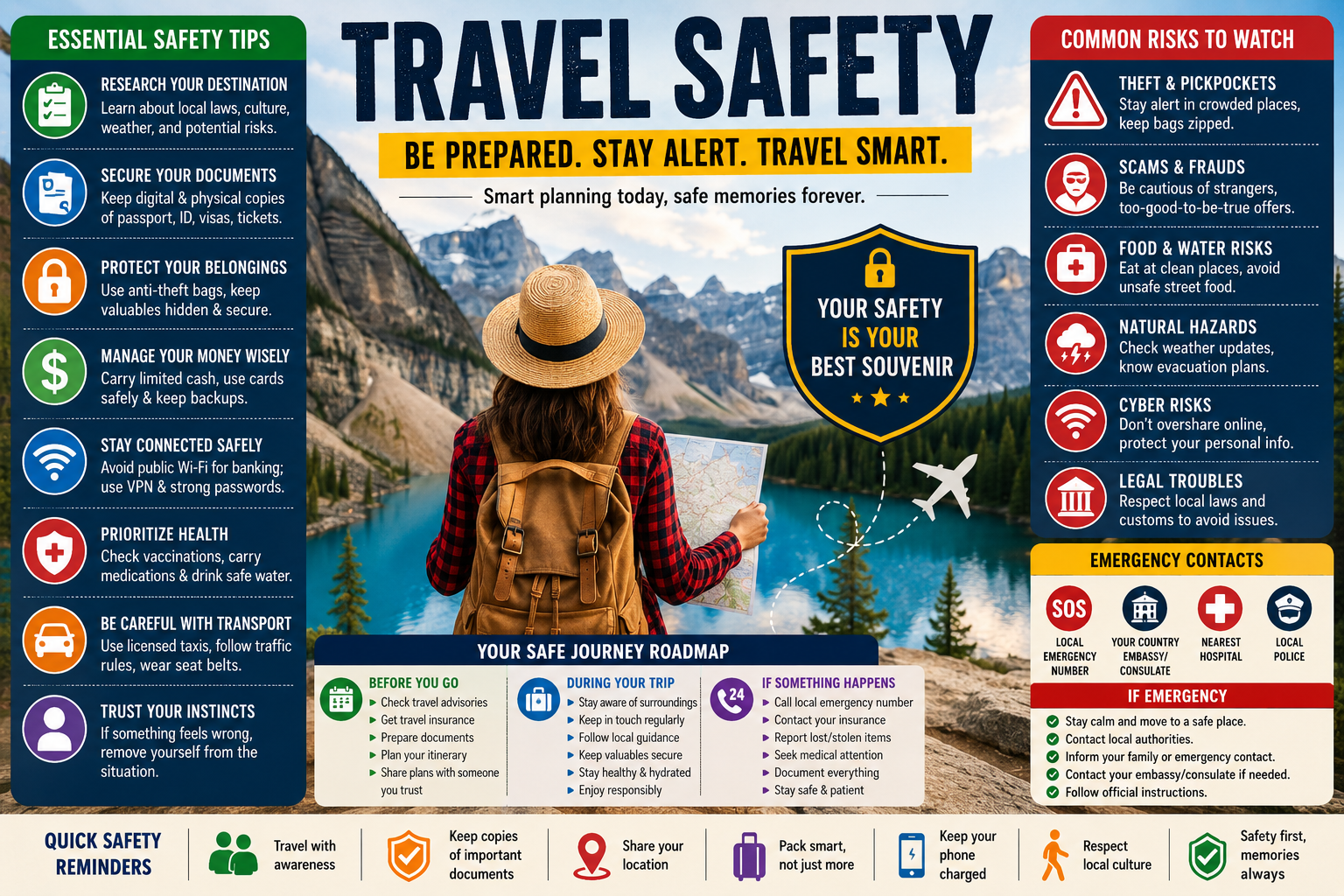
Travel safety is not about being afraid of the world; it is about understanding risks, preparing for realistic problems, and knowing what to do when plans change. The safest travelers combine destination research, secure documents, health preparation, smart transportation choices, digital security, emergency planning, and good judgment without allowing fear to ruin the experience Adventure Travel
What Is Travel Safety?
Travel safety is the practice of reducing avoidable risks while traveling and preparing for problems that cannot always be prevented.
It includes much more than avoiding dangerous neighborhoods.
A complete travel safety strategy considers personal security, health, transportation, accommodation, money, documents, technology, weather, communication, local laws, natural hazards, scams, and emergency response.
The Four Layers of Travel Safety
A useful way to think about travel safety is through four layers.
Prevention means reducing the chance that something goes wrong.
Preparation means making sure you have the documents, information, money, equipment, and contacts needed if something happens.
Response means knowing what to do during an emergency.
Recovery means having a plan for replacing documents, obtaining medical care, contacting family, changing transportation, and returning home.
This framework is more useful than simply creating a list of things to avoid.
Why Travel Safety Matters More Than Ever
Modern travel is easier than ever, but convenience has created new risks.
A smartphone can hold your boarding pass, hotel reservation, banking applications, identification photographs, maps, communication tools, and personal information.
If that phone is lost or stolen, several problems can occur simultaneously.
Likewise, online booking makes it easy to reserve accommodation anywhere, but travelers must still verify addresses, cancellation policies, payment requests, and property legitimacy.
International travel also exposes people to unfamiliar laws, transportation systems, languages, weather conditions, food environments, and healthcare systems.
The World Health Organization specifically emphasizes that travel health risks vary according to the destination and the individual traveler.
The Biggest Travel Safety Risks
Travel risks differ dramatically by destination and travel style.
A city break presents different risks from a mountain expedition.
A family resort vacation presents different challenges from solo backpacking.
A business traveler may be more concerned about digital security, while an adventure traveler may face weather, terrain, and equipment risks.
Theft and Pickpocketing
Petty theft is one of the most common practical concerns travelers encounter.
Busy transportation hubs, markets, festivals, tourist attractions, nightlife areas, and crowded public transportation can create opportunities for thieves.
The best strategy is not constant suspicion.
It is reducing opportunity.
Keep expensive items discreet.
Avoid displaying large amounts of cash.
Keep important documents secure.
Use bags that close properly.
Do not leave phones or wallets unattended on restaurant tables.
The U.S. Department of State recommends remaining alert, avoiding conspicuous valuables, planning ahead, and knowing where local police and hospitals are located.
Scams
Scams can be more difficult to recognize than theft because the traveler may voluntarily hand over money or information.
Common patterns include:
- Fake transportation offers
- Fake accommodation requests
- Overpriced tours
- Counterfeit tickets
- Friendship or romance scams
- Fake emergencies
- Payment redirection
- Fake officials
- ATM assistance scams
- Online booking fraud
- Unofficial guides
- Fake charity requests
The U.S. Department of State advises travelers to be cautious with unsolicited requests for money and personal information and warns that offers that appear too good to be true may be scams.
Transportation Accidents
Road safety deserves more attention than many travelers give it.
Depending on the destination, travelers may encounter unfamiliar traffic patterns, motorcycles, poorly maintained vehicles, limited sidewalks, different driving standards, or crowded roads.
Never assume that a short distance means a low-risk journey.
Health Problems
A traveler can become sick from contaminated food or water, infectious diseases, heat, altitude, exhaustion, allergies, medication problems, or an existing condition.
The WHO recommends seeking travel-health information before departure and visiting a travel clinic ideally several weeks before travel when appropriate.
Weather and Natural Hazards
Weather can change travel plans quickly.
Potential hazards include:
- Heat waves
- Flooding
- Hurricanes and tropical storms
- Snowstorms
- Wildfires
- Landslides
- Earthquakes
- Extreme cold
- Thunderstorms
- Avalanches
- High surf
- Dust storms
A destination can be safe under normal conditions and temporarily hazardous during a severe weather event.
How to Research a Destination Before Travel
Good travel safety begins with research.
Do not search only for attractions.
Research the destination as if you were preparing to solve problems there.
Check Official Travel Advisories
Government travel advisories can provide information about security conditions, crime, terrorism, civil unrest, health risks, kidnapping, border restrictions, and other concerns.
The U.S. State Department, for example, uses risk indicators including crime, terrorism, unrest, and health when developing its travel advisories.
Travelers should also check the official government guidance of their own country because recommendations can differ.
Research Local Laws
A behavior that is ordinary at home may be restricted elsewhere.
Research rules involving:
- Medicines
- Photography
- Drones
- Alcohol
- Smoking
- Public behavior
- Religious sites
- Dress
- Driving
- Identification documents
- Import restrictions
Never assume that “tourists do it all the time” means something is legally permitted.
Learn Emergency Numbers
Save the emergency number for the destination before you arrive.
Also identify:
- Police
- Ambulance
- Fire service
- Nearest hospital
- Your country’s embassy or consulate
- Accommodation emergency contact
- Travel insurance assistance number
Do not wait for an emergency to search for these details.
Build a Travel Safety Folder
A simple digital and physical document system can make emergencies much easier.
Essential Documents
Keep copies of:
- Passport
- Visa
- Travel insurance
- Flight reservations
- Hotel bookings
- Driving license
- International driving permit if required
- Medication information
- Emergency contacts
- Important identification
- Relevant vaccination documentation
The original passport should be protected carefully. The U.S. State Department advises travelers to protect passports from extreme conditions and avoid unauthorized markings or stamps.
Use Multiple Storage Locations
Do not keep every important document in one place.
A practical setup is:
Physical copy: stored separately from the original documents.
Encrypted or protected digital copy: accessible through a secure account.
Emergency contact copy: held by someone you trust when appropriate.
This creates redundancy.
Create an Emergency Contact Plan
One of the most overlooked travel safety strategies is telling someone where you are going.
Share Your Basic Itinerary
You do not need to publish your travel plans publicly.
Instead, share important details privately with a trusted person.
Include:
- Destination
- Hotel
- Flight information
- Major transportation
- Approximate travel dates
- Emergency contact information
The State Department advises travelers not to share detailed travel plans publicly before returning home.
Establish a Check-In System
For solo or adventure travel, arrange periodic check-ins.
For example, you might agree:
“I will message you when I arrive.”
“I will check in after the mountain hike.”
“If you do not hear from me by a specific time, contact the accommodation or appropriate local authority.”
The purpose is not to create anxiety.
It is to create a safety net.
How to Protect Your Passport
Your passport is one of your most important travel documents.
Treat it like a critical piece of equipment.
Keep It Secure
When not required, store it in a secure location.
Avoid carrying it unnecessarily through crowded nightlife areas or situations where loss is more likely.
However, follow local laws regarding identification requirements.
Keep a Copy
A secure copy can make replacement procedures easier if the original is lost.
Remember that a copy is not a replacement for the original passport.
Travel Money Safety
Money problems can become safety problems.
A traveler without access to funds may have difficulty arranging transportation, accommodation, food, or emergency medical care.
Use More Than One Payment Method
A sensible strategy is to carry:
- Primary payment card
- Backup payment card
- Small amount of local cash
- Emergency funds
- Secure digital payment option where practical
Do not keep everything in one wallet.
Avoid Carrying Large Amounts of Cash
Carry enough for normal needs rather than exposing yourself to unnecessary loss.
Be Careful With ATMs
Use ATMs in reputable, secure locations.
Check the machine for unusual attachments or suspicious behavior.
Shield your PIN.
If someone unexpectedly offers to “help” you with an ATM, politely decline unless you specifically need assistance from an authorized employee.
Digital Travel Safety
Travel safety now includes cybersecurity.
Your digital identity can be just as valuable as your wallet.
Use Strong Device Security
Enable:
- Screen lock
- Biometric authentication
- Device encryption where available
- Automatic updates
- Find-my-device features
- Multi-factor authentication
Avoid Unknown Charging Accessories
Public charging points can present security concerns in some environments.
Carry your own charging equipment.
A power bank can also reduce dependence on unfamiliar charging stations.
Be Careful With Public Wi-Fi
Public networks can be convenient but should not automatically be treated as trusted.
Avoid performing highly sensitive activities on unknown networks when safer alternatives are available.
Protect Your SIM and Phone Number
A lost phone or compromised number can create access problems for banking and authentication.
Keep recovery methods available.
If you use two-factor authentication, make sure you understand how you will regain access if your phone or SIM is lost.
How to Stay Safe in Hotels and Vacation Rentals
Accommodation is your temporary home.
Treat its security seriously.
Research Before Booking
Look beyond photographs.
Check:
- Location
- Recent reviews
- Transportation access
- Nearby services
- Building access
- Reception hours
- Emergency arrangements
- Cancellation policies
- Accessibility
- Security features
The State Department recommends researching accommodation carefully and considering factors such as proximity to public transportation, important services, security measures, and emergency exits.
Check Your Room
After arriving, understand how the room works.
Check:
- Door locks
- Windows
- Fire alarms
- Emergency exits
- Room phone
- Curtains
- Fire extinguishers where applicable
- Building evacuation instructions
The State Department specifically recommends checking emergency exits and ensuring doors and windows lock properly.
Don’t Advertise Your Room Number
Avoid announcing your room number loudly in public.
If meeting someone you do not know, a public lobby or common area is generally safer than inviting them directly to your room.
Transportation Safety
Transportation decisions can have a major effect on travel safety.
Airport Transfers
Pre-arrange transportation when practical, especially for late-night arrivals.
Verify:
- Driver identity
- Vehicle details
- Booking reference
- Pickup location
Avoid accepting unsolicited transportation offers when you cannot verify the provider.
Taxis and Ride Services
Use licensed transportation where available.
Confirm the destination before leaving.
If possible, share the trip details with someone you trust.
Rental Cars
Before driving, understand:
- Local traffic laws
- Road signs
- Insurance requirements
- License requirements
- Speed limits
- Parking rules
- Toll systems
- Fuel policies
Do not drive while exhausted.
Motorcycles and Scooters
Two-wheel travel can be enjoyable but significantly changes exposure to road hazards.
Wear appropriate protective equipment.
Use a properly licensed vehicle.
Understand local legal requirements.
Never assume your normal driving experience transfers automatically to unfamiliar roads.
Travel Safety for Solo Travelers
Solo travel provides freedom, but it also removes the immediate support of a companion.
Keep Someone Informed
Share your itinerary and important changes.
Avoid Predictable Patterns
You do not need to follow the exact same routine every day.
Trust Your Instincts
If a situation feels wrong, leaving early is often better than trying to be polite.
You do not owe strangers your time.
Be Careful With Alcohol
Alcohol can reduce situational awareness and judgment.
Solo travelers should be especially careful about consuming enough alcohol to impair their ability to navigate, communicate, or recognize risk.
Travel Safety for Families
Family travel introduces another layer of responsibility.
Teach Children Simple Safety Rules
Children should know:
- Their parent’s name
- Hotel name
- A trusted phone number
- What to do if separated
- Where to find an employee or police officer
- Not to leave with strangers
Create a Meeting Point
In crowded attractions, identify a visible meeting point before separating.
Keep Identification Accessible
Depending on the destination, consider having appropriate identification and emergency contact information available.
Travel Safety for Older Travelers
Older travelers may benefit from additional planning around mobility, medication, heat, fatigue, and healthcare access.
Plan Around Energy Levels
A schedule that looks comfortable on paper can become exhausting after long flights, heat exposure, or walking.
Build recovery time into the itinerary.
Carry Medication Properly
The WHO recommends carrying sufficient prescribed medication for the journey, including potential delays.
Check whether medicines are legal to bring into the destination.
Some countries have strict rules for specific medications.
Travel Safety for People With Disabilities
Accessibility is part of safety.
A hotel may advertise accessibility but have limitations in practice.
Ask specific questions.
Verify Accessibility Details
Check:
- Elevator access
- Ramp availability
- Bathroom layout
- Door widths
- Transportation
- Accessible emergency exits
- Distance to medical services
The State Department recommends contacting accommodations in advance when special facilities are required and confirming that those facilities are available.
Food and Water Safety
Food can be one of the most enjoyable parts of travel, but unfamiliar food environments can also create health risks.
Use Safe Drinking Water
Water safety varies by destination.
When local tap water is not considered safe, use an appropriate alternative.
Be cautious with:
- Unsealed water
- Ice from uncertain sources
- Raw foods washed with unsafe water
- Unpasteurized products where risks exist
Food Hygiene
Pay attention to:
- Food temperature
- Clean preparation areas
- Hand hygiene
- Cross-contamination
- Freshness
- Storage conditions
The WHO specifically lists safe food and water as important areas of travel-health preparation.
Travel Vaccinations and Health Preparation
Health preparation should begin before the flight.
Visit a Travel Health Professional
The WHO suggests a travel clinic visit ideally four to eight weeks before departure, although consultation can still be useful closer to travel.
The right advice depends on:
- Destination
- Season
- Trip duration
- Activities
- Medical history
- Age
- Vaccination status
Carry Medical Information
Keep a record of relevant:
- Prescriptions
- Allergies
- Medical conditions
- Emergency contacts
- Vaccination information
Plan for Delays
Do not pack exactly the number of medication doses needed for the planned itinerary if a reasonable additional supply can legally and safely be carried.
The WHO specifically recommends sufficient medication to cover the trip and possible delays.
Heat, Sun and Dehydration Safety
Hot destinations can create serious health problems.
Respect Heat Acclimatization
Do not assume that because you can tolerate summer temperatures at home, you will automatically tolerate a different climate.
Humidity, activity level, clothing, hydration, and sleep all matter.
Use Sun Protection
Practical measures include:
- Shade
- Appropriate clothing
- Sunscreen
- Sunglasses
- Hydration
- Rest periods
Extreme heat can affect even healthy travelers.
Mountain and Adventure Travel Safety
Adventure travel requires a different safety mindset.
The U.S. State Department’s current mountain-safety guidance emphasizes carrying water, first aid supplies, navigation backups, lighting, sun and insect protection, extra clothing, food, and shelter where appropriate.
Never Confuse Access With Safety
A trail being accessible does not mean it is appropriate for your experience level.
Weather can transform an easy route into a dangerous environment.
Carry Navigation Backup
GPS is useful.
But batteries fail.
Connections disappear.
Devices break.
A physical map and compass can provide a valuable backup in remote environments.
Tell Someone Your Route
For hikes, treks, camping trips, or remote excursions, provide someone with your planned route and expected return time.
Water and Beach Safety
Beautiful water can hide serious hazards.
Never Assume Calm Water Is Safe
Risks can include:
- Currents
- Sudden depth changes
- Rocks
- Boat traffic
- Poor visibility
- Waterborne pathogens
- Cold water
- Waves
- Strong tides
The State Department warns that natural bodies of water can contain dangerous organisms and recommends never swimming alone and avoiding diving or cliff jumping into unknown water.
Natural Disaster Travel Safety
A destination’s risk profile can change rapidly during a natural disaster.
Earthquakes
Learn basic local emergency guidance.
If an earthquake occurs, follow recognized local instructions and move away from damaged structures.
Floods
Never assume shallow-looking floodwater is harmless.
Roads and bridges may be damaged underneath the surface.
Wildfires
Monitor local alerts.
Do not rely solely on visual signs because smoke and wind can change conditions quickly.
Tropical Storms
If a storm is forecast, follow local evacuation and shelter instructions rather than attempting to continue sightseeing.
Political Unrest and Demonstrations
Travelers should avoid demonstrations and areas of civil unrest unless they have a legitimate reason and appropriate professional preparation.
Why Demonstrations Can Become Dangerous
A peaceful gathering can change quickly.
Transportation may be disrupted.
Police responses may escalate.
Roads can close.
Communications may become difficult.
Monitor Local Information
Use official alerts and reliable local reporting.
Do not rely solely on social media rumors.
Terrorism and Security Threats
No traveler can eliminate every security risk.
The practical goal is informed decision-making.
Government advisories may identify terrorism as a specific risk indicator when evaluating destinations.
Avoid Unnecessary Exposure
Pay attention to official warnings regarding:
- Large gatherings
- Demonstrations
- Government facilities
- Transportation hubs
- High-profile events
- Specific neighborhoods
Avoid turning a safety warning into an adventure challenge.
Travel Insurance and Emergency Assistance
Travel insurance can help with certain financial consequences of illness, injury, cancellation, interruption, baggage problems, and other covered events.
But policies differ significantly.
Read the Actual Policy
Do not buy based solely on a headline.
Check:
- Medical coverage
- Emergency evacuation
- Trip cancellation
- Trip interruption
- Baggage
- Adventure activities
- Exclusions
- Pre-existing conditions
- Deductibles
- Maximum limits
- Geographic restrictions
The WHO recommends comprehensive travel insurance as part of routine travel preparation and advises travelers to disclose relevant underlying health conditions to insurers.
Insurance Is Not the Same as Rescue Membership
Some services focus on evacuation, security assistance, or rescue rather than traditional trip insurance.
Understand exactly what you are purchasing.
Ten Travel Safety Brands Worth Knowing
The following comparison focuses on categories of travel-safety equipment and services rather than claiming that one company is universally safest. Products and services change, so travelers should verify current specifications before purchase.
| Brand | Main Category | Best Known For | Useful For | Key Consideration |
|---|---|---|---|---|
| Pacsafe | Travel security | Anti-theft travel gear | Urban and international travelers | Security features can add weight |
| LifeStraw | Water filtration | Portable water filters | Hiking and uncertain-water environments | Filtration capability varies by product |
| Garmin | Navigation and communication | GPS and satellite-enabled devices | Adventure and remote travel | Advanced devices require setup and charging |
| Apple | Device security and tracking | Find My ecosystem | Smartphone travelers | Best experience depends on device ecosystem |
| Anker | Power accessories | Chargers and power banks | Long travel days | Capacity, airline rules, and model specifications matter |
| Nite Ize | Travel accessories | Small safety and organization gear | Everyday travelers | Products are accessory-focused rather than complete safety systems |
| Osprey | Travel and outdoor packs | Travel and hiking backpacks | Adventure and long-distance travel | Choose the right size and fit |
| Eagle Creek | Travel organization | Packing and travel accessories | Organized travelers | Product range varies by market |
| GoPro | Action cameras | Compact cameras | Adventure travelers | A camera is not a substitute for navigation or communication |
| World Nomads | Travel insurance | Travel insurance for international travelers | Leisure and adventure trips | Coverage depends on policy, residence, destination, and activities |
The purpose of this list is not to declare a universal winner. The correct choice depends on the destination and problem you are trying to solve.
How to Choose Travel Safety Gear
Buying more equipment does not automatically make a trip safer.
The best gear is gear you understand and will actually use.
For City Travel
Prioritize:
- Secure bag
- Phone protection
- Backup battery
- Document copies
- Small first-aid kit
- Reliable transportation information
For Hiking
Prioritize:
- Navigation
- Water
- Weather protection
- Lighting
- First aid
- Appropriate clothing
- Emergency communication where needed
For Family Travel
Prioritize:
- Identification information
- Communication
- Medication
- Emergency contacts
- Child safety planning
- Reliable accommodation
For Long-Term Travel
Prioritize:
- Document redundancy
- Financial backups
- Insurance
- Health planning
- Digital security
- Communication
- Flexible emergency funds
The Minimalist Travel Safety Kit
You do not need to carry a suitcase full of emergency equipment.
A compact safety kit can include:
- Small first-aid supplies
- Power bank
- Charging cable
- Secure document copies
- Emergency contact card
- Basic medication
- Water solution appropriate to the destination
- Small flashlight
- Personal alarm where appropriate
- Backup payment method
The exact kit should change according to the trip.
Common Travel Safety Mistakes
Mistake: Carrying Everything in One Bag
If the bag disappears, everything disappears.
Solution: distribute critical items.
Mistake: Keeping All Money Together
A lost wallet can become a major problem.
Solution: separate primary and backup funds.
Mistake: Ignoring Local Laws
Tourists are not automatically exempt from local regulations.
Solution: research important restrictions before departure.
Mistake: Relying Completely on Your Phone
Phones can break, become lost, or lose battery.
Solution: keep offline maps and essential contact information available.
Mistake: Choosing Accommodation Only by Price
The cheapest room may be far from transportation, hospitals, or safe routes.
Solution: evaluate location and practical security.
Mistake: Posting Your Exact Location Publicly
Public posts can reveal that you are away from home or where you are staying.
Solution: delay detailed location sharing when appropriate.
Mistake: Ignoring Travel Health
People often plan attractions months ahead but think about health only days before departure.
Solution: research destination-specific health requirements early.
Mistake: Assuming Insurance Covers Everything
Policies contain exclusions.
Solution: read the policy wording before traveling.
Travel Safety for Nighttime
Night travel requires additional awareness in many destinations.
Plan the Route
Know where you are going before leaving.
Choose Reliable Transportation
Avoid getting into unverified vehicles.
Keep Your Phone Accessible but Secure
You may need navigation, but holding a phone openly while walking through an unfamiliar area can increase distraction and exposure.
Stay Around Active Areas
When appropriate, choose well-used routes rather than isolated shortcuts.
Travel Safety and Alcohol
Alcohol can affect judgment, balance, reaction time, and awareness.
This becomes particularly important in unfamiliar environments.
Set Your Limits
Know how you will return to your accommodation before drinking.
Never Leave Drinks Unattended
This is a basic personal-security precaution.
Do Not Drive After Drinking
Never combine alcohol with driving, cycling, scooter use, boating, or other activities where impaired judgment can cause serious harm.
Language Barriers and Communication
Language differences can turn a manageable problem into a confusing one.
Learn Essential Phrases
Useful phrases include:
- Help
- Police
- Hospital
- Doctor
- I need assistance
- I don’t understand
- Where is the hospital?
- Call an ambulance
- I lost my passport
Use Offline Translation
Download language resources before leaving reliable internet access.
Cultural Awareness Is a Safety Tool
Respecting local culture is not simply about etiquette.
It can reduce misunderstandings.
Research Dress Expectations
Religious and cultural sites may have specific expectations.
Understand Photography Rules
Do not assume that every public building, official, religious site, or person can be photographed.
Watch Local Behavior
Observe what locals do.
When uncertain, ask respectfully.
Travel Safety for Business Travelers
Business travelers face additional risks involving devices, sensitive information, schedules, and professional relationships.
Protect Company Information
Use appropriate company-approved security practices.
Avoid discussing confidential matters loudly in public spaces.
Keep Devices Secure
Do not leave laptops unattended in public places.
Separate Personal and Professional Data
Where company policy requires it, use approved devices and communication systems.
Travel Safety for Digital Nomads
Long-term travelers face a different challenge because temporary living becomes routine.
Familiarity can create complacency.
Maintain Regular Check-Ins
Tell a trusted person when changing countries or cities.
Keep Financial Redundancy
Long-term travel increases exposure to card expiration, banking restrictions, fraud, and unexpected costs.
Keep Important Documents Current
Check passport validity and visa conditions regularly.
Emergency Response: What to Do When Something Goes Wrong
Panic is normal.
A simple process helps.
Step One: Get to a Safer Position
Move away from immediate danger if possible.
Step Two: Contact Local Emergency Services
Use the local emergency number.
Step Three: Contact Someone You Trust
Provide your location and explain what happened.
Step Four: Contact Your Insurer or Assistance Provider
If relevant, follow the emergency procedures in your policy.
Step Five: Contact Your Embassy or Consulate When Appropriate
Embassies may assist citizens in specific circumstances, such as certain document or consular emergencies, but they do not replace local emergency services.
What to Do If Your Passport Is Lost
A lost passport is stressful but manageable if you prepared.
Immediate Steps
- Move to a secure place.
- Determine whether it was lost or stolen.
- Report theft to local authorities when appropriate.
- Contact your embassy or consulate.
- Provide identification and supporting documents.
- Contact airlines or other transportation providers if necessary.
- Follow replacement-document instructions.
This is why having copies of your passport and other documents before departure can be extremely useful.
What to Do If Your Phone Is Lost
A lost phone can expose personal information and interrupt communication.
Immediate Response
Use your device’s remote-location or lock function where available.
Change critical passwords if necessary.
Contact your mobile provider.
Contact your bank if financial applications may be exposed.
Use your backup communication method.
This is another reason not to rely on one device for every aspect of travel.
What to Do If Your Bank Card Is Lost
Contact the card issuer immediately.
Freeze or cancel the card according to the provider’s procedure.
Use your backup payment method.
Avoid accepting financial “help” from strangers.
How to Build a Travel Safety Checklist
A useful checklist should be short enough to use.
One Week or More Before Departure
Check:
- Passport validity
- Visa requirements
- Travel advisory
- Health recommendations
- Accommodation
- Transportation
- Insurance
- Emergency contacts
- Medication
- Financial backups
- Phone plan
One Day Before Departure
Confirm:
- Flight
- Hotel
- Transportation
- Documents
- Wallet
- Backup card
- Charging equipment
- Phone battery
- Offline maps
- Weather
- Emergency contacts
On Arrival
Identify:
- Hotel exit
- Emergency number
- Nearby hospital
- Safe transportation
- Local neighborhood
- Backup route
The Travel Safety Triangle
A useful original framework is to think about every trip through three questions:
What can happen?
This identifies hazards.
What can I do to prevent it?
This identifies prevention strategies.
What will I do if it happens anyway?
This identifies your emergency response.
For example:
Risk: Phone theft.
Prevention: Secure device, avoid unnecessary exposure, use a secure bag.
Response: Remote lock, carrier contact, bank notification, backup phone or communication.
This approach is more practical than simply collecting generic safety tips.
The Five-Minute Safety Audit
Before leaving your hotel each morning, take five minutes.
Ask:
- Where am I going?
- How am I getting there?
- What is the weather?
- How am I getting back?
- Do I have enough battery?
- Do I have payment options?
- Do I need identification?
- Is there anything unusual happening locally?
- Who knows where I am?
- What is my backup plan?
Ten minutes of preparation can prevent hours of trouble.
Pros and Cons of Travel Safety Planning
Benefits of Careful Planning
Travel safety planning can reduce preventable risks.
It can make emergencies easier to manage.
It can also reduce stress because you already know what to do if something goes wrong.
The Downside of Overplanning
Too much planning can create anxiety.
A traveler who constantly expects danger may stop enjoying the destination.
The Balanced Approach
The best travel safety strategy is neither reckless nor paranoid.
It is prepared but flexible.
Research the important risks.
Prepare reasonable backups.
Then enjoy the trip.
How Travel Safety Differs by Trip Type
Weekend Trips
Focus on:
- Transportation
- Accommodation
- Phone battery
- Money
- Weather
- Basic health needs
International Family Vacations
Focus on:
- Documents
- Medical preparation
- Child safety
- Accommodation
- Transportation
- Emergency contacts
Backpacking
Focus on:
- Navigation
- Financial redundancy
- Communication
- Health
- Accommodation
- Local transportation
Business Travel
Focus on:
- Digital security
- Documents
- Transportation
- Professional information
- Emergency communication
Adventure Travel
Focus on:
- Equipment
- Weather
- Navigation
- Emergency communication
- Medical preparation
- Local regulations
Future Trends in Travel Safety
Travel safety is becoming increasingly technology-driven.
Artificial Intelligence
AI tools may increasingly help travelers interpret destination information, translate instructions, identify changing conditions, and organize emergency information.
However, travelers should verify critical information through official sources.
Real-Time Alerts
Travelers can increasingly receive warnings about weather, transportation disruptions, and security events.
Satellite Communication
Satellite-enabled devices can provide communication capabilities in areas without conventional cellular service.
These tools can be especially valuable for remote travel.
Digital Identity Travel safety
Travelers will likely continue using more digital documents and identity systems.
That creates convenience but also makes cybersecurity increasingly important.
Smart Travel Gear Travel safety
Travel bags, trackers, watches, and connected devices increasingly combine security, navigation, communication, and location functions.
Preventive Travel Health Travel safety
Travel health is becoming more personalized as destination information, vaccination guidance, environmental data, and individual health factors are considered together.
The Future of Safe Travel Is Not Fear-Based
The future of travel safety should not mean carrying more gadgets and constantly checking alerts.
The better direction is intelligent preparation.
Technology should reduce uncertainty rather than increase anxiety.
Travelers should be able to understand:
- Which risks matter
- Which risks are unlikely
- Which risks they can control
- Which risks require insurance
- Which risks require professional advice
- What to do during an emergency
That is the difference between being prepared and being afraid.
A Complete Worldwide Travel Safety Checklist
Before traveling, review this list.
Documents Travel safety
- Passport
- Visa
- Identification
- Travel reservations
- Insurance documents
- Copies of important documents
Money Travel safety
- Primary card
- Backup card
- Emergency cash
- Banking access
Communication Travel safety
- Charged phone
- Charging cable
- Power bank
- Emergency contacts
- Offline maps
- Translation tools
Health Travel safety
- Required medications
- Basic first aid
- Destination-specific health preparation
- Medical information
- Appropriate hygiene supplies
Accommodation Travel safety
- Verified booking
- Address
- Transportation plan
- Emergency exits
- Door and window security
Transportation Travel safety
- Licensed provider
- Route
- Local rules
- Backup transportation plan
Security Travel safety
- Secure bag
- Device protection
- Awareness of scams
- Appropriate clothing and behavior
- Emergency plan
Environment Travel safety
- Weather forecast
- Local hazards
- Natural-disaster alerts
- Activity-specific precautions
Final Travel Safety Mindset
The safest traveler is not necessarily the person who carries the most equipment.
It is often the person who notices small problems before they become large ones.
A low phone battery becomes a minor inconvenience when you have a power bank.
A lost card becomes manageable when you have a backup.
A delayed flight becomes less stressful when you have emergency funds.
A medical problem becomes easier to handle when you know where the hospital is.
A lost passport becomes less overwhelming when you have document copies.
A changing weather forecast becomes manageable when you check it before leaving.
Travel safety is therefore less about predicting every possible disaster and more about building resilience.
FAQs
What is the most important travel safety tip?
The most important principle is preparation. Research the destination, understand local risks and laws, secure your documents and money, prepare for health needs, and have a simple emergency plan.
Is travel safe everywhere?
No destination can be described as completely risk-free. Safety conditions vary by country, city, neighborhood, season, activity, and current events. Travelers should review current official information before departure.
How can I avoid pickpockets while traveling?
Keep valuables discreet, secure bags properly, avoid displaying large amounts of cash, remain aware in crowded areas, and avoid placing phones or wallets where they can be easily grabbed.
Should I buy travel insurance?
For many international trips, travel insurance can provide valuable financial protection, particularly for unexpected medical care, evacuation, cancellation, interruption, or baggage problems. Coverage varies, so read the policy carefully before purchasing.
How early should I prepare for travel health?
The WHO recommends seeking travel-health advice early and suggests visiting a travel clinic ideally four to eight weeks before departure when possible.
Is it safe to use public Wi-Fi while traveling?
Public Wi-Fi can be convenient, but travelers should not automatically treat unknown networks as secure. Use appropriate device security, avoid unnecessary sensitive transactions on untrusted networks, and keep important accounts protected with strong authentication.
Should I carry my passport everywhere?
Requirements differ by destination. Follow local identification laws, but protect your passport carefully and avoid unnecessary exposure to loss or theft. Keep secure copies of important documents.
What should I do if my passport is stolen?
Move somewhere safe, report the theft when appropriate, contact your embassy or consulate, and follow the official replacement process. Having a secure copy of the passport and other identification documents can make the process easier.
How can solo travelers stay safe?
Research accommodation, share your itinerary with someone you trust, use reliable transportation, keep communication available, avoid unnecessary exposure to risky situations, and trust your instincts if something feels wrong.
How can families improve travel safety?
Parents should prepare identification information, emergency contacts, child-friendly safety rules, medication, transportation plans, and meeting points in crowded locations.
What should I pack for travel safety?
A practical kit can include a small first-aid kit, necessary medication, power bank, secure document copies, emergency contacts, appropriate water equipment, a flashlight, and activity-specific safety gear.
Is travel safety only about crime?
No. Travel safety also includes health, road safety, weather, natural disasters, scams, accommodation security, local laws, digital security, food and water, and emergency planning.
What should I do during a natural disaster?
Follow local emergency instructions, move away from immediate hazards, monitor official alerts, contact your emergency contacts when possible, and avoid unnecessary travel through affected areas.
Are travel advisories always accurate?
Official advisories are important sources of information, but conditions can change quickly and recommendations may differ between governments. Travelers should check current official information and understand the specific risks identified.
How can I protect my phone while traveling?
Use a secure passcode, biometric authentication, automatic updates, device tracking, multi-factor authentication, and regular backups. Keep your phone physically secure and carry a charging backup.
What is the best travel safety brand?
There is no universal best brand. The right choice depends on your needs. A traveler may prioritize an anti-theft bag, navigation device, water filter, power bank, tracker, insurance, or emergency communication device.
Is adventure travel safe?
Adventure travel can be safe when travelers match activities to their experience, use appropriate equipment, monitor conditions, understand local hazards, and maintain communication and emergency plans.
What should I do if I feel unsafe?
Leave the situation if possible and move toward a populated or secure location. Contact local authorities or emergency services when necessary, and inform someone you trust.
How can I avoid travel scams?
Research common scams before departure, verify transportation and accommodation, avoid sending money to strangers, protect personal information, and be cautious about offers that seem unusually attractive.
Is travel safety different for every country?
Yes. The risks in a major European city can differ substantially from those in a remote mountain region, tropical island, desert destination, or conflict-affected area. Safety planning should always be destination-specific.
Conclusion
Travel safety is not about eliminating every risk from a journey. That is impossible. Instead, it is about identifying realistic risks, reducing preventable problems, preparing for emergencies, and making informed decisions without allowing fear to control the trip. The strongest travel safety strategy begins before departure. Research the destination, check current official advisories, understand local laws, prepare health requirements, secure accommodation, organize documents, create financial backups, protect your devices, and share essential plans with someone you trust.