
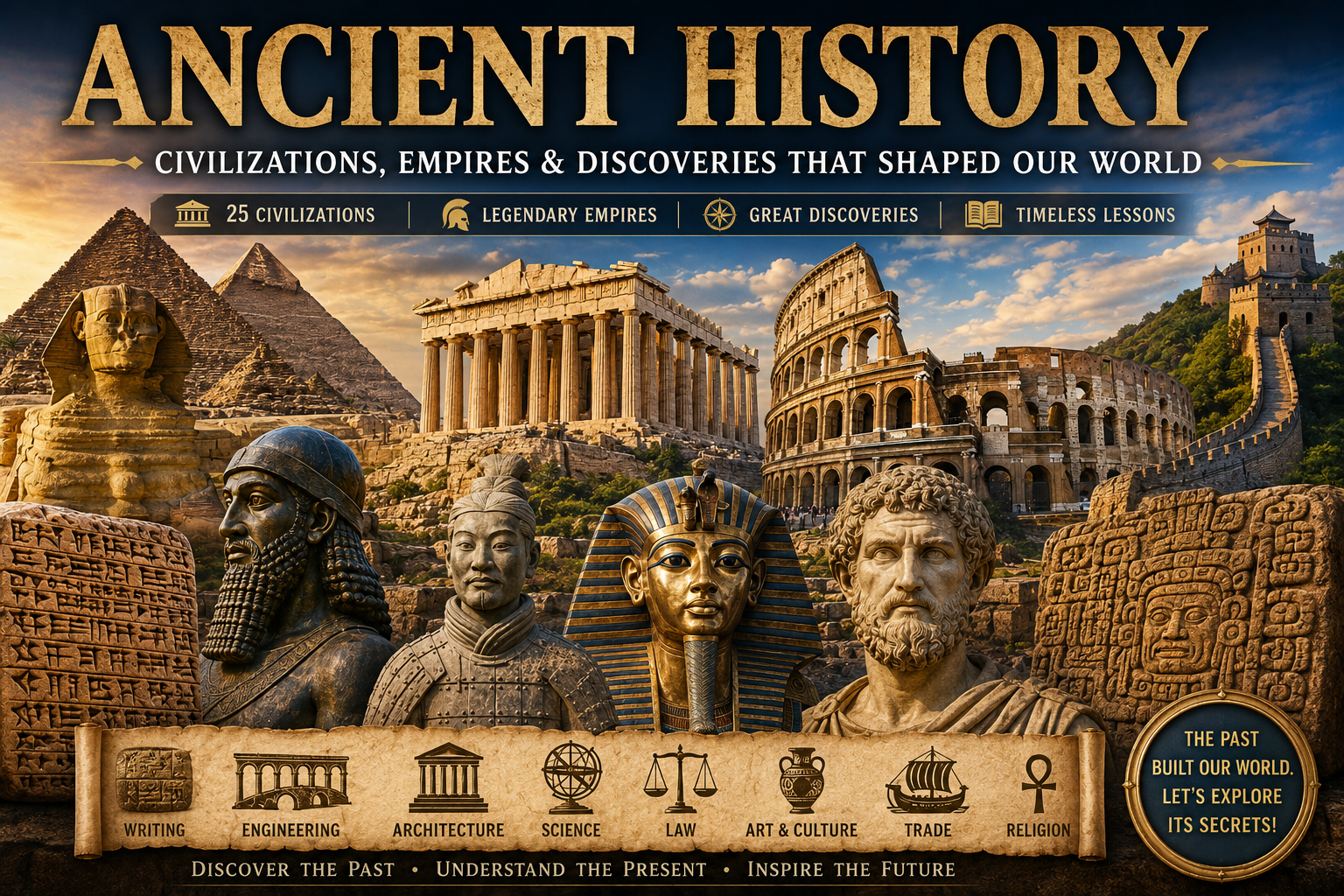
Ancient history is the story of how early human societies transformed small settlements into cities, kingdoms, empires, trading networks, religious traditions, and complex cultures that still influence the modern world. Studying ancient history is not simply about memorizing kings and dates; it is about understanding how people solved problems involving food, power, technology, trade, war, belief, climate, law, and everyday survival Europe Travel
What Is Ancient History?
Ancient history generally refers to the study of human societies from the emergence of early civilizations and written records through the ancient periods of major regions, usually ending around late antiquity and the transition into the medieval world.
There is no single worldwide date that marks the beginning or end of ancient history.
Different civilizations developed at different times.
Ancient History Is Not the Same as Prehistory
Prehistory generally refers to periods before written records were available for a particular society.
Ancient history becomes easier to reconstruct when written sources appear, but the boundary is not absolute.
Archaeology remains essential because written records are incomplete and often represent the viewpoint of governments, elites, religious institutions, or wealthy individuals.
A king may leave an inscription celebrating a military victory, but the inscription may say little about the people who suffered during the campaign.
Archaeological evidence can provide another perspective.
Ancient History Is a Combination of Disciplines
Ancient historians use texts, inscriptions, architecture, coins, pottery, human remains, environmental evidence, tools, artworks, and landscapes.
Modern research can also include chemistry, genetics, astronomy, geology, climatology, computer science, and statistics.
This is one of the most important changes in ancient historical research.
The field is no longer limited to reading old texts.
Why Ancient History Still Matters
Ancient history may seem distant, but many modern challenges have ancient precedents.
Cities still depend on water.
Governments still collect taxes.
States still compete for resources.
People still migrate.
Trade networks still connect distant regions.
Religions still influence societies.
Technological innovations still change political power.
Climate still affects food production and settlement.
Ancient history provides a laboratory for studying these patterns across long periods.
Ancient Cities Were Experiments in Urban Living
The development of cities transformed human society.
Large settlements required systems for:
- Food storage
- Water management
- Waste disposal
- Security
- Construction
- Trade
- Administration
- Taxation
- Social organization
- Religious activity
The ancient city was therefore more than a group of buildings.
It was a complex organizational system.
Ancient Trade Created Connected Worlds
The ancient world was never as isolated as it may appear on a modern map.
Goods, technologies, artistic ideas, languages, religious concepts, crops, animals, and people moved across long distances.
UNESCO describes Ancient Merv in Central Asia as an oasis-city connected to the Silk Roads and notes that the Merv oasis supported urban centers over thousands of years.
This demonstrates an important principle:
Ancient civilizations were connected through networks long before modern globalization.
The Rise of Early Civilizations
The emergence of complex societies was not a single event.
Different regions developed agriculture, settlements, political organization, writing, and urban systems through different processes.
Mesopotamia and the First Cities
Mesopotamia, located between the Tigris and Euphrates rivers, is one of the most important regions for understanding early urban civilization.
Sumerian cities such as Uruk developed complex institutions, monumental architecture, craft production, administration, and writing.
The environment provided opportunities for agriculture, but irrigation and water management were critical.
Writing and Administration
One of humanity’s most consequential innovations was writing.
Early writing was not necessarily created for literature.
Administrative needs were important.
Officials needed ways to record quantities of grain, livestock, labor, land, taxes, and transactions.
Over time, writing expanded into royal inscriptions, legal texts, religious literature, letters, mathematics, literature, and scientific observations.
Ancient Egypt and the Nile
Ancient Egypt developed along the Nile River.
The river supported agriculture and transportation while creating a relatively continuous zone of settlement.
Egyptian civilization is famous for pyramids and temples, but these monuments represent only part of the story.
Ancient Egypt also involved farmers, administrators, artisans, scribes, soldiers, merchants, priests, laborers, families, and children.
The British Museum’s educational material on ancient Egyptian life, for example, uses objects to investigate everyday subjects such as food, clothing, play, and religious beliefs.
This is an important approach to ancient history.
Instead of asking only how pyramids were built, historians can ask what ordinary people ate, wore, believed, and did every day.
Ancient Egypt: Beyond the Pyramids
Egypt is one of the world’s most recognizable ancient civilizations.
Its long history included changing dynasties, religious developments, political struggles, foreign interactions, technological achievements, and cultural transformations.
The Importance of the Nile
The Nile was central to agriculture, transportation, settlement, and economic organization.
Its predictable cycles helped shape Egyptian agricultural life, although ancient Egypt also experienced environmental changes and periods of political instability.
Pharaohs and Political Authority
Egyptian kingship combined political and religious authority.
The pharaoh was represented as a central figure responsible for maintaining order and legitimacy.
Monuments reinforced this political and religious system.
Egyptian Writing
Hieroglyphs were used for monumental and religious purposes, while other scripts were used for administrative and everyday writing.
Writing allows historians to reconstruct aspects of Egyptian society that archaeology alone cannot fully explain.
Ancient Egyptian Everyday Life
Ancient history becomes more interesting when viewed from the bottom up.
Farmers worked fields.
Craft workers produced objects.
Scribes maintained records.
Merchants moved goods.
Families raised children.
Religious communities performed rituals.
People became sick and sought treatments.
People celebrated, argued, married, mourned, and worked.
A civilization is not simply its monuments.
It is the people who made those monuments possible.
Ancient Mesopotamia: Cities, Kings and Innovation
Mesopotamia produced several major civilizations, including Sumerian, Akkadian, Babylonian, and Assyrian political traditions.
Uruk and Urbanization
Uruk became one of the most important early urban centers.
Its development illustrates how population growth, agriculture, administration, religious institutions, craft production, and political power could combine to create a city.
The Akkadian Empire
The Akkadian Empire is often remembered as one of the earliest territorial empires.
Its significance lies partly in the way political authority extended beyond individual city-states.
Babylon
Babylon became one of the most famous cities of the ancient Near East.
Its name remains strongly associated with King Hammurabi and the later Neo-Babylonian period.
The Code of Hammurabi
Hammurabi’s laws are among the most famous surviving legal texts from the ancient world.
They demonstrate that ancient governments used written legal traditions to regulate social and economic relationships.
However, the code should not be treated as a complete description of everyday law.
It is a royal legal monument and must be interpreted within its historical context.
Ancient Persia and the Achaemenid Empire
The Achaemenid Persian Empire became one of the largest empires of the ancient world.
It incorporated diverse peoples and territories across a huge geographic area.
Cyrus the Great
Cyrus II established the Achaemenid Empire’s early expansion.
His rule became influential in later historical traditions.
Darius I
Darius expanded and reorganized the empire.
He developed administrative structures and monumental projects.
Persepolis
Persepolis was founded by Darius I in 518 BCE and became an important ceremonial center of the Achaemenid Empire. UNESCO describes its monumental architecture as evidence of Persian architectural, artistic, and construction achievements.
Imperial Administration
The Persian Empire demonstrates that ancient imperial power was not based only on armies.
Governments also required:
- Taxation
- Roads
- Officials
- Communication
- Local administration
- Military logistics
- Diplomatic relationships
An empire could not survive through conquest alone.
It required systems.
Ancient Greece and the Birth of Political Experiments
Ancient Greece was not one unified country.
It consisted of numerous city-states and communities with different political systems.
Athens
Athens is famous for the development of a form of democracy.
However, Athenian democracy was limited.
Women, enslaved people, and many residents without citizenship rights were excluded from political participation.
This is an important reminder that historical concepts should not be transferred directly into modern definitions.
Sparta
Sparta developed a highly militarized social system.
Its society differed considerably from Athens.
Greek Philosophy
Greek thinkers influenced later traditions of philosophy, science, mathematics, ethics, politics, and logic.
Figures such as Socrates, Plato, and Aristotle became particularly influential.
Greek Science and Mathematics
Ancient Greek thinkers contributed to mathematics, astronomy, medicine, engineering, and natural philosophy.
Their work later influenced Islamic, European, and other intellectual traditions.
Alexander the Great and the Hellenistic World
Alexander III of Macedon created an enormous empire during the fourth century BCE.
His conquests connected Greek and Macedonian political traditions with societies in Egypt, Persia, Central Asia, and parts of South Asia.
Cultural Exchange
The Hellenistic world demonstrates that cultural exchange is rarely one-directional.
Greek traditions spread into new regions, but Greek settlers and rulers also encountered local languages, religions, artistic styles, and political systems.
The result was cultural transformation.
Alexandria
Alexandria in Egypt became one of the great intellectual and commercial centers of the Hellenistic world.
Its location supported connections between the Mediterranean and Egypt.
Ancient Rome: From Republic to Empire
Rome began as a city and eventually became the center of an enormous Mediterranean empire.
The Roman Republic
The Roman Republic developed institutions involving elected officials, assemblies, aristocratic families, and political competition.
Its system changed significantly over time.
Roman Expansion
Rome’s expansion was driven by a mixture of military power, alliances, political structures, economic interests, and strategic decisions.
Julius Caesar
Julius Caesar became one of the most famous figures in Roman history.
His rise exposed deep tensions within the Roman political system.
Augustus
Augustus became the first Roman emperor and established a political system that preserved many republican forms while concentrating power around the emperor.
Roman Infrastructure
Roman roads, bridges, aqueducts, ports, military installations, and urban planning remain among the most visible examples of ancient engineering.
But Roman infrastructure was not simply about construction.
It supported military movement, taxation, trade, administration, and urban life.
Pompeii and the Preservation of Everyday Life
Pompeii offers a remarkable archaeological window into Roman society.
The eruption of Mount Vesuvius in AD 79 buried Pompeii and nearby settlements, preserving structures and objects that would otherwise have deteriorated over centuries.
UNESCO notes that the archaeological areas of Pompeii, Herculaneum, and Torre Annunziata provide evidence of urban and elite life in the early Roman Empire, including commercial areas, villas, and wall paintings.
Why Pompeii Is So Valuable
Pompeii allows historians to study more than emperors.
Researchers can investigate:
- Shops
- Houses
- Kitchens
- Graffiti
- Religious spaces
- Food
- Architecture
- Businesses
- Public buildings
- Burial practices
This illustrates one of archaeology’s greatest strengths.
A city destroyed suddenly can preserve details that normal historical processes erase.
Ancient China and Long-Term Civilization
Ancient Chinese history developed through several dynasties and regional traditions.
Important early periods include the Shang, Zhou, Qin, and Han.
Shang Civilization
The Shang period is associated with bronze technology, royal centers, warfare, ritual practices, and oracle-bone inscriptions.
Zhou Political Thought
The Zhou developed political ideas including the concept of the Mandate of Heaven.
This idea helped explain political legitimacy and the right of rulers to govern.
Confucius
Confucius became one of the most influential thinkers in Chinese history.
His ideas emphasized social relationships, education, ethical conduct, responsibility, and political morality.
Qin Unification
The Qin dynasty unified major parts of China under centralized imperial rule.
Although the dynasty was short-lived, its political legacy was substantial.
The Han Dynasty
The Han developed a durable imperial system and expanded political, economic, and cultural connections across Asia.
Ancient India and the Indus Valley Civilization
The Indus Valley Civilization is one of the most important ancient civilizations of South Asia.
Major sites include Harappa and Mohenjo-daro.
Urban Planning
Indus cities demonstrate sophisticated planning, drainage systems, standardized construction, craft production, and long-distance trade.
The Mystery of the Script
The Indus script remains undeciphered.
This limits what historians can confidently say about the civilization’s political structure, language, and religious beliefs.
Why This Matters
The Indus Valley Civilization demonstrates that important ancient societies do not need to be understood entirely through written texts.
Archaeological evidence can reveal urban planning, economic activity, technology, diet, and social organization even when writing remains unreadable.
Ancient Africa Beyond Egypt
Ancient African history is much broader than Egypt.
Civilizations and societies developed across the Nile Valley, North Africa, the Horn of Africa, West Africa, and other regions.
Ancient Nubia
Nubian civilizations interacted with Egypt through trade, warfare, diplomacy, migration, and cultural exchange.
Aksum
The Kingdom of Aksum became an important power in northeastern Africa.
UNESCO describes Aksum as the heart of an ancient Ethiopian civilization positioned at a crossroads linking Africa, Arabia, and the Greco-Roman world.
This geographic position helped connect Aksum to broader commercial and cultural networks.
African Trade Networks
Ancient African societies participated in trade involving metals, livestock, agricultural products, luxury goods, and other resources.
The history of Africa therefore cannot be reduced to the history of Egypt.
Ancient Arabia and the Nabataean World
Ancient Arabia contained complex societies, trade routes, agricultural communities, kingdoms, and cities.
Petra
Petra became a major Nabataean caravan city.
UNESCO describes Petra as a city inhabited since prehistoric times and positioned at an important crossroads linking Arabia, Egypt, and the eastern Mediterranean.
Hegra
Hegra, also known as al-Hijr or Mada’in Salih, is another major Nabataean archaeological site.
UNESCO records monumental tombs dating mainly from the first century BCE to the first century CE, along with inscriptions and evidence of Nabataean hydraulic expertise.
Water as a Source of Power
The Nabataeans demonstrate an important principle of ancient history.
In dry environments, controlling water could determine whether a settlement survived.
Hydraulic engineering could therefore be as important as military strength.
Ancient Central Asia and the Silk Roads
Central Asia was not a peripheral region.
It was a bridge connecting major civilizations.
Ancient Merv
Ancient Merv developed through several urban phases and became an important center along long-distance trade routes.
Its archaeological layers preserve evidence from multiple periods and cultures.
Why the Silk Roads Matter
The Silk Roads were not a single road.
They were networks.
Merchants, travelers, soldiers, diplomats, migrants, religious teachers, artisans, and ideas moved through interconnected routes.
Cultural Exchange
Trade could spread:
- Textiles
- Metals
- Ceramics
- Spices
- Artistic styles
- Religious traditions
- Technologies
- Languages
- Agricultural products
Ancient globalization was slower than modern globalization, but it was real.
Ancient Civilizations of the Americas
Ancient history is often taught through Egypt, Greece, Rome, and Mesopotamia.
That creates an incomplete picture.
The Americas developed sophisticated civilizations independently of Afro-Eurasian societies.
Maya Civilization
The Maya developed cities, writing, mathematics, astronomy, architecture, agriculture, and complex political systems.
Teotihuacan
Teotihuacan became one of the largest urban centers in ancient Mesoamerica.
Its monumental architecture demonstrates sophisticated urban planning and political organization.
Ancient Andean Civilizations
The Andes produced major civilizations and cultural traditions long before the Inca Empire.
Chavín is one important example.
UNESCO describes the Chavín archaeological site as an important center of early pre-Columbian cultural and religious development in the Andes.
Ancient Japan and Early East Asian Development
Ancient Japanese history developed through periods including Jōmon, Yayoi, and Kofun traditions, followed by the formation of early centralized states.
Jōmon Culture
Jōmon communities are known for distinctive pottery traditions and long-term hunter-gatherer and semi-sedentary lifeways.
Yayoi Period
The Yayoi period brought significant changes in agriculture, metallurgy, settlement patterns, and social organization.
Kofun Period
Large burial mounds became an important feature of the Kofun period.
These structures provide archaeological evidence of emerging political elites.
Ancient Technology That Changed Human History
Ancient societies developed technologies that remain fundamental to understanding human civilization.
Agriculture
Agriculture transformed food production and settlement patterns.
It allowed some communities to produce surpluses that could support specialists such as artisans, administrators, soldiers, priests, and merchants.
Writing
Writing allowed information to be stored beyond human memory.
That changed administration, law, religion, commerce, and literature.
Metallurgy
Copper, bronze, iron, gold, and other materials changed tools, weapons, trade, art, and social organization.
Roads
Road networks allowed armies, merchants, officials, and information to move across territories.
Water Engineering
Canals, wells, reservoirs, aqueducts, drainage systems, and irrigation networks allowed societies to manage difficult environments.
Navigation
Ships and navigation technologies connected coastal and maritime communities across large distances.
Ancient Medicine and Science
Ancient people did not understand disease through modern biology, but they developed practical medical knowledge.
Egyptian Medicine
Egyptian medical texts reveal knowledge of injuries, treatments, symptoms, and practical procedures.
Greek Medicine
Hippocratic traditions emphasized observation and natural explanations for illness.
Roman Medical Knowledge
Roman physicians inherited and developed Greek medical traditions while adding their own experience.
Chinese Medical Traditions
Ancient Chinese medical traditions developed their own theories, practices, pharmacological knowledge, and diagnostic systems.
Ancient medicine therefore should not be dismissed as simply primitive.
It contained mixtures of observation, tradition, religious belief, empirical experience, and incorrect explanations.
Ancient Law and Government
Ancient governments had to solve recurring problems.
Who owns land?
Who pays taxes?
What happens when someone steals?
How are contracts enforced?
Who has political rights?
How are crimes punished?
How are disputes settled?
Hammurabi’s Laws
The laws associated with Hammurabi demonstrate the importance of formal legal traditions in ancient Mesopotamia.
Roman Law
Roman legal traditions became highly influential in later European legal history.
Chinese Political Thought
Chinese political philosophy explored relationships between rulers, subjects, family structures, morality, and social order.
Ancient political systems therefore provide valuable material for understanding the origins of law and governance.
Religion and Ancient Society
Religion was deeply connected with ancient politics, economics, architecture, art, and daily life.
Temples as Institutions
Temples could function as religious centers but also as economic and administrative institutions.
Burial Practices
Burial customs reveal beliefs about death, identity, social status, and the afterlife.
Monumental Architecture
Pyramids, temples, tombs, statues, and sacred landscapes often communicated political and religious authority.
Mythology
Myths helped societies explain origins, nature, morality, political legitimacy, and human suffering.
Ancient Warfare
War was a major force in ancient history.
But warfare should not be studied only through famous battles.
Logistics
Armies needed:
- Food
- Water
- Weapons
- Horses or other transport
- Camps
- Roads
- Medical care
- Communication
- Money or supplies
The ability to support an army could determine military success.
Fortifications
Walls and defensive systems reveal how societies responded to threats.
Empire and War
Military expansion could create larger political systems, but maintaining an empire required administration after conquest.
Ancient Trade and Economics
Ancient economies were complex.
People produced goods, exchanged products, paid taxes, borrowed money, hired labor, and participated in markets.
Coins
Coins helped standardize certain forms of exchange and provided rulers with a way to communicate political authority.
Long-Distance Trade
Luxury goods could travel enormous distances.
But everyday trade was equally important.
Most ancient people depended on local or regional systems for food, tools, clothing, and household goods.
What Ancient Archaeology Reveals About Ordinary People
One of the biggest developments in ancient history is the increasing focus on ordinary life.
Researchers can study:
- Human bones
- Teeth
- Pottery
- Food remains
- Animal bones
- House layouts
- Tools
- Waste deposits
- Clothing fragments
- Inscriptions
- Graffiti
These sources can reveal details that royal monuments cannot.
Ancient Diet
Food remains can reveal what people ate and how agriculture changed.
Ancient Mobility
Isotope analysis and other methods can help researchers investigate where individuals may have grown up or moved during their lives.
Ancient Disease
Human remains can provide evidence of trauma, nutritional stress, disease, and population health.
Ancient Work
Wear patterns on bones and tools can provide clues about physical labor.
This transforms ancient history from a story about rulers into a study of whole societies.
Ancient DNA and the New History of Human Movement
Ancient DNA has become an important tool for investigating population history.
Researchers can compare genetic material from ancient individuals with modern and other ancient populations.
Ancient DNA does not replace archaeology or historical interpretation.
Instead, it provides another type of evidence.
What Ancient DNA Can Tell Us
It can help investigate:
- Population movement
- Biological relationships
- Migration
- Genetic diversity
- Disease
- Domestication
- Population replacement and continuity
Ancient DNA research has been transformed by high-throughput sequencing, although DNA preservation varies significantly by environment and sample.
Satellite Imaging and LiDAR Are Changing Archaeology
Archaeologists no longer need to rely entirely on walking across landscapes looking for visible ruins.
Remote sensing can reveal subtle patterns.
LiDAR
LiDAR can produce detailed terrain models and sometimes reveal archaeological structures hidden beneath vegetation.
Satellite Imagery
Satellite images can reveal ancient roads, field systems, settlement patterns, irrigation structures, and landscape changes.
Machine Learning
Machine-learning systems can help researchers process enormous image datasets and identify possible archaeological features.
Nature’s current digital archaeology overview highlights the growing combination of LiDAR, multispectral imagery, photogrammetry, 3D modeling, machine learning, GIS, and other computational methods.
New Discoveries Continue to Change Ancient History
Ancient history is not a finished subject.
Researchers continue to discover new evidence.
For example, in 2026 Smithsonian reported on the discovery of approximately 43,000 ostraca at the ancient Egyptian site of Athribis, including pottery fragments carrying texts and drawings that illuminate everyday activities.
Another reported discovery involved a roughly 2,000-year-old Egyptian pleasure boat found near Alexandria, providing evidence about ancient maritime life and elite travel.
These discoveries demonstrate something important.
Ancient history is continually being rewritten because the evidence itself continues to grow.
How Historians Decide What Is True
Ancient history contains uncertainty.
Researchers must distinguish between:
Evidence
What physically or textually exists.
Interpretation
What researchers think the evidence means.
Hypothesis
A proposed explanation that may change with new evidence.
Tradition
A story or interpretation passed down through historical sources.
Why Ancient Sources Can Be Biased
Ancient rulers often commissioned inscriptions.
Writers could favor their political leaders.
Victorious armies could control historical narratives.
Later writers could misunderstand earlier cultures.
Archaeological remains can also be misleading because what survives is not necessarily what was most important to ancient people.
Common Myths About Ancient History
Ancient People Were Unintelligent
This is one of the most misleading assumptions.
Ancient societies solved complex problems without modern computers, engines, or industrial machinery.
Their achievements demonstrate sophisticated knowledge adapted to their available resources.
All Ancient People Believed the Same Things
They did not.
Religious beliefs varied enormously across regions and periods.
Ancient Civilizations Were Completely Isolated
They were connected through migration, diplomacy, trade, warfare, and cultural exchange.
Ancient History Is Only About Kings
Modern archaeology increasingly shows the importance of ordinary people.
Every Ancient Mystery Has a Simple Answer
Some questions remain uncertain because evidence has been lost or destroyed.
A good historian knows when to say, “We do not yet know.”
Common Mistakes When Studying Ancient History
Memorizing Dates Without Understanding Context
A list of dates is difficult to remember and easy to forget.
Instead, connect dates to major transformations.
Treating Ancient Civilizations as Isolated
Study relationships between regions.
Assuming Ancient Sources Are Neutral
Ask who created the source and why.
Ignoring Archaeology
Written evidence alone provides an incomplete picture.
Applying Modern Values Without Historical Context
Modern ethical questions are important, but historians should understand ancient societies on their own terms before judging them.
Treating Movies as Historical Evidence
Films can introduce people to history, but entertainment often changes chronology, characters, politics, and motivations.
How to Study Ancient History Effectively
Start With Geography
Understand rivers, mountains, deserts, coastlines, and trade routes.
Geography often explains why settlements developed where they did.
Build a Timeline
Create a basic chronology.
Do not attempt to memorize every date.
Compare Civilizations
Compare how different societies solved similar problems.
Focus on Themes
Useful themes include:
- Government
- Religion
- Technology
- Trade
- Warfare
- Agriculture
- Migration
- Family
- Medicine
- Environment
Use Primary Sources Carefully
Read inscriptions, laws, letters, poems, administrative records, and archaeological reports when possible.
Cross-Check Sources
Compare different types of evidence.
Ancient History for Students
Students can make ancient history easier by turning it into a story of problems and solutions.
Problem: Food
How did a society produce enough food?
Problem: Water
How did it control or access water?
Problem: Security
How did it protect settlements?
Problem: Administration
How did rulers collect taxes and organize labor?
Problem: Communication
How did information move?
Problem: Legitimacy
Why did people accept a ruler’s authority?
These questions make ancient history more understandable than memorizing disconnected facts.
Ancient History for General Readers
General readers do not need a university-level background to appreciate ancient history.
Start with one civilization.
Then connect it to neighboring regions.
For example, study Egypt and then investigate its relationships with Nubia, the Levant, Greece, and Rome.
This gradually creates a larger historical map.
Ancient History for Travelers
Ancient history becomes especially powerful when experienced at archaeological sites.
Visit Sites With Context
Before visiting a site, learn its approximate date, political background, economic role, and cultural significance.
Look Beyond the Famous Monument
Ask what ordinary houses, roads, workshops, storage spaces, and defensive structures reveal.
Respect Archaeological Heritage
Do not touch fragile remains, remove objects, climb restricted structures, or ignore site rules.
Understand Modern Communities
Ancient sites exist within modern countries and communities.
Heritage tourism should respect both archaeological preservation and local people.
Ten Leading History, Heritage and Educational Brands to Know
Because ancient history is an academic and cultural field rather than a consumer product category, the most useful “brands” are major museums, heritage organizations, educational institutions, and research platforms.
| Organization / Brand | Main Strength | Best For | Main Advantage | Limitation |
|---|---|---|---|---|
| British Museum | Global collections | General readers and students | Huge range of ancient objects | Collections reflect complex acquisition histories |
| UNESCO | World heritage | Heritage and archaeological sites | Global preservation framework | Not a general history textbook |
| Smithsonian | Science and history | General readers | Accessible research and discoveries | Coverage varies by topic |
| The Metropolitan Museum of Art | Art history | Ancient art | Strong visual collections | Focuses heavily on art |
| The Louvre | Ancient civilizations and art | Egypt and Near Eastern studies | Major historic collections | Museum-centered rather than full historical coverage |
| Penn Museum | Archaeology | Ancient Near East and Egypt | Strong archaeological focus | Less broad than global encyclopedic resources |
| National Geographic | Popular history | Beginners | Engaging storytelling and visuals | Popular format may simplify complex debates |
| Encyclopaedia Britannica | Reference history | Students and general readers | Concise background information | Less detailed than specialist research |
| Cambridge University Press | Academic history | Advanced learners | Scholarly books and research | Often more technical |
| Oxford University Press | Academic reference | Students and researchers | Strong academic publishing | Some material is designed for advanced readers |
The best resource depends on your goal.
A beginner may benefit from visual museum resources.
A university student may need academic monographs and journal articles.
A traveler may want archaeological-site information and heritage guidance.
The Pros and Cons of Studying Ancient History
Advantages of Ancient History
Ancient history provides long-term perspective.
It helps readers understand how institutions, cities, trade networks, political systems, religions, and technologies developed.
It also demonstrates that modern societies are not unique in facing problems involving resources, inequality, migration, environmental pressure, political conflict, and technological change.
Challenges of Ancient History
Evidence is incomplete.
Many ancient languages remain poorly understood or undeciphered.
Archaeological remains can be damaged.
Written sources can be biased.
Modern political debates can influence how ancient history is presented.
Some societies are better documented than others.
This creates an uneven historical record.
The Future of Ancient History
The future of ancient history is likely to become increasingly interdisciplinary.
Artificial Intelligence and Archaeology
AI can help classify images, identify patterns, translate or analyze large text collections, and process archaeological datasets.
But AI should assist researchers rather than replace historical judgment.
3D Archaeological Reconstruction
Digital models can reconstruct buildings and landscapes based on archaeological evidence.
The challenge is distinguishing evidence-based reconstruction from artistic speculation.
Environmental History
Researchers are increasingly examining how climate, drought, floods, soil degradation, and ecological change influenced ancient societies.
Ancient Genomics
Genetic research will continue to transform understanding of migration, population relationships, disease, and domestication.
Non-Invasive Archaeology
Remote sensing and geophysical methods can help researchers investigate archaeological landscapes without immediately excavating them.
This matters because excavation is destructive.
Once soil is removed, it cannot simply be put back exactly as it was.
Digital Preservation
3D scanning, photography, databases, and digital archives can preserve information about sites threatened by natural disasters, development, conflict, erosion, and climate change.
What Ancient History Can Teach the Modern World
Ancient history does not provide simple solutions to modern problems.
But it provides comparisons.
Cities Need Infrastructure
Ancient urban societies demonstrate that population concentration creates enormous infrastructure challenges.
Resources Shape Politics Ancient history
Control over water, food, land, metals, and trade routes has repeatedly influenced political power.
Technology Changes Society Ancient history
Writing, metallurgy, transportation, irrigation, and navigation all transformed ancient societies.
Modern technology does the same.
Trade Creates Opportunity and Vulnerability Ancient history
Connected economies can become prosperous, but disruptions can spread across networks.
Empires Are Complex Ancient history
Military conquest can create political control, but administration, taxation, communication, and legitimacy determine whether that control lasts.
Climate Matters Ancient history
Environmental change can place pressure on food production, migration, and political stability.
Ordinary People Matter Ancient history
Monuments survive because ordinary people built, maintained, used, and lived around them.
This is perhaps the most important lesson.
History is not only made by famous individuals.
It is made by millions of people whose names were never recorded.
A Better Way to Think About Ancient Civilizations
Instead of asking which civilization was “greatest,” ask better questions.
Which society developed the most effective water system for its environment?
Which political structure best handled diversity?
Which trade network connected the greatest number of regions?
Which technologies solved specific problems?
How did ordinary people experience political change?
How did climate influence settlement?
How did migration transform cultures?
What evidence supports the historical claim?
These questions produce deeper historical understanding.
Why Ancient History Is Still Being Rewritten
The biggest misconception about ancient history is that everything important has already been discovered.
It has not.
New archaeological excavations continue.
Existing collections are being reexamined.
Old interpretations are challenged.
New scientific techniques reveal information hidden inside objects and human remains.
Remote sensing reveals landscapes that were difficult to identify from the ground.
Digital tools allow researchers to analyze enormous datasets.
Even objects sitting in museums for decades can produce new information when examined using modern methods.
The British Museum, for example, describes its research as covering roughly two million years of global history and emphasizes object-based research, international collaboration, archaeological investigation, and modern conservation techniques.
This means ancient history is not a closed book.
It is a book with missing pages that researchers continue to recover.
FAQs
What is ancient history?
Ancient history is the study of human societies and civilizations in the ancient world, including their governments, economies, religions, cultures, technologies, wars, trade networks, and everyday lives. It is reconstructed through written sources, archaeology, scientific analysis, art, architecture, and other evidence.
When did ancient history begin?
There is no single worldwide starting date. It developed at different times in different regions. The emergence of cities, states, agriculture, and writing are often important markers when discussing early civilizations.
What are the major ancient civilizations?
Major civilizations often studied include Mesopotamia, ancient Egypt, Persia, Greece, Rome, ancient China, the Indus Valley Civilization, Nubia, Aksum, the Maya, and ancient Andean societies. Many other cultures and civilizations are equally important.
What is the oldest civilization?
There is no universally agreed single “oldest civilization.” Different regions developed complex settlements, agriculture, political organization, and urban systems at different times. Mesopotamia and ancient Egypt are among the earliest civilizations commonly discussed in world-history courses.
Why is Mesopotamia important?
Mesopotamia is important because societies in the region developed early cities, writing traditions, administrative systems, monumental architecture, agriculture, legal traditions, and long-distance trade networks.
Why is ancient Egypt important?
Ancient Egypt provides evidence of a long-lasting civilization with complex government, religion, writing, architecture, agriculture, medicine, art, and administrative systems centered heavily around the Nile.
Why are the pyramids important?
The pyramids demonstrate ancient Egyptian monumental architecture, political organization, religious beliefs, engineering capabilities, and the ability to mobilize large amounts of labor and resources.
Was ancient Greece one country?
No. Ancient Greece consisted of numerous city-states and communities. Athens and Sparta are two famous examples, but many other Greek communities existed.
Why was Rome so powerful?
Rome’s success resulted from multiple factors, including military organization, political institutions, alliances, infrastructure, economic resources, citizenship policies, and the ability to incorporate conquered territories into a broader imperial system.
What caused the fall of the Roman Empire?
There was no single cause. Political instability, military pressures, economic problems, administrative challenges, civil wars, external migrations and invasions, and changing relationships between different parts of the empire all contributed to transformations traditionally described as the fall of the Western Roman Empire.
Was the ancient world connected?
Yes. Trade, migration, diplomacy, warfare, religion, and cultural exchange connected regions across Africa, Europe, Asia, and parts of the Indian Ocean and Mediterranean worlds.
What is archaeology?
Archaeology is the systematic study of past human societies through material remains such as buildings, tools, pottery, human remains, landscapes, and other physical evidence.
How does archaeology differ from history?
History traditionally relies heavily on written records, while archaeology focuses on material evidence. In practice, the two fields often overlap and strengthen each other.
Can archaeology prove historical stories?
Archaeology can provide evidence supporting, challenging, or complicating historical claims, but it rarely proves every detail of a narrative by itself.
What is ancient DNA?
Ancient DNA is genetic material recovered from archaeological remains. Researchers can use it to investigate population history, migration, biological relationships, disease, and other questions.
What is LiDAR archaeology?
LiDAR uses laser measurements to create detailed models of landscapes. Archaeologists can use these models to identify subtle terrain features and possible buried or obscured structures.
Why are ancient inscriptions important?
Inscriptions can provide information about rulers, laws, religion, languages, construction projects, military campaigns, personal identities, and political ideology.
Why is ancient history difficult to study?
The evidence is incomplete, many texts have been lost, some languages remain undeciphered, archaeological sites can be damaged, and surviving written sources often reflect elite viewpoints.
Can ancient history help explain modern society?
Yes, but it should not be used to create simplistic comparisons. Ancient history provides long-term examples of urbanization, political organization, trade, technology, environmental pressures, migration, and cultural change.
What is the best way to learn ancient history?
Begin with geography and a basic timeline, then study civilizations through themes such as government, religion, economy, technology, warfare, trade, and daily life. Compare multiple sources and distinguish evidence from interpretation.
Is ancient history only about Europe and the Middle East?
No. Ancient history is global. Important civilizations and societies developed throughout Africa, Asia, Europe, the Americas, and Oceania, although the available evidence differs greatly between regions.
Why should ordinary people be included in ancient history?
Because civilizations consisted primarily of ordinary people. Studying farmers, workers, families, merchants, artisans, soldiers, and children provides a more complete picture than focusing only on rulers.
Conclusion
Ancient history is far more than a record of kings, wars, monuments, and forgotten dates. It is the story of how people built communities, developed governments, created technologies, traded across distant regions, practiced religions, adapted to environmental challenges, and shaped cultures that continue to influence the modern world.