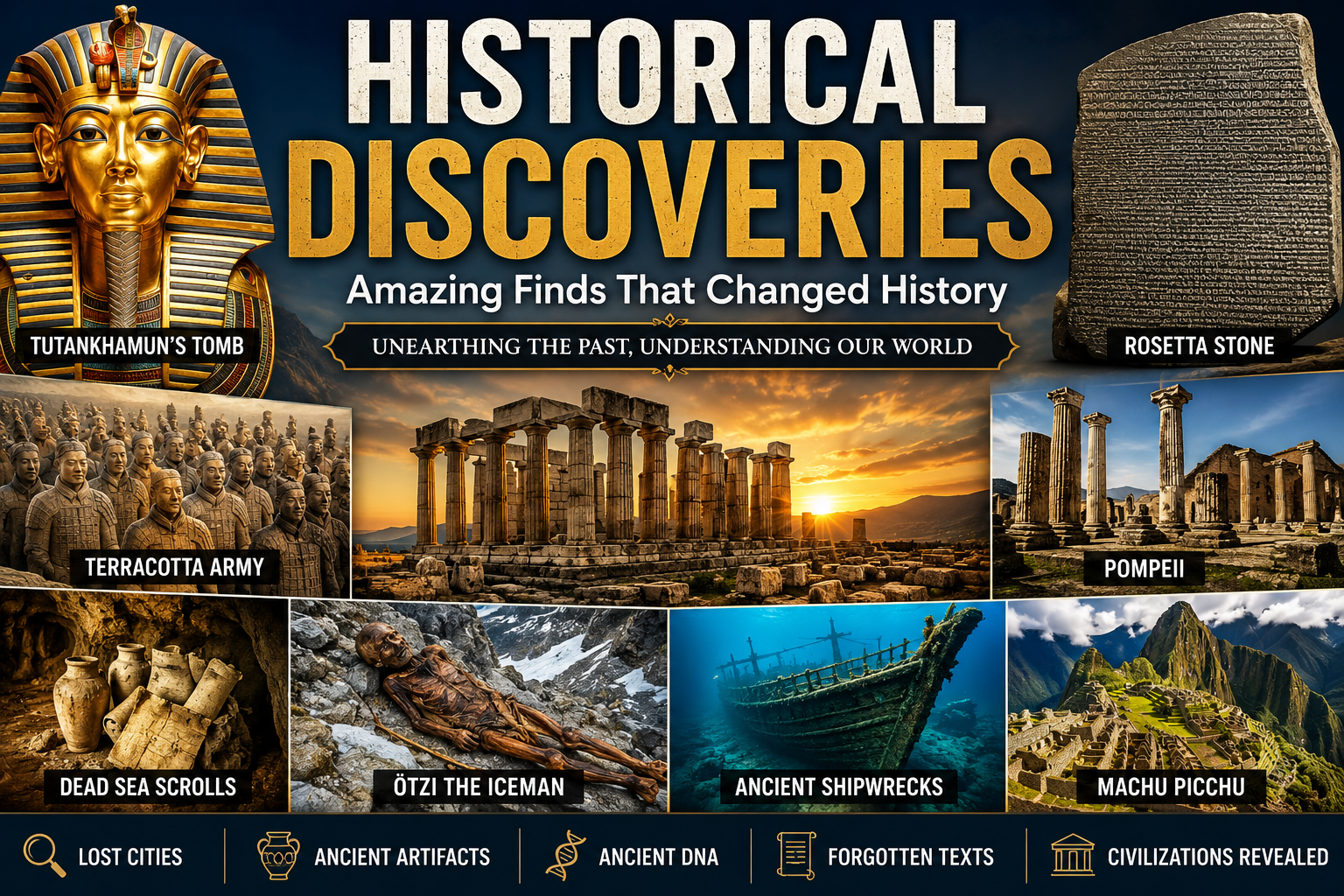
Historical discoveries have repeatedly changed what humanity believes about its own past, from ancient cities buried beneath the earth to manuscripts that revealed forgotten cultures and scientific evidence that rewrote established timelines. These discoveries show that history is not simply a collection of completed stories; it is an evolving investigation shaped by archaeology, technology, science, and newly uncovered evidence Cultural Heritage
What Are Historical Discoveries?
Historical discoveries are findings that provide new evidence about past human societies, events, cultures, technologies, environments, or individuals.
The term can cover a huge range of discoveries.
An archaeologist might uncover an ancient settlement.
A historian might locate a previously unknown manuscript.
A marine archaeologist might discover a shipwreck.
A scientist might analyze ancient DNA and reveal that populations migrated much earlier than previously believed.
A researcher might use satellite imagery to identify the remains of an ancient road network.
Therefore, historical discovery is not limited to digging in the ground.
It is an interdisciplinary process involving:
- Archaeology
- History
- Anthropology
- Geography
- Genetics
- Geology
- Linguistics
- Chemistry
- Astronomy
- Computer science
- Remote sensing
- Conservation science
Why Historical Discoveries Matter
History influences how societies understand:
- Identity
- Culture
- Migration
- Religion
- Technology
- Politics
- Trade
- Warfare
- Architecture
- Agriculture
- Human development
A single discovery can challenge an assumption that has survived for generations.
For example, discovering evidence of long-distance trade can change our understanding of how connected ancient communities were.
Finding writing in a previously underestimated society can change perceptions of its political or intellectual development.
Discovering an ancient medical text can demonstrate that historical societies possessed surprisingly sophisticated knowledge.
The deeper lesson is simple:
Evidence can change the story.
How Historical Discoveries Are Made
Historical discoveries rarely happen exactly like they do in adventure movies.
Researchers usually follow a systematic process.
Surveying a Potential Site
Researchers may begin with:
- Historical maps
- Local traditions
- Old documents
- Geological surveys
- Satellite imagery
- Aerial photography
- Previous archaeological reports
Excavation
When researchers identify a promising site, excavation may be conducted carefully layer by layer.
This matters because archaeological context is extremely important.
A coin by itself tells one story.
A coin found inside a sealed structure alongside pottery, tools, organic material, and inscriptions can tell a much larger story.
Dating the Evidence
Researchers can use different dating techniques depending on the material.
Examples include:
- Radiocarbon dating
- Dendrochronology
- Thermoluminescence
- Potassium-argon dating
- Stratigraphy
- Historical chronology
No single method works for every object.
Laboratory Analysis
Objects can be analyzed for:
- Chemical composition
- Pigments
- Metal sources
- DNA
- Isotopes
- Residue
- Microscopic wear
This allows researchers to discover information that cannot be seen with the naked eye.
The Rosetta Stone
The Rosetta Stone is one of the most famous discoveries in the history of archaeology.
Discovered in Egypt in 1799 during Napoleon’s campaign, the stone contained inscriptions in three scripts:
- Greek
- Demotic
- Egyptian hieroglyphs
Its importance was enormous.
Researchers already understood ancient Greek.
The presence of the same decree in multiple scripts provided a crucial pathway toward understanding Egyptian hieroglyphs.
Why the Rosetta Stone Was So Important
The discovery helped scholars connect a known language with an ancient writing system.
Jean-François Champollion later made major breakthroughs in deciphering hieroglyphs.
This opened a vast body of Egyptian historical evidence.
Suddenly, temples and monuments could be studied not only as architectural objects but also as written historical sources.
The Bigger Lesson
The Rosetta Stone demonstrates that historical discoveries can function like keys.
One artifact can unlock thousands of other sources.
The Tomb of Tutankhamun
The discovery of Tutankhamun’s tomb in Egypt in 1922 became one of the most famous archaeological events of the modern era.
Howard Carter’s excavation revealed an extraordinary collection of objects.
The tomb contained:
- Furniture
- Jewelry
- Chariots
- Statues
- Weapons
- Ritual objects
- Clothing
- The famous golden burial mask
Why the Discovery Was Significant
The tomb had remained relatively intact compared with many other royal burials.
This gave researchers an unusually detailed view of elite Egyptian burial practices.
The discovery also captured global public attention.
It helped turn archaeology into a subject of mass fascination.
What the Tomb Revealed
The artifacts provided evidence about:
- Royal craftsmanship
- Egyptian religion
- Burial traditions
- Clothing
- Warfare
- Artistic techniques
- Political symbolism
The tomb also reminded researchers that historical objects are not simply treasures.
They are evidence.
Pompeii and Herculaneum
The ancient Roman cities of Pompeii and Herculaneum were buried following the eruption of Mount Vesuvius in AD 79.
Their destruction became a tragedy for the people living there.
For archaeologists, however, the volcanic deposits created an extraordinary archaeological record.
Why Pompeii Is So Important
Pompeii preserved details of ordinary Roman life that are often missing from historical texts.
Researchers have found evidence of:
- Homes
- Shops
- Restaurants
- Graffiti
- Public buildings
- Gardens
- Tools
- Household objects
- Political messages
- Religious practices
Historical Value of Everyday Evidence
One of Pompeii’s greatest contributions is that it helps historians study ordinary people.
Ancient history often focuses on:
- Emperors
- Kings
- Generals
- Priests
Pompeii provides evidence about:
- Workers
- Shopkeepers
- Families
- Customers
- Slaves
- Craftspeople
This makes the site exceptionally valuable for social history.
The Dead Sea Scrolls
The Dead Sea Scrolls were discovered in caves near the Dead Sea beginning in the 1940s.
They include ancient Jewish religious texts and other writings.
Their discovery became one of the most important manuscript discoveries of the twentieth century.
Why the Scrolls Matter
The manuscripts provide evidence for the religious and intellectual environment of ancient Jewish communities.
They also help scholars study:
- Ancient languages
- Biblical textual traditions
- Religious practices
- Community organization
- Historical interpretation
A Broader Historical Lesson
Written evidence can survive in unexpected environments.
Dry caves, deserts, sealed rooms, and other unusual conditions can preserve fragile materials for centuries.
The Terracotta Army
The Terracotta Army was discovered near Xi’an, China, in 1974.
Thousands of life-sized clay figures were created to accompany Qin Shi Huang, the first emperor of a unified China, in the afterlife.
The figures include:
- Soldiers
- Officers
- Horses
- Chariots
- Specialized military units
Why the Terracotta Army Changed Historical Understanding
The site reveals the scale and organization of imperial China.
The figures also provide evidence about:
- Military organization
- Clothing
- Weapons
- Rank
- Artistic production
- Imperial ideology
The discovery demonstrated how material evidence can reveal the ambitions of a political system.
The Ancient City of Troy
For centuries, Troy existed somewhere between literature and history.
The city became famous through Homer’s epic tradition, but researchers debated how much of the story reflected an actual historical place.
Archaeological excavations at Hisarlik in modern Türkiye revealed multiple layers of settlement.
Why Troy Matters
The site demonstrated that a major ancient settlement existed in the region traditionally associated with Troy.
The archaeology does not prove every detail of the literary story.
That distinction is important.
Historical research does not work by simply saying:
“An ancient text says it happened, therefore everything in it is factual.”
Instead, researchers compare:
- Literature
- Archaeology
- Geography
- Dating
- Material evidence
This produces a more careful interpretation.
Ötzi the Iceman
In 1991, hikers discovered the naturally preserved body of a man in the Alps.
He became known as Ötzi the Iceman.
The discovery provided an extraordinary opportunity to study an individual who lived more than 5,000 years ago.
What Researchers Learned
Researchers were able to study:
- Clothing
- Tools
- Diet
- Tattoos
- Health indicators
- Genetic information
- Stomach contents
- Injuries
- Lifestyle
His equipment included a sophisticated collection of tools and weapons.
Why Ötzi Is Extraordinary
Traditional historical sources rarely provide such detailed information about one prehistoric individual.
Ötzi became something like a biological time capsule.
His remains demonstrated how modern science can extract information from ancient bodies without relying solely on written records.
The Antikythera Mechanism
The Antikythera Mechanism was recovered from an ancient shipwreck discovered near the Greek island of Antikythera.
It is a complex mechanical device dating to antiquity.
Researchers have described it as an ancient astronomical calculator.
Why It Changed Perceptions
The mechanism demonstrated that ancient Greek engineers could produce extraordinarily sophisticated mechanical devices.
It contained intricate gearing capable of representing astronomical cycles.
The Important Lesson
Historical stereotypes can be misleading.
People sometimes imagine ancient societies as technologically simple.
The Antikythera Mechanism shows that technological knowledge can be advanced in one field while leaving few surviving examples.
The absence of evidence is not necessarily evidence of technological absence.
Sutton Hoo
Sutton Hoo is an archaeological site in England associated with an early medieval ship burial.
Discovered in the twentieth century, it contained an extraordinary collection of artifacts.
Among them was a famous helmet and numerous objects associated with elite status and international connections.
What Sutton Hoo Revealed
The discovery provided valuable information about early medieval society in England.
It demonstrated connections involving:
- Trade
- Craftsmanship
- Political power
- Warfare
- Burial customs
- International cultural exchange
Why Ship Burials Matter
Burials can preserve objects that might otherwise disappear.
They also reveal what societies considered important enough to accompany elite individuals into death.
The Viking Settlement at L’Anse aux Meadows
L’Anse aux Meadows in Newfoundland provides strong archaeological evidence of Norse settlement in North America around a millennium ago.
This discovery transformed the story of European exploration.
Why It Matters
For a long time, popular narratives treated Columbus’s voyage as the beginning of European contact with the Americas.
The Norse evidence demonstrated that Europeans had reached North America centuries earlier.
The Bigger Lesson
Historical timelines can change dramatically when physical evidence confirms an event or activity that was previously uncertain.
Machu Picchu
Machu Picchu is one of the world’s best-known archaeological sites.
Located high in the Andes, the Inca site became internationally famous after its introduction to wider modern audiences in the early twentieth century.
What Machu Picchu Reveals
The site demonstrates impressive achievements in:
- Stone construction
- Agricultural engineering
- Water management
- Urban planning
- Landscape adaptation
Why the Site Is Important
Machu Picchu illustrates how architecture can reveal environmental intelligence.
The builders did not simply construct buildings.
They designed infrastructure around mountains, water, slopes, and agricultural requirements.
Göbekli Tepe
Göbekli Tepe in modern Türkiye transformed debates about early monumental construction.
The site contains monumental structures dating to the early Neolithic period.
Why Göbekli Tepe Was Surprising
Researchers traditionally associated large monumental architecture with settled agricultural societies.
Göbekli Tepe complicated that model.
It encouraged researchers to reconsider relationships between:
- Ritual
- Community
- Food production
- Settlement
- Monument building
The Historical Significance
The discovery shows that major social organization can emerge in ways that do not fit simple linear models.
Human history is rarely:
simple → complex
It is more often:
complex → changing → adapting → reorganizing
Ancient Egyptian Papyri
Papyri discoveries have provided historians with information about ancient Egyptian administration, literature, religion, business, and daily life.
These documents can include:
- Contracts
- Letters
- Religious texts
- Administrative records
- Medical information
- Legal documents
Why Written Records Matter
Monuments tell us what rulers wanted remembered.
Ordinary documents can tell us what people actually did.
A receipt or contract may reveal more about everyday economic life than an enormous monument.
Ancient Shipwrecks
Shipwreck archaeology is one of the most exciting areas of historical discovery.
A shipwreck can preserve:
- Cargo
- Tools
- Weapons
- Ceramics
- Food
- Coins
- Navigation equipment
- Shipbuilding techniques
Why Underwater Archaeology Is Important
The ocean can act as a protective environment.
Materials that might disappear on land can sometimes remain buried underwater.
Shipwrecks also provide evidence of ancient trade networks.
A single cargo can reveal connections between distant regions.
The Uluburun Shipwreck
The Uluburun shipwreck, discovered off the coast of modern Türkiye, is one of the most important Bronze Age shipwreck discoveries.
Its cargo included materials from different regions of the ancient Mediterranean and Near East.
What It Revealed
The cargo demonstrated extensive long-distance trade.
It provided evidence for the movement of:
- Metals
- Glass
- Ceramics
- Timber
- Luxury goods
- Raw materials
Why Trade Discoveries Matter
Trade networks challenge the idea that ancient societies were isolated.
Long before modern globalization, communities were connected by complex systems of exchange.
The Behistun Inscription
The Behistun Inscription, created under the Persian king Darius I, became extremely important for understanding ancient Persian imperial history and cuneiform languages.
The inscription was written in multiple languages.
Why Multilingual Inscriptions Matter
Like the Rosetta Stone, multilingual texts can provide bridges between known and unknown writing systems.
They allow scholars to compare:
- Names
- Titles
- Events
- Vocabulary
- Grammar
This makes them powerful tools for decipherment.
The Library of Ashurbanipal
The ancient library associated with Ashurbanipal at Nineveh produced thousands of clay tablets.
These included literary, administrative, religious, and scholarly texts.
Why the Library Is Important
The collection preserved information about Mesopotamian intellectual life.
It included versions of the famous Epic of Gilgamesh.
What It Demonstrates
Ancient societies maintained sophisticated systems for:
- Writing
- Education
- Administration
- Literature
- Religious scholarship
- Scientific observation
The library provides a window into the intellectual world of ancient Mesopotamia.
The Palace of Knossos
Knossos on Crete became central to the study of the Minoan civilization.
The site contains large architectural complexes and evidence of an advanced Bronze Age society.
What Researchers Learned
Archaeological evidence reveals:
- Complex architecture
- Art
- Storage systems
- Trade
- Religious practices
- Administration
Knossos also demonstrates how archaeology can transform ancient mythology into a more complicated historical conversation.
19. The Maya Civilization’s Hidden Cities and Infrastructure
Modern technology has revealed previously unknown or underestimated features of Maya landscapes.
Remote sensing techniques such as LiDAR can detect structures hidden beneath dense vegetation.
Why LiDAR Is Revolutionary
Traditional archaeological surveys can be difficult in tropical forests.
LiDAR can create detailed elevation models by measuring the landscape with laser pulses.
Researchers can identify:
- Roads
- Platforms
- Buildings
- Reservoirs
- Agricultural systems
- Urban networks
The Bigger Discovery
The technology has helped demonstrate that ancient Maya landscapes could contain extensive urban and agricultural infrastructure.
The forest may hide a city without completely erasing its physical footprint.
20. Ancient DNA and Population History
One of the biggest modern developments in historical research is ancient DNA analysis.
Genetic evidence can help researchers investigate:
- Migration
- Population relationships
- Disease
- Ancestry
- Family relationships
- Population replacement
- Human mobility
Why Ancient DNA Matters historical discoveries
Written records may describe kings and wars.
DNA can reveal population movement across generations.
It can answer questions that documents cannot.
Ethical Considerations historical discoveries
Ancient DNA research also raises important ethical questions.
Researchers must consider:
- Consent
- Community rights
- Cultural sensitivity
- Human remains
- Data privacy
- Indigenous perspectives
Scientific capability does not eliminate ethical responsibility.
Historical Discoveries and the Importance of Context
An artifact’s location can be as important as the artifact itself.
Imagine finding an ancient coin.
By itself, it provides limited information.
Now imagine finding the coin:
- Inside a sealed room
- Beside imported pottery
- Near a burial
- Alongside local currency
- With an inscription
- In a known historical layer
Suddenly, the interpretation becomes much richer.
This is why archaeologists emphasize context.
How Technology Is Transforming Historical Discoveries
Modern archaeology increasingly uses technologies that would have seemed impossible to earlier generations.
Satellite Imaging historical discoveries
Satellites can identify:
- Ancient roads
- Earthworks
- Settlement patterns
- Agricultural systems
- Buried structures
LiDAR historical discoveries
LiDAR is especially useful in forests.
It can reveal landscape structures hidden beneath vegetation.
Ground-Penetrating Radar historical discoveries
Ground-penetrating radar can help researchers identify underground features without immediately excavating them.
3D Scanning historical discoveries
Three-dimensional scanning can digitally preserve:
- Statues
- Buildings
- Tools
- Pottery
- Archaeological sites
Artificial Intelligence historical discoveries
AI can assist researchers with:
- Image classification
- Pattern recognition
- Text analysis
- Fragment reconstruction
- Satellite-image analysis
- Large archaeological datasets
AI is unlikely to replace archaeologists.
Instead, its greatest value may come from helping humans analyze enormous quantities of evidence faster.
Historical Discoveries That Happened by Accident
Not every discovery begins with a carefully planned expedition.
Some famous finds were accidental.
Construction Workers Finding Archaeological Remains
Infrastructure projects can uncover:
- Ancient roads
- Graves
- Walls
- Pottery
- Settlements
Farmers Finding Buried Objects historical discoveries
Agricultural activity has sometimes exposed ancient artifacts.
Hikers and Climbers historical discoveries
People exploring mountains, deserts, and remote regions occasionally discover archaeological remains.
Divers Discovering Shipwrecks historical discoveries
Underwater discoveries have expanded our understanding of ancient maritime networks.
The important lesson is:
Chance may reveal the evidence, but professional investigation determines what it means.
Why Some Historical Discoveries Remain Controversial
Not every discovery immediately produces consensus.
Researchers can disagree about:
- Dating
- Authenticity
- Interpretation
- Cultural identity
- Purpose
- Historical significance
Conflicting Evidence historical discoveries
Different types of evidence can produce different interpretations.
An ancient text may describe an event differently from archaeological remains.
A monument may have been reused.
An object may have traveled far from where it was produced.
Incomplete Evidence historical discoveries
Archaeology is essentially a puzzle with missing pieces.
Researchers rarely recover everything.
Organic materials may disappear.
Buildings may be destroyed.
Texts may be lost.
Objects may be looted.
This means historical conclusions often carry degrees of uncertainty.
Common Mistakes When Studying Historical Discoveries
Mistake 1: Treating Every Discovery as Absolute Proof historical discoveries
A discovery can provide strong evidence without proving every interpretation surrounding it.
Better approach: Separate the artifact from the claims made about it.
Mistake 2: Confusing Legend With Historical Evidence historical discoveries
Legends can contain memories of real events, but they are not automatically factual records.
Better approach: Compare literary traditions with archaeology and other evidence.
Mistake 3: Ignoring Dating Methods historical discoveries
An object found at a site does not automatically date the entire site.
Better approach: Understand how researchers established chronology.
Mistake 4: Assuming Older Means Less Advanced historical discoveries
Ancient societies could be technologically sophisticated in surprising areas.
Better approach: Study each society on its own terms.
Mistake 5: Ignoring Ordinary People historical discoveries
Historical narratives often focus on rulers.
Better approach: Examine homes, tools, food, clothing, workplaces, and everyday documents.
Pros and Cons of Historical Archaeological Evidence
| Aspect | Advantages | Limitations |
|---|---|---|
| Artifacts | Provide physical evidence | Context may be missing |
| Written records | Can provide names and events | Authors may be biased |
| Human remains | Reveal health and lifestyle | Ethical issues can arise |
| Ancient DNA | Shows population relationships | Samples can be incomplete |
| Architecture | Reveals engineering and social organization | Interpretation can be uncertain |
| Shipwrecks | Preserve trade evidence | Underwater work is difficult |
| Remote sensing | Finds hidden structures | Does not always explain their purpose |
| Dating techniques | Establish chronology | Methods have limitations |
| Oral traditions | Preserve cultural memory | Can change over time |
| AI analysis | Processes large datasets | Results depend on data quality |
Ten Major Historical Discovery Organizations and Brands
The following organizations and brands are influential in archaeology, historical research, museums, cultural heritage, exploration, or public understanding of the past.
| Organization or Brand | Main Focus | Strongest Contribution | Best For |
|---|---|---|---|
| National Geographic | Exploration and education | Public storytelling and expeditions | General audiences |
| Smithsonian Institution | Museums and research | Broad historical and scientific collections | Students and researchers |
| British Museum | Global cultural heritage | Major archaeological collections | Ancient civilizations |
| The Metropolitan Museum of Art | Art and cultural history | Historical objects and visual culture | Art and history enthusiasts |
| American Museum of Natural History | Anthropology and natural history | Human origins and cultural research | Families and learners |
| UNESCO | Cultural heritage | World Heritage protection | Heritage awareness |
| Archaeological Institute of America | Archaeology education | Research and professional community | Archaeology enthusiasts |
| Getty | Art and conservation | Conservation and cultural heritage | Art-history audiences |
| Google Arts & Culture | Digital cultural access | Digital exploration of collections | Online learners |
| The British Library | Manuscripts and knowledge | Historical documents and manuscripts | Researchers and readers |
These organizations differ significantly.
A museum may emphasize collections.
A research institution may emphasize fieldwork.
A heritage organization may focus on preservation.
A digital platform may focus on accessibility.
Together, they demonstrate how historical knowledge reaches the public through many channels.
Historical Discoveries for Students
Students can learn historical discovery more effectively by asking questions instead of simply memorizing dates.
Ask What Was Found historical discoveries
Start with the artifact or site.
Ask Where It Was Found historical discoveries
Location provides context.
Ask How It Was Dated historical discoveries
Chronology is essential.
Ask Who Created It historical discoveries
Researchers may use inscriptions, style, materials, and comparisons.
Ask What It Changes historical discoveries
This is the most important question.
Did the discovery:
- Confirm an existing theory?
- Challenge a theory?
- Add detail?
- Reveal a completely unknown society?
This method encourages historical thinking.
Historical Discoveries for Beginners
Beginners should start with discoveries that demonstrate different types of evidence.
A useful learning sequence is:
- Rosetta Stone — writing
- Tutankhamun — burial archaeology
- Pompeii — everyday life
- Terracotta Army — imperial power
- Ötzi — human remains
- Antikythera Mechanism — technology
- L’Anse aux Meadows — migration
- Göbekli Tepe — early monumental culture
- Ancient DNA — population history
- LiDAR discoveries — modern archaeological technology
This provides a broad introduction to the field.
Historical Discoveries for Professionals and Advanced Researchers
Advanced researchers should look beyond famous artifacts.
Important questions include:
- What was the excavation context?
- Which dating methods were used?
- Are the results independently replicated?
- What alternative interpretations exist?
- What evidence remains missing?
- Has the material been properly conserved?
- Who owns the cultural heritage?
- Were local communities involved?
- Could modern political narratives influence interpretation?
These questions help distinguish popular archaeology from rigorous scholarship.
Families historical discoveries
Parents can make archaeology engaging for children by turning discoveries into questions.
Instead of:
“Tutankhamun died young.”
Ask:
“What would you expect to find inside a king’s tomb?”
Instead of:
“Romans lived in Pompeii.”
Ask:
“What objects would you leave behind if your entire city disappeared tomorrow?”
This approach turns history into investigation.
Historical Discoveries for Travelers historical discoveries
Historical discoveries can also improve travel experiences.
Before visiting an archaeological site, research:
- Who built it
- When it was built
- Why it was important
- How researchers discovered it
- What remains uncertain
This changes the experience.
A stone wall stops being just a wall.
It becomes evidence of:
- Engineering
- Politics
- Religion
- Trade
- Human adaptation
Historical knowledge can therefore transform tourism into deeper cultural exploration.
How to Research a Historical Discovery Correctly
A strong research process should include several stages.
Start With the Primary Discovery historical discoveries
Find out:
- What was discovered?
- When?
- Where?
- By whom?
Examine the Evidence historical discoveries
Determine whether the evidence is:
- Archaeological
- Written
- Biological
- Geological
- Artistic
- Architectural
Check Dating historical discoveries
Ask how the researchers established the date.
Compare Interpretations historical discoveries
Look for scholarly disagreements.
Separate Fact From Speculation historical discoveries
Use careful language.
Instead of:
“This proves that ancient people believed X.”
Prefer:
“The evidence has been interpreted as suggesting X.”
That distinction matters.
The Role of Museums in Historical Discovery
Museums do more than display objects.
They:
- Preserve artifacts
- Conduct research
- Educate visitors
- Support conservation
- Digitize collections
- Publish scholarship
- Provide cultural context
Museums also face important questions about ownership and repatriation.
Cultural Heritage and Repatriation historical discoveries
Many historical artifacts were removed from their countries of origin during colonial periods, wars, expeditions, or earlier collecting practices.
Modern institutions increasingly face demands to:
- Return objects
- Reconsider ownership
- Share collections
- Collaborate with source communities
This is one of the most important ethical dimensions of modern historical research.
The Problem of Looting and Illegal Antiquities historical discoveries
Historical discoveries can be damaged when artifacts are removed from their archaeological context.
Looting can destroy:
- Dating information
- Cultural context
- Settlement relationships
- Scientific evidence
An artifact sold privately may look impressive.
But if researchers do not know where it came from, much of its historical value can be lost.
This is why responsible archaeology emphasizes documentation and legal excavation.
How Climate Change Could Affect Historical Discoveries
Climate change presents both opportunities and threats.
Melting ice can expose previously inaccessible archaeological material.
Changing water levels can reveal or destroy sites.
Drought can expose buried structures.
Rising seas can threaten coastal heritage.
Extreme weather can damage:
- Ancient monuments
- Archaeological sites
- Manuscripts
- Historic buildings
Future archaeology will therefore include not only discovery but also emergency preservation.
Future Trends in Historical Discoveries
AI-Assisted Archaeology historical discoveries
AI will likely become increasingly useful for identifying patterns in:
- Satellite images
- Archaeological datasets
- Ancient texts
- Pottery fragments
- Architectural remains
More Non-Invasive Archaeology historical discoveries
Researchers increasingly want to understand sites without destroying them through excavation.
Technologies such as:
- Ground-penetrating radar
- Magnetometry
- LiDAR
- Photogrammetry
can help.
Ancient DNA Expansion
Genetic research may provide increasingly detailed information about:
- Migration
- Family structures
- Disease
- Diet
- Population changes
Underwater Archaeology
As underwater technology improves, researchers may locate more shipwrecks and submerged settlements.
Digital Reconstruction
Virtual and augmented reality could allow people to experience reconstructed historical environments.
Imagine standing inside a digital recreation of an ancient city while archaeological evidence explains exactly which elements are known and which are reconstructed.
Community-Based Archaeology
Future research may increasingly involve local communities directly in:
- Excavation
- Interpretation
- Conservation
- Heritage management
- Decision-making
This is especially important for Indigenous and culturally significant sites.
What Historical Discoveries May Reveal Next
Some of the most exciting discoveries may not be famous monuments.
Researchers may find:
- Unknown settlements
- Previously undocumented trade routes
- Ancient agricultural systems
- Lost manuscripts
- Family relationships
- Evidence of migration
- New shipwrecks
- Submerged settlements
- Previously unknown technologies
The future of archaeology may increasingly focus on ordinary evidence.
A broken pot can sometimes tell us more about daily life than a palace.
A seed can reveal ancient agriculture.
A tooth can reveal diet.
A road can reveal trade.
A DNA sample can reveal migration.
The future historian may therefore work as much like a scientist as a traditional historian.
Why Historical Discovery Is Never Really Finished
There is a common misconception that the major discoveries have already been made.
That is unlikely.
Large portions of the world’s archaeological record remain undiscovered, undocumented, underwater, buried beneath modern cities, or hidden beneath vegetation.
Even known sites can produce new information.
A museum collection may contain an artifact that has not yet been correctly identified.
An old excavation may be reanalyzed using modern technology.
A previously known manuscript may reveal new information through advanced imaging.
A familiar archaeological site may produce new discoveries when researchers apply a different analytical method.
History can therefore be rediscovered without physically discovering something new.
The Most Important Lesson From Historical Discoveries
Historical discoveries teach us humility.
The past is larger than the surviving evidence.
We know a great deal about certain societies because their records survived.
We know much less about others because their evidence disappeared.
This creates an important warning:
The historical record is not necessarily a complete record of the past.
It is a record of what survived.
That difference matters.
A civilization without surviving written documents was not necessarily less sophisticated.
A society without monumental architecture may have invested its resources elsewhere.
A population missing from traditional histories may simply have left fewer surviving records.
Archaeology helps correct these imbalances.
Balanced Analysis: The Strengths and Limits of Historical Discoveries
Historical discoveries can provide extraordinary evidence.
But evidence requires interpretation.
Strengths historical discoveries
- Physical evidence can challenge historical myths.
- Archaeology can reveal ordinary life.
- Scientific dating can improve chronology.
- DNA can reveal population relationships.
- Technology can locate hidden structures.
- Written documents can provide names and events.
- Artifacts can reveal technological capabilities.
- Shipwrecks can expose international trade networks.
Limitations historical discoveries
- Archaeological sites are often incomplete.
- Objects can be moved from their original locations.
- Dating methods have uncertainties.
- Historical texts can be biased.
- Preservation varies by environment.
- Modern interpretations can change.
- Looting can destroy archaeological context.
- Political and cultural assumptions can influence interpretation.
The best historical research therefore combines evidence from multiple sources.
FAQs
When you encounter a sensational claim online, use this checklist.
What Exactly Was Discovered?
Do not rely on the headline.
Where Was It Found?
Location matters.
How Old Is It?
Check the dating method.
What Evidence Supports the Claim?
Look for physical, written, scientific, or archaeological evidence.
Who Made the Claim?
Consider whether it comes from:
- A university
- A museum
- A professional archaeologist
- A government heritage agency
- A popular media account
- An anonymous social media page
Is There Scholarly Agreement?
A single exciting interpretation does not automatically represent consensus.
What Remains Unknown?
This question is often ignored.
Good historical research clearly distinguishes between:
Known → probable → possible → unknown.
Conclusion
Historical discoveries are much more than spectacular objects displayed behind museum glass. They are pieces of evidence that allow humanity to investigate its own origins. The Rosetta Stone helped unlock ancient writing. Tutankhamun’s tomb revealed extraordinary details about Egyptian royal burial. Pompeii preserved everyday Roman life. The Terracotta Army demonstrated the scale of imperial China. Ötzi provided an extraordinary look at an individual from prehistoric Europe. The Antikythera Mechanism challenged assumptions about ancient technology. L’Anse aux Meadows changed the timeline of European exploration in North America. Göbekli Tepe complicated ideas about the development of monumental societies.