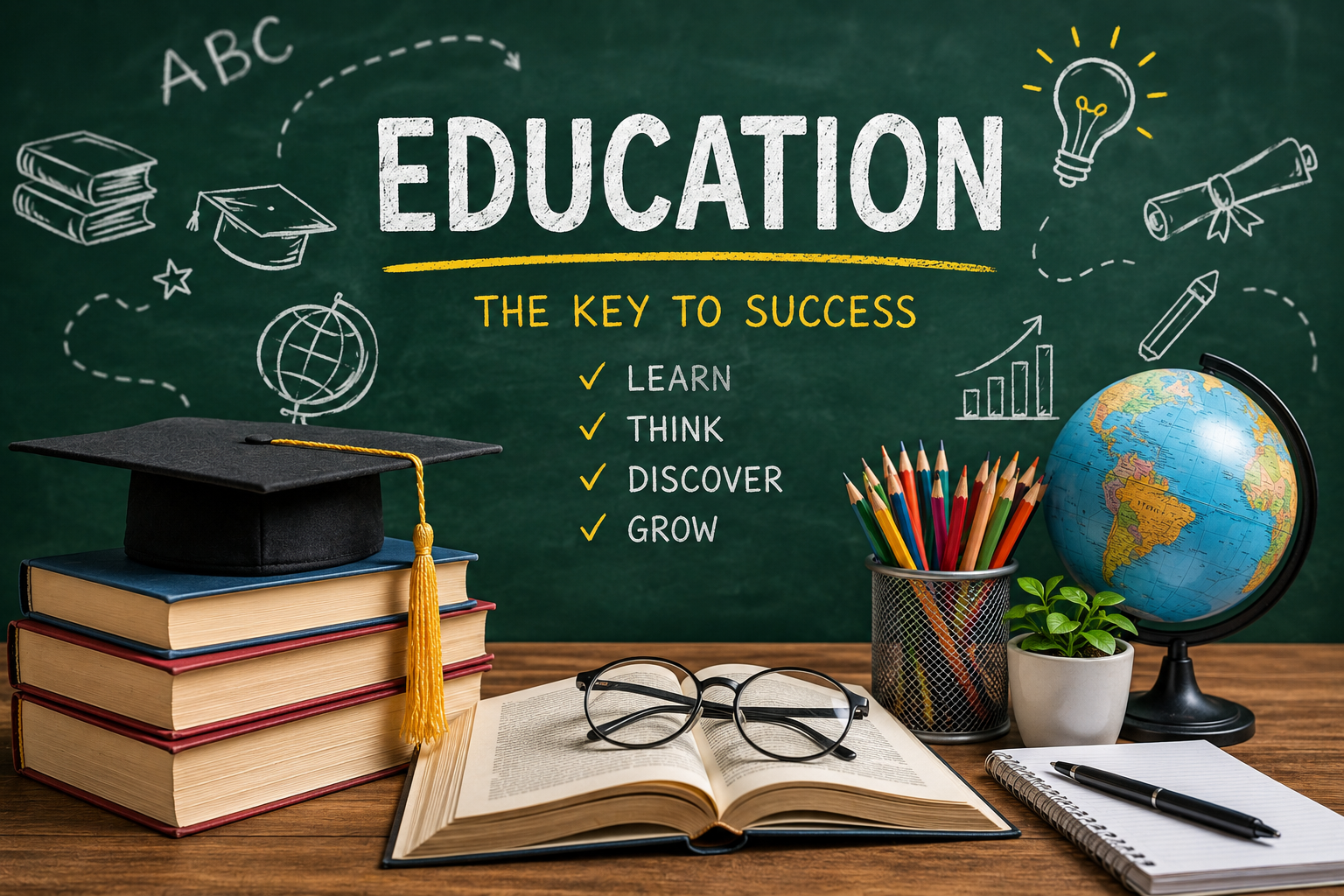
d u c a t i o n is one of the most important parts of human life. It gives people knowledge, skills, confidence, and the ability to understand the world around them. From early childhood to adulthood, education helps people learn how to communicate, solve problems, make decisions, and build a better future. Education is not limited to schools and universities. People can learn from teachers, parents, books, workplaces, communities, online courses, and everyday experiences. Every learning experience can add new knowledge and skills educatiob
What Is Education?
Education is the process of gaining knowledge, skills, values, ideas, and experience. It helps people understand information and use what they learn in real-life situations.
Education can happen in many places. A child may begin learning at home before entering school. Later, the child may attend primary school, secondary school, college, or university. Adults can continue education through professional training, online courses, workshops, and workplace learning.
Education can include many areas, such as:
- Reading and writing
- Mathematics
- Science
- History
- Languages
- Technology
- Arts
- Communication
- Business
- Health and physical education
- Professional skills
- Social and cultural knowledge
The goal of education is not only to help students pass exams. Good education should also prepare people to think, communicate, solve problems, work with others, and make responsible decisions.
Importance of Education
Education plays a major role in personal development and social progress. A strong education system can give people the tools they need to improve their lives.
Education Builds Knowledge
Knowledge helps people understand the world. Students learn about science, history, mathematics, languages, society, and many other subjects.
Knowledge also helps people understand information they see every day. A person with basic education may find it easier to read instructions, understand financial information, communicate with others, and make informed choices.
Education Develops Skills
Education develops both academic and practical skills.
Students may learn:
- Writing
- Reading
- Communication
- Research
- Computer skills
- Mathematics
- Critical thinking
- Teamwork
- Time management
- Problem-solving
These skills can be useful in school, work, business, and everyday life.
Education Improves Career Opportunities
Education can provide access to a wider range of career opportunities. Many professions require specific qualifications or training.
Doctors, engineers, teachers, lawyers, accountants, scientists, and many other professionals need specialized education before entering their careers.
Education does not guarantee a particular job, but it can provide the knowledge and qualifications needed to apply for many positions.
Education Builds Confidence
Learning something new can increase confidence. When students understand a difficult subject or successfully complete a project, they may become more confident in their abilities.
Education can also teach people how to communicate their ideas and interact with others.
Education Encourages Better Decisions
People make decisions every day about money, health, work, relationships, and other areas of life. Education can help people understand information and think carefully before making decisions.
A person who can compare information, ask questions, and identify reliable sources may be better prepared to make informed choices.
Types of Education
Education comes in different forms. Each type serves a different purpose.
| Type of Education | Main Purpose | Common Examples |
|---|---|---|
| Formal education | Structured academic learning | Schools, colleges, universities |
| Informal education | Learning through everyday life | Family, friends, personal experience |
| Non-formal education | Organized learning outside traditional schools | Workshops, training programs |
| Online education | Learning through digital platforms | Online courses and virtual classes |
| Vocational education | Practical career skills | Technical and trade training |
| Higher education | Advanced academic and professional learning | Colleges and universities |
Formal Education
Formal education takes place within an organized educational system. It normally includes teachers, classrooms, courses, exams, and defined learning goals.
Schools are a major part of formal education. Students usually move through different levels as they become older.
Formal education can provide:
- Structured lessons
- Qualified teachers
- Learning materials
- Exams and assessments
- Academic qualifications
- Social interaction
- Opportunities for further study
Formal education is important because it provides a planned learning path.
Informal Education
Informal education happens naturally in daily life. It does not always involve a classroom, teacher, or examination.
Children learn many basic skills from parents and family members. Adults may learn through conversations, books, hobbies, travel, work, and personal experiences.
For example, someone may learn how to repair a simple household item by watching another person. Another person may improve communication skills through everyday conversations.
Informal education continues throughout life.
Non-Formal Education
Non-formal education is organized learning that takes place outside the traditional school system.
Examples include:
- Short training courses
- Workshops
- Community programs
- Professional development
- Language classes
- Computer courses
- Skill development programs
Non-formal education can be useful for people who want to develop a specific skill without completing a long academic program.
Online Education
Online education has become an important part of modern learning. Students can access lessons through computers, tablets, and smartphones.
Online education may include:
- Recorded video lessons
- Live classes
- Digital textbooks
- Online tests
- Discussion forums
- Virtual classrooms
- Educational applications
- Digital assignments
One major advantage of online education is flexibility. Students may be able to study from home and choose learning times that fit their schedules.
However, online education also has challenges. Students need reliable internet access, suitable devices, and enough self-discipline to complete their work.
Vocational Education
Vocational education focuses on practical skills for specific careers or industries.
Examples include:
- Electrical work
- Plumbing
- Automotive repair
- Cooking
- Construction
- Graphic design
- Information technology
- Welding
- Fashion design
- Healthcare support
Vocational education can help students develop practical abilities that can be used directly in the workplace.
Higher Education
Higher education usually refers to education after secondary school. Colleges and universities offer undergraduate, graduate, and professional programs.
Higher education can help students develop advanced knowledge in a specific field.
Common areas include:
- Business
- Engineering
- Medicine
- Law
- Computer science
- Education
- Social sciences
- Arts
- Natural sciences
Higher education can also provide opportunities for research and innovation.
Benefits of Education
Education provides many personal, professional, and social benefits.
| Benefit | Description |
|---|---|
| Knowledge | Helps people understand different subjects |
| Career development | Provides skills and qualifications |
| Confidence | Helps people trust their abilities |
| Communication | Improves speaking and writing |
| Critical thinking | Helps people evaluate information |
| Problem-solving | Teaches people how to handle challenges |
| Social awareness | Helps people understand communities |
| Personal growth | Encourages lifelong learning |
Personal Development
Education helps people discover their interests and abilities. Students may learn that they enjoy science, art, technology, languages, business, or another field.
Learning can also help people become more organized and responsible.
Better Communication
Communication is important in almost every part of life. Education can improve reading, writing, speaking, listening, and presentation skills.
Good communication can help students at school and adults in professional environments.
Critical Thinking
Critical thinking means examining information carefully instead of accepting everything immediately.
Education can encourage students to:
- Ask questions
- Compare information
- Identify problems
- Consider different opinions
- Use evidence
- Make logical conclusions
These skills are useful in everyday life as well as professional work.
Problem-Solving Skills
Life includes many challenges. Education can teach people how to break problems into smaller parts and find possible solutions.
Mathematics, science, technology, and practical activities can all contribute to problem-solving abilities.
Primary and Secondary Education
Primary and secondary education form the foundation of a person’s learning journey.
Primary Education
Primary education usually focuses on basic skills such as:
- Reading
- Writing
- Mathematics
- Basic science
- Social knowledge
- Communication
- Creative activities
Early education is important because students build foundational skills that they will use in later education.
Secondary Education
Secondary education usually provides more advanced subjects. Students may begin to explore subjects connected to their future careers and interests.
Secondary education can prepare students for:
- Higher education
- Vocational training
- Employment
- Professional development
- Independent learning
A strong foundation during primary and secondary education can make future learning easier.
The Role of Teachers
Teachers are one of the most important parts of education. A teacher does more than provide information. Teachers can guide students, answer questions, encourage learning, and help students understand difficult subjects.
A good teacher can:
- Explain difficult ideas clearly
- Encourage students to ask questions
- Identify learning problems
- Provide useful feedback
- Motivate students
- Support different learning needs
- Develop classroom discipline
- Encourage teamwork
Teachers can also influence students’ attitudes toward learning. A positive teacher can help students see education as an opportunity rather than only a requirement.
Technology in Education
Technology has changed education in many ways. Computers, smartphones, tablets, digital boards, educational software, and online platforms have become useful learning tools.
Technology can help students access information quickly and communicate with teachers and classmates.
Digital Classrooms
Digital classrooms can include interactive screens, computers, online resources, and educational software.
These tools can make lessons more interactive and allow teachers to present information in different formats.
Online Libraries
Digital libraries can provide access to books, research papers, articles, and other educational resources.
Students no longer need to depend only on physical libraries. Digital resources can make learning materials available from many locations.
Educational Applications
Educational apps can help students practice mathematics, languages, science, writing, and other subjects.
Some applications provide immediate feedback, allowing students to understand mistakes and practice again.
Artificial Intelligence
Artificial intelligence is becoming part of education through tutoring systems, learning assistants, content tools, and personalized learning platforms.
AI may help students understand difficult topics, practice questions, organize information, and receive additional explanations.
However, technology should support learning rather than replace thinking. Students still need to develop their own understanding and judgment.
Challenges in Education
Despite its importance, education faces many challenges around the world.
High Education Costs
Education can be expensive for families. Costs may include:
- Tuition
- Books
- Transportation
- Uniforms
- Devices
- Internet
- Accommodation
- Examination fees
High costs can prevent some students from continuing their education.
Unequal Access
Not every student has the same access to quality education.
Some communities may have excellent schools, trained teachers, libraries, and technology, while others may have limited resources.
Reducing this gap is an important goal for d u c a t i o n systems.
Lack of Learning Resources
Students need suitable books, equipment, classrooms, laboratories, and digital resources.
Without appropriate learning materials, teachers may find it difficult to provide effective d u c a t i o n
Teacher Shortages
Some areas face a shortage of qualified teachers. When there are too few teachers, classrooms may become overcrowded and students may receive less individual attention.
Teacher training and professional development are important for improving d u c a t i o n quality.
Digital Access Problems
Online d u c a t i o n depends on technology. Students without reliable internet or suitable devices may struggle to participate in digital learning.
Digital access should therefore be considered an important part of modern education.
How to Improve d u c a t i o n
Improving education requires cooperation between schools, teachers, families, communities, governments, and students.
Better Teacher Training
Teachers should receive regular training so they can learn new teaching methods and use modern educational tools effectively.
Training can cover:
- Classroom management
- Digital d u c a t i o n
- Student assessment
- Communication
- Inclusive d u c a t i o n
- New teaching methods
Improve Learning Materials
Schools need suitable books, computers, laboratories, libraries, and other resources.
Good learning materials can make lessons clearer and more practical.
Make d u c a t i o n More Affordable
Reducing unnecessary education costs can help more students continue their studies.
Scholarships, financial support, affordable programs, and community education can improve access.
Encourage Practical Learning
Students should have opportunities to apply what they learn.
Practical learning can include:
- Projects
- Experiments
- Internships
- Group activities
- Field visits
- Workshops
- Real-world problem solving
Practical d u c a t i o n can help students understand how knowledge is used outside the classroom.
d u c a t i o n and Career Development
d u c a t i o n and career development are closely connected. Students often use their education to prepare for future employment.
Career d u c a t i o n can help students understand their strengths and interests.
Students can explore:
- Career options
- Required qualifications
- Professional skills
- Training programs
- University courses
- Internships
- Job opportunities
However, career development does not stop after finding a job. Workers may need to continue learning because technology and workplace requirements change over time.
Lifelong d u c a t i o n
d u c a t i o n should not end when a person finishes school or university. Lifelong education means continuing to learn throughout life.
Adults may study because they want to:
- Improve their career
- Change professions
- Learn a new language
- Develop a hobby
- Understand new technology
- Start a business
- Improve professional skills
Lifelong d u c a t i o n can help people adapt to changes in society and the workplace.
d u c a t i o n and Social Development
d u c a t i o n can benefit entire communities. Educated people may have better opportunities to participate in social and economic activities.
d u c a t i o n can encourage:
- Social responsibility
- Respect for others
- Better communication
- Community participation
- Awareness of social issues
- Understanding of different cultures
Schools can also teach students about teamwork and cooperation. These experiences can prepare young people to become active members of their communities.
d u c a t i o n and Economic Development
d u c a t i o n can contribute to economic development by creating a skilled workforce.
Businesses need people with different skills, including:
- Technical knowledge
- Communication
- Management
- Computer skills
- Engineering
- Healthcare
- Research
- Creative abilities
When people have access to quality d u c a t i o n and training, they may be better prepared to contribute to businesses and industries.
d u c a t i o n can therefore play an important role in innovation, productivity, and economic growth.
The Future of d u c a t i o n
d u c a t i o n will continue to change as technology and society develop.
Future education may include more personalized learning, digital classrooms, artificial intelligence, virtual learning environments, and flexible study options.
Personalized Learning
Technology can help create learning experiences based on individual student needs.
Students may receive different exercises depending on their strengths and weaknesses.
Remote d u c a t i o n
Remote d u c a t i o n allows students to learn without attending a physical classroom every day.
This can be useful for people who live far from educational institutions or have work and family responsibilities.
Digital Skills
Digital skills are becoming increasingly important. Students may need to understand computers, online communication, data, software, cybersecurity, and other technologies.
Digital d u c a t i o n can therefore become an even more important part of school and professional training.
New Teaching Methods
Future d u c a t i o n may place greater focus on projects, teamwork, practical learning, research, and problem-solving.
Instead of only memorizing information, students may be encouraged to understand concepts and apply them in real situations.
How Students Can Improve Their d u c a t i o n
Students also have an important role in their own d u c a t i o n
They can improve learning by developing good habits.
Useful habits include:
- Creating a study schedule
- Taking clear notes
- Asking questions
- Reviewing lessons regularly
- Practicing difficult subjects
- Reading outside the classroom
- Limiting distractions
- Getting enough rest
- Working on practical projects
- Learning from mistakes
Students should understand that making mistakes is a normal part of learning. The important thing is to identify the problem and try again.
Role of Parents in d u c a t i o n
Parents can support education by creating a positive learning environment at home.
Parents can:
- Encourage reading
- Ask children about school
- Help organize study time
- Support homework
- Encourage questions
- Attend school meetings
- Communicate with teachers
- Celebrate progress
Parents do not need to know every subject to support d u c a t i o n. Encouragement, attention, and a positive attitude can make a meaningful difference.
d u c a t i o n and Equal Opportunity
Quality education should be accessible to people from different backgrounds and communities.
Equal opportunity means that students should have a fair chance to learn and develop their abilities.
Education systems can support equal opportunity through:
- Affordable schooling
- Scholarships
- Accessible facilities
- Teacher support
- Digital resources
- Inclusive learning
- Special educational support
When more people have access to d u c a t i o n communities can benefit from a larger pool of skills and ideas.
FAQs
What is education?
Education is the process of gaining knowledge, skills, values, and experience through schools, colleges, universities, training, technology, and everyday life.
Why is education important?
Education helps people develop knowledge, improve skills, build confidence, find career opportunities, solve problems, and make informed decisions.
What are the main types of education?
The main types include formal education, informal education, primary education, secondary education, higher education, vocational education, online education, and adult education.
How does education help with career development?
Education provides the knowledge, qualifications, and practical skills needed for many careers. It can also help people discover their interests and choose suitable career paths.
What is formal education?
Formal education is structured learning provided by schools, colleges, universities, and other recognized educational institutions.
Conclusion
d u c a t i o n is a foundation for personal growth, professional development, and social progress. It gives people knowledge, practical skills, confidence, communication abilities, and critical thinking skills. Education takes many forms. Formal education takes place in schools, colleges, and universities, while informal education happens through family, work, hobbies, and everyday experiences. Non-formal education, vocational training, and online education provide additional ways to develop knowledge and skills. The benefits of education can continue throughout life. Education can improve career opportunities, support personal development, encourage better decision-making, and help people understand different communities and cultures.