
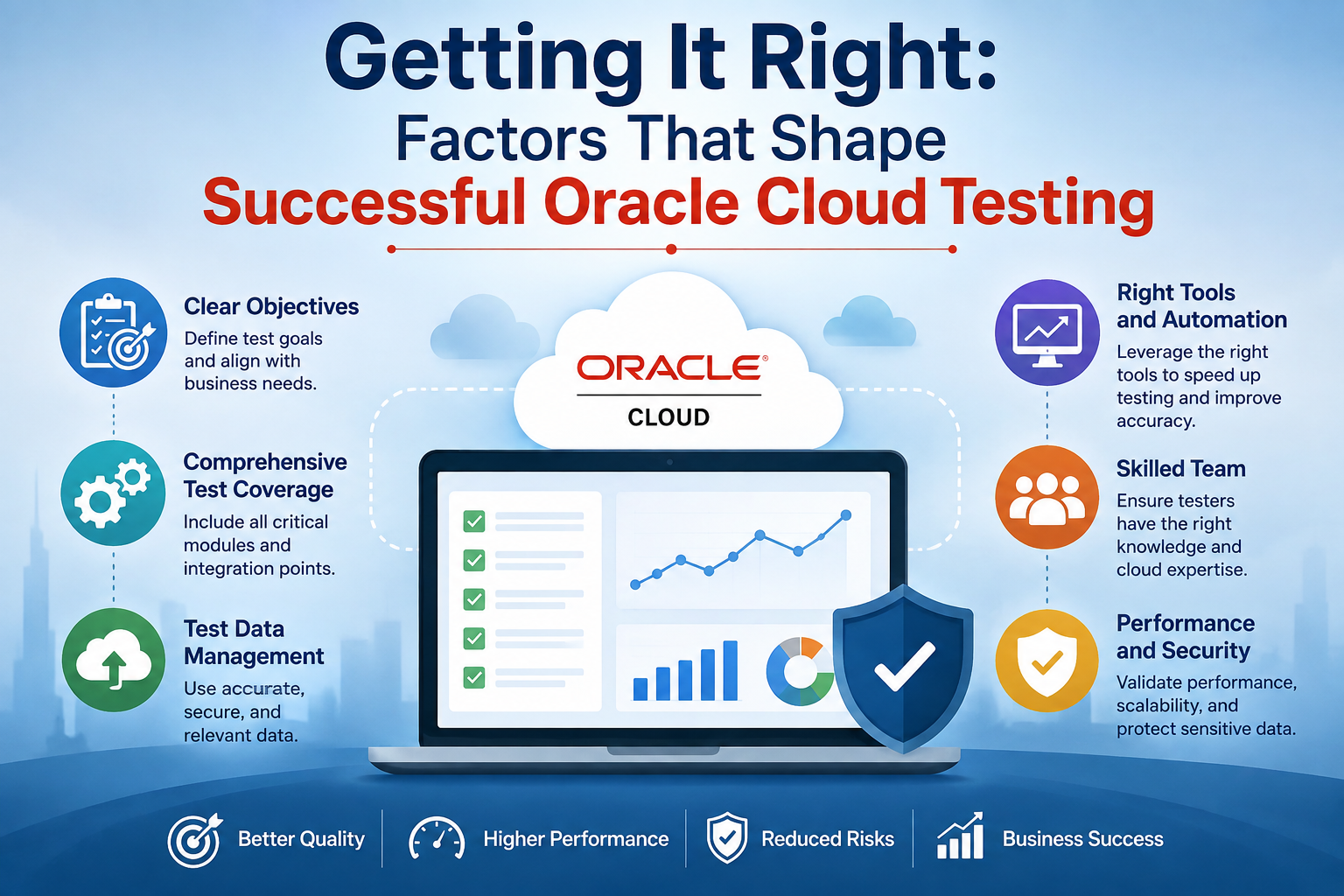
There is no one-size-fits-all method for testing Oracle Cloud apps. Every organization configures its Oracle solution differently due to unique modules, workflows, and business rules layered on top of the underlying platform. Ignoring important aspects can result in coverage gaps or unnecessary testing. There are a few factors that should be carefully considered before creating an Oracle Cloud testing plan. These variables should be carefully considered.
1. Environment Configuration Differences
Usually, Oracle Cloud comes with distinct instances for testing, development, and production, each with a somewhat different configuration. To prevent erroneous results, testing procedures must take these variances into consideration. When a process is launched to production, it may act differently from how it does in a test instance. In order to minimize surprises after going live and maintain consistent results across all environments, teams can create test cases that truly reflect real conditions by being aware of these configuration variances beforehand.
2. Quarterly Release Frequency
Oracle Cloud regularly releases new features and changes as part of an established quarterly upgrade cycle. Due to the frequent nature of releases, testing needs to be continuous and tied to each release rather than occurring only once. Companies must schedule testing cycles around these quarterly changes, setting forth enough time and resources beforehand. Ignoring this rhythm puts you at danger of slipping behind and exposing crucial business processes to compatibility problems that could have been detected by timely testing.
3. Customization and Personalization Complexity
Through personalization, unique workflows, and configurable business rules catered to their particular requirements, numerous organizations expand Oracle Cloud. While this modification allows us to do a lot more, it also makes testing that much harder. The customizations may not be covered by the baseline testing scripts and may require more manual testing efforts. Because disregarding this complexity frequently results in personalized features that are not fully checked, teams must take into account the extent to which their instance has been customized and modify testing procedures accordingly.
4. Cross Module Dependency Mapping
Oracle Cloud unifies several company operations into a single, networked system, including finance, procurement, and human resources. Modifications to one module may unintentionally impact other modules’ processes. Mapping out these dependencies before testing starts makes it easier to determine which areas could be affected by a particular upgrade. Testing efforts run the danger of overlooking crucial linkages between modules in the absence of this mapping, which could cause ripple effects to go undiscovered until they interfere with regular business operations.
5. Resource and Timeline Allocation
You must have the proper resources (people who understand the platform, and time to properly test) to properly test Oracle Cloud. Rushed testing cycles often overlook details that end up causing issues when going live, particularly during quarterly updates. Instead of considering testing as a last-minute task, organizations need to accurately examine how much time and manpower it actually demands. Appropriate distribution guarantees that testing gets the attention required to safeguard system dependability.
Conclusion
Thorough preparation, ongoing validation, and the capacity to adjust to regular platform changes are essential for successful Oracle Cloud testing. Adopting an effective lifecycle management system becomes crucial as businesses handle intricate settings, customizations, and linked business processes. With its AI-powered Cloud Application Lifecycle Management platform, Opkey streamlines Oracle Cloud testing by automating testing, change impact analysis, configuration, and training through the use of Argus AI and more than 20 specialized AI agents. Opkey eliminates up to 80% manual effort, accelerates go-live by 30%, and decreases downtime risk by 92% because organizations stop using siloed tools and consolidate onto one platform. The organization can confidently handle every Oracle Cloud release, improving overall efficiency, reliability and business value.