Traveling to the United States can be an exciting experience. The country offers large cities, national parks, beaches, mountains, museums, historic places, shopping areas, and many different cultures. However, travelers should understand the basic US travel guidelines before starting their journey. The United States has federal rules that apply across the country, but some requirements and laws can also differ between states and local areas. This means a traveler should not assume that a rule in one state is exactly the same in another state. Good preparation can help visitors avoid delays, misunderstandings, unnecessary costs, and other travel problems att international
What Are US Travel Guidelines?
US travel guidelines are the rules, requirements, and practical recommendations that help people travel to, within, and around the United States.
For an international traveler, US travel guidelines may include:
- Passport requirements
- Visa requirements
- ESTA eligibility
- Immigration procedures
- Customs rules
- Baggage requirements
- Transportation rules
- State and local laws
- Health and safety information
- Driving requirements
- Emergency procedures
For domestic travelers, US travel guidelines may focus more on identification, airline rules, transportation, accommodation, state laws, weather, and general safety.
The most important point is that travel guidelines are not always permanent. Rules may change because of new laws, security requirements, public health conditions, transportation policies, or other circumstances.
Therefore, travelers should check current information before leaving.
Why US Travel Guidelines Matter
Following US travel guidelines can make a trip smoother and more organized.
A traveler who does not check entry requirements could face problems at the airport. Someone who does not understand customs rules may accidentally bring a restricted item. A person renting a car without understanding local driving requirements may face problems on the road.
Good preparation can help prevent these situations.
US travel guidelines are especially important for international tourists because entering another country involves immigration and customs procedures.
Travelers should understand:
- What documents they need.
- Whether they need a visa.
- Whether they may qualify for ESTA.
- What they can bring into the country.
- How long they may be permitted to stay.
- What local and federal laws apply.
- How to travel safely within the United States.
US Entry Requirements
International travelers should check US entry requirements before booking their trip.
The exact requirements depend on factors such as nationality, purpose of travel, travel history, and the type of travel authorization or visa involved.
Common considerations include:
- A valid passport
- Appropriate visa or travel authorization when required
- Accurate travel information
- Supporting information where applicable
- Compliance with immigration requirements
- Customs declarations
- Airline requirements
Having a travel authorization or visa does not necessarily mean that entry is automatically guaranteed. Admission is determined through the appropriate border inspection process.
This is why travelers should understand the difference between obtaining permission to travel and actually being admitted into the United States.
Documents You May Need
Documents are one of the most important parts of US travel guidelines.
The documents required can vary depending on the traveler’s circumstances.
| Document | Main Purpose |
|---|---|
| Passport | International identification |
| Visa | Entry permission when required |
| ESTA | Travel authorization for eligible Visa Waiver Program travelers |
| Flight information | Confirms travel arrangements |
| Accommodation information | Shows planned lodging |
| Travel insurance details | Provides insurance information when purchased |
| Identification | May be useful during domestic travel |
| Document copies | Backup information |
International travelers should make sure their documents are accurate and valid before traveling.
It is also wise to keep secure copies of important documents. A digital copy can be useful, but travelers should protect their personal information and avoid storing sensitive documents in insecure locations.
Visa Requirements for the United States
A visa may be required for travelers who want to enter the United States, depending on their nationality and purpose of travel.
There are different types of US visas for different purposes. For example, tourism, business, study, employment, and other activities can have different requirements.
A tourist should not assume that a visa for one purpose allows them to perform activities associated with another visa category.
Before applying, travelers should understand:
- The purpose of their trip
- The appropriate visa category
- Application requirements
- Required documents
- Interview requirements when applicable
- Processing considerations
- Conditions attached to the visa
Travelers should use official US government information for current requirements rather than relying on unofficial agents or social media posts.
Understanding ESTA
ESTA stands for Electronic System for Travel Authorization. It is connected to the Visa Waiver Program and is available only to eligible travelers who meet the relevant requirements.
ESTA is not the same as a traditional visa.
An eligible traveler may use ESTA for qualifying short visits under the conditions of the Visa Waiver Program. However, travelers should check current eligibility rules before relying on ESTA.
A traveler should understand that authorization to travel does not mean automatic admission into the United States. Border authorities still have the authority to inspect travelers and determine whether they meet entry requirements.
Visa and ESTA Difference
| Visa | ESTA |
|---|---|
| Used by travelers who need a visa | Available to eligible Visa Waiver Program travelers |
| Can apply to different travel purposes | Designed for qualifying travel under the Visa Waiver Program |
| Application requirements vary by visa type | Has specific eligibility requirements |
| May involve an interview depending on circumstances | Electronic authorization process |
| Does not automatically guarantee admission | Does not automatically guarantee admission |
Always check the current official requirements before traveling because eligibility rules can change.
Customs and Border Inspection
Customs and border procedures are important parts of US travel guidelines.
When arriving in the United States, international travelers may go through immigration inspection and customs procedures.
Travelers should answer questions honestly and follow instructions from border officials.
The process can involve:
- Passport inspection
- Questions about the trip
- Travel purpose
- Baggage inspection
- Customs declarations
- Examination of certain goods or items
Travelers should never provide false information to immigration or customs authorities.
If you are unsure whether an item must be declared, it is better to seek clarification through the appropriate official process.
US Travel Guidelines for Baggage
Airlines have their own baggage rules, while US customs has separate requirements concerning items entering the country.
Travelers should check both.
Before flying, review:
- Carry-on size and weight
- Checked baggage limits
- Prohibited items
- Liquid restrictions
- Electronics requirements
- Food rules
- Agricultural products
- Medication requirements
- Special equipment rules
Airline baggage policies can vary, so travelers should check their specific airline before departure.
Food and Agricultural Products
Travelers should be careful when carrying food, plants, animal products, seeds, and agricultural materials.
Some items may be restricted because of concerns about agriculture, pests, diseases, or environmental protection.
Do not assume that something allowed in your home country is automatically allowed into the United States.
When in doubt, check the relevant official customs and agriculture guidance.
US Travel Guidelines for International Tourists
International tourists should prepare carefully before arriving in the United States.
A useful preparation process is:
- Check passport validity.
- Determine whether you need a visa.
- Check whether you may qualify for ESTA.
- Review current entry requirements.
- Confirm flight details.
- Confirm accommodation.
- Understand customs rules.
- Check baggage requirements.
- Prepare financial resources.
- Review transportation options.
- Learn basic local laws.
- Save emergency contacts.
Travelers should also know the permitted conditions and length of their stay.
Do not assume that you can remain in the country indefinitely simply because you entered legally. Your authorized stay and immigration status matter.
Transportation in the United States
The United States is a large country, so transportation planning is important.
Depending on your destination, you may use:
- Domestic flights
- Rental cars
- Buses
- Trains
- Taxis
- Ride-hailing services
- Public transportation
- Private vehicles
Major cities often have public transportation systems, while many smaller destinations may be easier to explore by car.
A traveler should choose transportation according to distance, budget, location, and personal comfort.
Domestic Flights
Flying is often the easiest option for long-distance travel within the United States.
Before a domestic flight:
- Check airline baggage rules.
- Confirm your departure terminal.
- Arrive with enough time.
- Keep identification accessible.
- Check flight status.
- Follow airport security instructions.
Travelers should also allow additional time when traveling during busy periods or from large airports.
Rental Cars and Driving
Road travel is popular in the United States, especially for tourists visiting several cities or national parks.
However, driving rules can differ between states.
Before renting a vehicle, check:
- Driver’s license requirements
- Minimum age rules
- Rental company requirements
- Insurance requirements
- International Driving Permit requirements where applicable
- Local traffic laws
- Parking rules
- Toll roads
- Speed limits
Do not assume that your home country’s driving rules are identical to US rules.
Always wear a seat belt and obey local traffic signs.
Driving Across Different States
One important point in US travel guidelines is that the country has federal, state, and local laws.
A rule that applies in one state may differ in another.
For example, rules involving:
- Speed limits
- Parking
- Vehicle equipment
- Insurance
- Road use
- Tolls
- Traffic violations
can vary.
If you are planning a long road trip, research the rules for each state you will enter.
Accommodation Guidelines
Choosing a safe and suitable place to stay is another important part of US travel guidelines.
Before booking a hotel, apartment, or other accommodation, consider:
- Location
- Reviews
- Security
- Transportation access
- Check-in requirements
- Cancellation policy
- Additional fees
- Parking
- Emergency exits
Do not choose accommodation only because it is the cheapest option.
A location that is far from your main activities may increase transportation costs and make your trip less convenient.
When staying at a hotel, learn where emergency exits are located. Keep valuable belongings secure and avoid sharing room information publicly.
Money and Payment in the United States
The US dollar is the primary currency used in the United States.
Credit and debit cards are widely used, but travelers should still consider carrying a reasonable amount of cash for situations where cards are not accepted.
Useful financial practices include:
- Keep a backup payment method.
- Monitor bank transactions.
- Protect your PIN.
- Avoid showing large amounts of cash.
- Use secure ATMs.
- Keep cards in a safe location.
- Keep emergency funds separate.
Understanding Tipping
Tipping is common in many US service industries.
Depending on the situation, customers may encounter tips at:
- Restaurants
- Hotels
- Taxis
- Ride services
- Salons
- Tours
- Other service businesses
Travelers should learn the normal tipping expectations for the services they use.
Sales Tax
Another important point for tourists is that the displayed price may not always represent the final amount paid.
Sales taxes can vary by location and may be added at checkout.
This means a traveler should keep some extra room in their budget.
Health and Travel Insurance
Healthcare in the United States can be expensive, so travelers should think about health needs before departure.
Travel insurance may provide protection for certain covered events, depending on the policy.
Possible areas of coverage can include:
- Medical emergencies
- Trip cancellation
- Trip interruption
- Lost baggage
- Delayed baggage
- Emergency transportation
Policies are different, so travelers should carefully read the coverage limits and exclusions.
Do not assume that every medical or travel problem is covered.
Medication
If you take regular medication, prepare appropriately before traveling.
Consider:
- Carrying enough medication
- Keeping medication in its original packaging when appropriate
- Checking applicable rules
- Carrying relevant prescriptions or documentation
- Keeping important medication accessible during travel
For international travel, check the rules that apply to bringing medication into the United States.
US Travel Safety Guidelines
Personal safety should always be part of your travel plan.
Simple habits can help:
- Stay aware of your surroundings.
- Protect your passport and identification.
- Avoid displaying expensive belongings.
- Be careful in crowded places.
- Use trusted transportation.
- Keep emergency contacts.
- Follow local instructions.
- Avoid areas that authorities advise against visiting.
- Do not share sensitive personal information with strangers.
Tourists should also be careful when accepting offers from unknown people.
If something seems suspicious, step away and seek help from a trusted source.
Weather and Natural Disaster Preparedness
The United States has many different climates and can experience different types of severe weather.
Depending on the region and season, travelers may encounter:
- Hurricanes
- Tornadoes
- Winter storms
- Heavy snow
- Wildfires
- Flooding
- Extreme heat
- Severe thunderstorms
Before traveling, check the weather forecast for your destination.
For outdoor activities, check conditions shortly before leaving because weather can change quickly.
If local authorities issue evacuation or safety instructions, follow them.
State and Local Travel Rules
One of the most important US travel guidelines is understanding that laws can vary by location.
The United States has federal laws, state laws, and local rules.
For travelers, this means it is useful to research the specific places they will visit.
Rules can differ in areas such as:
- Driving
- Parking
- Alcohol
- Smoking
- Public behavior
- Recreational activities
- Wildlife protection
- Camping
- Fire safety
Do not assume that a rule you learned in one city automatically applies everywhere.
Cultural and Social Guidelines
The United States is culturally diverse, and visitors will encounter different lifestyles and communities.
Travelers should be respectful toward local residents and other visitors.
Useful habits include:
- Respect personal space.
- Wait your turn in lines.
- Follow posted instructions.
- Ask permission before photographing people in sensitive situations.
- Respect religious and cultural locations.
- Keep public areas clean.
- Speak politely to service workers.
- Follow local rules.
American cities can be very diverse, so travelers should avoid judging an entire country based on one city or community.
Emergency Information for Travelers
Knowing what to do during an emergency is an important part of US travel guidelines.
If you experience a serious emergency:
- Move to a safe location if possible.
- Contact emergency services when necessary.
- Follow instructions from local authorities.
- Contact your accommodation if appropriate.
- Inform family or a trusted person.
- Contact your insurance provider if relevant.
- For international travelers, contact your embassy or consular service when appropriate.
Keep important information accessible before you need it.
If You Lose Your Passport
Losing a passport can be stressful, but travelers should focus on staying safe and following the correct process.
Keep secure copies of important passport information. If your passport is lost or stolen, contact the relevant authorities and your country’s embassy or consular service for guidance.
Common Mistakes Travelers Should Avoid
Travelers can avoid many problems by preparing before departure.
| Common Mistake | Better Approach |
|---|---|
| Not checking entry rules | Review current requirements |
| Assuming a visa guarantees entry | Understand border inspection |
| Ignoring customs rules | Check restricted items |
| Overstaying | Follow authorized stay conditions |
| Ignoring state laws | Research each destination |
| Driving without checking requirements | Confirm license and rental rules |
| Carrying restricted items | Check baggage and customs guidance |
| No emergency plan | Save important contacts |
| Booking only by price | Consider location and safety |
| Relying on old information | Verify current official guidance |
US Travel Guidelines for Families
Families traveling to the United States may need additional preparation.
Parents should think about:
- Child-friendly accommodation
- Safe transportation
- Food needs
- Medical facilities
- Rest breaks
- Weather
- Entertainment
- Identification for children
Keep children close in busy airports, theme parks, shopping centers, and other crowded locations.
Teach children basic safety information. Older children should know how to contact their parents or guardians and what to do if they become separated.
US Travel Guidelines for Solo Travelers
Solo travelers have more freedom, but they also need to manage their own safety.
Before traveling alone:
- Research the destination.
- Choose accommodation carefully.
- Save emergency contacts.
- Share your basic itinerary with someone trusted.
- Keep your phone charged.
- Use reliable transportation.
- Avoid unnecessary risks.
- Protect your documents.
- Keep backup payment options.
Solo travel can be enjoyable when the traveler is prepared and aware.
US Travel Guidelines for Budget Travelers
Traveling on a budget does not mean ignoring safety.
A budget traveler can reduce expenses by:
- Comparing accommodation
- Using public transportation
- Booking transportation carefully
- Eating at reasonably priced restaurants
- Choosing free attractions
- Planning daily spending
- Avoiding unnecessary purchases
However, travelers should not sacrifice basic safety to save a small amount of money.
For example, an extremely cheap accommodation may be located far from transportation or major attractions. The additional transportation costs and inconvenience may make it a poor choice.
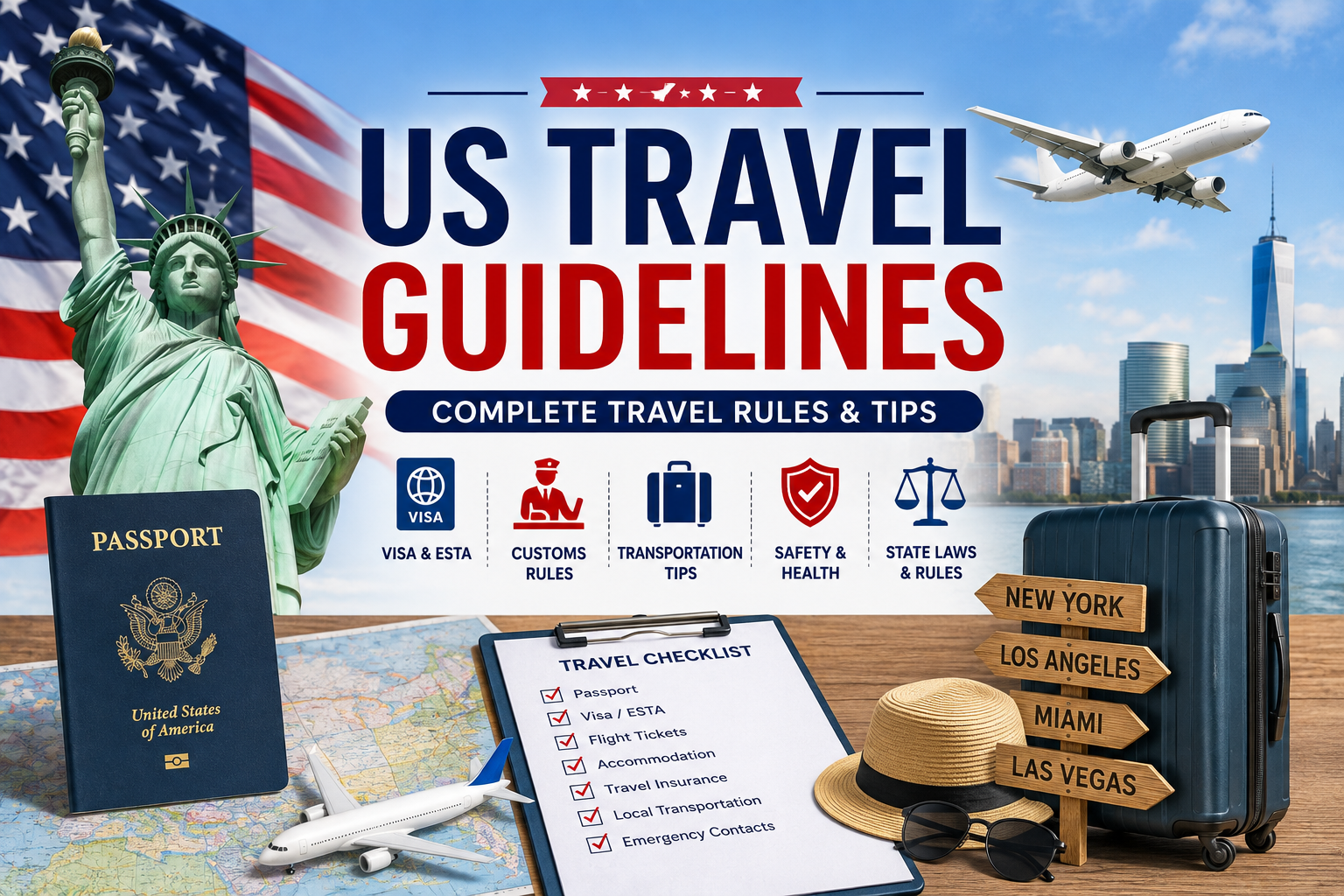
A Practical US Travel Guidelines Checklist
Before traveling, use this simple checklist:
- Check passport validity.
- Determine whether you need a US visa.
- Check ESTA eligibility if applicable.
- Review current entry requirements.
- Confirm flight details.
- Confirm accommodation.
- Review baggage rules.
- Check customs restrictions.
- Prepare necessary medication.
- Consider travel insurance.
- Check transportation options.
- Review driving requirements if renting a car.
- Check state and local rules.
- Save emergency contacts.
- Keep copies of important documents.
- Check weather conditions.
- Prepare payment methods.
- Keep an emergency fund.
- Share basic travel plans with someone trusted.
How to Prepare for US Travel Step by Step us travel guidelines
A simple preparation process can make your trip easier.
Step 1: Choose Your Destination us travel guidelines
Decide which cities, states, parks, or attractions you want to visit.
Step 2: Check Entry Requirements us travel guidelines
If traveling internationally, determine whether you need a visa, ESTA, or another form of authorization.
Step 3: Prepare Documents us travel guidelines
Check passport validity and prepare any required documents.
Step 4: Book Transportation us travel guidelines
Choose flights, trains, buses, rental cars, or other transportation according to your itinerary.
Step 5: Reserve Accommodation us travel guidelines
Choose a suitable and reliable place to stay.
Step 6: Review Customs Rules us travel guidelines
Check what items you can and cannot bring into the United States.
Step 7: Plan Your Budget us travel guidelines
Include accommodation, transportation, food, activities, taxes, tips, and emergency costs.
Step 8: Check Weather us travel guidelines
Review the expected weather for every major destination.
Step 9: Learn Local Rules us travel guidelines
If visiting several states, research important state and local differences.
Step 10: Prepare for Emergencies us travel guidelines
Save emergency contacts and keep copies of important documents.
FAQs
What are the basic US travel guidelines?
Basic US travel guidelines include checking entry requirements, preparing the correct documents, understanding customs rules, following transportation laws, respecting local regulations, and maintaining personal safety.
Do tourists need a visa to visit the United States?
Some tourists need a visa, while eligible travelers from Visa Waiver Program countries may be able to travel under the program with ESTA authorization. Requirements depend on nationality and travel circumstances, so travelers should check current official information.
What is ESTA?
ESTA is an electronic travel authorization used by eligible travelers under the Visa Waiver Program for qualifying travel to the United States.
Does ESTA guarantee entry?
No. Travel authorization does not automatically guarantee admission. Travelers remain subject to inspection and applicable entry requirements.
What documents should international travelers carry?
Travelers may need a passport, visa or ESTA when applicable, flight information, accommodation details, insurance information, and other supporting documents depending on their circumstances.
Can tourists drive in the United States?
Tourists may be able to drive depending on applicable state laws, their license, age, rental company requirements, and other conditions. Requirements can differ between states.
Do US travel rules differ between states?
Yes. Federal rules apply across the country, but states and local governments can have their own laws and regulations. Travelers should check the specific places they plan to visit.
What should travelers declare at customs?
Travelers should follow current customs requirements and declare items when required. Food, agricultural products, animal products, and other goods can have special restrictions.
Is travel insurance required?
Travel insurance requirements can depend on the situation, but insurance may provide useful protection against certain covered unexpected expenses. Travelers should review the policy before purchasing it.
What should I do if I lose my passport in the United States?
Keep yourself safe, report the loss or theft when appropriate, and contact your country’s embassy or consular service for guidance on obtaining replacement travel documentation.
Conclusion
Understanding US travel guidelines is an important part of preparing for a trip to the United States. Whether you are visiting New York, California, Florida, Texas, Washington, or another state, preparation can make the journey easier and more comfortable. International travelers should begin by checking passport, visa, ESTA, and entry requirements. They should also understand customs procedures and baggage restrictions before arriving at the border. Once inside the United States, travelers should pay attention to transportation, accommodation, money, health, weather, and local laws. The country is large, and rules can vary between states and cities, so researching each destination is useful.