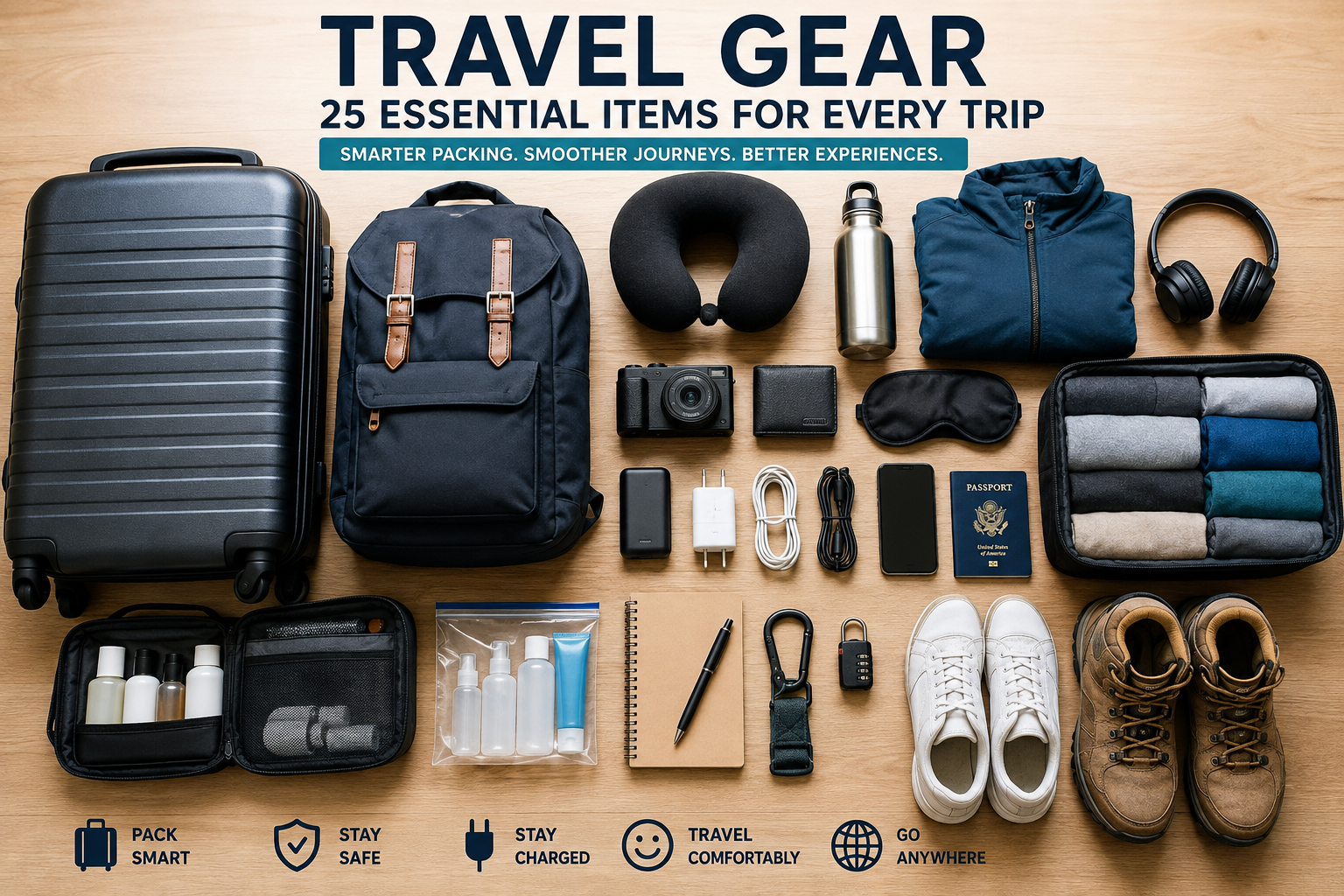
The right travel gear can make the difference between a stressful journey and a smooth, comfortable adventure. From luggage and packing organizers to power banks, travel adapters, comfortable clothing, and safety essentials, the best gear is practical, durable, lightweight, and matched to your destination and travel style Road Trips
What Is Travel Gear?
Travel gear is the collection of products and accessories used to make traveling easier, safer, more organized, and more comfortable. It can include luggage, backpacks, packing cubes, travel adapters, portable chargers, toiletry bags, travel pillows, water bottles, clothing, footwear, security accessories, electronics, and destination-specific equipment.
The important point is that travel gear is not simply a collection of things you can buy before a trip. Effective travel gear solves specific travel problems.
A traveler flying internationally may prioritize a universal power adapter and compact luggage. A backpacker may care more about weight, durability, and water resistance. A business traveler might need a laptop backpack, garment organization, and charging equipment. A family traveling with children may prioritize organization and accessibility.
The best setup therefore depends on where you are going, how long you are staying, how you are traveling, and what you will actually do when you arrive.
Why Good Travel Gear Matters
Travel can expose your belongings to conditions they rarely experience at home. Bags are moved through airports, clothing is packed tightly, electronics are repeatedly charged, and equipment may encounter rain, dust, heat, cold, or rough transportation.
Good travel gear helps reduce these problems.
It Improves Organization
A suitcase containing loose clothing, cables, toiletries, documents, and accessories quickly becomes difficult to manage.
Packing cubes, cable organizers, toiletry bags, and dedicated compartments turn one large space into several smaller systems.
This has another advantage: you can find what you need without unpacking everything.
It Can Reduce Travel Stress
Small inconveniences accumulate during travel.
A dead phone, missing charging cable, uncomfortable shoes, badly organized passport documents, or a leaking toiletry bottle can create unnecessary stress.
Well-selected gear acts as preparation against these predictable problems.
It Can Make Movement Easier
Travel frequently involves walking through airports, train stations, hotel corridors, sidewalks, stairs, and unfamiliar streets.
A heavy suitcase may feel acceptable when you first leave home but become frustrating after several hours.
This is why weight should be treated as a major specification, not an afterthought.
It Protects Valuable Items
Modern travelers often carry smartphones, laptops, cameras, tablets, headphones, passports, cards, and other important possessions.
Protective cases, organized compartments, and sensible security practices can reduce the likelihood of accidental damage or loss.
The Travel Gear System: Think in Five Layers
Instead of buying products randomly, think of your travel setup as five connected layers.
Carry
This includes your suitcase, backpack, personal item, daypack, and luggage accessories.
Organize
Packing cubes, toiletry bags, document organizers, and cable pouches belong here.
Power
Chargers, cables, power banks, adapters, and charging hubs keep your electronics functioning.
Protect
Locks, luggage covers, protective cases, waterproof pouches, and document protection help safeguard your belongings.
Comfort
Travel pillows, eye masks, appropriate clothing, footwear, water bottles, and sleep accessories improve the physical experience.
This framework helps prevent a common mistake: buying many individual products without considering how they work together.
Essential Travel Gear for Every Traveler
Some equipment is useful across a wide range of trips.
Travel Luggage
Your primary bag is arguably the most important piece of travel equipment.
A good suitcase should be:
- Easy to maneuver
- Strong enough for repeated use
- Appropriate for airline restrictions
- Comfortable to lift
- Large enough for your trip without encouraging overpacking
- Easy to organize
- Suitable for the type of transportation you use
Wheeled luggage is particularly useful for airport and urban travel, while backpacks can be better when you expect stairs, uneven surfaces, hiking, or frequent movement.
Travel Backpack
A travel backpack can function as your primary luggage or as a personal day bag.
Look for:
- Comfortable shoulder straps
- A supportive back panel
- Multiple compartments
- Laptop protection when required
- Water-resistant materials
- Easy-access pockets
- Durable zippers
- A size appropriate to your airline’s requirements
Avoid choosing a backpack simply because it has the largest capacity.
A larger bag can encourage you to carry unnecessary items.
Packing Cubes
Packing cubes are among the simplest organization tools for travelers.
Instead of throwing everything into one suitcase, you can separate:
- Shirts
- Pants
- Underwear
- Sleepwear
- Sports clothing
- Accessories
- Dirty laundry
They can also make it easier to transfer clothing between a suitcase and hotel drawers.
Toiletry Bag
A dedicated toiletry bag keeps personal-care items together and makes airport security and hotel organization easier.
Choose one with compartments for smaller bottles and accessories.
For international air travel, remember that liquid restrictions can apply depending on the airport and route, so check the current rules applicable to your departure and connecting airports.
Universal Travel Adapter
Electrical outlets differ between countries, making a travel adapter essential for many international travelers.
Before buying one, determine the plug types used at your destination and whether your devices support the local voltage.
An adapter changes the physical plug connection. It does not automatically convert electrical voltage.
This distinction is important for appliances that are not designed for the destination’s electrical system.
Travel Electronics You Should Consider
Electronics have become central to modern travel.
Power Bank
A portable power bank can be valuable during long flights, airport delays, road trips, sightseeing days, and train journeys.
When choosing one, consider:
- Capacity
- Physical size
- Weight
- Charging speed
- Number of ports
- USB-C compatibility
- Safety certifications
- Airline restrictions
Always check your airline’s current rules before flying with a power bank because aviation regulations can restrict how spare lithium batteries are carried.
Charging Cables
A charger is useless if you forget the cable required by your device.
A practical strategy is to create a dedicated travel charging kit.
Keep your frequently used cable types together instead of removing them from the kit after every trip.
Compact Multi-Port Charger
A multi-port charger can reduce the number of charging bricks you need.
This is particularly useful for travelers carrying several devices.
One charger may support a phone, headphones, tablet, camera battery charger, or other compatible equipment.
Noise-Canceling Headphones
Noise reduction can make long journeys significantly more comfortable.
They can be particularly useful on:
- Airplanes
- Trains
- Buses
- Busy hotel environments
- Airports
- Shared accommodations
However, travelers should remain aware of announcements and their surroundings, especially during boarding and while walking in unfamiliar environments.
E-Reader or Tablet
For travelers who enjoy reading, an e-reader can replace several physical books while adding relatively little luggage.
A tablet provides broader functionality but may be heavier and require more charging.
The better choice depends on whether your priority is reading or general entertainment and productivity.
Travel Gear for Different Types of Travelers
The ideal packing list changes dramatically according to the traveler.
Travel Gear for Beginners
Beginners should prioritize simplicity.
A useful basic setup can include:
- Carry-on or checked luggage
- Daypack
- Packing cubes
- Toiletry bag
- Travel adapter
- Charger
- Power bank
- Reusable water bottle
- Comfortable walking shoes
- Basic first-aid supplies
- Document organizer
- Weather-appropriate clothing
Beginners often make the mistake of purchasing too much specialized equipment before understanding their own travel habits.
Start with versatile products.
Travel Gear for Backpackers
Backpackers should focus heavily on weight and durability.
Useful categories include:
- Lightweight backpack
- Compact sleeping equipment when necessary
- Quick-drying clothing
- Packing organizers
- Portable water solution
- Headlamp
- Compact first-aid kit
- Waterproof storage
- Multipurpose accessories
Every item should justify its place in the backpack.
A product that performs one tiny function but weighs significantly more than a simpler alternative may not be worth carrying.
Travel Gear for Business Travelers
Business travelers have different priorities.
They may need:
- Professional laptop backpack
- Laptop sleeve
- Cable organizer
- Multi-port charger
- Power bank
- Compact toiletry kit
- Wrinkle-resistant clothing
- Document organizer
- Noise-canceling headphones
- Comfortable but professional footwear
The goal is usually to transition quickly from transportation mode to work mode.
Travel Gear for Families
Family travel requires organization more than minimalism.
Useful equipment can include:
- Larger luggage
- Individual packing cubes
- Snack containers
- Reusable water bottles
- Entertainment devices
- Child-friendly headphones
- Extra clothing
- Wet/dry bags
- Compact first-aid supplies
- Portable organization pouches
Parents should also consider dividing essential items among bags rather than placing everything belonging to one person in one suitcase.
Travel Gear for Older Travelers
Comfort, accessibility, and simplicity become increasingly important.
Consider:
- Lightweight luggage
- Easy-grip handles
- Comfortable footwear
- Organized medication storage where appropriate
- Travel documents kept in an accessible location
- Lightweight daypacks
- Supportive travel pillows
- Clothing suitable for the destination
The best gear reduces physical effort rather than adding complexity.
Travel Gear for Different Destinations
Destination should influence what you pack.
Beach Travel Gear
Beach trips may benefit from:
- Quick-drying towels
- Waterproof pouches
- Sand-resistant bags
- Sun protection
- Reusable water bottles
- Lightweight clothing
- Comfortable sandals
- Dry bags where appropriate
Avoid bringing expensive electronics near water unless they are properly protected.
Cold-Weather Travel Gear
Cold destinations require a different strategy.
Instead of relying on one extremely bulky garment, layering can provide greater flexibility.
A practical system can include:
- Base layer
- Insulating layer
- Weather-resistant outer layer
- Warm socks
- Gloves
- Hat
- Appropriate footwear
The exact combination depends on temperature, wind, precipitation, activity, and duration outdoors.
Hiking Travel Gear
Hiking requires more specialized preparation.
Depending on the route, useful equipment may include:
- Hiking backpack
- Appropriate footwear
- Navigation tools
- Headlamp
- Water system
- Weather protection
- First-aid kit
- Emergency communication equipment
- Sun protection
- Trekking poles when appropriate
The more remote the route, the more important it becomes to prepare for emergencies.
Urban Travel Gear
City travelers usually benefit from lightweight equipment.
A compact daypack, comfortable shoes, portable charger, water bottle, weather layer, and secure organization pouch may be enough for many sightseeing days.
The goal is mobility.
You do not want to carry your entire hotel room around a city.
Travel Gear for Airport and Airplane Travel
Air travel introduces unique requirements.
Choose Your Personal Item Carefully
A personal item should be easy to access under the seat and contain the things you may need during the flight.
Consider placing these items together:
- Passport
- Wallet
- Phone
- Charging cable
- Headphones
- Medication you need during the journey
- Travel documents
- Empty reusable bottle for filling after security where permitted
Build a Flight Comfort Kit
A compact flight kit may contain:
- Eye mask
- Earplugs
- Headphones
- Travel pillow
- Lip balm
- Moisturizer
- Charging cable
- Small hygiene items
The purpose is not to carry everything imaginable.
It is to keep a small collection of high-value comfort items accessible.
How to Choose Travel Gear Without Wasting Money
Buying expensive equipment does not automatically produce a better travel setup.
Evaluate Function Before Branding
Ask:
What problem does this product solve?
If you cannot answer the question clearly, you may not need it.
Consider Cost Per Trip
A $100 product used for 100 trips may provide better value than a $30 product that needs replacement after a few journeys.
Think beyond purchase price.
Consider:
- Durability
- Warranty
- Repairability
- Materials
- Maintenance
- Replacement cost
- Frequency of use
Prioritize Versatility
A versatile item can replace several specialized products.
For example, a lightweight layer may work for flights, restaurants, sightseeing, and evening walks.
Versatility is particularly valuable for minimalist travelers.
How to Build a Lightweight Travel Gear Setup
The most useful question is not “What should I pack?”
It is:
What can I remove without reducing safety, comfort, or functionality?
Use the One-Week Test
Imagine you are traveling for seven days.
Identify what you genuinely need.
Then ask whether each item can be washed, reused, combined, or replaced with something lighter.
Follow the Three-Question Rule
For every item, ask:
- Will I use it?
- Is there a lighter alternative?
- Can another item perform the same function?
If the answer to all three questions points toward removal, leave it at home.
Keep Heavy Items Close to Your Body
When carrying a backpack, heavier items are generally more comfortable when positioned close to your back rather than hanging far away from your center of gravity.
Organization is therefore also an ergonomics issue.
Common Travel Gear Mistakes
Even experienced travelers can make poor equipment decisions.
Buying Too Much Gear
Travel influencers and product marketing can make specialized equipment look essential.
Often it is not.
Buying ten accessories does not necessarily make travel easier.
Ignoring Weight
A suitcase may look excellent when empty.
The real test is how it feels when fully loaded.
Choosing Style Over Function
A beautiful bag with uncomfortable straps is still uncomfortable.
A fashionable shoe that causes pain after two hours of walking is not a good travel shoe.
Packing for Imaginary Situations
People frequently pack for situations that are unlikely to happen.
The result is excessive luggage.
Prepare for realistic needs, not every hypothetical scenario.
Forgetting Destination Conditions
A product that works perfectly in one environment may be inappropriate elsewhere.
Climate, terrain, transportation, local infrastructure, and cultural expectations all matter.
How to Organize Your Travel Gear Before Leaving
Preparation can be divided into several stages.
One Week Before Travel
Check:
- Passport validity
- Visa requirements
- Weather forecast
- Electrical requirements
- Airline baggage rules
- Destination transportation
- Necessary equipment
Two Days Before Travel
Pack your main luggage and identify anything still missing.
This gives you time to replace or purchase essentials without last-minute stress.
The Night Before
Keep your travel-day essentials accessible.
Do not bury your passport, wallet, phone charger, or important documents under clothing.
Before Leaving Home
Perform a final check of:
- Passport
- Wallet
- Phone
- Chargers
- Travel documents
- Medication or essential personal items
- Keys
- Luggage
- Accommodation information
Travel Gear and Security
Security should be practical rather than paranoid.
Use Secure Storage
Important documents and valuable electronics should be stored thoughtfully.
Avoid placing everything valuable in one location.
Protect Digital Devices
Use strong device passwords and keep important data backed up.
If a device is lost, your information may be more valuable than the hardware itself.
Be Careful With Public Charging
Travelers should consider the security implications of connecting personal devices to unfamiliar USB ports.
Using your own charger and cable connected to a conventional power outlet can provide greater control over what your device connects to.
Travel Gear Comparison: 10 Popular Brands
The following brands are well known across different parts of the travel-gear market. They should not be treated as identical competitors because some specialize more strongly in luggage, backpacks, outdoor equipment, or travel accessories.
| Brand | Known For | Best For | Key Strength | Potential Limitation |
|---|---|---|---|---|
| Samsonite | Luggage | Frequent travelers | Broad luggage range | Some premium models can be expensive |
| Osprey | Backpacks | Backpackers and outdoor travelers | Carry comfort and outdoor design | Less focused on traditional suitcases |
| Travelpro | Luggage | Frequent flyers | Travel-oriented luggage design | Styling is more functional than fashion-focused |
| Thule | Travel and outdoor gear | Active travelers | Durable, practical designs | Premium pricing on some products |
| Eagle Creek | Travel organization | Organized travelers | Travel-focused accessories | Product availability varies by market |
| Patagonia | Outdoor gear | Adventure travelers | Outdoor-oriented products | Often premium priced |
| The North Face | Outdoor and travel gear | Adventure and everyday travel | Versatile outdoor equipment | Some products prioritize outdoor use over formal travel |
| Cotopaxi | Travel and outdoor gear | Colorful adventure travel | Distinctive designs and travel packs | Style may not suit minimalist preferences |
| Bellroy | Bags and accessories | Urban and business travel | Organization and compact design | Premium price positioning |
| Sea to Summit | Outdoor travel equipment | Backpacking and camping | Lightweight outdoor equipment | More specialized for outdoor travel |
The best brand is not necessarily the one with the strongest reputation. Choose the product that fits your specific travel requirements.
How to Compare Travel Gear Properly
When comparing two products, avoid focusing on a single specification.
Weight
Lower weight can make a major difference during long journeys.
Capacity
More capacity is not automatically better.
Durability
Look at construction quality, materials, zippers, wheels, seams, and handles.
Comfort
For backpacks and wearable equipment, comfort may matter more than appearance.
Weather Resistance
Water resistance can be valuable, but it is important to distinguish water-resistant construction from genuinely waterproof equipment.
Repairability
A repairable product can remain useful much longer than a disposable one.
Warranty
A strong warranty can increase the long-term value of a product.
Sustainable Travel Gear
Sustainability is becoming an increasingly important consideration in travel equipment.
The most sustainable product is often not the newest product.
A durable bag used for many years can be preferable to repeatedly replacing cheaper products.
Buy Less, Use Longer
Avoid purchasing equipment simply because a new version has been released.
Look for Durable Construction
Strong stitching, reliable zippers, replaceable components, and repair options can extend product life.
Consider Secondhand Gear
For some travelers, secondhand luggage and outdoor equipment can provide excellent value.
Inspect used products carefully for damage, hygiene issues, worn structural components, and compromised safety features.
The Psychology of Travel Gear
One overlooked aspect of travel equipment is psychological.
People often purchase gear because buying something creates a feeling of preparation.
But preparation and possession are not the same thing.
Owning a large collection of travel accessories can create an illusion of readiness while leaving major practical issues unresolved.
A better approach is to build a system around actual travel problems.
For example, if your biggest issue is losing cables, an expensive suitcase may not help. A simple cable organizer might solve the real problem.
This leads to an important principle:
Buy solutions, not souvenirs from the travel-gear aisle.
The Best Travel Gear Is Often Boring
Great travel equipment does not always look exciting.
A simple packing cube may dramatically improve organization.
A comfortable pair of shoes may prevent an exhausting day.
A reliable charger may solve a critical problem.
A lightweight bag may make an entire journey easier.
The best equipment often disappears into the background because it simply works.
That is a sign of good design.
Future Trends in Travel Gear
Travel equipment continues to evolve as technology, sustainability, and traveler expectations change.
Smarter Luggage
Connected luggage concepts may continue incorporating tracking, digital identification, and improved organization.
However, travelers should evaluate whether smart features provide meaningful benefits or simply introduce additional electronics that can fail or require charging.
More Lightweight Materials
Manufacturers continue experimenting with materials that balance low weight, strength, weather resistance, and durability.
The challenge is finding the right balance rather than maximizing one specification.
Modular Travel Systems
Future products may increasingly work together as modular systems.
A backpack could connect with smaller daypacks, organizers, tech pouches, or luggage systems.
This could allow travelers to configure equipment according to the trip.
Greater Focus on Repairability
As consumers become more conscious of waste, repairability may become a more important purchasing factor.
Products designed around replaceable components can potentially remain useful longer.
Multifunctional Travel Accessories
Travelers increasingly value products that serve multiple purposes.
A compact accessory that works across several situations can reduce both luggage volume and spending.
Pairing Travel Gear With Traveler Demographics
Different people have different problems, so travel gear recommendations should be more specific than simply saying “best travel gear.”
Travel Gear for Students
Students may prioritize affordability, lightweight backpacks, charging equipment, and organization.
Travel Gear for Digital Nomads
Digital nomads often need:
- Laptop protection
- Portable charging
- Reliable connectivity accessories
- Comfortable work bags
- Cable organization
- Compact clothing systems
Travel Gear for Couples
Couples can share certain equipment while keeping personal essentials separate.
Shared chargers, organizers, and larger toiletry systems may reduce duplication.
Travel Gear for Solo Travelers
Solo travelers benefit from equipment that improves organization, security, and mobility.
A lightweight setup can make navigating unfamiliar locations easier.
Travel Gear for Frequent Flyers
Frequent flyers should focus on durability, fast access, comfort, and efficient packing.
Products that save several minutes every trip can provide substantial value over time.
Travel Gear for Minimalists
Minimalists should emphasize multifunctionality, low weight, durability, and simplicity.
The goal is not to own the fewest products.
It is to carry the fewest products that adequately solve your needs.
Problem-Solving Travel Gear Combinations
Instead of buying products individually, create combinations around specific problems.
Problem: Dead Phone
Use a charging cable, compact charger, power bank, and destination-appropriate adapter.
Problem: Disorganized Suitcase
Use packing cubes, a laundry pouch, and a small accessories organizer.
Problem: Poor Sleep
Consider an eye mask, earplugs, travel pillow, and comfortable clothing.
Problem: Rain
Use weather-resistant outerwear, protective bags, and appropriate footwear.
Problem: Long Walking Days
Prioritize comfortable footwear, lightweight clothing, water, and a comfortable daypack.
Problem: Business Meetings After Travel
Combine a professional laptop bag, organized tech pouch, wrinkle-resistant clothing, and compact grooming kit.
A Practical Travel Gear Checklist
Before a trip, review your equipment according to these categories.
Documents
- Passport
- Visa or entry documentation where applicable
- Travel confirmations
- Identification
- Copies or secure digital backups of important documents
Luggage
- Main suitcase or backpack
- Personal item
- Daypack if needed
- Packing cubes
- Luggage tags
Electronics
- Phone
- Chargers
- Cables
- Power bank
- Travel adapter
- Headphones
- Camera equipment if required
Clothing
- Destination-appropriate clothing
- Comfortable walking shoes
- Sleepwear
- Weather layer
- Underwear and socks
- Appropriate accessories
Personal Care
- Toiletries
- Hygiene products
- Personal medications or essential health items
- Small towel where useful
Comfort
- Travel pillow
- Eye mask
- Earplugs
- Reusable water bottle
- Snacks where appropriate
Safety
- Small first-aid supplies
- Secure storage for valuables
- Device security
- Emergency contact information
How Much Travel Gear Do You Really Need?
There is no universal number.
A weekend city traveler might need only a small backpack and a compact set of accessories.
A family spending several weeks abroad may need significantly more.
The right amount is determined by function rather than quantity.
A useful rule is:
If an item does not improve safety, comfort, organization, mobility, or a necessary activity, question whether it deserves space in your luggage.
This simple test can dramatically reduce overpacking.
FAQs
What is the most important travel gear?
There is no single item that is universally most important. Luggage, comfortable footwear, charging equipment, travel documents, and destination-appropriate clothing are among the most important categories because they address basic transportation, communication, comfort, and practical needs.
What travel gear should every beginner buy?
A beginner can start with reliable luggage or a backpack, packing cubes, a toiletry bag, charging equipment, a suitable travel adapter for international travel, comfortable footwear, a reusable water bottle, and a small organization pouch.
Is expensive travel gear worth it?
Sometimes. Price alone does not determine quality. Expensive gear can be worthwhile when it provides superior durability, comfort, repairability, warranty coverage, or functionality that you will use repeatedly.
Are packing cubes really useful?
They can be. Packing cubes do not necessarily create additional suitcase space, but they can improve organization and make clothing easier to separate and access.
What is the best travel bag?
The best travel bag depends on your trip. A wheeled suitcase may be ideal for airports and hotels, while a backpack can be better for stairs, public transportation, uneven streets, or outdoor travel.
What should I pack in my travel backpack?
Keep essential documents, electronics, chargers, valuables, medication or essential personal items, and anything needed during transportation accessible. The exact contents should reflect your destination and travel duration.
Do I need a universal travel adapter?
If you are traveling internationally, you may need an adapter depending on the plug system at your destination and the plugs used by your devices.
Is a power bank necessary for travel?
It is not mandatory for every traveler, but it can be extremely useful during long transportation periods, sightseeing, delays, or situations where convenient electrical outlets are unavailable.
How can I reduce my luggage weight?
Start by removing duplicate items, choosing lightweight clothing, limiting footwear, using versatile products, reducing unnecessary toiletries, and evaluating every item before packing.
What travel gear is best for long flights?
Comfort-oriented equipment can include noise-reducing headphones, an eye mask, earplugs, a suitable travel pillow, charging equipment, comfortable clothing, and easy-access personal items.
What travel gear is best for backpacking?
Backpackers generally benefit from lightweight, durable equipment that performs multiple functions. The exact equipment depends on climate, terrain, accommodation, remoteness, and planned activities.
What travel gear is best for business travel?
Business travelers often benefit from a professional laptop backpack, organized charging system, compact toiletries, appropriate clothing, comfortable footwear, and equipment that supports productivity.
How do I choose sustainable travel gear?
Focus on durability, repairability, long-term use, responsible materials where relevant, and whether you genuinely need the product. Buying fewer products and using them longer can be more meaningful than constantly replacing equipment.
Conclusion
The best travel gear is not the gear with the longest feature list. It is the equipment that solves real problems without adding unnecessary weight, complexity, or expense. A good travel setup should make movement easier, organization simpler, communication more reliable, and your overall journey more comfortable. Before buying anything, consider your destination, transportation, climate, activities, trip length, luggage restrictions, and personal habits. Then build your equipment around those requirements.