
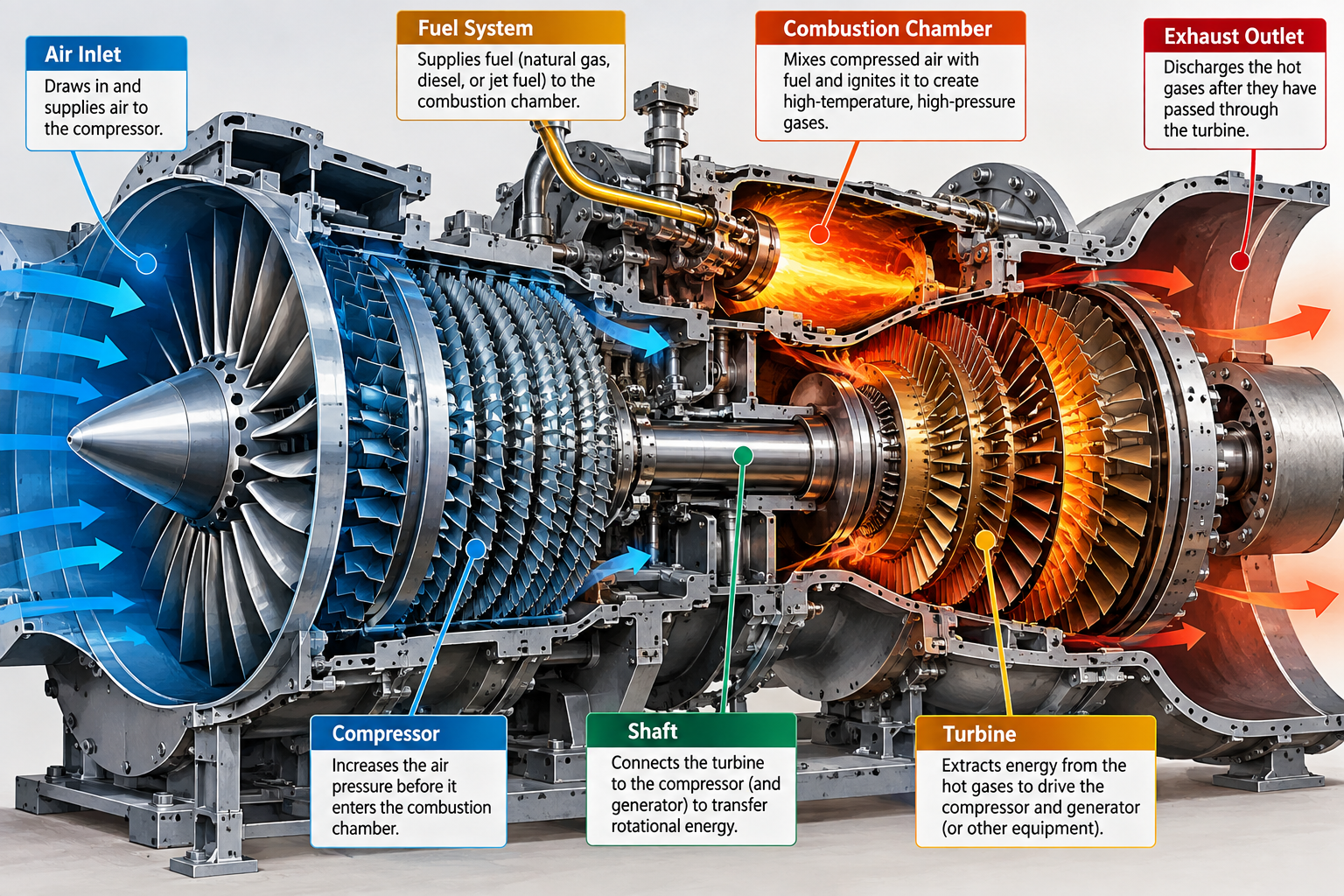
Turbines are the indispensable powerhouses of modern infrastructure, driving everything from regional electrical grids and industrial processing plants to commercial aviation. At their core, these complex machines operate on a fundamental principle: transforming the kinetic and thermal energy of moving fluids—such as steam, high-pressure gas, or wind—into mechanical rotational energy. Because turbines often operate under severe rotational speeds, extreme pressure, and blazing temperatures, their performance depends entirely on the seamless interaction of precisely engineered internal components. Understanding these vital parts provides critical insight into how modern power systems remain efficient, durable, and safe.
The Dynamic Core: Rotors and Blades
At the center of energy conversion sits the rotor assembly and its attached turbine blades. Together, they form the dynamic engine responsible for extracting force from moving fluids and translating it into continuous torque.
Turbine Blades
Engineered to endure massive centrifugal forces, turbine blades are meticulously contoured airfoils designed to maximize kinetic energy capture. In high-temperature gas turbines, these blades are exposed to combustion gases exceeding 1,000°C. To survive such harsh thermal environments without warping or losing structural integrity, manufacturers construct them using advanced nickel-based superalloys like Inconel. In aerospace applications where weight efficiency is paramount, lightweight titanium alloys such as Ti-6Al-4V are widely deployed due to their exceptional strength-to-weight ratio and fatigue resistance.
The Rotor Assembly
The rotor is the heavy central shaft upon which the blade arrays are mounted. As fluid forces the blades to rotate, the rotor transfers this immense rotational torque down the powertrain to driven equipment, such as an electrical generator. Precise dynamic balancing and laser alignment are crucial during installation to prevent excessive vibration, which can cause catastrophic bearing damage or mechanical fatigue. Over extended operational lifespans, component wear or surface imperfections can develop on critical shaft interfaces; in such cases, precision field machining allows engineers to repair and re-align massive rotor components directly on-site without necessitating a costly, full-plant teardown.
Structural Framework: Casings and Shafts
While the blades and rotor manage dynamic energy transfer, stationary structural elements provide containment and force transmission
Advanced Materials and Surface Protection
Modern industrial efficiency demands higher operating temperatures, which in turn require cutting-edge material science to protect component surfaces from premature degradation.
Composite Innovations
Traditional metals are increasingly supplemented or replaced by Ceramic Matrix Composites (CMCs). CMCs can withstand ultra-high temperatures without requiring extensive internal cooling air, allowing turbines to burn fuel more efficiently and cleanly. Non-rotating components or fan blades frequently integrate Carbon Fiber Reinforced Polymers (CFRP) to shave off structural weight.
Protective Coatings and Laser Restoration
To shield metal alloys against oxidation and hot corrosion, internal components are sprayed with Thermal Barrier Coatings (TBCs), often made from ceramics like yttria-stabilized zirconia. When surfaces experience localized erosion or wear from high-velocity particles, facilities frequently turn to advanced laser cladding techniques to deposit fresh, wear-resistant material, restoring original tolerances and extending component service life.
Essential Auxiliary Systems: Lubrication and Cooling
No turbine can operate reliably in isolation; supporting subsystems are essential to combat friction and heat build-up.
Conclusion
From high-strength nickel superalloys and ceramic coatings to precision rotor assemblies and smart cooling channels, every turbine component plays an irreplaceable role in power generation. Through advanced material engineering, predictive monitoring, and targeted maintenance techniques, modern turbines continue to deliver exceptional reliability and efficiency across critical global industries.