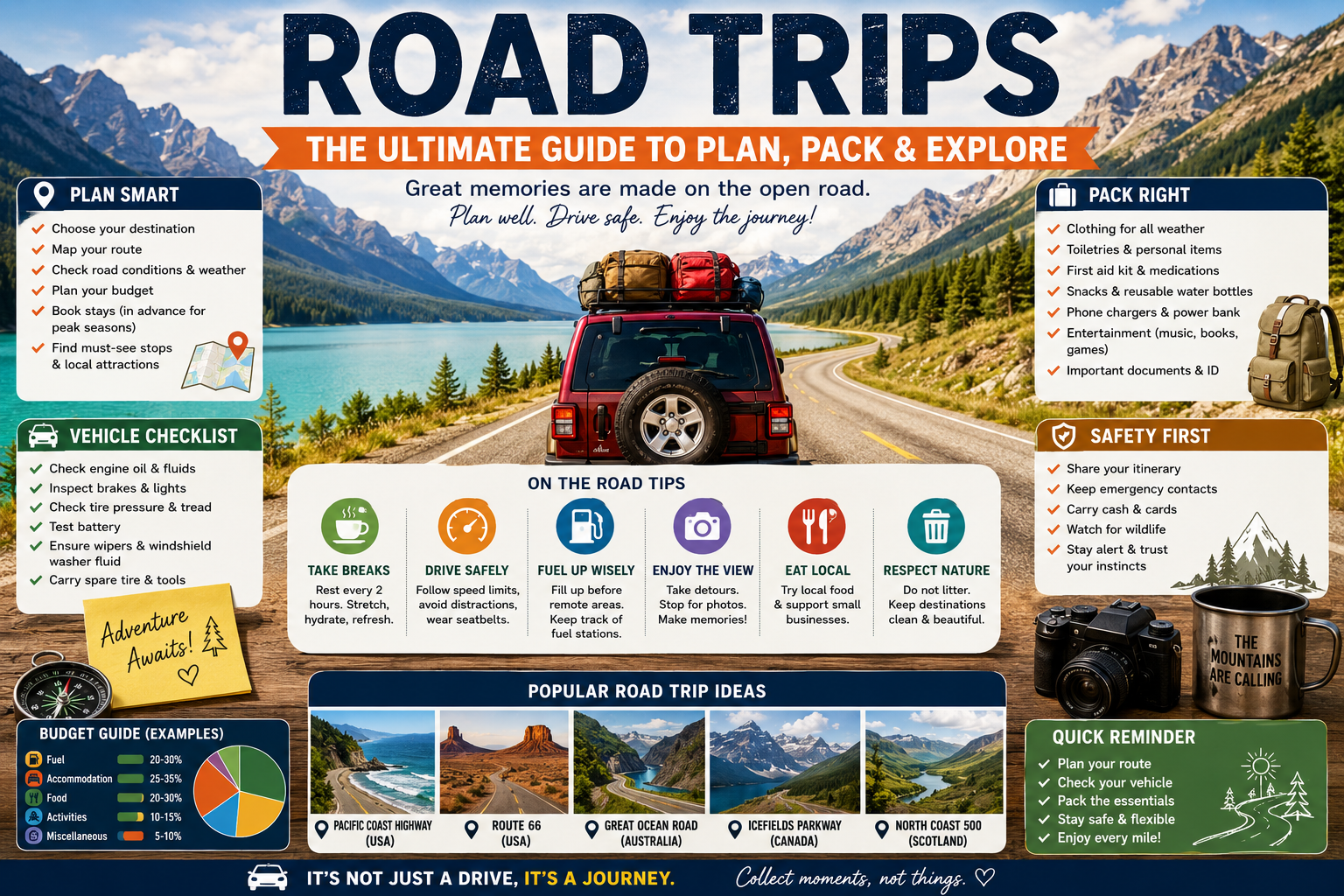
Road trips are journeys where the route itself becomes part of the experience, combining transportation, exploration, flexibility, and adventure in a single travel experience. The best road trips balance careful preparation with enough freedom to make spontaneous stops, while giving equal attention to vehicle safety, route planning, accommodation, food, fuel, weather, communication, and emergency preparation Historical Discoveries
What Is a Road Trip?
A road trip is a journey in which traveling by road is a central part of the experience rather than simply a method of reaching a destination.
Unlike conventional vacations, where transportation can feel like a necessary transition between locations, road trips make the journey itself part of the adventure.
You might leave a major city in the morning, stop at a small town for breakfast, discover a viewpoint that was never on the original itinerary, continue through changing landscapes, spend the evening near a national park, and wake up somewhere completely different the following morning.
That flexibility is the defining characteristic of road travel.
Road Trips Versus Traditional Vacations
A conventional vacation often follows a structure such as:
Home → Airport → Destination → Hotel → Attractions → Airport → Home
A road trip can look more like:
Home → Scenic Route → Small Town → Nature Area → Local Restaurant → Viewpoint → Overnight Stop → Unexpected Discovery → Destination
The second journey contains more variables.
That creates both its greatest advantage and its greatest challenge.
You have more freedom, but you also have more responsibility.
Why People Love Road Trips
People choose road trips for many reasons.
Some want freedom from fixed transportation schedules.
Others enjoy driving.
Families may find road travel easier because they can carry more equipment and control their schedule.
Adventure travelers appreciate access to remote destinations.
Photographers enjoy changing landscapes.
Couples may value the privacy and shared experience.
Budget travelers may use road trips to combine transportation and accommodation strategies.
The psychological appeal is also important.
A road trip creates a sense of progression. You physically move through changing environments rather than simply appearing at a destination after a few hours in an aircraft.
The Psychology of a Great Road Trip
Road trips are not simply logistical exercises.
They are experiences shaped by anticipation, uncertainty, novelty, companionship, and discovery.
The Value of Controlled Uncertainty
One reason road trips feel adventurous is that not everything is known in advance.
You may know your destination but not exactly where you will stop for lunch.
You may know the main route but discover a scenic detour.
You may have a hotel reservation but spend the afternoon exploring an unexpected attraction.
This creates what could be called controlled uncertainty.
You prepare enough to remain safe while leaving enough space for discovery.
Why Overplanning Can Hurt
A schedule such as:
8:00 breakfast
8:37 departure
9:24 viewpoint
10:15 fuel
11:02 attraction
12:11 lunch
may look organized but can become exhausting.
Traffic, construction, weather, parking, queues, fatigue, and spontaneous discoveries can quickly destroy such a timetable.
A better road-trip plan uses anchors rather than minute-by-minute instructions.
For example:
- Leave in the morning.
- Stop at one major attraction.
- Have lunch somewhere along the route.
- Reach the overnight destination before dark.
- Keep the evening flexible.
This preserves structure without eliminating freedom.
How to Plan a Road Trip From Scratch
The easiest way to plan road trips is to work from the largest decisions toward the smallest.
Start with the overall journey.
Step 1: Define the Purpose
Ask why you are taking the trip.
Are you looking for:
- Nature?
- Beaches?
- History?
- Food?
- Adventure?
- Photography?
- Family time?
- Romantic travel?
- Outdoor activities?
- Cultural experiences?
- A relaxing drive?
Your answer affects every later decision.
A nature-focused trip should prioritize landscapes and parks.
A food-focused journey might prioritize towns and local restaurants.
A family trip needs more frequent breaks.
An adventure trip may require specialized equipment.
Step 2: Choose the General Route
Do not begin with hundreds of individual attractions.
First determine the broad geographic path.
Think in terms of:
Starting point → Major region → Key stops → Overnight areas → Final destination
Once the backbone is established, add smaller stops.
Step 3: Estimate Driving Time
Navigation apps often provide a theoretical driving time.
Your real travel time may be significantly longer.
Add time for:
- Fuel
- Meals
- Restrooms
- Traffic
- Parking
- Photos
- Construction
- Weather
- Roadside attractions
- Unexpected delays
A route that appears to require six hours of driving may realistically become an eight- or nine-hour travel day.
Step 4: Choose Overnight Stops
Avoid selecting overnight locations solely because they are halfway between two points.
Consider:
- Safety
- Accommodation availability
- Parking
- Food
- Fuel
- Nearby attractions
- Distance from the next destination
Sometimes driving an extra hour creates a much better overnight stop.
How Many Hours Should You Drive Each Day?
There is no universal maximum that applies to every traveler because road conditions, driver experience, traffic, vehicle type, weather, and local regulations differ.
The important principle is driver fatigue management.
Prioritize Alertness Over Distance
A road trip should never become a competition to see how many kilometers you can cover.
If the driver becomes sleepy, the itinerary becomes irrelevant.
Stop.
Rest.
Change drivers if another qualified driver is available.
Never rely on caffeine as a substitute for sleep.
Build Breaks Into the Route
Regular breaks improve comfort and can help maintain attention.
A practical rhythm may involve:
- Driving
- Short rest
- Driving
- Meal break
- Driving
- Longer rest
The exact timing should depend on conditions and individual needs.
Avoid the Late-Night Push
Many road-trip problems happen when travelers try to reach a destination despite increasing fatigue.
Arriving an hour earlier is not worth compromising safety.
Choosing the Right Vehicle for a Road Trip
The perfect road-trip vehicle depends on the journey.
A compact car may be ideal for a couple traveling between cities.
A larger vehicle may make sense for a family.
An SUV may be useful for certain outdoor destinations.
A campervan can combine transportation and accommodation.
Important Vehicle Characteristics
Consider:
- Reliability
- Fuel economy
- Passenger capacity
- Cargo space
- Comfort
- Tire condition
- Ground clearance
- Safety features
- Climate control
- Spare tire or repair equipment
- Availability of service along the route
Fuel Efficiency Matters
Fuel costs can become one of the largest road-trip expenses.
A vehicle with better fuel economy may reduce the total cost significantly over long distances.
Calculate estimated fuel consumption before departure rather than discovering the expense afterward.
Vehicle Preparation Before a Road Trip
One of the most important road-trip rules is simple:
Do not begin a long journey without checking the vehicle.
Tires
Check:
- Tire pressure
- Tread condition
- Visible damage
- Spare tire
- Tire repair equipment
Incorrect tire pressure can affect handling, fuel economy, and tire wear.
Engine Fluids
Depending on the vehicle, check:
- Engine oil
- Coolant
- Brake fluid
- Windshield washer fluid
Follow the manufacturer’s recommendations.
Battery
A weak battery can turn a simple stop into a major delay.
If the battery is old or showing warning signs, have it inspected before a long trip.
Brakes
Pay attention to:
- Unusual noises
- Vibration
- Reduced braking performance
- Warning lights
Any significant concern should be professionally inspected before departure.
Lights and Wipers
Check headlights, brake lights, indicators, and windshield wipers.
These simple components become especially important during nighttime driving or bad weather.
The Ultimate Road Trip Packing List
Packing for road trips is easier than packing for air travel because luggage restrictions are usually less restrictive.
However, more space often encourages people to pack too much.
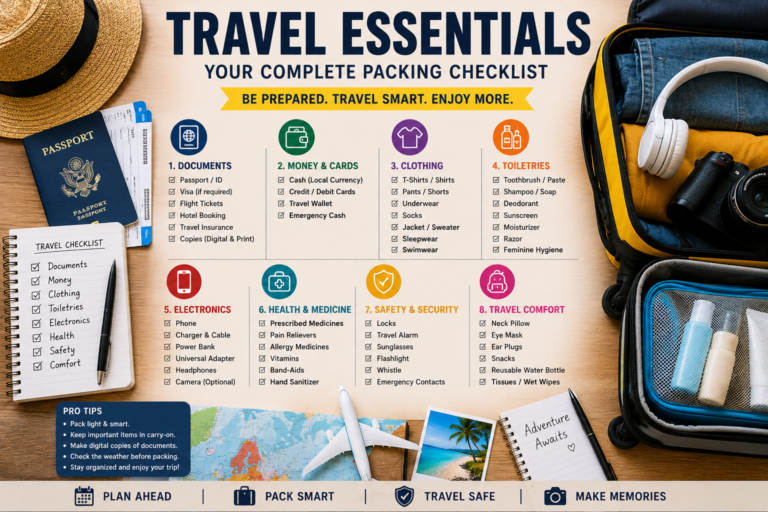
Essential Documents
Carry:
- Driver’s license
- Vehicle registration
- Insurance documentation
- Identification
- Travel documents
- Accommodation confirmations
- Emergency contacts
For international road trips, research driving permits, border requirements, insurance requirements, and vehicle documentation well before departure.
Clothing
Pack according to:
- Weather
- Trip length
- Activities
- Laundry availability
Useful clothing can include:
- Comfortable shirts
- Trousers
- Underwear
- Socks
- Sleepwear
- Jacket
- Rain layer
- Activity-specific clothing
- Comfortable footwear
Personal Items
Consider:
- Toiletries
- Medication
- Sunglasses
- Sunscreen
- Hand sanitizer
- Tissues
- Personal hygiene products
Road Comfort
Useful items may include:
- Travel pillow
- Blanket
- Reusable water bottle
- Snacks
- Phone charger
- Power bank
- Headphones
- Small trash bags
Road Trip Emergency Kit
A road-trip emergency kit can be valuable, particularly on long or remote routes.
Depending on the destination, consider carrying:
- First-aid supplies
- Flashlight or headlamp
- Reflective equipment
- Basic tools
- Tire repair equipment
- Jumper cables or appropriate battery equipment
- Portable charger
- Water
- Emergency food
- Blankets
- Gloves
- Warning equipment
The contents should reflect the environment.
A winter mountain journey requires different emergency supplies from a short summer drive between major cities.
Road Trip Food and Drinks
Food is one of the easiest ways to save time and money during a road trip.
But food planning should not turn the car into a moving kitchen.
Smart Road Trip Snacks
Good options are generally:
- Easy to store
- Low mess
- Convenient to eat
- Resistant to heat when appropriate
Examples include:
- Nuts
- Crackers
- Dried fruit
- Fresh fruit
- Granola
- Sandwiches
- Energy bars
Hydration
Carry enough water for the journey while considering access to safe drinking water along the route.
Avoid creating unnecessary plastic waste when reusable bottles can be used safely.
Local Food Stops
Do not make every meal a highway rest-stop meal.
Local restaurants, markets, bakeries, cafes, and roadside food businesses can become some of the most memorable parts of a road trip.
How to Budget for a Road Trip
A realistic road-trip budget should include more than fuel.
Major Road Trip Expenses
Consider:
- Fuel
- Accommodation
- Food
- Tolls
- Parking
- Vehicle maintenance
- Attractions
- Insurance
- Emergency expenses
- Internet or communication costs
- Rental vehicle fees where applicable
Fuel Budget Formula
A simple estimate can be calculated as:
Total fuel cost = distance ÷ vehicle fuel efficiency × fuel price
For example, if a vehicle uses 8 liters per 100 kilometers and the journey covers 2,000 kilometers:
2,000 ÷ 100 × 8 = 160 liters
You can then multiply the estimated fuel requirement by the expected fuel price.
Actual consumption can vary because of traffic, speed, terrain, weather, vehicle load, and driving style.
Create an Emergency Budget
Do not budget every last unit of currency.
Unexpected costs can include:
- Tire problems
- Vehicle repairs
- Accommodation changes
- Medical needs
- Road closures
- Additional fuel
- Replacement equipment
A contingency fund gives you flexibility.
How to Save Money on Road Trips
Road travel can be affordable, but costs can rise quickly.
Compare Accommodation
Instead of automatically selecting the cheapest hotel, compare total value.
Consider:
- Parking
- Breakfast
- Location
- Cancellation policy
- Wi-Fi
- Room size
- Security
- Additional fees
A slightly more expensive hotel with free parking and breakfast may actually cost less overall.
Use Strategic Fuel Stops
Do not wait until the fuel warning appears in an unfamiliar region.
Plan refueling around major towns and known fuel availability.
Mix Restaurant Meals With Simple Food
You do not need to eat at restaurants for every meal.
Combining local dining with simple meals can reduce costs without eliminating the experience.
Travel During Shoulder Seasons
Depending on the destination, traveling outside peak periods may reduce accommodation and attraction costs while also lowering congestion.
How to Plan Scenic Road Trips
A scenic route is not always the fastest route.
That is the point.
Choose Routes Based on Experience
Consider:
- Mountains
- Coastlines
- Forests
- Deserts
- Lakes
- Historic towns
- Rural landscapes
- Wildlife areas
Use Scenic Stops as Anchors
Instead of attempting to visit every viewpoint, select a few meaningful stops.
Quality usually beats quantity.
Allow Extra Time
Scenic roads may be slower.
There may also be:
- Narrow sections
- Curves
- Traffic
- Construction
- Wildlife
- Weather changes
Build realistic margins into the itinerary.
Road Trips With Children
Family road trips require a different approach.
Children often experience long driving periods differently from adults.
Plan Frequent Breaks
Stops can provide opportunities to:
- Stretch
- Eat
- Use restrooms
- Play
- Explore
- Reset emotionally
Entertainment
Depending on age, consider:
- Audiobooks
- Music
- Offline games
- Books
- Travel journals
- Educational activities
Do not rely entirely on screens.
The road itself can become part of the educational experience.
Pack a Reachable Bag
Keep important child-related items accessible rather than buried under luggage.
Road Trips for Couples
Road trips can be wonderful for couples because they create extended periods of shared time.
But the same feature can also create tension.
Share Responsibilities
One person does not need to handle everything.
Responsibilities can include:
- Navigation
- Food planning
- Accommodation
- Music
- Photography
- Vehicle checks
Agree on Priorities
Before departure, discuss what matters most.
One traveler may want scenic routes while another prioritizes reaching the destination quickly.
Knowing this in advance prevents unnecessary arguments.
Solo Road Trips
Solo driving offers maximum independence but requires stronger personal planning.
Plan for Fatigue
There is no second driver.
Therefore, daily driving distances should be conservative.
Keep Others Informed
A trusted person can know your general route and expected arrival times, especially when traveling through remote areas.
Carry Backup Navigation
Do not depend entirely on mobile data.
Download important maps before entering areas where connectivity may be limited.
International Road Trips
International road trips introduce additional considerations.
Border Requirements
Research:
- Passport requirements
- Visa requirements
- Vehicle documentation
- Insurance
- Driving permits
- Customs requirements
- Border crossing rules
Driving Laws
Traffic laws can differ significantly between countries.
Understand:
- Speed limits
- Road signs
- Right- or left-side driving
- Seat-belt requirements
- Child-seat requirements
- Alcohol and driving rules
- Mobile-phone restrictions
- Toll systems
Do not assume that the rules you know at home apply elsewhere.
Road Trip Safety Essentials
Safety should be integrated into the entire journey rather than treated as an emergency-only subject.
Check Weather
Weather can transform road conditions.
Before leaving each morning, check the forecast for the route rather than only the destination.
Understand Road Conditions
Potential hazards include:
- Flooding
- Snow
- Ice
- Landslides
- Strong winds
- Dust
- Extreme heat
- Wildlife
- Construction
Avoid Distracted Driving
The driver should not use a phone while driving in ways prohibited by local law or that compromise attention.
Navigation should be configured before departure whenever possible.
Seat Belts
Every passenger should use the appropriate restraint.
This should be automatic.
What to Do During a Vehicle Breakdown
A breakdown can feel frightening, especially in an unfamiliar area.
The first priority is safety.
Move to a Safe Position
If the vehicle can be moved safely, get away from active traffic where possible.
Turn on hazard lights when appropriate.
Assess the Situation
Determine whether the problem is:
- Tire-related
- Battery-related
- Fuel-related
- Mechanical
- Electrical
- Weather-related
Do not attempt repairs beyond your knowledge or equipment if doing so could create additional danger.
Contact Assistance
Depending on the location, contact:
- Roadside assistance
- Rental company
- Insurance provider
- Local emergency services
- Police where appropriate
Keep your location information available.
Technology That Makes Road Trips Easier
Technology can improve road trips dramatically when used intelligently.
Navigation Apps
Useful functions include:
- Turn-by-turn navigation
- Traffic information
- Road closures
- Fuel locations
- Restaurants
- Parking
- Accommodation
But no navigation system is perfect.
Always maintain situational awareness.
Offline Maps
Download maps before departure, particularly when traveling through rural or remote areas.
Phone Mount
A secure, legal phone mount can keep navigation visible without requiring the driver to hold the device.
Power Bank
Long driving days can drain phone batteries.
A backup power source can prevent navigation and communication problems.
Dash Camera
Depending on local laws, a dash camera can provide useful evidence after certain incidents.
Check privacy and recording laws before using one.
How to Choose Road Trip Accommodation
Accommodation should match the route rather than simply the destination.
Hotels
Hotels can provide convenience, security, parking, and predictable facilities.
Motels
Motels can be practical for driving-heavy journeys where easy vehicle access matters.
Vacation Rentals
Vacation rentals may work well for families or groups staying several nights.
Camping
Camping can lower accommodation costs and create a stronger connection with nature, but it requires additional equipment and planning.
The Best Location Is Not Always the Cheapest
A cheap property far from the route may cost more in fuel and time.
Calculate the total journey rather than comparing room prices alone.
Road Trip Camping
Camping can transform a road trip into a more immersive adventure.
Essential Camping Gear
Depending on the camping style:
- Tent
- Sleeping system
- Cooking equipment
- Lighting
- Water storage
- Food storage
- Weather protection
- First-aid supplies
- Navigation
- Appropriate clothing
Understand Local Regulations
Camping rules vary by location.
Some areas require permits.
Others restrict fires, vehicles, overnight parking, or wildlife interactions.
Always follow local rules and environmental guidelines.
Road Trips and Sustainable Travel
Road trips can create environmental impacts through fuel consumption, emissions, waste, and pressure on popular destinations.
That does not mean road travel cannot be responsible.
Drive Efficiently
Avoid unnecessary acceleration and aggressive driving.
Maintain the vehicle properly.
Correct tire pressure and sensible driving can improve fuel efficiency.
Reduce Waste
Use:
- Reusable water bottles
- Reusable food containers
- Durable shopping bags
Avoid unnecessary disposable products.
Respect Natural Areas
Do not:
- Leave trash
- Disturb wildlife
- Damage vegetation
- Drive where vehicles are prohibited
- Remove natural objects
- Ignore fire restrictions
The principle is simple:
Leave the place at least as clean and undisturbed as you found it.
The Role of Spontaneity in Road Trips
Spontaneity is one of the biggest reasons people choose road travel.
But spontaneous does not have to mean careless.
Plan the Essentials, Not Everything
Reserve or arrange the things that genuinely require advance planning.
Leave flexibility around:
- Lunch
- Short stops
- Scenic viewpoints
- Local attractions
- Evening activities
Use the 70/30 Approach
A useful personal planning model is to have roughly 70% of the journey structured and 30% flexible.
The exact ratio does not matter.
The principle does.
Give yourself space to discover something unexpected.
Common Road Trip Mistakes and How to Avoid Them
Mistake 1: Driving Too Far Every Day
Problem: Travelers spend most of the vacation behind the wheel.
Solution: Plan fewer major driving days and allow enough time to experience stops.
Mistake 2: Ignoring Vehicle Maintenance
Problem: A small issue becomes a breakdown.
Solution: Inspect the vehicle before departure and address warning signs.
Mistake 3: Trusting Navigation Completely
Problem: GPS may select a route that is technically possible but unsuitable for the vehicle or conditions.
Solution: Check road conditions and use judgment.
Mistake 4: Forgetting Fuel Availability
Problem: Fuel becomes scarce in remote regions.
Solution: Identify fuel opportunities ahead of time.
Mistake 5: Overpacking
Problem: The vehicle becomes cluttered.
Solution: Pack versatile items and organize luggage.
Mistake 6: No Emergency Fund
Problem: A minor repair creates a financial crisis.
Solution: Keep contingency funds.
Mistake 7: No Backup Plan
Problem: Road closures or bad weather destroy the itinerary.
Solution: Identify alternative routes and overnight options.
Mistake 8: Starting Exhausted
Problem: The trip begins with fatigue.
Solution: Sleep properly before departure.
Mistake 9: Ignoring Local Laws
Problem: Travelers assume familiar driving rules apply everywhere.
Solution: Research destination-specific regulations.
Mistake 10: Turning the Trip Into a Race
Problem: The driver becomes focused on arrival rather than safety.
Solution: Treat driving as part of the experience.
Road Trip Pros and Cons
Advantages of Road Trips
Road travel offers exceptional flexibility.
You can leave when you want, change routes, stop at smaller destinations, carry more luggage, and explore places that are poorly served by public transportation.
Road trips can also create memorable shared experiences because travelers spend significant time together.
For families, road travel can offer greater control over food, luggage, breaks, and schedules.
For photographers and outdoor travelers, vehicles provide access to locations that would otherwise be difficult to reach.
Disadvantages of Road Trips
Road trips also have limitations.
Long-distance driving can be tiring.
Fuel and vehicle expenses can become significant.
Traffic can cause delays.
Vehicle breakdowns create additional risks.
Environmental impacts can be higher than some forms of shared transportation.
Some routes require careful attention to weather and road conditions.
The key is understanding whether a road trip actually matches your travel goals.
Road Trips Versus Flying
Flying is usually faster for very long distances.
Road trips are usually better when the journey itself is part of the experience.
Flying May Be Better When:
- Time is limited.
- The distance is extremely long.
- Multiple destinations are far apart.
- Driving would consume too much vacation time.
Road Travel May Be Better When:
- Scenic landscapes matter.
- You want flexibility.
- You are traveling with substantial equipment.
- Multiple stops are part of the plan.
- Remote locations are important.
- You enjoy driving.
Neither option is universally better.
The right choice depends on the journey.
Ten Popular Road Trip and Travel Gear Brands Compared
The following brands represent different approaches to luggage, outdoor equipment, travel organization, and road-trip gear. Brand suitability depends on the specific product rather than the brand name alone.
| Brand | Main Strength | Best For | Key Advantage | Potential Limitation |
|---|---|---|---|---|
| Samsonite | Luggage | General road travelers | Broad luggage range | Some models are designed primarily for air travel |
| American Tourister | Affordable luggage | Budget travelers | Accessible pricing | Basic models may prioritize value over premium durability |
| Tumi | Premium luggage | Frequent travelers | Premium organization and design | Higher price |
| Osprey | Backpacks | Outdoor road trips | Strong ergonomic backpack designs | Some products are more technical than necessary for casual trips |
| The North Face | Outdoor equipment | Adventure travelers | Wide outdoor product range | Outdoor-focused designs may not suit every city trip |
| Patagonia | Outdoor clothing | Nature-focused travelers | Technical and durable apparel | Premium pricing |
| Deuter | Backpacks | Hiking travelers | Comfortable carrying systems | Primarily outdoor-oriented |
| Travelpro | Travel luggage | Frequent travelers | Travel-focused luggage engineering | Less focused on outdoor equipment |
| Peak Design | Tech travel gear | Photographers and creators | Excellent organization for electronics | Premium pricing |
| Eagle Creek | Travel organization | Organized packers | Packing and travel accessories | Product availability varies by market |
The best choice depends on what you actually need.
A backpacker, family traveler, photographer, and business professional should not necessarily buy the same equipment.
Road Trips for Different Demographics
A useful road-trip plan changes according to the traveler.
Road Trips for Beginners
Beginners should choose manageable distances, reliable roads, comfortable accommodation, and well-serviced destinations.
Avoid making your first road trip unnecessarily complicated.
Road Trips for Families
Families should prioritize:
- Frequent breaks
- Child safety
- Accessible food
- Entertainment
- Comfortable accommodation
- Emergency preparation
Road Trips for Couples
Couples can emphasize scenic routes, local dining, flexible schedules, and memorable experiences.
Road Trips for Seniors
Older travelers may benefit from shorter driving periods, comfortable accommodation, accessible attractions, and carefully planned rest periods.
Road Trips for Solo Travelers
Solo travelers should prioritize fatigue management, communication, navigation backups, and emergency preparation.
Road Trips for Adventure Travelers
Adventure travelers need stronger preparation for terrain, weather, remote locations, communications, equipment, and emergency response.
Road Trips for Budget Travelers
Budget travelers can save money through flexible accommodation, efficient driving, simple meals, free attractions, camping where legal, and careful fuel planning.
Road Trips for Different Problems
Sometimes travelers do not need a general road-trip plan.
They need a solution to a specific problem.
If You Hate Long Drives
Break the journey into shorter stages and make overnight stops part of the experience.
If You Get Bored Easily
Use podcasts, audiobooks, playlists, conversation games, scenic stops, and interesting local destinations.
If You Worry About Safety
Focus on vehicle maintenance, route research, weather monitoring, emergency supplies, communication, and sensible driving.
If You Have a Small Budget
Prioritize free attractions, affordable accommodation, local food, efficient driving, and realistic daily distances.
If You Have Limited Vacation Time
Use a concentrated route with fewer destinations rather than attempting to cover a huge geographic area.
If You Are Traveling With Pets
Research pet-friendly accommodation, vehicle restraints, breaks, food, water, health documentation, and destination rules before departure.
How to Make Road Trips More Comfortable
Comfort matters because travelers may spend hours inside the vehicle.
Adjust the Seating Position
The driver should have a comfortable position that allows good control of the vehicle.
Keep the Cabin Organized
Do not allow luggage to become a pile of objects.
Use designated spaces.
Maintain Temperature Comfortably
Extreme temperatures can increase fatigue.
Use Music Strategically
Create playlists before departure.
But do not allow entertainment to distract the driver.
Stretch During Breaks
Long periods of sitting can make the body stiff.
Use rest stops to move around.
Road Trip Photography Tips
Road trips create excellent photography opportunities because landscapes change continuously.
Keep the Camera Accessible
Do not bury the camera at the bottom of the trunk.
Stop Safely
Never stop in dangerous locations simply to capture a photograph.
Use legal parking areas and designated viewpoints whenever possible.
Capture the Journey
Do not photograph only famous attractions.
Roadside signs, local businesses, landscapes, meals, roadside architecture, and ordinary moments often become the strongest memories.
Road Trip Music, Podcasts, and Entertainment
Entertainment can make long driving periods more enjoyable.
Music
Create several playlists rather than one enormous playlist.
Consider:
- Morning music
- Relaxing music
- Energetic music
- Local music
- Evening music
Podcasts
Podcasts can turn driving time into learning time.
Audiobooks
A long road trip can be an excellent opportunity to complete a book.
Conversation
Do not underestimate conversation.
For families and couples, uninterrupted road time can become one of the most valuable parts of the trip.
How Weather Changes Road Trips
Weather is one of the most underestimated road-trip variables.
Rain
Rain can reduce visibility and increase stopping distances.
Snow and Ice
Winter conditions can dramatically change driving risk.
Travelers should check local advisories and avoid unnecessary journeys in dangerous conditions.
Extreme Heat
Hot conditions can increase stress on vehicles and people.
Carry appropriate water and monitor vehicle temperature and condition.
Strong Wind
High winds can affect vehicle stability, especially for high-profile vehicles.
Flooding
Never assume that a flooded road is safe simply because another vehicle appears to have crossed it.
Road conditions can be deceptive.
Road Trips and Navigation Without Internet
Connectivity can disappear unexpectedly.
This is especially important in:
- Mountains
- Deserts
- Rural regions
- National parks
- Border areas
- Remote highways
Prepare Offline Navigation
Download maps before leaving strong connectivity.
Also consider carrying a physical map for unfamiliar or remote routes.
Know Your Route
Even when using GPS, understand the general direction of travel.
Technology should assist your awareness, not replace it.
How to Build a Perfect Road Trip Itinerary
A strong itinerary usually contains several layers.
Layer One: Non-Negotiables
These are the experiences you absolutely want.
Layer Two: Flexible Stops
These are attractive but optional.
Layer Three: Practical Stops
These include:
- Fuel
- Food
- Restrooms
- Accommodation
- Charging
- Vehicle services
Layer Four: Backup Options
Have alternatives for major disruptions.
This four-layer structure creates resilience.
If a scenic attraction closes, the entire trip does not collapse.
Road Trip Planning With Electric Vehicles
Electric vehicles change the road-trip planning equation.
Instead of focusing only on fuel stations, travelers need to consider charging locations, charging speed, vehicle range, weather effects, terrain, and charger availability.
Charging Strategy
Do not wait until the battery is nearly empty before looking for a charger.
Plan charging around realistic opportunities.
Consider Weather
Cold or very hot conditions can influence energy consumption and charging performance.
Research Charger Availability
Remote routes may have fewer charging options.
Always check current charging availability before committing to a long-distance route.
The Future of Road Trips
Road trips are likely to become increasingly technology-assisted.
Smarter Navigation
Navigation systems will continue improving their ability to combine traffic, weather, charging, road conditions, and traveler preferences.
Electric Road Travel
As charging infrastructure expands, electric vehicles are likely to become increasingly practical for long-distance journeys.
AI Travel Planning
Artificial intelligence can increasingly help travelers build personalized itineraries based on:
- Travel time
- Interests
- Weather
- Budget
- Vehicle type
- Accommodation preferences
- Activities
Connected Vehicles
Vehicles are becoming increasingly connected.
Future road trips may involve real-time maintenance information, predictive service alerts, intelligent route planning, and integrated travel reservations.
More Sustainable Road Travel
Future road trips may increasingly emphasize:
- Electric mobility
- Car sharing
- Lower-impact accommodation
- Responsible tourism
- Smaller destinations
- Off-peak travel
The future road trip may therefore be less about simply driving farther and more about traveling smarter.
The Ultimate Road Trip Checklist
Before leaving, review the following checklist.
Vehicle
- Tires checked
- Oil and fluids checked
- Battery inspected
- Brakes checked
- Lights working
- Wipers working
- Fuel or charge planned
- Spare tire or repair equipment available
Documents
- Driver’s license
- Registration
- Insurance
- Identification
- Travel documents
- Accommodation information
Technology
- Phone
- Charger
- Power bank
- Navigation
- Offline maps
- Vehicle charging equipment if required
Health
- Medication
- First-aid kit
- Personal health supplies
- Water
Comfort
- Comfortable clothing
- Pillow
- Blanket
- Snacks
- Headphones
- Sunglasses
Emergency
- Flashlight
- Warning equipment
- Basic tools
- Tire equipment
- Jumper cables or suitable battery equipment
- Emergency food and water
- Emergency contacts
Planning
- Route
- Fuel or charging stops
- Overnight locations
- Weather
- Alternative route
- Local driving regulations
A One-Week Road Trip Planning Example
Imagine you are planning a seven-day road trip.
Rather than trying to visit ten cities, you could select three primary destinations and several smaller stops.
Day One: Departure
Start early after adequate rest.
Keep the first day relatively manageable.
Stop for lunch and one interesting attraction before reaching your overnight destination.
Day Two: Scenic Exploration
Spend less time on the highway and more time exploring the landscape.
Day Three: Major Destination
Arrive at a primary destination and spend the day exploring rather than immediately driving onward.
Day Four: Local Experiences
Visit markets, historic locations, restaurants, parks, or cultural attractions.
Day Five: Scenic Transfer
Drive toward the next destination using a route chosen for scenery rather than pure speed.
Day Six: Flexible Day
Leave this day less structured.
This creates space for discoveries or delays.
Day Seven: Return
Start the return journey with enough time and energy.
Do not schedule an exhausting final drive immediately before work or another major responsibility.
This example demonstrates an important principle:
A good road trip is not measured by the number of places visited. It is measured by the quality of the experience.
FAQs
What is the best way to plan a road trip?
Start by defining your purpose, choosing the main route, identifying key destinations, estimating realistic driving time, checking vehicle condition, calculating expenses, booking essential accommodation, and leaving some time for spontaneous stops.
How long should a road trip be?
A road trip can last anywhere from a single day to several months. The ideal duration depends on distance, available vacation time, driving conditions, budget, and how much time you want to spend exploring.
How many hours should I drive during a road trip?
There is no universal number suitable for every traveler. Driving time should account for fatigue, traffic, weather, road conditions, and individual experience. It is safer to plan conservatively and stop when tired.
What should I bring on a road trip?
Important road-trip essentials include identification, vehicle documents, medication, water, food, phone and charging equipment, appropriate clothing, navigation, emergency supplies, and destination-specific equipment.
How can I make a road trip cheaper?
Control the major expenses first: fuel, accommodation, food, and attractions. Compare accommodation options, drive efficiently, use free attractions, prepare some meals yourself, and maintain an emergency budget.
Should I plan every stop on a road trip?
No. Plan essential destinations, fuel or charging stops, accommodation, and important reservations, but leave some time for spontaneous discoveries.
Is it better to take highways or scenic routes?
It depends on your objective. Highways are usually better when reaching a destination quickly matters, while scenic routes are better when landscapes and exploration are central to the trip.
What is the most important road-trip safety tip?
Never allow the itinerary to override safety. If you are tired, weather conditions become dangerous, or the vehicle develops a serious problem, stop and reassess the journey.
How can I prevent boredom during long drives?
Music, podcasts, audiobooks, conversation, scenic stops, interesting attractions, and breaks can make long drives more enjoyable. However, entertainment should never distract the driver.
Are road trips good for families?
Yes. Road trips can give families greater control over breaks, food, luggage, and schedules. The itinerary should include frequent stops and age-appropriate entertainment.
Are road trips suitable for solo travelers?
Yes, but solo travelers should pay particular attention to fatigue, communication, navigation, emergency preparation, and realistic daily driving distances.
What should I do if my car breaks down?
Move to a safe location if possible, activate appropriate warning signals, assess the situation without taking unnecessary risks, and contact roadside assistance, the rental company, insurance provider, or emergency services as appropriate.
Should I carry cash during a road trip?
A small amount of local currency can be useful, particularly where card payments may not be accepted. However, the amount needed depends on the destination.
Do I need offline maps?
Offline maps are strongly useful for remote or unfamiliar areas where mobile connectivity may be unreliable.
What should I check on my car before a road trip?
Check tires, fluids, brakes, lights, windshield wipers, battery condition, fuel or charging requirements, and the spare tire or appropriate repair equipment.
How can I avoid driving fatigue?
Start well-rested, take regular breaks, share driving with another qualified driver when possible, avoid pushing through sleepiness, and adjust the itinerary when necessary.
What is the best vehicle for a road trip?
There is no universal best vehicle. A suitable vehicle should match the route, number of passengers, luggage requirements, terrain, weather, fuel or charging availability, and comfort needs.
Are road trips environmentally friendly?
Road trips can have environmental impacts, particularly when using conventional fuel vehicles. Travelers can reduce their impact through efficient driving, vehicle maintenance, shared travel, reusable products, electric vehicles where practical, and responsible behavior at destinations.
How much should I budget for a road trip?
Calculate fuel, accommodation, food, tolls, parking, attractions, vehicle expenses, insurance, and emergency costs. Keep a contingency fund for unexpected expenses.
What makes a road trip memorable?
The most memorable road trips usually combine meaningful destinations with unexpected discoveries, local experiences, scenic routes, good companions, and enough flexibility to enjoy the journey rather than simply rushing toward the endpoint.
Conclusion
Road trips offer a rare form of travel in which the journey and the destination have equal importance. Instead of treating transportation as a gap between two places, road travel turns that gap into an opportunity for exploration. A successful road trip does not require an expensive vehicle, a huge budget, or a perfectly optimized itinerary. It requires thoughtful preparation and realistic expectations Before leaving, make sure the vehicle is ready. Organize your documents, money, medication, technology, food, clothing, and emergency equipment. Study the route and weather. Identify fuel or charging opportunities. Choose accommodation that supports the journey. Most importantly, understand that driving time is part of the trip and should be planned around safety rather than speed.