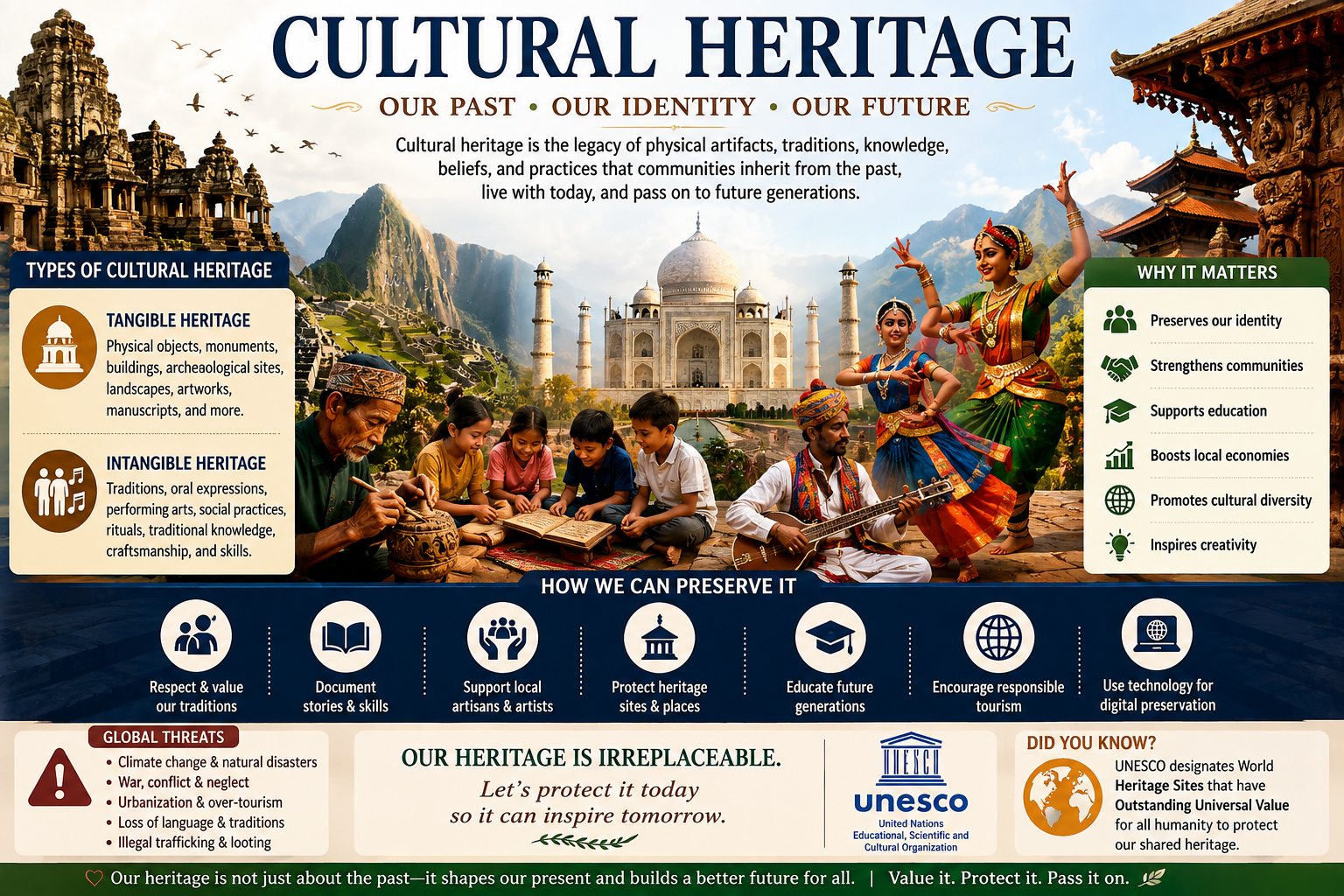
Cultural heritage is the collection of physical places, objects, traditions, knowledge, skills, expressions, and living practices that communities recognize as part of their identity and pass from one generation to another. It matters because heritage does more than preserve the past: it shapes identity, strengthens communities, supports education and tourism, carries traditional knowledge, and can help societies respond to challenges such as climate change and globalization .ydesi
What Is Cultural Heritage?
Cultural heritage refers broadly to the cultural resources, expressions, places, objects, knowledge, traditions, and practices that communities value and transmit across generations.
The concept has evolved significantly.
Earlier approaches often concentrated on monuments, archaeological sites, historic buildings, artworks, and museum collections. The modern understanding is much wider and recognizes that culture also lives in everyday practices.
UNESCO’s World Heritage Convention defines cultural heritage in terms of monuments, groups of buildings, and sites with outstanding universal value from historical, artistic, scientific, aesthetic, ethnological, or anthropological perspectives.
The later UNESCO framework for intangible cultural heritage expanded attention toward living traditions and community knowledge.
That distinction gives us two useful starting points:
Tangible heritage is something we can physically encounter.
Intangible heritage is something people practice, remember, perform, teach, or transmit.
In real life, however, the two are often connected.
A traditional building may exist because of a construction technique.
A musical instrument may be connected to a particular performance tradition.
A historic marketplace may support traditional crafts.
A religious or ceremonial site may provide the physical space where intangible practices continue.
Heritage therefore works more like an ecosystem than a collection of isolated objects.
The Two Major Forms of Cultural Heritage
Tangible Cultural Heritage
Tangible cultural heritage consists of physical things and places.
Examples include:
- Historic buildings
- Monuments
- Archaeological sites
- Ancient settlements
- Religious architecture
- Historic neighborhoods
- Traditional houses
- Fortifications
- Bridges
- Sculptures
- Paintings
- Manuscripts
- Ceramics
- Clothing
- Tools
- Archaeological artifacts
- Museum collections
- Historic landscapes
A stone building may survive for hundreds of years, but preservation is not automatic.
Moisture, pollution, earthquakes, floods, fires, conflict, poor maintenance, inappropriate renovation, and urban development can all damage historic structures.
Intangible Cultural Heritage
Intangible cultural heritage is often less visible but equally important.
UNESCO identifies five broad domains:
- Oral traditions and expressions
- Performing arts
- Social practices, rituals, and festive events
- Knowledge and practices concerning nature and the universe
- Traditional craftsmanship
Examples include:
- Traditional storytelling
- Indigenous knowledge
- Languages
- Songs
- Dance
- Traditional theater
- Festivals
- Rituals
- Food preparation
- Traditional medicine knowledge
- Agricultural practices
- Craft techniques
- Weaving
- Woodworking
- Metalworking
- Pottery
The important point is that intangible heritage is not simply a collection of old customs.
It is living knowledge.
Living Cultural Heritage and Why It Is Different
One of the biggest misunderstandings about cultural heritage is the belief that preservation means keeping something exactly as it was.
Living heritage does not normally work that way.
UNESCO describes intangible cultural heritage as traditional, contemporary, and living at the same time. Communities continue to adapt traditions in response to changing environments and social conditions.
A traditional recipe may change slightly.
A musical performance may incorporate new instruments.
A craft design may respond to modern customers.
A festival may use modern technology for communication.
A traditional building technique may be combined with contemporary safety requirements.
These changes do not automatically destroy authenticity.
Sometimes adaptation is precisely how heritage survives.
Cultural Heritage Is About People, Not Just Objects
A museum object can be beautiful.
A historic building can be spectacular.
An ancient manuscript can be extremely valuable.
But cultural heritage becomes meaningful through human relationships.
A traditional object can tell us:
- Who created it
- Why it was created
- How it was used
- What knowledge went into making it
- Which community valued it
- What stories became attached to it
- How it changed over time
This is why community participation is essential.
UNESCO’s definition of intangible heritage emphasizes that something qualifies as community heritage when communities, groups, or individuals recognize it as such.
In other words, heritage should not simply be declared from above.
People who live with and practice heritage need a voice in deciding what should be preserved and how.
Why Cultural Heritage Is Important
Cultural Identity
Heritage provides a sense of continuity.
People often understand themselves partly through:
- Family traditions
- Language
- Religion and customs
- Food
- Music
- Architecture
- Clothing
- Stories
- Festivals
- Shared historical experiences
These connections can help people understand where they came from and how their communities developed.
Community Connection
Shared cultural practices can bring people together.
A festival, craft tradition, neighborhood, or oral tradition can create opportunities for people to cooperate across generations.
Heritage can therefore support social cohesion.
Education
Heritage can make history tangible.
Instead of reading only about an ancient civilization, students can study:
- Its architecture
- Tools
- Art
- Written records
- Agricultural methods
- Trade systems
- Music
- Language
- Food traditions
This creates a richer learning experience.
Economic Opportunities
Cultural heritage can support local economies through:
- Tourism
- Museums
- Crafts
- Cultural events
- Restaurants
- Heritage hotels
- Local guides
- Creative industries
- Educational programs
However, economic value should not become the only reason something is preserved.
A tradition does not lose its importance simply because it cannot attract tourists.
Cultural Diversity
The world becomes culturally poorer when different communities lose their languages, practices, stories, and knowledge.
Protecting cultural heritage contributes to cultural diversity and encourages people to understand different ways of life.
UNESCO specifically links intangible heritage with cultural diversity, identity, continuity, and mutual respect.
Cultural Heritage and History
Heritage and history are closely connected, but they are not identical.
History attempts to study and interpret the past.
Heritage refers to the ways people preserve, experience, transmit, and use aspects of the past in the present.
A historical event may be documented in archives.
Heritage may involve the places, objects, stories, commemorations, traditions, or memories associated with that event.
This distinction matters because heritage is often emotionally meaningful.
People do not always experience the past as a neutral academic subject.
They may experience it through family memories, community identity, religious practices, landscapes, or inherited traditions.
Cultural Heritage Around the World
South Asia
South Asia contains exceptionally diverse cultural traditions.
Its heritage includes:
- Ancient archaeological sites
- Historic cities
- Mughal and regional architecture
- Buddhist heritage
- Hindu heritage
- Islamic architecture
- Sikh heritage
- Traditional textiles
- Handicrafts
- Classical music
- Folk music
- Storytelling
- Traditional cuisine
- Languages
- Festivals
One city can contain multiple layers of cultural history.
This makes preservation both exciting and complicated.
Urban development can place historic neighborhoods under pressure, while living traditions may evolve rapidly.
The Middle East
The Middle East contains some of the world’s most important archaeological, architectural, literary, religious, and trading traditions.
Heritage includes:
- Ancient settlements
- Historic mosques
- Churches
- Synagogues
- Fortifications
- Traditional markets
- Desert architecture
- Calligraphy
- Poetry
- Weaving
- Ceramics
- Traditional navigation and environmental knowledge
Historic marketplaces, for example, are not simply collections of buildings.
They can represent economic systems, social relationships, craftsmanship, food culture, and urban history.
Europe
European heritage includes:
- Medieval towns
- Castles
- Cathedrals
- Roman archaeological sites
- Industrial heritage
- Historic gardens
- Museums
- Traditional music
- Crafts
- Food traditions
- Languages
- Folk customs
Europe also illustrates an important challenge: heritage preservation must coexist with modern urban life.
A historic city cannot always function like a museum.
People need housing, transportation, businesses, schools, and modern infrastructure.
Africa
African cultural heritage includes extraordinary diversity in:
- Oral traditions
- Languages
- Music
- Dance
- Architecture
- Textiles
- Metalwork
- Woodcarving
- Indigenous knowledge
- Sacred landscapes
- Archaeological sites
- Traditional ecological practices
Oral transmission is particularly important in many communities.
When knowledge is passed through storytelling, performance, apprenticeship, and community practice, preservation requires more than digitizing an object.
It requires keeping the social transmission system alive.
East Asia
East Asian heritage demonstrates how ancient traditions can coexist with modern technology.
Examples include:
- Historic temples
- Traditional architecture
- Calligraphy
- Tea traditions
- Martial arts
- Ceramics
- Textile arts
- Theater
- Festivals
- Traditional gardens
- Craft techniques
Some traditions remain highly visible because they have developed mechanisms for formal teaching and apprenticeship.
Indigenous Cultural Heritage
Indigenous heritage is particularly important because it can contain deep relationships between people, land, language, ecosystems, and traditional knowledge.
Indigenous knowledge may include:
- Plant knowledge
- Water management
- Seasonal knowledge
- Agriculture
- Navigation
- Animal behavior
- Craft
- Storytelling
- Land stewardship
This knowledge should not be treated simply as a resource for outsiders.
Questions of consent, ownership, cultural rights, and benefit-sharing matter.
The Five Major Domains of Intangible Cultural Heritage
Oral Traditions and Expressions
Stories can preserve history, moral lessons, identity, humor, and community memory.
Oral traditions include:
- Legends
- Myths
- Proverbs
- Poems
- Songs
- Family histories
- Epic storytelling
Language is often central to these traditions.
When a language disappears, certain cultural meanings may become much harder to transmit.
Performing Arts
Music, dance, theater, puppetry, and other performance traditions carry cultural knowledge through movement and sound.
Performing arts are especially powerful because they involve participation.
People do not merely observe them.
They perform them.
Social Practices, Rituals, and Festivals
Festivals can express:
- Community identity
- Religious beliefs
- Seasonal cycles
- Historical memory
- Agricultural traditions
- Family relationships
They can also strengthen social networks.
Knowledge About Nature and the Universe
Traditional knowledge can include observations about:
- Weather
- Plants
- Animals
- Water
- Agriculture
- Seasons
- Landscapes
- Navigation
This area is increasingly important in discussions about climate resilience.
UNESCO now explicitly highlights traditional and local knowledge as a resource for climate adaptation.
Traditional Craftsmanship
Craft knowledge includes the skills required to create objects using traditional techniques.
Examples include:
- Weaving
- Pottery
- Carpentry
- Metalworking
- Embroidery
- Basketry
- Stonework
- Jewelry
- Leatherwork
A finished object is only part of the heritage.
The knowledge of how to make it may be even more valuable.
Cultural Heritage and Language
Language is one of the strongest carriers of cultural memory.
A language can contain concepts that are difficult to translate perfectly.
It can encode:
- Family relationships
- Ecological knowledge
- Humor
- Poetry
- Place names
- Historical memory
- Social customs
Language preservation therefore deserves attention within cultural heritage programs.
Practical approaches include:
- Recording elders
- Creating dictionaries
- Developing educational materials
- Supporting local-language publishing
- Teaching children
- Digitizing recordings
- Supporting community media
But documentation alone is not enough.
A language survives best when people have meaningful reasons to use it.
Cultural Heritage and Traditional Food
Food is often one of the easiest ways to experience heritage.
Recipes can preserve:
- Geography
- Agriculture
- Migration history
- Religious customs
- Trade routes
- Family traditions
- Seasonal knowledge
A traditional dish may tell a complicated story.
Its ingredients can reveal which crops grew locally.
Its spices can reveal trade connections.
Its preparation method can reveal available technology.
Its social context can reveal how families and communities interacted.
Food heritage therefore deserves serious documentation.
Cultural Heritage and Traditional Crafts
Traditional crafts are especially vulnerable because craft knowledge depends on skilled practitioners.
If young people stop learning a technique, the knowledge can disappear even when thousands of finished objects remain in museums.
A sustainable craft strategy therefore needs more than collecting objects.
It should support:
- Apprenticeships
- Fair wages
- Training
- Market access
- Documentation
- Design innovation
- Community ownership
- Quality standards
The objective should be to make traditional skills viable enough that people can continue practicing them.
Cultural Heritage and Museums
Museums play a major role in preservation.
They can:
- Protect collections
- Conduct research
- Educate visitors
- Document objects
- Provide conservation
- Support exhibitions
- Preserve archives
But museums also face difficult questions.
Who owns an object?
Who has the right to display it?
Should sacred objects be displayed publicly?
Should communities be able to request the return of cultural materials?
Modern heritage work increasingly recognizes that collections can involve complicated histories of acquisition, colonialism, conflict, and unequal power.
Museums therefore need transparency and dialogue.
Cultural Heritage and Archaeology
Archaeology helps recover information about past societies.
It can reveal:
- Settlement patterns
- Trade
- Technology
- Diet
- Religion
- Architecture
- Burial practices
- Environmental adaptation
But archaeological heritage is vulnerable to:
- Looting
- Illegal excavation
- Construction
- Natural erosion
- Climate change
- Conflict
- Poor documentation
Preserving archaeological sites requires both physical protection and research.
Cultural Heritage and Architecture
Historic architecture provides evidence of how societies lived.
A traditional house can reveal:
- Climate adaptation
- Available materials
- Family structure
- Social customs
- Security needs
- Economic conditions
This is one reason historic architecture can provide lessons for modern sustainability.
UNESCO notes that historic urban forms, traditional building techniques, and resource-management practices can offer tested approaches to resilience and sustainable development.
Cultural Heritage and Climate Change
Climate change is becoming one of the major threats to cultural heritage.
Threats include:
- Flooding
- Coastal erosion
- Sea-level rise
- Heat
- Wildfires
- Storms
- Drought
- Changing humidity
- Biological deterioration
- Permafrost loss
- Desertification
UNESCO notes that historic sites, living traditions, and creative practices face increasing pressure from rising temperatures, extreme weather, and environmental degradation.
Climate change creates a difficult problem.
Heritage needs protection from climate impacts.
But heritage can also provide knowledge for climate adaptation.
That makes cultural heritage both vulnerable to climate change and potentially useful for responding to it.
Why Historic Buildings Can Teach Modern Sustainability
Traditional buildings often evolved in response to local climates.
They may use:
- Thick walls
- Courtyards
- Shading
- Natural ventilation
- Local materials
- Passive cooling
- Orientation strategies
- Water-management techniques
Modern construction can learn from these principles.
The lesson is not that old buildings are always better.
The lesson is that traditional architecture contains accumulated environmental knowledge that should not be ignored.
The New Climate Heritage Movement
Climate adaptation is becoming a more visible part of global heritage policy.
In January 2026, UNESCO reported that heritage-related indicators were included among global climate-adaptation indicators developed through the UN climate process, reflecting a stronger recognition of cultural and natural heritage in adaptation planning.
In June 2026, ICOMOS and partners launched the Heritage Adapts! campaign with a goal of supporting climate adaptation action across at least 3,000 sites and practices by 2030.
This signals a broader change.
Heritage conservation is increasingly being discussed not only as preservation but also as climate resilience.
Cultural Heritage and Tourism
Tourism can support heritage preservation.
Visitors create demand for:
- Museums
- Local guides
- Heritage hotels
- Crafts
- Restaurants
- Cultural performances
- Transportation
- Conservation programs
But tourism can also damage heritage.
Too many visitors can cause:
- Physical wear
- Waste
- Traffic
- Rising local prices
- Commercialization
- Loss of community access
- Pressure to simplify traditions
The goal should therefore be responsible heritage tourism, not maximum visitor numbers.
How Sustainable Cultural Tourism Works
A sustainable heritage tourism model should ask:
- Does the community benefit?
- Are local businesses involved?
- Is the site protected?
- Are visitor numbers manageable?
- Is interpretation accurate?
- Are sacred practices respected?
- Are local people able to continue living normally?
A destination is not successful if tourists enjoy it while residents can no longer afford to live there.
Cultural Heritage and Digital Technology
Technology is changing heritage preservation.
Digital tools can help with:
- 3D scanning
- Photogrammetry
- Digital archives
- Virtual museums
- Geographic information systems
- Drone documentation
- AI-assisted cataloging
- Digital storytelling
- Online exhibitions
Digital preservation can create valuable records of vulnerable places and traditions.
But digital copies should not be confused with the original heritage.
A 3D model of a historic building does not replace the building.
A recording of a traditional song does not replace the community that performs it.
Digital technology is best understood as a preservation and access tool, not a complete substitute for living heritage.
3D Scanning and Digital Documentation
Three-dimensional scanning can document architectural details with high precision.
It can help researchers:
- Record existing conditions
- Monitor deterioration
- Plan conservation
- Study construction techniques
- Create educational models
- Preserve information after damage
Digital documentation is particularly valuable for heritage at risk from disasters or environmental change.
Artificial Intelligence and Cultural Heritage
AI may become increasingly useful for heritage work.
Potential applications include:
- Digitizing handwritten records
- Translating historical texts
- Identifying objects
- Organizing archives
- Searching large collections
- Restoring damaged digital records
- Analyzing historical images
- Creating educational experiences
But AI creates risks too.
A model can misunderstand cultural context.
It can reproduce stereotypes.
It can incorrectly label objects.
It can generate historically inaccurate material.
AI should therefore support experts and communities rather than replace them.
Virtual Reality and Cultural Heritage
Virtual reality can allow people to experience heritage sites that are:
- Remote
- Fragile
- Closed
- Under restoration
- Difficult to access
- At risk from environmental damage
Virtual experiences can expand education.
However, they should be clearly presented as interpretations.
A digital reconstruction may involve assumptions.
Users should know what is historically documented and what has been reconstructed.
Digital Heritage and Ownership
Digitalization raises a difficult question:
Who owns a digital representation of cultural heritage?
A company may scan a historic object and create a highly valuable digital model.
Does that mean the company owns the cultural knowledge?
Not necessarily.
Heritage organizations increasingly need clear policies around:
- Consent
- Data ownership
- Community access
- Copyright
- Commercial use
- Cultural restrictions
- Sensitive information
The goal should be digital preservation without digital exploitation.
Cultural Heritage and Globalization
Globalization has both positive and negative effects.
It allows traditions to travel.
A local craft can reach international markets.
A traditional musical style can gain global audiences.
A regional cuisine can become internationally recognized.
But globalization can also encourage cultural standardization.
Traditional products may be simplified to satisfy tourist demand.
Local languages may lose everyday use.
Fast commercial production may replace handmade techniques.
The challenge is not stopping cultural exchange.
It is ensuring that exchange does not destroy the communities that create the culture.
Cultural Heritage and Cultural Appropriation
Cultural exchange can become controversial when elements of one culture are used by outsiders without understanding, acknowledgment, consent, or fair benefit.
Examples can involve:
- Sacred symbols
- Traditional clothing
- Indigenous designs
- Music
- Ceremonial practices
- Traditional knowledge
Not every use by outsiders is inappropriate.
The key questions include:
Who created it?
What does it mean?
Who benefits?
Was permission appropriate?
Is the context being respected?
Is the community being represented accurately?
These questions are particularly important when heritage becomes commercial.
Cultural Heritage and Intellectual Property
Traditional knowledge does not always fit neatly into conventional intellectual-property systems.
A traditional technique may belong to a community rather than an individual.
A design may have been transmitted for generations.
A song may have no single identifiable author.
This creates legal and ethical challenges.
Heritage protection may therefore require a combination of:
- Copyright
- Trademarks
- Geographical indications
- Traditional-knowledge frameworks
- Community protocols
- Contracts
- Cultural rights
Legal mechanisms vary significantly by country.
Cultural Heritage During Conflict
Conflict can cause devastating heritage losses.
Historic buildings may be destroyed.
Museums may be looted.
Archives may disappear.
Religious sites may be damaged.
Cultural landscapes can be transformed.
But heritage can also become a target because it represents identity.
Protecting heritage during conflict is therefore not simply about protecting buildings.
It can be about protecting community memory and cultural continuity.
International heritage frameworks recognize the importance of safeguarding cultural property during armed conflict.
Cultural Heritage and Disaster Preparedness
Heritage organizations should not wait for a disaster before thinking about protection.
A practical disaster plan should identify:
- High-risk structures
- Vulnerable collections
- Emergency contacts
- Evacuation procedures
- Fire protection
- Flood risks
- Backup documentation
- Storage priorities
- Recovery procedures
Digital documentation can support recovery after damage.
But physical preparedness remains essential.
The Problem of “Frozen Heritage”
One of the most common preservation mistakes is treating heritage as something that must never change.
Culture has always changed.
Trade, migration, technology, intermarriage, climate, political events, and economic conditions influence traditions.
The goal should not be to freeze culture.
It should be to maintain the ability of communities to transmit meaningful cultural knowledge while allowing appropriate evolution.
This is especially important for living heritage.
How Communities Can Preserve Cultural Heritage
Document Local Knowledge
Record:
- Stories
- Recipes
- Songs
- Crafts
- Languages
- Oral histories
- Traditional building techniques
Documentation should involve consent and community participation.
Teach the Next Generation
Children should have opportunities to learn heritage through:
- Schools
- Families
- Apprenticeships
- Community centers
- Museums
- Workshops
- Cultural events
Support Local Practitioners
If artisans cannot earn a reasonable living, traditions may disappear.
Supporting practitioners can include:
- Fair pricing
- Grants
- Training
- Market access
- Cooperative models
- Apprenticeships
Protect Cultural Spaces
Heritage often depends on physical places.
Protect:
- Historic neighborhoods
- Markets
- Religious sites
- Community halls
- Traditional workshops
- Landscapes
Use Technology Carefully
Digital tools can help document and share heritage.
But technology should remain accountable to communities.
How Individuals Can Preserve Cultural Heritage
You do not need to work for a museum to protect heritage.
Individuals can:
- Learn family history.
- Record stories from older relatives.
- Learn traditional recipes.
- Support local artisans.
- Visit museums responsibly.
- Learn local history.
- Teach children cultural traditions.
- Support heritage organizations.
- Use culturally sensitive language.
- Document traditions with permission.
Small actions matter because heritage is transmitted through everyday behavior.
How Schools Can Teach Cultural Heritage
Schools can move beyond textbook-based heritage education.
Students can:
- Interview elders
- Visit historic sites
- Document local architecture
- Study traditional crafts
- Record oral histories
- Research local food traditions
- Create digital archives
- Organize cultural exhibitions
This approach makes heritage personal.
Instead of asking only:
“What happened hundreds of years ago?”
Students can ask:
“What parts of that history are still visible around us?”
Cultural Heritage for Children and Young People
Young people are often described as a threat to traditional culture because they adopt new technology and lifestyles.
That view is too simplistic.
Young people can become powerful heritage protectors.
They can use:
- Video
- Podcasts
- Social media
- Digital archives
- Photography
- Animation
- Virtual reality
- Online storytelling
The challenge is making heritage relevant without turning it into a marketing slogan.
Young people should be allowed to reinterpret heritage while understanding its context.
Cultural Heritage for Travelers
Travelers can help preserve culture by making thoughtful choices.
Choose Local Businesses
Spend money with locally owned:
- Restaurants
- Guides
- Craft workshops
- Hotels
- Cultural organizations
Respect Sacred Places
Follow local rules.
Ask before photographing people or ceremonies.
Avoid Illegal Cultural Objects
Do not purchase questionable antiquities or artifacts.
A cheap “ancient” object could be illegally excavated or falsely marketed.
Learn Before You Visit
Understanding basic local history can make travel more meaningful.
Avoid Turning Communities Into Performances
A community should not have to behave like a tourist attraction simply to satisfy visitors.
Common Mistakes in Cultural Heritage Preservation
Mistake 1: Preserving Only Buildings
A building without its cultural context can become an empty shell.
Solution: Preserve associated traditions, stories, crafts, and community relationships.
Mistake 2: Ignoring Local Communities
Outside experts may know conservation science but not understand local meaning.
Solution: Include communities in decision-making.
Mistake 3: Treating Culture as Frozen
Traditions naturally evolve.
Solution: Protect transmission rather than demanding artificial immobility.
Mistake 4: Focusing Only on Tourism
Tourism can support heritage but can also distort it.
Solution: Put community well-being and conservation first.
Mistake 5: Digitalizing Without Context
A database full of objects is not necessarily meaningful.
Solution: Record stories, context, provenance, language, and community knowledge alongside objects.
Mistake 6: Ignoring Climate Risks
A site may appear stable today but face serious future hazards.
Solution: Include climate-risk assessment in long-term heritage planning.
Mistake 7: Underpaying Cultural Practitioners
Expecting artisans to preserve traditions without economic support is unrealistic.
Solution: Create fair markets and sustainable livelihoods.
Mistake 8: Assuming Technology Solves Everything
A virtual museum cannot replace a living community.
Solution: Use technology as a complement to physical and social preservation.
The Pros of Cultural Heritage Preservation
Protects Identity
Heritage provides continuity between generations.
Supports Education
It gives people tangible connections to history.
Encourages Cultural Diversity
It protects different ways of living and understanding the world.
Creates Economic Opportunities
Responsible heritage tourism and crafts can support local livelihoods.
Strengthens Communities
Shared traditions can create social connections.
Supports Climate Adaptation
Traditional knowledge and historic practices can provide useful lessons for resilience.
The Cons and Difficulties of Cultural Heritage Preservation
Preservation itself can create challenges.
High Costs
Conservation can require specialized skills and expensive materials.
Commercialization
Heritage can become overly focused on tourism.
Community Displacement
Heritage-led redevelopment can sometimes increase property prices and push residents away.
Authenticity Debates
People may disagree about which version of a tradition is “authentic.”
Political Disputes
Heritage can become connected to competing national or ethnic narratives.
Access Restrictions
Protecting a fragile site may require limiting visitors.
Digital Inequality
Not every community has equal access to digital preservation technology.
The answer is not to abandon preservation.
It is to recognize its complexity.
A Better Framework for Cultural Heritage Preservation
A strong heritage strategy can be organized around six principles.
People
Ask who practices, owns, uses, and values the heritage.
Place
Understand the physical and environmental context.
Practice
Document how heritage is actually transmitted.
Protection
Identify physical, social, environmental, and economic threats.
Participation
Include communities in decisions.
Continuity
Measure whether knowledge can continue into future generations.
This framework moves preservation away from simply asking:
“How do we save this object?”
and toward:
“How do we keep this cultural relationship alive?”
Ten Major Cultural Heritage Organizations, Platforms, and Brands
The cultural heritage ecosystem includes international organizations, conservation groups, digital platforms, and institutions. These entities do not perform identical roles, so the comparison below focuses on their primary contribution rather than treating them as direct competitors.
| Organization / Brand | Main Role | Heritage Focus | Major Strength | Best Use |
|---|---|---|---|---|
| UNESCO | International cultural heritage framework | World Heritage and intangible heritage | Global standards and cooperation | International heritage research |
| ICOMOS | Heritage conservation organization | Monuments, sites, conservation | Professional expertise | Conservation guidance |
| ICCROM | Conservation and restoration | Cultural heritage protection | Training and capacity building | Conservation professionals |
| World Monuments Fund | Heritage preservation | At-risk historic places | Field conservation projects | Endangered sites |
| Europa Nostra | European heritage network | Built and cultural heritage | Advocacy and networking | European heritage |
| Google Arts & Culture | Digital cultural platform | Museums, collections, cultural stories | Global digital access | Online exploration and education |
| CyArk | Digital heritage documentation | 3D cultural sites | Digital preservation | 3D documentation |
| Smithsonian Institution | Museum and research network | Art, history, science, culture | Major collections and research | Education and research |
| Europeana | Digital cultural platform | European cultural collections | Digital access to collections | Research and discovery |
| National Trust | Heritage conservation organization | Historic places and landscapes | Public engagement and stewardship | Heritage places and education |
These organizations illustrate how diverse heritage preservation has become.
Some focus on international policy.
Some work directly with buildings.
Some train conservation professionals.
Others use digital technology to expand access.
The important lesson is that no single organization can preserve cultural heritage alone.
How Cultural Heritage Organizations Can Work Better Together
The future of heritage preservation will require collaboration between:
- Governments
- Local communities
- Museums
- Universities
- Conservation professionals
- Technology companies
- Indigenous organizations
- Tourism organizations
- Schools
- Private donors
- International institutions
Each group contributes something different.
Governments provide policy.
Communities provide knowledge.
Experts provide conservation skills.
Technology companies can provide digital infrastructure.
Museums provide collections and education.
Universities provide research.
Local businesses provide economic pathways.
Successful heritage projects connect these strengths.
Cultural Heritage and the Economy
Heritage can create economic value without becoming purely commercial.
Potential economic activities include:
- Cultural tourism
- Handicrafts
- Heritage architecture
- Local food
- Cultural festivals
- Museums
- Publishing
- Film
- Photography
- Creative industries
- Educational experiences
The important question is where the money goes.
If a community’s heritage generates millions in tourism but local residents receive little benefit, the system is not sustainable.
A better model keeps a meaningful portion of economic value within the community.
Cultural Heritage and Rural Communities
Rural heritage can be overlooked because global attention often focuses on famous monuments.
But rural communities may preserve:
- Agricultural traditions
- Traditional houses
- Oral history
- Local crafts
- Seasonal festivals
- Indigenous knowledge
- Landscape practices
- Food traditions
These systems can be highly valuable.
Rural heritage preservation can also support local development if designed carefully.
Cultural Heritage in Cities
Cities create a particularly difficult preservation problem.
Urban areas need:
- Housing
- Roads
- Public transportation
- Commercial space
- Energy infrastructure
- Schools
- Hospitals
Historic areas must coexist with these needs.
The goal should not always be to prevent change.
Instead, planners can ask:
How can modern development respect existing cultural identity?
Adaptive reuse is one possible answer.
A historic building can receive a new function while retaining important architectural and cultural characteristics.
Adaptive Reuse and Heritage
Adaptive reuse means giving an existing historic structure a new purpose.
Examples can include converting:
- Warehouses into cultural centers
- Historic homes into museums
- Old industrial buildings into offices
- Traditional buildings into guesthouses
- Former public buildings into community spaces
Adaptive reuse can reduce demolition while allowing historic structures to remain useful.
But changes should respect the building’s significance.
Cultural Heritage and Migration
Migration changes culture.
People carry traditions across borders.
A community that moves to a new country may preserve:
- Language
- Food
- Music
- Religion
- Clothing
- Festivals
- Family customs
At the same time, these traditions can evolve.
This demonstrates that heritage does not require people to remain in one place.
Culture can travel.
Migration can create new forms of heritage through cultural exchange.
Cultural Heritage and Diaspora Communities
Diaspora communities can play an important role in preservation.
They may maintain traditions even when they are geographically distant from ancestral places.
Digital communication makes this easier.
Families can:
- Record oral histories
- Share recipes
- Teach languages
- Organize cultural events
- Maintain archives
- Connect younger generations with elders
Digital heritage can therefore help communities maintain relationships across borders.
The Future of Cultural Heritage
More Community-Led Preservation
Future heritage programs are likely to place greater emphasis on community participation.
The question will increasingly be:
What do communities want to preserve, and why?
Climate-Resilient Heritage
Climate adaptation will become increasingly central.
UNESCO and ICOMOS are already treating heritage as both vulnerable to climate change and potentially useful for climate resilience.
Digital Twins
Historic places may increasingly have digital twins containing:
- 3D scans
- Historical photographs
- Architectural records
- Conservation data
- Oral histories
- Environmental measurements
AI-Assisted Archives
AI may make huge cultural collections easier to search and analyze.
But human experts will remain essential for context and interpretation.
More Ethical Digital Heritage
Future digital projects will need clearer rules around:
- Ownership
- Consent
- Cultural rights
- Data access
- Commercialization
Heritage as Climate Knowledge
Traditional ecological knowledge may become more important as societies search for locally adapted ways to respond to environmental change.
Cultural Heritage in 2030 and Beyond
By the end of this decade, heritage preservation may look significantly different from traditional museum-based approaches.
A major heritage project could include:
- Community interviews
- 3D scanning
- Climate modeling
- Digital archives
- GIS mapping
- AI-assisted cataloging
- Apprenticeship programs
- Tourism planning
- Economic development
- Disaster preparedness
This represents a shift from static preservation to integrated heritage management.
The Future of Intangible Cultural Heritage
The biggest future challenge may be transmission.
A tradition survives when someone learns it.
Therefore, future preservation programs should invest in:
- Teachers
- Apprentices
- Community practitioners
- Young people
- Cultural spaces
- Local-language education
- Fair compensation
Recording a tradition is valuable.
Teaching someone to practice it is even more powerful.
What Most Cultural Heritage Articles Miss
A common heritage discussion asks:
“How can we preserve the past?”
A better question is:
“How can we ensure that people in the future still have the freedom and knowledge to decide what parts of their heritage matter to them?”
That distinction is profound.
Heritage should not become a burden imposed on future generations.
It should remain a resource they can understand, reinterpret, and carry forward.
The objective is not to make culture permanent.
Culture is never completely permanent.
The objective is to maintain continuity through change.
A Practical Cultural Heritage Preservation Checklist
For Families
- Record stories from older relatives.
- Preserve photographs.
- Document recipes.
- Teach children family traditions.
- Record traditional songs.
- Preserve family documents responsibly.
For Communities
- Identify important traditions.
- Support practitioners.
- Create apprenticeship opportunities.
- Protect cultural spaces.
- Build local archives.
- Document endangered knowledge.
For Schools
- Create local-history projects.
- Invite community practitioners.
- Visit heritage sites.
- Record oral histories.
- Teach traditional crafts.
- Develop digital exhibitions.
For Governments
- Fund conservation.
- Protect historic areas.
- Support cultural practitioners.
- Create disaster plans.
- Integrate heritage into climate policy.
- Consult local communities.
For Technology Companies
- Build ethical digital archives.
- Support community ownership.
- Protect sensitive data.
- Improve accessibility.
- Avoid presenting AI reconstructions as historical fact.
For Travelers
- Respect local customs.
- Support local businesses.
- Avoid illegal artifacts.
- Follow photography rules.
- Learn the history of destinations.
- Avoid damaging fragile places.
How to Start a Local Cultural Heritage Project
Step 1: Define the Community
Determine whose heritage you are documenting.
Step 2: Identify What Matters
Create a list of:
- Places
- Objects
- Stories
- Traditions
- Skills
- Languages
- Food
- Music
Step 3: Ask the Community
Do not assume everything important from an outsider’s perspective.
Step 4: Assess Risk
Determine what is:
- Disappearing
- Damaged
- Under threat
- Poorly documented
Step 5: Prioritize
You cannot preserve everything at once.
Choose high-value and high-risk areas.
Step 6: Document
Use:
- Photography
- Video
- Audio
- Interviews
- 3D scanning
- Written records
Step 7: Teach
Create opportunities for younger generations to learn.
Step 8: Build Economic Support
Where appropriate, connect heritage skills with sustainable livelihoods.
Step 9: Review Regularly
Heritage needs change.
Preservation should evolve with communities.
FAQs
What is cultural heritage in simple words?
Cultural heritage is the collection of places, objects, traditions, knowledge, skills, stories, and practices that communities value and pass between generations.
What are the main types of cultural heritage?
The two broad categories are tangible cultural heritage and intangible cultural heritage. Tangible heritage includes physical places and objects, while intangible heritage includes traditions, knowledge, skills, performances, rituals, and other living cultural expressions.
What is tangible cultural heritage?
Tangible cultural heritage includes physical things such as monuments, historic buildings, archaeological sites, artworks, manuscripts, traditional houses, artifacts, and cultural landscapes.
What is intangible cultural heritage?
Intangible cultural heritage includes living practices and knowledge such as oral traditions, music, dance, festivals, rituals, traditional craftsmanship, and knowledge concerning nature and the universe. UNESCO’s 2003 framework identifies five broad domains for intangible heritage.
Why is cultural heritage important?
Cultural heritage helps communities maintain identity and continuity, supports education and cultural diversity, provides economic opportunities, and preserves knowledge that can be valuable for future generations.
What is the difference between culture and cultural heritage?
Culture describes the broader ways people live, communicate, create, believe, and interact. Cultural heritage refers more specifically to cultural elements that communities recognize as meaningful and transmit across generations.
Is cultural heritage only about old things?
No. Heritage can be ancient, relatively recent, or contemporary. UNESCO describes intangible heritage as traditional, contemporary, and living at the same time.
Can cultural heritage change over time?
Yes. Living heritage naturally evolves. Communities adapt traditions to changing social, environmental, and technological conditions. Change does not automatically mean that heritage has been lost.
What threatens cultural heritage?
Major threats include climate change, conflict, urban development, neglect, pollution, disasters, illegal trafficking, loss of language, declining craft skills, mass tourism, and the disappearance of community transmission.
How does climate change affect cultural heritage?
Climate change can cause flooding, storms, coastal erosion, heat damage, changing humidity, wildfires, drought, and other pressures on historic sites and cultural practices. UNESCO increasingly emphasizes both the vulnerability of heritage and its potential contribution to climate adaptation.
Can technology help preserve cultural heritage?
Yes. Digital photography, 3D scanning, GIS, digital archives, virtual reality, and AI-assisted research can support documentation, conservation, research, and public access.
Can digital technology replace physical heritage?
No. A digital representation can preserve information and provide access, but it does not fully replace the physical, social, spiritual, or community context of heritage.
Why is community participation important in heritage preservation?
Communities often possess the knowledge needed to understand the meaning, use, history, and appropriate treatment of cultural heritage. UNESCO’s framework emphasizes that intangible heritage is community-based.
How can young people help preserve cultural heritage?
Young people can learn traditional skills, interview elders, create digital archives, document local history, participate in cultural events, support artisans, and use modern media to share heritage responsibly.
How can cultural heritage support tourism?
Heritage can attract visitors to museums, historic sites, cultural events, traditional craft markets, and local food experiences. Responsible tourism can create income for conservation and local communities.
Can tourism harm cultural heritage?
Yes. Excessive tourism can cause physical damage, overcrowding, commercialization, waste, rising costs, and loss of local access. Sustainable tourism should balance visitor access with conservation and community needs.
What is cultural heritage preservation?
Cultural heritage preservation is the process of protecting, documenting, maintaining, transmitting, and responsibly managing cultural places, objects, knowledge, practices, and traditions for present and future generations.
What is living cultural heritage?
Living cultural heritage refers to traditions and knowledge that communities continue to practice and transmit. It is not simply a historical artifact but something that remains active in contemporary life.
Why are traditional crafts important?
Traditional crafts preserve specialized knowledge and skills. If practitioners stop teaching those skills, the knowledge can disappear even if finished craft objects remain in museums.
What is digital cultural heritage?
Digital cultural heritage includes cultural materials that are created, preserved, digitized, or experienced through digital technologies, including digital archives, 3D models, virtual exhibitions, photographs, recordings, and digital collections.
What is the future of cultural heritage preservation?
The future is likely to combine community participation, conservation science, climate adaptation, digital documentation, responsible tourism, education, traditional knowledge, and new technologies such as AI and 3D modeling.
Conclusion
Cultural heritage is much more than a collection of ancient buildings, museum objects, or famous historical sites. It is the living connection between people and the knowledge, places, stories, skills, traditions, languages, objects, and practices that give meaning to their shared past and influence their future. The most effective approach to preservation recognizes both tangible and intangible heritage and understands that physical structures, cultural practices, communities, and landscapes often depend on one another.