
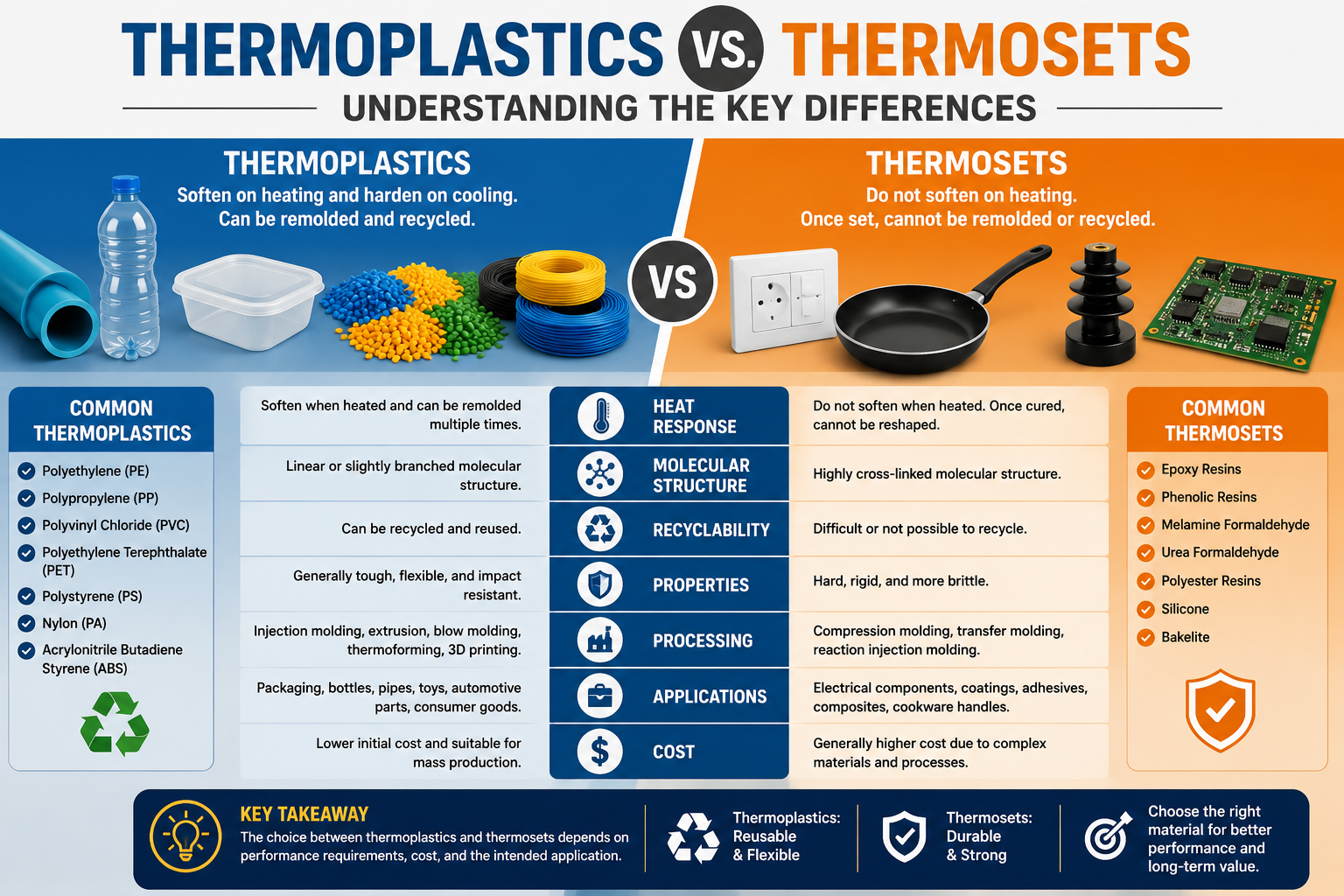
Plastics are essential materials in modern manufacturing, serving industries that require lightweight, durable, and cost-effective solutions. Among the many categories available, thermoplastics and thermosets stand out as two of the most widely used options. Although they may appear similar, their unique structures and performance characteristics make them suitable for different applications. Understanding these distinctions helps manufacturers, designers, and engineers choose the right material for specific production needs.
What Are Thermoplastics and Thermosets?
Thermoplastics and thermosets are both polymer-based materials, but they respond differently to heat because of their molecular structures. This fundamental distinction influences how they are processed, reused, and applied across various industries.
Thermoplastics soften when heated and harden again as they cool. This process can be repeated multiple times without significantly altering the material’s chemical structure. Because they can be reshaped and remolded, thermoplastics offer exceptional flexibility during manufacturing and recycling. Their adaptability makes them a preferred choice for applications requiring complex designs, frequent modifications, or material recovery.
Thermosets, in contrast, undergo a permanent chemical reaction during curing. Once hardened, they cannot be melted or reshaped. Instead of softening under heat, they retain their form until exposed to temperatures high enough to cause degradation. This permanent structure provides outstanding mechanical strength, dimensional stability, and resistance to heat and chemicals.
The difference in molecular bonding largely explains these behaviors. Thermoplastics consist of polymer chains with weaker intermolecular interactions, allowing them to flow when heated. Thermosets form tightly cross-linked molecular networks during curing, creating rigid structures that maintain their shape under demanding conditions.
Comparing Physical Properties
Choosing between thermoplastics and thermosets often depends on the performance requirements of the finished product. Each material offers distinct advantages that suit different environments and manufacturing objectives.
Thermoplastics are generally known for their flexibility, impact resistance, and ease of fabrication. Many grades provide excellent toughness while maintaining relatively low weight. Since they can be reheated, manufacturers can repair, reshape, or recycle components more easily than thermoset materials.
Thermosets excel in applications where structural integrity must remain stable under high temperatures or continuous mechanical stress. Their rigid molecular structure enables them to resist deformation, creep, and chemical exposure more effectively than many thermoplastics.
Strength and Impact Performance
Not all thermoplastics perform identically. Certain engineering plastics offer significantly higher toughness than standard commodity plastics. One widely used example is high-impact polystyrene, which combines improved durability with ease of processing. Its enhanced impact resistance makes it suitable for applications requiring greater toughness while maintaining efficient manufacturing characteristics.
Thermosets generally provide higher compressive strength and better long-term dimensional stability. These characteristics make them valuable in components subjected to heavy mechanical loads, elevated temperatures, or demanding industrial environments.
Ultimately, the intended application determines whether flexibility or permanent structural rigidity offers the greater advantage.
Manufacturing Processes and Production Efficiency
Manufacturing considerations often influence material selection as much as mechanical performance. Production speed, tooling costs, processing flexibility, and waste management all contribute to the overall efficiency of a manufacturing operation.
Thermoplastics are compatible with a wide range of manufacturing methods, including injection molding, extrusion, thermoforming, rotational molding, and blow molding. Because they soften repeatedly with heat, production adjustments can often be made without replacing entire batches of material. Excess material generated during production can frequently be recovered and reprocessed, reducing waste and improving cost efficiency.
Thermosets require a different manufacturing approach. During curing, irreversible chemical cross-linking permanently sets the material into its final shape. Common processing methods include compression molding, transfer molding, resin casting, and reaction molding. Since curing cannot be reversed, production errors generally result in unusable parts that cannot simply be remelted.
Tooling requirements also differ. Thermoset processing often involves longer curing cycles, while thermoplastic manufacturing typically supports higher production speeds for large-volume manufacturing. Businesses focused on rapid production cycles frequently favor thermoplastics for this reason.
Manufacturers must also consider quality control, material handling, and production consistency when selecting between the two material families.
Applications Across Different Industries
The versatility of both thermoplastics and thermosets has led to widespread adoption across numerous industries. However, each category serves distinct purposes depending on performance expectations.
Thermoplastics are commonly used in consumer goods, automotive components, packaging, household products, medical equipment, and industrial containers. Their lightweight nature, design flexibility, and recyclability support large-scale production while meeting diverse functional requirements.
Many electrical and electronic components also incorporate thermoplastics because of their insulation properties and manufacturing efficiency. Depending on the formulation, they may offer varying levels of chemical resistance, weatherability, and mechanical durability.
Thermosets are widely utilized in applications requiring superior thermal stability and structural performance. Industrial machinery, electrical insulation systems, construction materials, aerospace components, marine structures, and heavy-duty equipment frequently rely on thermosetting polymers for their long-term reliability.
The ability of thermosets to maintain their strength under elevated temperatures makes them particularly valuable where conventional thermoplastics may soften or deform during operation.
Sustainability and Material Selection
Environmental responsibility has become an increasingly important consideration in material selection. Manufacturers are evaluating not only product performance but also the environmental impact of production, use, and end-of-life management.
Thermoplastics generally offer greater opportunities for recycling because they can be reheated and reprocessed multiple times. While repeated recycling may gradually affect certain material properties, many thermoplastics remain suitable for secondary applications after recovery.
Their compatibility with mechanical recycling systems supports circular manufacturing strategies that reduce landfill waste and conserve raw materials. Manufacturers can often reuse production scrap, improving both sustainability and operational efficiency.
Thermosets present greater recycling challenges because their permanently cross-linked structure cannot be remelted. Instead, recovery methods may involve mechanical grinding, energy recovery, or specialized recycling technologies that continue to evolve.
Material longevity also contributes to sustainability. Products designed to perform reliably for many years reduce replacement frequency and conserve resources over their operational lifespan. In many industrial settings, the exceptional durability of thermosets supports this objective despite their recycling limitations.
Selecting the most sustainable material, therefore, requires balancing durability, recyclability, manufacturing efficiency, and the intended service environment.
Choosing the Right Material for Your Application
Selecting between thermoplastics and thermosets requires careful evaluation of multiple factors rather than focusing on a single property. Mechanical requirements, production methods, operating temperatures, cost considerations, environmental conditions, and product lifespan all influence the optimal material choice.
Thermoplastics are often the preferred solution for products requiring flexibility, rapid manufacturing, lightweight construction, or future recyclability. Their ability to be reshaped also provides greater design flexibility throughout product development and manufacturing.
Thermosets become the better option when applications demand exceptional heat resistance, chemical stability, structural rigidity, or long-term dimensional accuracy. Their permanent molecular structure enables reliable performance under conditions that may exceed the capabilities of many thermoplastic materials.
Working closely with experienced material specialists during product development helps manufacturers evaluate these variables and select materials that align with both technical requirements and long-term business objectives.
Conclusion
Thermoplastics and thermosets each offer unique advantages that make them indispensable across modern manufacturing. While thermoplastics provide flexibility, efficient processing, and recycling potential, thermosets deliver outstanding strength, heat resistance, and dimensional stability. Understanding their differences enables manufacturers to select materials that meet specific performance goals, improve production efficiency, and support reliable, long-lasting products in a wide range of industrial applications.