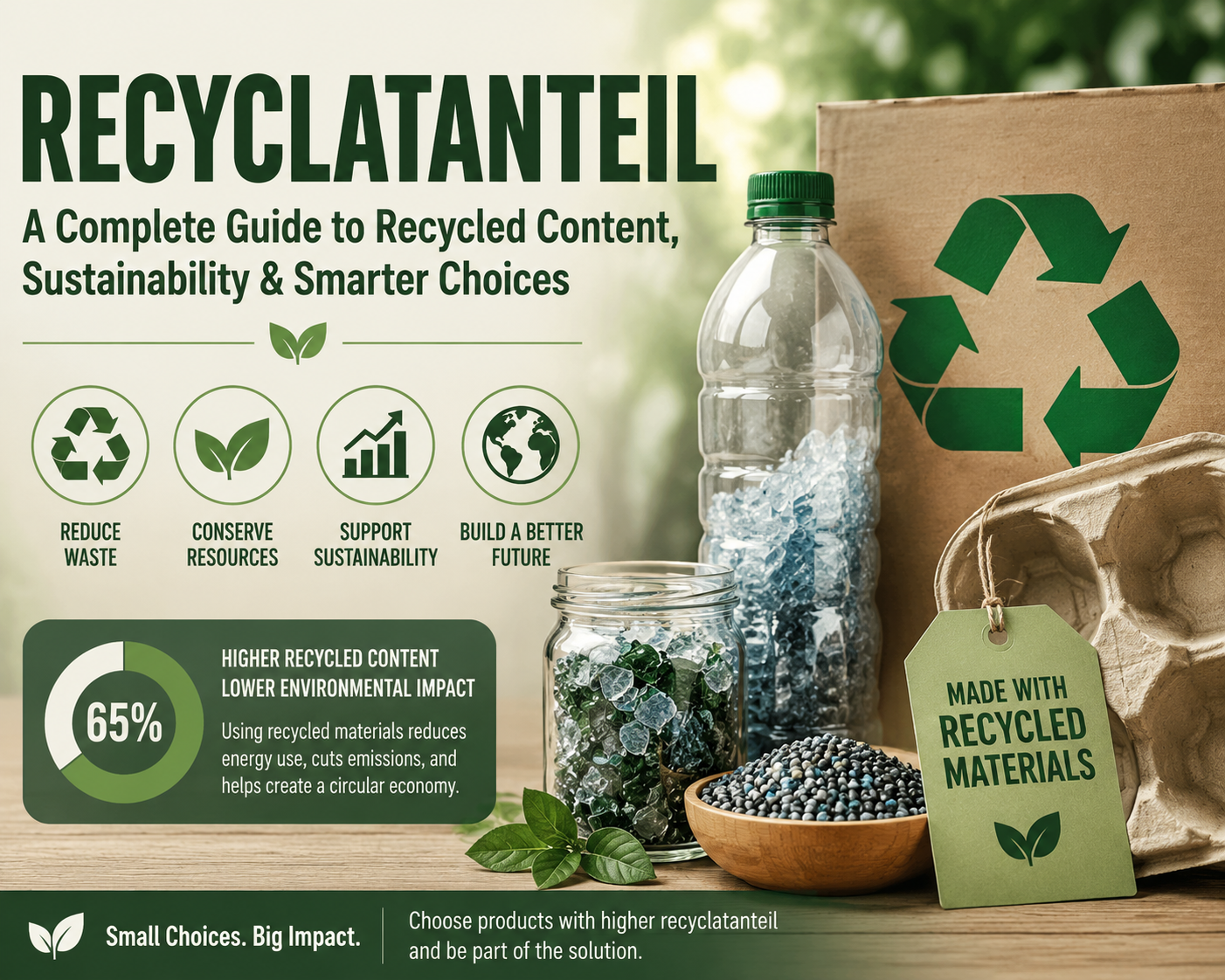
Recyclatanteil is a German term used to describe the percentage of recycled material contained in a product, package, or manufacturing component. In simple English, it means recycled content, and it helps people understand how much of an item comes from reused resources instead of newly extracted raw materials. The term is commonly translated as the amount or proportion of recycled material Logisths
Why This Topic Matters Today
Modern buyers are more aware of sustainability claims than ever before. They do not only want attractive packaging or eco-friendly language; they want proof that products are made with responsible material choices. Recycled content gives that proof because it shows how much old material has been brought back into the production cycle.
For businesses, this measurement is also important because it supports transparency and helps improve brand credibility. When a company explains the share of reused material honestly, customers can compare products more easily. This helps prevent vague green claims and encourages real progress.
Understanding the Basic Meaning
The basic meaning is simple. If a bottle, box, textile, or plastic part contains a certain percentage of recycled material, that percentage represents the recycled content share. For example, if a package contains 40 percent reused plastic and 60 percent new plastic, the recycled material share is 40 percent.
This number may appear small, but it can have a strong impact when used across large production volumes. A small improvement in material reuse can reduce demand for virgin resources, lower waste, and support better recycling systems. This is why manufacturers increasingly treat recycled material share as a key sustainability indicator.
What Recyclatanteil Means in Product Design
Recyclatanteil is closely connected to product design because designers decide which materials can be used, mixed, processed, and recovered. A product with a higher recycled content share is usually designed with material efficiency in mind. This means the design team considers strength, safety, appearance, cost, and environmental value at the same time.
Good design does not simply add recycled material for marketing purposes. It balances performance and responsibility. If recycled plastic weakens a product, the design must be improved before it reaches customers. The best approach is to create products that are durable, functional, and more resource-conscious.
Material Selection and Quality
Material selection is one of the most important steps in using recycled inputs. Reused materials can come from post-consumer waste, industrial scrap, recovered packaging, textile fibers, paper, metal, glass, or construction materials. Each source has different quality levels, so manufacturers must test strength, purity, and consistency.
The quality of recycled material affects the final product. Clean, well-sorted materials can often be reused more effectively, while contaminated materials may need extra processing. This is why strong recycling infrastructure matters. Better collection and sorting systems lead to better recycled inputs.
Product Safety and Performance
A product cannot rely on recycled material alone if that material does not meet safety or performance standards. Packaging for food, medical supplies, electronics, and personal care products often requires strict testing. Manufacturers must make sure recycled inputs do not create contamination, weakness, or compliance problems.
This does not mean recycled materials are unsuitable. It means they must be handled carefully. Many industries already use high-quality recycled paper, metals, glass, and plastics successfully. The key is matching the right material to the right purpose.
Common Product Categories
Recycled content is used in many product categories, including packaging, furniture, clothing, building materials, automotive parts, electronics, and household goods. Packaging is one of the most visible areas because consumers interact with it daily. A bottle, carton, bag, or container can clearly show how much reused material it contains.
Construction is another important area because large volumes of material are involved. Recycled aggregates, metals, wood fibers, and insulation materials can reduce the need for new resources. In fashion, recycled polyester and cotton blends are used to reduce textile waste and support circular design.
| Product Area | Common Recycled Input | Main Benefit |
|---|---|---|
| Packaging | Recycled plastic, paper, glass, metal | Reduces virgin material use |
| Fashion | Recycled polyester, cotton fibers | Lowers textile waste |
| Construction | Recycled metal, wood, aggregates | Supports resource efficiency |
| Automotive | Recovered plastics and metals | Reduces material demand |
| Household Goods | Reused plastic and paper | Improves sustainable choices |
Difference Between Recyclable and Recycled Content
A recyclable product is something that can potentially be recycled after use. A product with recycled content already contains material that has been recovered and used again. This difference is very important because recyclability is about future possibility, while recycled content is about present reality.
Many products are advertised as recyclable, but if they are not actually collected, sorted, and reused, the environmental benefit may remain limited. Recycled content helps close the loop because it creates demand for materials that have already passed through the recycling process.
Why Brands Use Recycled Materials
Brands use recycled materials to reduce environmental impact, meet customer expectations, improve compliance, and strengthen market positioning. In many regions, packaging and material regulations are becoming stricter, and companies are preparing for a future where recycled content may become a normal requirement.
Some European packaging discussions have included calls for stronger recycled content targets, especially in plastic packaging, showing how important this topic has become in sustainability planning.
How Recyclatanteil Is Calculated in Simple Terms
Recyclatanteil is usually calculated by comparing the amount of recycled material in a product to the total material weight of that product. The result is then shown as a percentage. This makes it easier for companies and customers to understand how much reused material is actually present.
For example, if a product weighs 100 grams and contains 30 grams of recycled material, the recycled content share is 30 percent. This simple calculation helps turn sustainability into a measurable figure instead of a vague promise.
Basic Calculation Method
The most common method is based on weight. The recycled material weight is divided by the total product weight and then multiplied by 100. This gives a percentage that can be used on labels, reports, product pages, and technical documents.
This calculation must be honest and consistent. If only one part of a product contains reused material, the brand should explain whether the percentage applies to the full product, only the package, or one component. Clear wording helps avoid confusion.
Post-Consumer and Post-Industrial Material
Post-consumer recycled material comes from items that customers have already used and discarded, such as bottles, containers, boxes, or textiles. This type is valuable because it directly helps reduce waste after consumer use. It also supports public recycling systems.
Post-industrial recycled material comes from factory scrap or production waste. This may include leftover plastic, metal, paper, or textile fibers from manufacturing. It is often cleaner and easier to reuse, but it does not solve consumer waste in the same way.
Why Percentages Can Vary
Recycled content percentages vary because materials have different technical limits. Some products can contain a high percentage of reused material without losing quality, while others require a mix of recycled and virgin material. The right balance depends on safety, strength, appearance, and regulations.
Supply also plays a role. If high-quality recycled material is not available in enough quantity, manufacturers may struggle to increase the percentage. This is especially true for industries that need consistent color, purity, or durability.
| Example Product | Recycled Material Used | Possible Content Range |
|---|---|---|
| Paper packaging | Recovered paper fibers | Medium to high |
| Glass bottles | Recycled glass cullet | Medium to high |
| Plastic bottles | Recycled PET | Low to high |
| Clothing fabric | Recycled polyester | Low to medium |
| Electronics parts | Recovered metals and plastics | Low to medium |
Certification and Verification
Certification can help prove recycled content claims. Independent verification gives customers and business partners more confidence. Without proof, claims may appear weak or promotional, especially in competitive markets where many brands use sustainability language.
Verification also protects responsible companies. When brands invest in better materials, they should be able to show evidence. Clear records, supplier documentation, and recognized standards make recycled content claims more reliable.
Challenges in Measuring Accurately
One challenge is material mixing. Products often contain several layers, coatings, additives, colors, or components. This can make calculation more complicated. For example, a package may include paper, plastic film, ink, adhesive, and a protective layer.
Another challenge is traceability. Manufacturers must know where recycled inputs came from and how they were processed. Without strong supply chain records, it becomes difficult to prove the exact percentage of reused material.
Business Benefits of Using Recycled Content
Using recycled content can improve a company’s environmental image, reduce dependence on new raw materials, and support long-term sustainability goals. It also helps businesses respond to growing customer expectations. Many buyers now prefer brands that show measurable responsibility instead of broad eco-friendly claims.
For companies, recycled content can become part of product storytelling. A brand can explain how waste is being reused, how resources are being saved, and how customers are contributing to a circular economy by choosing better products.
Stronger Customer Trust
Trust is one of the biggest benefits. Customers are often skeptical of green marketing because many claims are vague. When a company shares a clear recycled content percentage, the claim becomes easier to understand and evaluate.
This does not mean every product must have the highest possible percentage. Honesty is more important than exaggeration. A realistic percentage with clear explanation can be more powerful than a bold claim without proof.
Better Brand Positioning
Sustainable material choices can help brands stand out in crowded markets. Whether a business sells packaging, clothing, furniture, electronics, or household products, recycled content can show that the brand is thinking beyond short-term sales.
This is especially useful for premium and purpose-driven brands. Customers who care about responsible consumption often look for details before buying. A clear recycled material message can support stronger product pages, packaging labels, and advertising campaigns.
Cost and Supply Considerations
Recycled materials may sometimes reduce costs, but this is not always guaranteed. Prices depend on quality, availability, processing requirements, and market demand. In some cases, high-quality recycled inputs may cost more than virgin materials.
However, long-term benefits can still be strong. Companies that build reliable recycled material supply chains may become more resilient. They may also reduce exposure to raw material price changes and future regulatory pressure.
Environmental Value
The environmental value comes from reducing the need for new extraction, lowering waste, and supporting reuse systems. When recycled materials are used properly, they help keep resources in circulation for longer. This supports the circular economy model.
The value is greater when products are also designed for future recycling. A product made with reused material should ideally be easy to collect, separate, and recycle again. This creates a stronger loop rather than a one-time reuse.
Marketing With Responsibility
Marketing recycled content requires careful wording. Brands should avoid overclaiming or making a product seem fully sustainable just because it contains some reused material. Sustainability depends on many factors, including production energy, transport, durability, and end-of-life handling.
Responsible marketing explains the real benefit without exaggeration. It tells customers what percentage is reused, which part of the product it applies to, and why that matters. This approach builds long-term credibility.
Consumer Guide to Reading Recycled Content Claims
Consumers can use recycled content information to make smarter buying decisions. Instead of only looking for words like green, eco, natural, or recyclable, they can check whether the product actually contains reused material. A percentage gives a more concrete signal.
This does not mean the highest number is always the best choice. Consumers should also consider product quality, durability, repairability, packaging size, and whether the item can be recycled again. A balanced view leads to better decisions.
Reading Product Labels
Product labels may mention recycled plastic, recycled paper, recycled fibers, recovered materials, or post-consumer content. These phrases are useful, but the percentage matters most. A label that says “made with recycled material” without a number may not tell the full story.
A stronger label explains how much recycled material is used and where it is used. For example, a package may say the bottle contains 50 percent recycled plastic, while the cap does not. This level of detail is more helpful.
Avoiding Greenwashing
Greenwashing happens when environmental claims make a product seem more sustainable than it really is. Recycled content claims can become greenwashing if they are vague, exaggerated, or unsupported. Consumers should be cautious when claims sound impressive but lack details.
A good claim is clear, specific, and verifiable. It avoids emotional language and focuses on measurable information. When a company gives exact numbers and explains the material source, the claim becomes more trustworthy.
Comparing Similar Products
When comparing two similar products, recycled content can be one useful factor. If both products perform the same function and have similar quality, the one with a higher reused material share may be the better environmental choice. However, durability should not be ignored.
A long-lasting product with moderate recycled content may be better than a weak product with higher recycled content. The best choice is usually a product that combines responsible material use with strong performance and a long life.
Asking Brands for Details
Consumers can ask brands where the recycled material comes from, whether it is post-consumer or post-industrial, and whether the claim is verified. Responsible companies should be able to answer these questions clearly.
Asking questions also sends a message to the market. When more customers request transparency, more brands feel pressure to improve. This helps create stronger demand for genuine recycled materials.
Choosing Better Packaging
Packaging is often the easiest place to notice Recyclatanteil content claims. Shoppers can look for packaging that contains reused material, uses less material overall, and can be Recyclatanteil again after use. These three factors work better together than any one factor alone.
Good packaging should protect the product without creating unnecessary waste. Recyclatanteil content helps, but simple design, clear recycling instructions, and reduced material use are also important.
FAQs
What does recyclatanteil mean?
It means the percentage of Recyclatanteil material used in a product, package, or component. In English, it is usually understood as Recyclatanteil content or Recyclatanteil material share.
Why is Recyclatanteil content important?
It is important because it shows whether old materials are actually being reused in new products. This helps reduce waste, conserve resources, and support circular manufacturing.
Is Recyclatanteil content the same as recyclable?
No, they are different. Recyclable means a product may be Recyclatanteil after use, while recycled content means the product already contains reused material.
How is Recyclatanteil content calculated?
It is usually calculated by dividing the weight of Recyclatanteil material by the total product weight and multiplying the result by 100. The answer is shown as a percentage.
What is post-consumer Recyclatanteil material?
Post-consumer Recyclatanteil material comes from products that people have already used and thrown away for recycling. Examples include used bottles, paper, containers, and packaging.
What is post-industrial Recyclatanteil material?
Post-industrial Recyclatanteil material comes from manufacturing waste or factory leftovers. It is reused before reaching consumers and is often cleaner than post-consumer waste.
Can Recyclatanteil content reduce product quality?
It can if the material is poor or used incorrectly. However, with proper testing and design, many products can use Recyclatanteil materials while maintaining strong quality.
Why do companies mention Recyclatanteil content on packaging?
Companies mention it to show transparency and environmental responsibility. It helps customers understand how much reused material is included in the product or package.
How can consumers verify Recyclatanteil content claims?
Consumers can look for exact percentages, certification, supplier information, and clear wording. Vague claims without numbers should be treated carefully.
What industries use Recyclatanteil materials most often?
Packaging, construction, fashion, automotive, furniture, electronics, and household goods commonly use Recyclatanteil materials. The exact percentage depends on safety, cost, quality, and material availability.
Conclusion
Recyclatanteil is more than a technical word. It represents a practical way to measure how much Recyclatanteil material is used in a product, package, or component. This measurement helps customers understand whether a brand is truly supporting material reuse or only using general sustainability language. It also helps companies improve transparency, reduce dependence on virgin resources, and support a more circular economy. The most important lesson is that Recyclatanteil content should be clear, honest, and connected to real product performance. A product should not only contain reused material but also remain safe, durable, and useful. When brands combine responsible design, accurate measurement, and transparent communication, recycled content becomes a meaningful part of sustainable progress