Technology is changing the way people design, build, sell, and use products. One of the most important changes is the growth of 3D digital technology. Businesses can now create detailed digital models, scan real objects, test products in virtual environments, and turn computer designs into physical objects. This change is often described as 3D digital disruption. It is more than simply using a 3D printer or creating a 3D model. It is a wider change in the way businesses think about product development, manufacturing, healthcare, construction, education, retail, and many other industries Prizmatem
What Is 3D Digital Disruption?
3D digital disruption is the process of using digital 3D technologies to change traditional methods of designing, testing, producing, and managing physical products or environments.
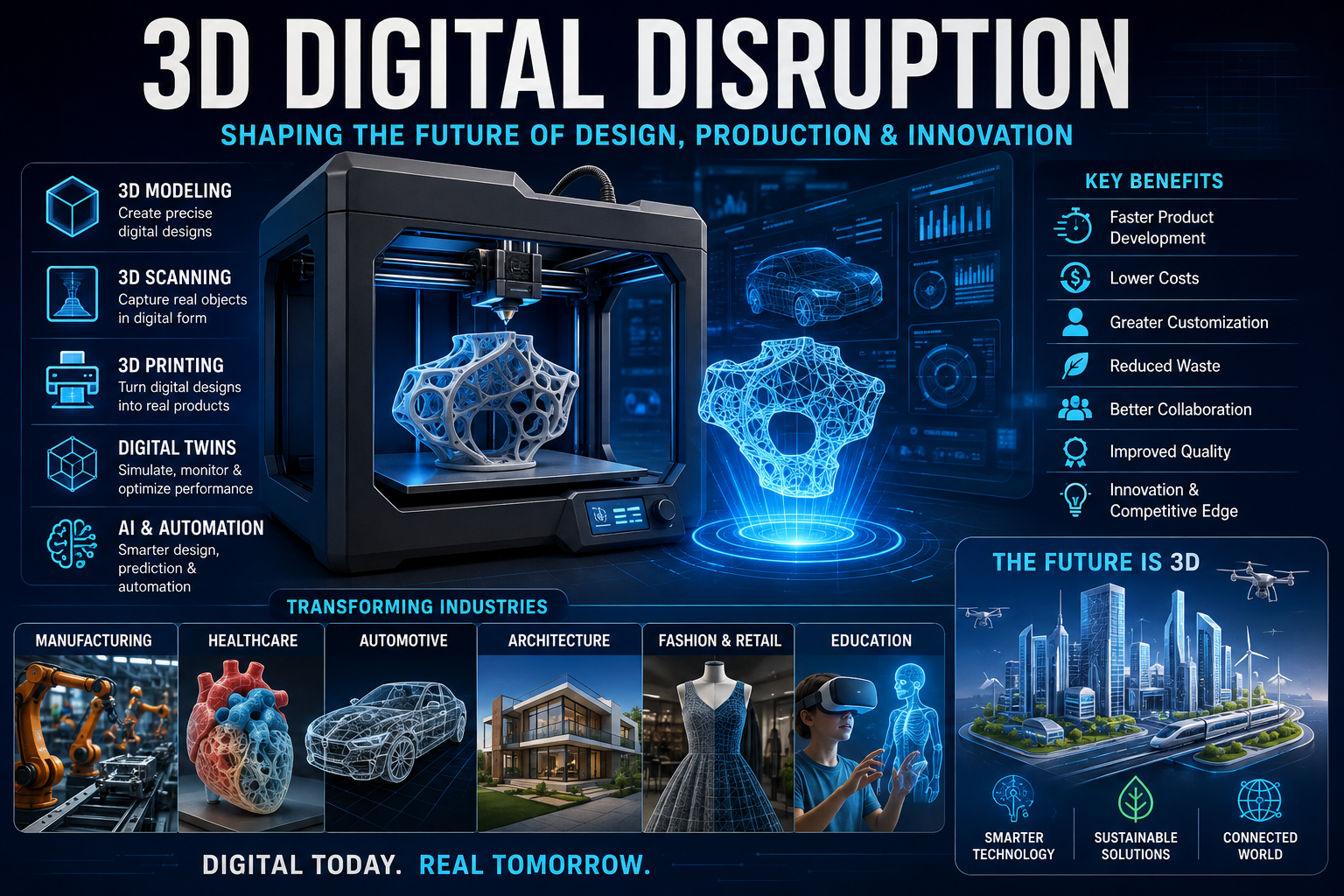
The idea combines several technologies and processes, including:
- 3D modeling
- Computer-aided design
- 3D scanning
- 3D printing
- Digital twins
- Artificial intelligence
- Virtual reality
- Augmented reality
- Digital manufacturing
- Simulation
- Automated design
Traditional product development often follows a long process. A company may create an idea, make a physical prototype, test it, change the design, build another prototype, and repeat the process.
With digital 3D tools, many of these steps can happen inside a computer before a physical product is produced.
For example, a company designing a new machine part can create a digital model first. Engineers can inspect the shape, test dimensions, simulate how the part may perform, and make changes without producing a new physical part every time.
This can save time and reduce waste.
3D digital disruption also connects design and manufacturing more closely. A digital design can move from a designer’s computer to a production system with fewer manual steps.
Why 3D Digital Disruption Matters
The importance of 3D technology comes from its ability to connect the digital world with the physical world.
A digital model is not simply a picture. It can contain information about shape, size, measurements, materials, and other product details.
This information can be used across different stages of a project.
For example:
- A designer creates a digital model.
- Engineers review the model.
- Software tests the design.
- A prototype is produced.
- The prototype is tested.
- Changes are made digitally.
- The final design is sent to production.
This process can be faster than traditional development.
The benefits can be especially important for industries where products are complex, expensive, or highly customized.
Key Technologies Behind 3D Digital Disruption
Several technologies are helping businesses move toward digital 3D processes.
3D Modeling and Design
3D modeling is one of the basic parts of digital product development.
Designers use specialized software to create three-dimensional objects on a computer. They can view the object from different angles and change its dimensions, shape, surface, or structure.
A digital model can be used for many purposes, such as:
- Product design
- Engineering
- Architecture
- Automotive development
- Game development
- Animation
- Manufacturing
- Medical planning
Digital modeling makes it easier to experiment with ideas before spending money on physical production.
Computer-Aided Design
Computer-aided design, commonly called CAD, allows professionals to create accurate technical drawings and 3D models.
CAD systems are widely used in engineering, manufacturing, construction, and product design.
A designer can change a dimension or component without starting the entire design again. This makes product development more flexible.
CAD models can also be shared between departments, allowing designers, engineers, manufacturers, and other professionals to work from the same digital information.
3D Scanning
3D scanning works in the opposite direction of traditional digital design.
Instead of creating a digital object from scratch, a scanner captures the shape of a real object and converts it into a digital model.
This can be useful when a company needs to:
- Copy an existing shape.
- Inspect a manufactured part.
- Repair old equipment.
- Create replacement components.
- Perform reverse engineering.
- Record historical objects.
- Measure complex surfaces.
For example, if an old machine part is no longer available, a company may scan an existing part and use the resulting digital model to create a replacement.
3D Printing
3D printing turns a digital model into a physical object.
Instead of cutting away material from a large block, many 3D printing methods build an object layer by layer.
Depending on the technology, materials can include plastics, resins, metals, ceramics, and other specialized materials.
3D printing is useful for:
- Rapid prototypes
- Custom products
- Replacement parts
- Medical devices
- Product testing
- Small production runs
- Educational models
It is one of the clearest examples of how digital information can quickly become a physical product.
Digital Twins
A digital twin is a digital representation of a physical object, machine, building, system, or process.
The digital model can be used to study how the real object performs.
For example, a factory may create a digital twin of a machine. Information from the real machine can be used to monitor its condition.
Businesses may use digital twins to:
- Monitor equipment.
- Test changes.
- Predict maintenance needs.
- Improve performance.
- Identify possible problems.
- Study production processes.
Digital twins can become more powerful when combined with sensors, data analysis, artificial intelligence, and 3D visualization.
Artificial Intelligence and 3D Technology
Artificial intelligence is adding another layer to 3D technology.
AI systems can help designers analyze large amounts of information and find possible design improvements.
AI may support:
- Automated design suggestions
- Product optimization
- Shape generation
- Manufacturing planning
- Quality inspection
- Digital model analysis
- Simulation
- Predictive maintenance
For example, an engineer may provide certain requirements for a component, such as size, strength, weight, and material limits. AI-assisted software may generate different possible designs.
The engineer can then review the options and select the most suitable one.
How 3D Digital Disruption Is Changing Manufacturing
Manufacturing is one of the industries most strongly affected by 3D technology.
Traditional manufacturing often depends on large production lines, specialized tools, molds, and equipment.
3D technologies can introduce more flexible production methods.
Faster Product Development
A company can create a digital model and produce a prototype relatively quickly.
If the prototype has a problem, the design can be changed digitally before another version is produced.
This can reduce the time between an idea and a working product.
Reduced Material Waste
Some traditional manufacturing methods remove material from larger blocks.
3D printing can build objects layer by layer, which can reduce waste for suitable applications.
The exact amount of material saved depends on the product, printing process, material, and manufacturing method.
Custom Manufacturing
Traditional mass production is usually designed around making large numbers of similar products.
Digital 3D manufacturing can make customization easier.
A business might produce products with different:
- Sizes
- Shapes
- Measurements
- Designs
- Features
- Fittings
This can be especially useful for medical products, specialized equipment, and custom consumer goods.
Improved Testing
Digital models can be tested through computer simulations before physical production.
Engineers can examine how a product may respond to different conditions.
This can help identify design problems earlier in the development process.
3D Digital Disruption in Healthcare
Healthcare is another field where 3D technology can provide valuable solutions.
Doctors and medical professionals can use 3D models to understand complex structures and plan certain procedures.
Medical Models
A 3D model can provide a physical representation of a body structure.
Students can use these models for learning, while medical professionals may use them to better understand specific cases.
Surgical Planning
In some situations, 3D models can help medical teams study anatomy before a procedure.
A model may allow doctors to understand the shape and position of structures more clearly.
Prosthetics
3D technology can support the creation of customized prosthetic devices.
A digital scan can help create a design that matches the specific shape and measurements of a person.
Medical Devices
Some medical devices can be designed for specific requirements.
Digital design and manufacturing can make it easier to adjust dimensions and create specialized components.
3D Digital Disruption in the Automotive Industry
The automotive industry has used digital design for many years, but advanced 3D technologies are creating new possibilities.
Vehicle Design
Designers can create detailed digital vehicle models before physical production.
They can change body shapes, interior components, and other elements during the development process.
Rapid Prototyping
Automotive companies can use 3D printing to create prototype parts.
This can help engineers evaluate designs without immediately setting up full-scale manufacturing.
Custom Parts
Specialized vehicle parts can sometimes be created using digital manufacturing.
This can be useful for:
- Racing vehicles
- Classic cars
- Experimental vehicles
- Specialized equipment
- Low-volume production
Production Improvements
Digital 3D models can also help manufacturers plan assembly and production processes.
Engineers can identify potential problems before a new production line is fully operational.
3D Digital Disruption in Architecture and Construction
Architecture has also changed because of 3D digital tools.
Architects can create detailed digital buildings and explore designs before construction begins.
3D Building Models
A 3D model can show the shape and structure of a building more clearly than a basic drawing.
Architects can examine:
- Rooms
- Walls
- Windows
- Doors
- Roofs
- Structural elements
- Interior layouts
Virtual Walkthroughs
Virtual environments can allow clients to explore a building before it is constructed.
They may be able to walk through digital rooms and understand the planned space.
This can make it easier to identify design problems early.
Better Planning
3D models can improve communication between architects, engineers, builders, and clients.
Everyone can work from a clearer representation of the proposed project.
3D Construction Printing
Some companies are also exploring large-scale 3D printing for construction.
This approach can potentially automate parts of the building process.
However, construction printing still has technical, regulatory, material, and economic challenges.
3D Digital Disruption in Fashion and Retail
Fashion businesses are also exploring 3D design.
Instead of creating every design physically, designers can first create digital versions.
Digital Clothing Design
3D fashion software allows designers to create garments digitally.
They can experiment with:
- Colors
- Shapes
- Patterns
- Fabrics
- Sizes
- Styles
This can reduce the need for physical samples during early design stages.
Virtual Products
Digital clothing and accessories can also be created for virtual environments, games, social platforms, and digital experiences.
This creates opportunities for businesses that were not possible when fashion products existed only in physical form.
Customization
Digital design can make customized products easier to develop.
A customer may be able to provide measurements or preferences, allowing a product to be designed around individual requirements.
3D Digital Disruption in Education
3D technology can make difficult concepts easier to understand.
Students sometimes struggle when learning about objects that are difficult to see in a normal textbook.
3D models can provide a more visual learning experience.
Students may use 3D models to study:
- Human anatomy
- Machines
- Buildings
- Geography
- Science
- Engineering
- Product design
- Architecture
Interactive Learning
Instead of simply reading about an object, students can interact with a digital model.
They may rotate it, zoom in, examine parts, or view it from different angles.
This can make some subjects more engaging.
Virtual Laboratories
3D and virtual technologies can also support virtual laboratories.
Students can explore experiments and systems in a digital environment where physical equipment may not be available.
Product Design Training
Students studying engineering, manufacturing, or architecture can practice digital design skills using professional software.
This can help connect classroom learning with workplace requirements.
Benefits of 3D Digital Disruption
3D digital technologies can offer several important benefits.
| Benefit | How It Helps |
|---|---|
| Faster development | Speeds up design and testing |
| Lower waste | Can reduce unnecessary physical materials |
| Customization | Supports products made for specific needs |
| Better visualization | Makes complex designs easier to understand |
| Faster prototypes | Allows physical testing earlier |
| Easier collaboration | Lets teams work with shared digital models |
| Better testing | Supports virtual simulations |
| Flexible production | Helps with small and custom production |
| Improved innovation | Makes experimentation easier |
| Data integration | Connects design with manufacturing and monitoring |
Faster Development
Digital design can reduce the time needed to create and change prototypes.
A designer can make adjustments on a computer instead of rebuilding an entire physical model.
Lower Production Costs
3D technology can reduce certain costs by limiting material waste, reducing prototype expenses, and improving production planning.
However, businesses should consider the complete cost of equipment, software, training, maintenance, and materials.
Better Product Quality
Digital models can be examined carefully before production.
This may help reduce design errors and improve product consistency.
More Customization
Digital manufacturing can support products designed around specific customers.
This is particularly useful in areas where one standard product may not fit everyone’s needs.
Improved Collaboration
A shared 3D model can help teams understand a product more clearly.
Designers, engineers, manufacturers, and customers can review the same digital representation.
Challenges of 3D Digital Disruption
Despite its advantages, 3D technology is not a perfect solution.
Businesses need to understand its limitations before investing.
High Initial Investment 3D digital disruption
Professional 3D printers, scanners, software, computers, and related equipment can be expensive.
Small businesses may need to start with limited projects instead of investing in a complete system immediately.
Need for Skilled Workers 3D digital disruption
3D systems require people who understand digital design, manufacturing, scanning, software, and equipment.
Companies may need to train existing employees or hire specialists.
Software and Hardware Costs 3D digital disruption
Technology expenses do not end after purchasing equipment.
Businesses may also need to pay for:
- Software licenses
- Maintenance
- Upgrades
- Materials
- Training
- Technical support
- Equipment repairs
Data Security 3D digital disruption
Digital models can contain valuable intellectual property.
If a company stores its product designs online or shares them across networks, it needs suitable security measures.
Unauthorized access could expose important designs.
Integration Problems 3D digital disruption
New 3D technology may not easily connect with older business systems.
Companies may need to update workflows and software to ensure different systems can communicate properly.
Quality Control 3D digital disruption
A digital model may look perfect on a computer but still create problems during physical production.
Materials, machines, temperature, printing settings, and other factors can affect the final product.
Quality checks remain important.
Intellectual Property Concerns 3D digital disruption
Digital designs are easy to copy and share.
Businesses need to protect original designs, models, and other digital assets.
3D Digital Disruption and Business Strategy
Technology alone does not create business success. Companies need a clear reason for using it.
Before investing in 3D technology, businesses should ask:
- What problem are we trying to solve?
- Which part of our process is too slow?
- Can 3D technology reduce waste?
- Can it improve product quality?
- Do customers need more customization?
- Do employees have the required skills?
- What will the complete cost be?
- How will success be measured?
A company should not adopt 3D technology simply because it is new.
The technology should have a clear purpose.
How Businesses Can Adopt 3D Technology
Businesses can take a step-by-step approach instead of changing everything at once.
Identify a Suitable Project 3D digital disruption
Start with a specific problem.
For example, a company may have a slow prototype process. This could be a suitable area for testing 3D printing.
Start Small
A small project can help a company understand the technology without making a huge investment.
The company can measure the results and decide whether a larger implementation makes sense.
Train Employees 3D digital disruption
Employees should understand how to use the technology safely and effectively.
Training may include:
- 3D modeling
- Scanning
- Printing
- Digital file management
- Quality control
- Equipment maintenance
Protect Digital Assets 3D digital disruption
3D digital disruption Companies should create clear rules for storing and sharing 3D files.
Important designs should be protected with suitable access controls and security practices.
Measure Results 3D digital disruption
3D digital disruption After implementing a 3D system, businesses should compare the results with the old process.
Useful measures can include:
- Development time
- Material use
- Prototype cost
- Production time
- Product quality
- Customer satisfaction
- Number of design changes
=3D digital disruption Technology and Sustainability
3D digital disruption Sustainability is becoming an important consideration for businesses.
3D technology can support more efficient production in some applications, although it is not automatically environmentally friendly.
The environmental impact depends on factors such as:
- Material type
- Energy consumption
- Production method
- Product lifespan
- Transportation
- Waste
- Recycling options
3D printing can reduce waste in certain manufacturing processes because material is added in layers rather than removed from a larger block.
It can also support local production, which may reduce transportation requirements for some products.
However, companies should evaluate the complete life cycle of a product rather than assuming that every 3D process is sustainable.
3D Digital Disruption and Customer Experience
3D digital disruption Customers increasingly expect products that fit their needs.
3D technology can help businesses respond to this demand.
For example, customers may be able to choose:
- Product dimensions
- Colors
- Shapes
- Materials
- Features
- Personalized designs
Digital visualization can also help customers understand a product before buying it.
A furniture company, for example, could provide a 3D model that allows customers to view how a product may look in a room.
This can make the buying process more interactive.
The Future of 3D Digital Disruption
The future of 3D technology is likely to involve stronger connections between digital design, artificial intelligence, automation, sensors, and physical manufacturing.
AI-Powered 3D digital disruption
3D digital disruption AI may help designers create and compare many possible designs quickly.
Instead of manually testing every possible shape, designers may use software to generate options based on specific requirements.
Human professionals will still need to review these designs and make final decisions.
Advanced 3D digital disruption
3D printing technology is likely to continue developing.
Future systems may provide improvements in:
- Speed
- Accuracy
- Material choices
- Automation
- Production scale
- Quality control
Smart Factories 3D digital disruption
3D digital disruption Factories are becoming more connected.
3D design systems can work with sensors, robots, manufacturing equipment, and software.
This can create a more connected production environment.
Digital Twins and Smart Systems
3D digital disruption Digital twins may become more common as businesses collect more information from physical equipment.
A digital twin can help companies understand how machines and systems behave over time.
Virtual and Augmented Reality
3D digital disruption Virtual reality can place users inside digital environments.
Augmented reality can place digital information over the physical world.
Both technologies can work with 3D models.
Possible uses include:
- Product demonstrations
- Training
- Maintenance
- Design reviews
- Architecture
- Education
- Customer experiences
Mass Customization
3D digital disruption Mass customization means producing products on a larger scale while allowing customers to select specific features.
3D digital technologies can make this approach easier because digital designs can be changed without rebuilding an entire traditional production system.
How 3D Digital Disruption May Change Work
3D digital disruption Technology can change the skills businesses need.
Workers may increasingly need to understand both traditional industry knowledge and digital tools.
For example, a manufacturing professional may need to understand machines while also working with 3D models and digital production systems.
Future jobs may combine:
- Engineering
- Design
- Data
- AI
- Manufacturing
- Software
- Digital modeling
This means education and professional training will also need to evolve.
3D Digital Disruption and Innovation
Innovation often requires experimentation.
Traditional physical prototyping can make experimentation expensive.
Digital 3D tools can lower some of these barriers.
A designer can create several digital versions and compare them before producing physical samples.
This encourages businesses to test more ideas.
A small company can also use digital tools to create specialized products without building a large traditional manufacturing operation.
This can make innovation more accessible to smaller businesses.
Traditional Production Compared With 3D Digital Processes
| Traditional Approach | 3D Digital Approach |
|---|---|
| Physical prototypes | Digital models and rapid prototypes |
| More manual changes | Digital design changes |
| Large production setups | Flexible production options |
| Standard products | Greater customization |
| Physical testing first | Digital simulation can come earlier |
| More dependence on molds | Some products can be produced without traditional molds |
| Separate design and production steps | More connected digital workflow |
| Physical samples for communication | Shared 3D models |
The traditional approach is not always worse. It can remain the best option for high-volume manufacturing and products that require established production methods.
The key difference is flexibility.
Important Things to Consider Before Adopting 3D Technology
Businesses should consider the following points before making an investment:
- Define the business problem.
- Select the right 3D technology.
- Calculate total costs.
- Check employee skills.
- Plan employee training.
- Review security requirements.
- Test the technology on a small project.
- Measure results.
- Improve the process.
- Expand only when the results justify it.
This approach can reduce unnecessary spending and make adoption more practical.
FAQs
What is 3D digital disruption?
3D digital disruption is the use of 3D technologies to change traditional ways of designing, testing, producing, and managing physical products and environments.
How does 3D technology disrupt manufacturing?
It can make product development more flexible by supporting digital design, rapid prototyping, customization, simulation, and some forms of direct digital manufacturing.
What industries use 3D digital technology?
Many industries use 3D technology, including manufacturing, healthcare, automotive, architecture, construction, education, fashion, retail, aerospace, and engineering.
What are the main benefits of 3D digital disruption?
Important benefits can include faster development, easier customization, better visualization, rapid prototyping, improved collaboration, and potentially lower material waste.
How does artificial intelligence improve 3D design?
AI can help analyze design requirements, generate possible shapes, optimize models, identify problems, and automate some repetitive tasks.
What is the difference between 3D modeling and 3D printing?
3D modeling creates a digital representation of an object. 3D printing uses a digital model to produce a physical object.
What is a digital twin?
A digital twin is a digital representation of a physical object, machine, building, or system. It can be used to monitor, analyze, simulate, or improve the physical version.
Is 3D printing suitable for every product?
No. 3D printing has specific strengths and limitations. Traditional manufacturing may still be more suitable for some high-volume products, materials, and production requirements.
Is 3D digital technology expensive?
It can be expensive, especially for professional equipment and advanced software. Businesses should consider equipment, materials, training, maintenance, and software costs together.
What is the future of 3D digital disruption?
The future may involve stronger connections between 3D design, artificial intelligence, digital twins, robotics, virtual reality, augmented reality, and automated manufacturing.
Conclusion
3D digital disruption is changing the relationship between digital ideas and physical products. Businesses can now design products in digital environments, scan physical objects, test ideas virtually, create prototypes quickly, and manufacture customized products using advanced technologies. 3D modeling, CAD, scanning, printing, digital twins, artificial intelligence, and virtual environments each play a different role in this transformation. The impact can be seen across many industries. Manufacturers can improve product development. Healthcare professionals can use customized models and devices. Automotive companies can develop prototypes faster. Architects can explore buildings before construction. Fashion companies can design products digitally. Schools can use 3D models to make complex subjects easier to understand.